Kirjailija
Marcus Aurelius
Kirjat ja teokset yhdessä paikassa: 336 kirjaa, julkaisuja vuosilta 1890-2027, suosituimpien joukossa Itselleni. Vertaile teosten hintoja ja tarkista saatavuus suomalaisista kirjakaupoista.
336 kirjaa
Kirjojen julkaisuhaarukka 1890-2027.
A manifesto for ethical reflections A former Roman emperor from AD161-180, Mark Aurelius, goes on to advise himself in his journal. A series of 12 books, this piece of Greek and philosophical literature finds resonance with today's readers too, even after centuries. Having gone through the text, you will not be able to stop yourself from revisiting his advice should you find yourself in trouble in any phase of your life. His spiritual exercises, which included reminders to make himself humble, empathetic, generous, patient and strong in the face of adversities, make for an imperative read. You can get an insight into the life and philosophy of the last of the 'Five Good Emperors'. A masterpiece on philosophy Replete with insights, wisdom and practical guidance on everything-from the worldly to the spiritual A self-healing book of epic proportions A great work of spiritual and ethical reflections A required reading for statesmen, politicians and strategists alike A timeless classic on self-help and self-healing
Marcus Aurelius var kendt som filosoffen på kejsertronen, da han skrev en lang række stoiske aforismer på græsk under sine mange felttog. Aforismerne er samlet i værket Ta eis heauton (Tanker til sig selv). Hans filosofi er præget af en beskeden og værdig holdning til livets tilskikkelser. En del af hans tanker ligner kristendommens, som han i øvrigt bekæmpede. Lighederne skyldes, at også kristendommens var påvirket af stoicismen. Marcus Aurelius' her foreliggende "Betragtninger" indeholder alle 12 bøger i L. C. Hansteens klassiske oversættelse med moderniseret retskrivning. Tidligere er udsendt Marcs Aurelius'"Tanker til sig selv", i et kommenteret udvalg ved K. G. Brøndsted.
Marcus Aurelius var kendt som filosoffen p kejsertronen, da han skrev en lang r kke stoiske aforismer p gr sk under sine mange felttog. Aforismerne er samlet i v rket Ta eis heauton (Tanker til sig selv). Hans filosofi er pr get af en beskeden og v rdig holdning til livets tilskikkelser. En del af hans tanker ligner kristendommens, som han i vrigt bek mpede. Lighederne skyldes, at ogs kristendommens var p virket af stoicismen.
"Meditations" is a series of personal writings by Marcus Aurelius, Roman Emperor from 161 to 180 AD, recording his private notes to himself and ideas on Stoic philosophy. Written nearly 2000 Years ago, Meditations remains profoundly relevant for anyone seeking to lead a meaningful life. The Meditations is divided into 12 books that chronicle different periods of Aurelius' life. Each book is not in chronological order and it was written for no one but himself. A series of spiritual exercises filled with wisdom, practical guidance, and profound understanding of human behaviour, it remains one of the greatest works of spiritual and ethical reflection ever written. With ancient wisdom that is as relevant in modern times as it was then, Meditations is one of the greatest works of Greek and philosophical literature. Meditation's has continued to influence its readers throughout the centuries.
Marcus Aurelius Antoninus was the sixteenth emperor of Rome -- and by far the most powerful and wealthy man in the world. Yet he was also an intensely private person, with a rich interior life and deep reservoirs of personal insight. He collected his thoughts in notebooks, gems which have come to be called his Meditations. Never intended for publication, the work survived his death and has proved an inexhaustible source of wisdom and one of the most important Stoic texts of all time. In often passionate language, the entries range from essays to one-line aphorisms, and from profundity to bitterness.Marcus wrote to console himself in the face of the shortness of life, the shoddiness of the world, and the challenges of being human. He asks the very same questions that every thinking person must ask themselves today: Does the universe have a moral purpose, and what is my role in it? What exactly is it to be a good person, and how do I get there? Life is short: what does that mean for me? How can I get to know myself better? Anyone who is puzzled by such questions or searching for answers will profit from this timeless book, which is both an important historical document and a personal spiritual diary.This annotated edition will be the definitive translation of this classic and much-beloved text, with copious notes that will illuminate one of the greatest works of popular philosophy for new readers and enrich the understanding of even the most hardcore Stoic.
How to live a better life. One of the most important books on Western philosophy - a powerful and inspirational guide for the complicated world of today'Refreshing and restorative' GUARDIAN'An ancient work of spiritual reflection which remains a powerful reminder of how we could live a more dignified life by avoiding deceit, vanity and greed' OK MAGAZINEFew ancient works have been as influential as the MEDITATIONS of Marcus Aurelius. Filled with wisdom, practical guidance, and profound understanding of human behaviour, it remains one of the greatest works of spiritual and ethical reflection ever written. Marcus's insights and advice - on everything from living in the world to coping with adversity and interacting with others - have made the MEDITATIONS required reading for statesmen and philosophers alike, while generations of ordinary readers have responded to the straightforward intimacy of his style.In Gregory Hays's translation Marcus's thoughts speak with a new immediacy. Never before have Marcus's insights been so directly and powerfully presented.
Meditations is a series of personal writings by Marcus Aurelius, Roman Emperor from 161 to 180 AD, recording his private notes to himself and ideas on Stoic philosophy. Marcus Aurelius wrote the 12 books of the Meditations in Koine Greek as a source for his own guidance and self-improvement. It is possible that large portions of the work were written at Sirmium, where he spent much time planning military campaigns from 170 to 180. Some of it was written while he was positioned at Aquincum on campaign in Pannonia, because internal notes tell us that the first book was written when he was campaigning against the Quadi on the river Granova (modern-day Hron) and the second book was written at Carnuntum. It is unlikely that Marcus Aurelius ever intended the writings to be published. The work has no official title, so "Meditations" is one of several titles commonly assigned to the collection. These writings take the form of quotations varying in length from one sentence to long paragraphs
Lettres Inédites, Retrouvées Sur Les Palimpsestes de Milan Et de Rome. Tome 2
Marcus Aurelius; Armand Cassan; Étienne-François Corpet
Hachette Livre - BNF
2021
pokkari
Lettres Inédites, Retrouvées Sur Les Palimpsestes de Milan Et de Rome. Tome 1
Marcus Aurelius; Armand Cassan; Étienne-François Corpet
Hachette Livre - BNF
2021
pokkari
Marcus Aurelius's Meditations serves as both a compact treatise on living a happier, more virtuous life and an excellent introduction to Stoic philosophy. Marcus Aurelius (121-180 C.E.) The philosophy of the Roman Emperor Marcus Aurelius can be found in a collection of personal writings known as the Meditations. These reflect the influence of Stoicism and, in particular, the philosophy of Epictetus, the Stoic. It's one of the best books I have ever read. Meditations might make a point in say book 1 or 2 and then follow up on it in book 6 or whatever. Overall don't worry about how fast you read it and yes it is tough to read I have times where I can read a chapter a day but may not read again for a week or so.
This is a book of knowledge and philosophy that teaches readers about the origin of the universe, species, stars, suns, planets, and mammal life and has the top philosophies and riddles possible to this day. This book teaches readers that success is loving to repeat yourself over and over. It tells how 99 percent of people like to believe that the four true stomachs turn into, usually, a large tree when they die from over a million years ago. This book also teaches readers about limb regeneration from the top theory of a, yes, white pink flowered evergreen tree. Likely, this is the top book made available in this time of the human race-top everything book from over a million years ago. A book to calm the soul has been the greatest aspiration of man up to this point in history-I believe this is that book, and it will be, for ages upon ages to come, the most scientific, greatest simplification in all its forms. This book took twenty years to write.
"Meditations" is a series of personal writings by Marcus Aurelius, Roman Emperor from second century, recording his private notes to himself and ideas on Stoic philosophy. Marcus Aurelius wrote the Meditations as a source for his own guidance and self-improvement. The Meditations is divided into 12 books that chronicle different periods of Marcus' life. A central theme to Meditations is the importance of analyzing one's judgment of self and others and the development of a cosmic perspective. The style of writing that permeates the text is one that is simplified, straightforward, and perhaps reflecting Marcus' Stoic perspective on the text.
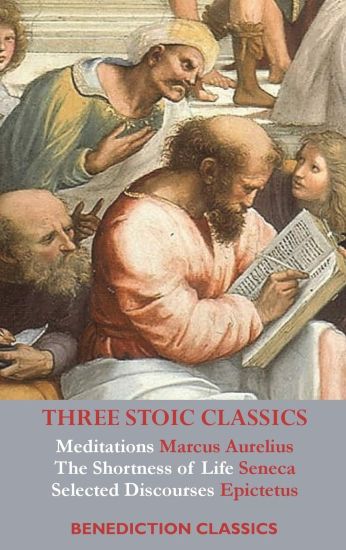
"The happiness of your life depends upon the quality of your thoughts." ― Marcus Aurelius"You have power over your mind - not outside events. Realize this, and you will find strength." ― Marcus Aurelius"So it is: we are not given a short life but we are wasteful of it... Life is long if you know how to use it.― Seneca"We must indulge the mind and from time to time allow it the leisure which is its food and strength." ― Seneca"Don't explain your philosophy. Embody it." ― Epictetus"First say to yourself what you would be; and then do what you have to do." ― EpictetusThree Stoic Classics contains three vital works introducing this life-changing philosophy.The Shortness of Life is a succinct call to the pursuit of philosophy, which leads to wise choices and the full life: "Of all men they alone are at leisure who take time for philosophy; they alone really live."Seneca offers piercing and profound insights into human nature, and a vision of the good life, summarised in his aphorism, "Life is long, if you know how to use it." Seneca elucidates many of the principles of modern productivity manuals, including the wise valuing of time: "People are frugal in guarding their personal property; but as soon as it comes to squandering time they are most wasteful of the one thing in which it is right to be stingy,"intentionality, and rest and recreation: "We must go for walks out of doors, so that the mind can be strengthened and invigorated by a clear sky and plenty of fresh air. At times it will acquire fresh energy from a journey by carriage and a change of scene, or from socializing and drinking freely."Epictetus' Selected Discourses is a longer meditation on the sixty principles important to pursuing the Stoic Life. Beginning with the foundational principle: the difference in how we relate to the things under our control (our acts, thoughts, and desires) and those not under our control (our possessions, position, reputation), Epictetus's discourses cover topics including: How to maintain one's character in all circumstances, Friendship, Contentment, Anxiety, and On Dealing with Tyrants.Meditations is a life-changing book. It contains the private meditations of the most powerful man in the Roman world, the Emperor Marcus Aurelius, as he wrestled with the complexities of his life using the wisdom of Stoic Philosophy. Meditations is written in lucid, accessible language and, interestingly, we see that the problems and perplexities of this philosopher-King are much like ours. Marcus Aurelius was impressively able to live out his philosophical ideals-such as the importance of gratitude, mindfulness, simplicity and life-long learning, of seizing the day, and of remembering the shortness of life-while administering the Roman Empire.Stoic philosophy is, above all, practical. It uses reason and the careful observation of human life to address the problems of daily life. It is also universal-the emperor Marcus Aurelius and the freed slave Epictetus are both leading Stoic philosophers; indeed, Marcus Aurelius carefully studied the works of Epictetus. In recent years, Stoic philosophy has provided vital life lessons to people in all spheres of life. Indeed, modern Stoic thought "hold s] fascinating promise for business and government leaders tackling global problems in a turbulent, post-recession slump," (Forbes). Three Stoic Classics is an indispensable guide to Stoic philosophy.
Meditations (Royal Collector's Edition) (Case Laminate Hardcover with Jacket)
Marcus Aurelius
Royal Classics
2020
sidottu
Part of the Hero Classics series“Everything we hear is an opinion, not a fact. Everything we see is a perspective, not the truth.”A collection of personal writings covering an array of topics. Marcus delves into spiritual reflections and exercises, which he developed as a leader, in his struggled to understand himself and make sense of the universe. The book cover such diverse topics as the question of virtue, human rationality, the nature of the gods and Aurelius's own emotions such as doubt, despair and exaltation.The Hero Classics series:MeditationsThe ProphetA Room of One’s OwnIncidents in the Life of a Slave GirlThe Art of WarThe Life of Charlotte BronteThe RepublicThe PrinceNarrative of the Life of Frederick Douglass, an American Slave