Kirjojen hintavertailu. Mukana 12 657 676 kirjaa ja 12 kauppaa.
Kirjailija
Marcus Aurelius
Kirjat ja teokset yhdessä paikassa: 338 kirjaa, julkaisuja vuosilta 1890-2027, suosituimpien joukossa Itselleni. Vertaile teosten hintoja ja tarkista saatavuus suomalaisista kirjakaupoista.
Meditations contains a series of personal writings by Marcus Aurelius, Roman Emperor from 161 to 180 AD, recording his private notes to himself and ideas on Stoic philosophy. Stoics often present their philosophy as a way of life. To live a good life, one has to understand the rules of the natural order since they taught that everything is rooted in nature.Marcus Aurelius was Roman Emperor from 161 to 180. He ruled with Lucius Verus as co-emperor from 161 until Verus' death in 169. Marcus Aurelius was the last of the so-called Five Good Emperors. He was a practitioner of Stoicism, and his untitled writing, commonly known as the Meditations, is the most significant source of the modern understanding of ancient Stoic philosophy.
Meditations is a series of personal writings by Marcus Aurelius, Roman Emperor from 161 to 180 AD, recording his private notes to himself and ideas on Stoic philosophy. Marcus Aurelius wrote the 12 books of the Meditations in Koine Greek as a source for his own guidance and self-improvement. It is possible that large portions of the work were written at Sirmium, where he spent much time planning military campaigns from 170 to 180. Some of it was written while he was positioned at Aquincum on campaign in Pannonia, because internal notes tell us that the first book was written when he was campaigning against the Quadi on the river Granova (modern-day Hron) and the second book was written at Carnuntum. It is unlikely that Marcus Aurelius ever intended the writings to be published and the work has no official title, so "Meditations" is one of several titles commonly assigned to the collection. These writings take the form of quotations varying in length from one sentence to long paragraphs.
The Thoughts is a series of personal reflections by Marcus Aurelius, Roman Emperor 161-180 CE, written over a series of years in far-flung places as he led the Romans in military campaigns, quashed revolts, and dealt with the other tribulations of governing the Empire. It is best described as a spiritual journal, containing a record of the emperor's philosophical exercises.
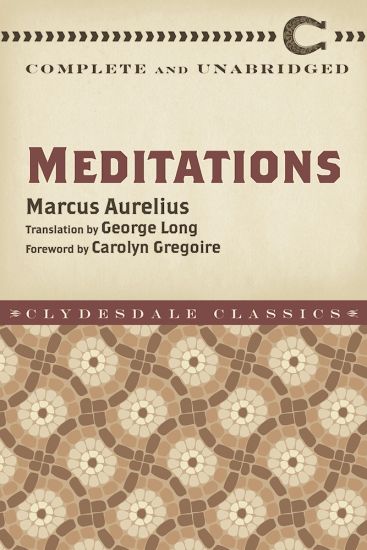
The profundity and spirit of Roman Emperor Marcus Aurelius is brought out superbly in this hardcover edition of the Meditations, translated by George Long. All twelve books are present, complete with original footnotes which help to clarify and explain the meanings behind the passages. Since the original text was written in Greek after the spirit of many classical philosophers, an index of Greek terminology is also included at the conclusion for the benefit of the reader. The spirit of Stoicism, whereby Marcus Aurelius details a lifetime spent cultivating good habits, manners, attitude and evenness of temperament are laid out upon these pages evocatively. Many of the pages are thought to have been written at Sirmium, during periods of military planning. It is a strongly autobiographical text; each book focuses upon a different time - from upbringing to youth to maturity. The writing is famously frank, clear and honest - with none of the superiority or pretense one might expect of an Emperor of Rome.
The profundity and spirit of Roman Emperor Marcus Aurelius is brought out superbly in this edition of the Meditations, translated by George Long. All twelve books are present, complete with original footnotes which help to clarify and explain the meanings behind the passages. Since the original text was written in Greek after the spirit of many classical philosophers, an index of Greek terminology is also included at the conclusion for the benefit of the reader. The spirit of Stoicism, whereby Marcus Aurelius details a lifetime spent cultivating good habits, manners, attitude and evenness of temperament are laid out upon these pages evocatively. Many of the pages are thought to have been written at Sirmium, during periods of military planning. It is a strongly autobiographical text; each book focuses upon a different time - from upbringing to youth to maturity. The writing is famously frank, clear and honest - with none of the superiority or pretense one might expect of an Emperor of Rome.
Introduction 4 First Book 17 Second Book 26 Third Book 31 Fourth Book 39 Fifth Book 52 Sixth Book 64 Seventh Book 77 Eighth Book 91 Ninth Book 105 Tenth Book 117 Eleventh Book 131 Twelfth Book 141 Glossary 150 Excerpt: SECOND BOOK I. Remember how long thou hast already put off these things, and how often a certain day and hour as it were, having been set unto thee by the gods, thou hast neglected it. It is high time for thee to understand the true nature both of the world, whereof thou art a part; and of that Lord and Governor of the world, from whom, as a channel from the spring, thou thyself didst flow: and that there is but a certain limit of time appointed unto thee, which if thou shalt not make use of to calm and allay the many distempers of thy soul, it will pass away and thou with it, and never after return. II. Let it be thy earnest and incessant care as a Roman and a man to perform whatsoever it is that thou art about, with true and unfeigned gravity, natural affection, freedom and justice: and as for all other cares, and imaginations, how thou mayest ease thy mind of them. Which thou shalt do; if thou shalt go about every action as thy last action, free from all vanity, all passionate and wilful aberration from reason, and from all hypocrisy, and self-love, and dislike of those things, which by the fates or appointment of God have happened unto thee. Thou seest that those things, which for a man to hold on in a prosperous course, and to live a divine life, are requisite and necessary, are not many, for the gods will require no more of any man, that shall but keep and observe these things. III. Do, soul, do; abuse and contemn thyself; yet a while and the time for thee to respect thyself, will be at an end. Every man's happiness depends from himself, but behold thy life is almost at an end, whiles affording thyself no respect, thou dost make thy happiness to consist in the souls, and conceits of other men. IV. Why should any of these things that happen externally, so much distract thee? Give thyself leisure to learn some good thing, and cease roving and wandering to and fro. Thou must also take heed of another kind of wandering, for they are idle in their actions, who toil and labour in this life, and have no certain scope to which to direct all their motions, and desires. V. For not observing the state of another man's soul, scarce was ever any man known to be unhappy. Tell whosoever they be that intend not, and guide not by reason and discretion the motions of their own souls, they must of necessity be unhappy.
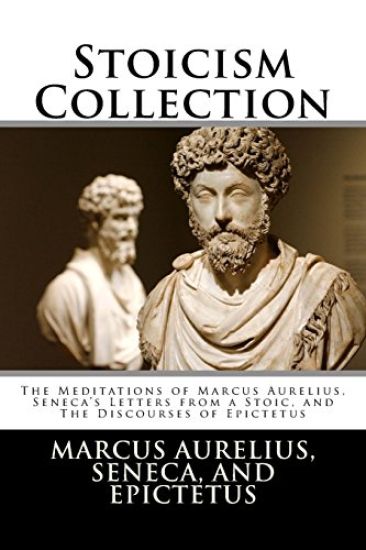
This Stoicism Collection contains three of the most notable Stoic pieces, The Meditations of Marcus Aurelius, Seneca's Letters from a Stoic, and The Discourses of Epictetus. These three pieces are the foundations of Stoicism.
Completely unabridged, with a new foreword written by Huffington Post writer Carolyn Gregoire, this publication of Meditations is an all-encompassing collection of Marcus Aurelius’s works.“Do every deed, speak every word, think every thought in the knowledge that you may end your days any moment.”“We have body, soul, and intelligence. To the body belong the senses, to the soul the passions, to the intelligence principles.”“Think not as your insulter judges or wishes you to judge: but see things as they truly are.”“To pursue impossibilities is madness; and it is impossible that the wicked should not act in some such way as this.”“Order not your life as though you had ten thousand years to live. Fate hangs over you. While you live, while yet you may, be good.”Meditations is a collection of twelve books written by Roman Emperor Marcus Aurelius. This set of books was originally compiled in the form of private journals. Marcus Aurelius used these notes as personal guides to live by and to better himself as a ruler.He compiled these journals during his time as emperor, and while they were not intended for public consumption, there are valuable lessons to be gleaned from his wisdom. The entries include his views of stoicism—the Hellenistic philosophy devoid of “destructive emotions” that could tamper with logic—and its practical use in ruling and military tactics.
With ancient wisdom that is as relevant in modern times as it was then, 'Meditations' is one of the greatest works of Greek and philosophical literature. Written in Greek by an intellectual Roman emperor without any intention of publication, this book gives an insight into the inner life and philosophy of the last of the 'Five Good Emperors,' Ma...
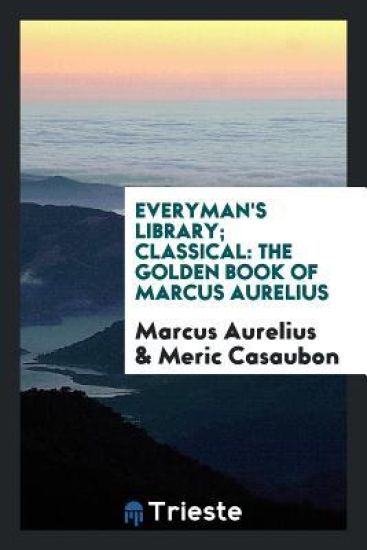
Meditations (from Medieval Greek, literally "things to one's self") is a series of personal writings by Marcus Aurelius, Roman Emperor from 161 to 180 A.D., recording his private notes to himself and ideas on Stoic philosophy. Marcus Aurelius wrote the 12 books of the Meditations in Koine Greek as a source for his own guidance and self-improvement. It is possible that large portions of the work were written at Sirmium, where he spent much time planning military campaigns from 170 to 180. Some of it was written while he was positioned at Aquincum on campaign in Pannonia, because internal notes tell us that the first book was written when he was campaigning against the Quadi on the river Granova (modern-day Hron) and the second book was written at Carnuntum. It is unlikely that Marcus Aurelius ever intended the writings to be published and the work has no official title, so "Meditations" is one of several titles commonly assigned to the collection. These writings take the form of quotations varying in length from one sentence to long paragraphs. A central theme to Meditations is the importance of analyzing one's judgment of self and others and the development of a cosmic perspective. This edition was originally translated out of the Greek by Meric Casaubon in 1634 as The Golden Book of Marcus Aurelius, with an Introduction by W.H.D. Rouse. It was subsequently edited by Ernest Rhys. London: J.M. Dent & Co; New York: E.P. Dutton & Co, 1906; Everyman's Library.
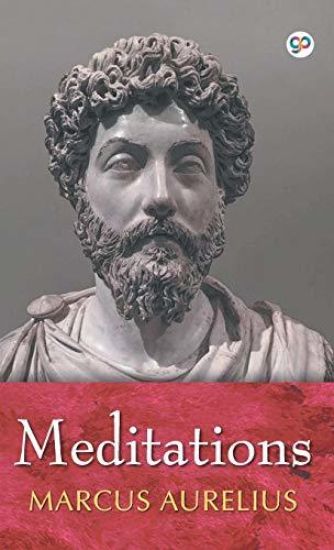
The Meditations is a series of personal writings by Marcus Aurelius, Roman Emperor from 161 to 180 AD, recording his private notes to himself and ideas on Stoic philosophy.
Meditations is a series of personal writings by Marcus Aurelius, Roman Emperor from 161 to 180 AD, recording his private notes to himself and ideas on Stoic philosophy. Marcus Aurelius wrote the 12 books of the Meditations in Koine Greek as a source for his own guidance and self-improvement. It is possible that large portions of the work were written at Sirmium, where he spent much time planning military campaigns from 170 to 180. Some of it was written while he was positioned at Aquincum on campaign in Pannonia, because internal notes tell us that the first book was written when he was campaigning against the Quadi on the river Granova (modern-day Hron) and the second book was written at Carnuntum. It is unlikely that Marcus Aurelius ever intended the writings to be published and the work has no official title, so "Meditations" is one of several titles commonly assigned to the collection. These writings take the form of quotations varying in length from one sentence to long paragraphs.
Description Stoicism: Conquer fear, crush stress, find inner peace and be successful is your practical guide to a better and more interesting life. This handy manual will teach you how to deal with any type of stressful situations, how to confront your challenges and succeed. Learn how the ancient teachings of Stoicism can help you to solve your modern-day problems and achieve your goals. If you want to enjoy peace of mind and success then this book is for you. Learn: Stoic teachings from Marcus Aurelius, Seneca, and EpictetusHow to use Stoicism in modern eraPractical strategies to live efficient and positive lifeHow to deal with stressful situationsStoic exercises and meditations to achieve successAnd so much more What's in the book? Stoicism: Conquer fear, crush stress, find inner peace and be successful is built in a specific way in order to involve the reader slowly into the practices of ancient philosophy of Stoicism. The book consists of informative and practical parts that are based on the teachings of the most profound Stoic philosophers such as Seneca, Epictetus and Marcus Aurelius. Now is the time to change your life. So, do not waste your time and grab your copy of the book to learn and practice the Stoic teachings and live a happier life.
Selections from the Thoughts of Marcus Aurelius - For Every Day in the Year is an unchanged, high-quality reprint of the original edition of 1888. Hansebooks is editor of the literature on different topic areas such as research and science, travel and expeditions, cooking and nutrition, medicine, and other genres. As a publisher we focus on the preservation of historical literature. Many works of historical writers and scientists are available today as antiques only. Hansebooks newly publishes these books and contributes to the preservation of literature which has become rare and historical knowledge for the future.
How to think clearly, act purposefully, overcome obstacles, and find peace & happiness along the way. Marcus Aurelius (121-180 CE) was one of the few true philosopher-kings in history. His father died when Marcus was three. At age fifteen, he was adopted by his aunt's husband, the future Emperor Antoninus Pius, putting him in the line of succession. At forty, he became a reluctant emperor of the Roman Empire. Marcus was conflicted because the demands of being emperor--on top of the temptations of wealth and power--seemed incompatible with his true ambition: to be a humble student of philosophy. Over time, though, he worked out a practical philosophy that kept him grounded amidst the stresses and excesses of palace life. That's why his philosophy is so relevant to us today, in the modern world. How did he fare as emperor? During his twenty years of service, Marcus earned the love of the people and the loyalty of the senate. Later historians called him "the last of the five good emperors." In spare moments, Marcus wrote the journal entries collected in The Meditations. They were not intended for publication, but to remind Marcus himself of his principles and priorities. As a result, they are intimate, direct, and extremely useful. This new edition of The Meditations is an interpretive paraphrase in contemporary English, with a foreword, by bestselling author Sam Torode. A companion volume, The Manual: A Philosopher's Guide to Life, is also available from Ancient Renewal.