Kirjojen hintavertailu. Mukana 12 657 676 kirjaa ja 12 kauppaa.
Kirjailija
Marcus Aurelius
Kirjat ja teokset yhdessä paikassa: 338 kirjaa, julkaisuja vuosilta 1890-2027, suosituimpien joukossa Itselleni. Vertaile teosten hintoja ja tarkista saatavuus suomalaisista kirjakaupoista.
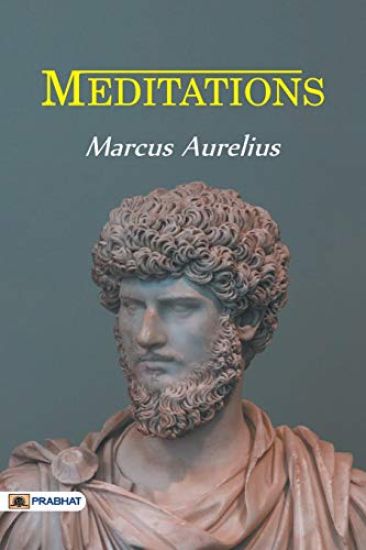
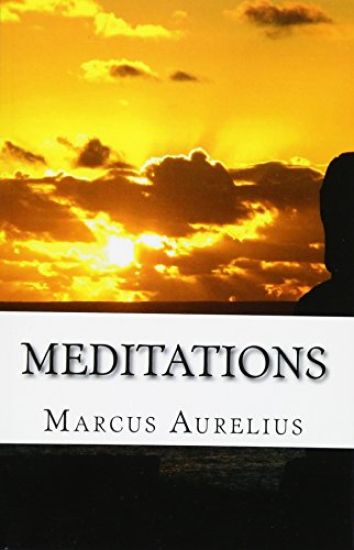
The Meditations are a set of personal reflections by Marcus Aurelius. He writes about the vicissitudes of his own life and explores how to live wisely and virtuously in an unpredictable world. Part of the Macmillan Collector's Library; a series of stunning, clothbound, pocket sized classics with gold foiled edges and ribbon markers. These beautiful books make perfect gifts or a treat for any book lover. This edition is translated by A. S. L. Farquharson and features an introduction by John Sellars. Marcus Aurelius was a follower of the Stoic tradition of philosophy, and one of its finest advocates, both in the clarity of his writing and in the uprightness of his life. The aphorisms show how for him, as perhaps for us all, the answer to life lies in keeping a calm and rational mind, and in refusing to be cast down or alarmed by things over which we have no control.
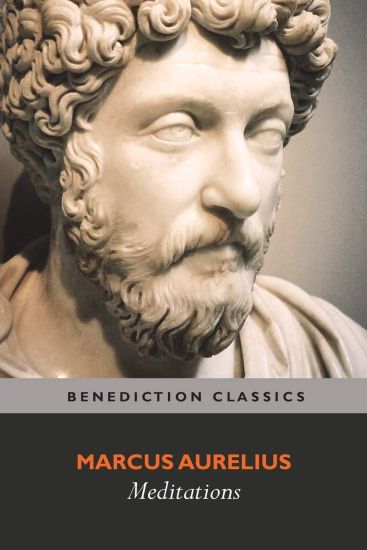
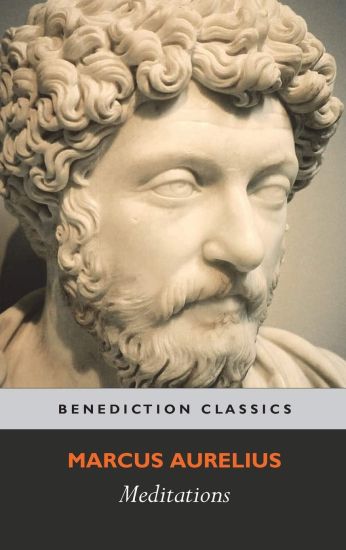
THE BOOKMeditations is a series of personal writings by Marcus Aurelius, Roman Emperor from 161 to 180 AD, recording his private notes to himself and ideas on Stoic philosophy or stoicism.The Meditations is divided into 12 books that chronicle different periods of Marcus' life. Each book is not in chronological order and it was written for no one but himself. The style of writing that permeates the text is one that is simplified, straightforward, and perhaps reflecting Marcus' Stoic perspective on the text. Depending on the English translation, Marcus' style is not viewed as anything regal or belonging to royalty, but rather a man among other men, which allows the reader to relate to his wisdom.THE AUTHORMarcus Aurelius (Latin: Marcus Aurelius Antoninus Augustus; 26 April 121 - 17 March 180) was Roman emperor from 161 to 180 and a Stoic philosopher. He was the last of the rulers known as the Five Good Emperors, and the last emperor of the Pax Romana, an age of relative peace and stability for the Roman Empire. He served as Roman consul in 140, 145, and 161.The son of the praetor Marcus Annius Verus (III) and the wealthy heiress Domitia Lucilla, Marcus was raised by his mother and by his grandfather, Marcus Annius Verus (II), after his father died. His uncle, Antoninus Pius, adopted him shortly before becoming emperor in 138. Now heir to the throne, Marcus studied Greek and Latin under tutors such as Herodes Atticus and Marcus Cornelius Fronto.The reign of Marcus Aurelius was marked by military conflict. In the East, the Roman Empire fought successfully with a revitalized Parthian Empire and the rebel Kingdom of Armenia. Marcus defeated the Marcomanni, Quadi, and Sarmatian Iazyges in the Marcomannic Wars; however, these and other Germanic peoples began to represent a troubling reality for the Empire. He modified the silver purity of the Roman currency, the denarius. The persecution of Christians in the Roman Empire is believed to have increased during his reign. The Antonine Plague broke out in 165 or 166 and devastated the population of the Roman Empire, causing the deaths of five million people.Unlike some of his predecessors, Marcus chose not to adopt an heir. His children included Lucilla (who married Lucius Verus, co-emperor from 161 to 169) and Commodus, whose succession after Marcus has become a subject of debate among both contemporary and modern historians. The Column and Equestrian Statue of Marcus Aurelius still stand in Rome, where they were erected in celebration of his military victories. Meditations, the writings of "the philosopher" - as contemporary biographers called Marcus, are a significant source of the modern understanding of ancient Stoic philosophy. They have been praised by fellow writers, philosophers, monarchs, and politicians centuries after his death.Marcus acquired the reputation of a philosopher king within his lifetime, and the title would remain after his death; both Dio and the biographer call him 'the philosopher'. Christians such as Justin Martyr, Athenagoras, and Melito also gave him the title. The last named went so far as to call him "more philanthropic and philosophic" than Antoninus and Hadrian, and set him against the persecuting emperors Domitian and Nero to make the contrast bolder. "Alone of the emperors," wrote the historian Herodian, "he gave proof of his learning not by mere words or knowledge of philosophical doctrines but by his blameless character and temperate way of life". Iain King concludes that Marcus' legacy is tragic, because the emperor's "Stoic philosophy - which is about self-restraint, duty, and respect for others - was so abjectly abandoned by the imperial line he anointed on his death."
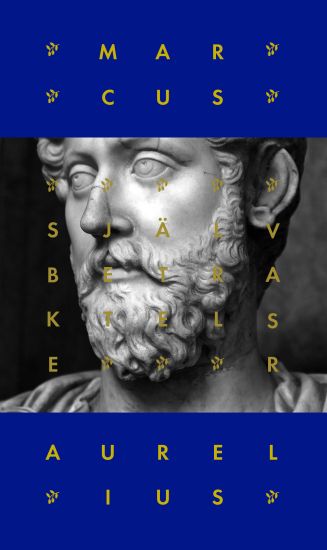
Under belägringen av Aquileia, omgiven av krigiska markomanner och kvader, började den romerske kejsaren Marcus Aurelius skriva ned sina tankar. Resultatet blev denna odödliga samling reflexioner om hur man finner själslig styrka och därmed ett sätt att förhålla sig till världen, både utom och inom en själv. I snart tvåtusen år har Marcus Aurelius Självbetraktelser inspirerat och hjälpt människor i livets alla skeden. Det är en tidlös text om moralen, livet och döden och många anser än idag att verket är ett av de allra främsta inom västerländsk litteratur. Förord av Sven-Eric Liedman
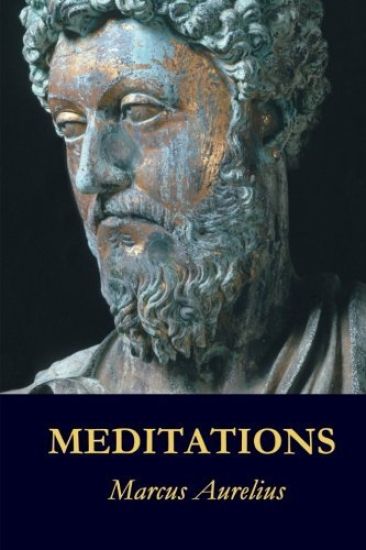
Meric Casaubon's famous 1634 translation of Meditations was the first English version of the Stoic masterwork to be reprinted many times because of its widespread popularity. The Shakespearean language has been called difficult by modern standards but the poetic Elizabethan prose greatly enhances this deeply spiritual work. Aurelius is no less eloquent or articulate than in later versions and the power of his thoughts and ideas are beautifully conveyed.
Meric Casaubon's famous 1634 translation of Meditations was the first English version of the Stoic masterwork to be reprinted many times because of its widespread popularity. The Shakespearean language has been called difficult by modern standards but the poetic Elizabethan prose greatly enhances this deeply spiritual work. Aurelius is no less eloquent or articulate than in later versions and the power of his thoughts and ideas are beautifully conveyed.
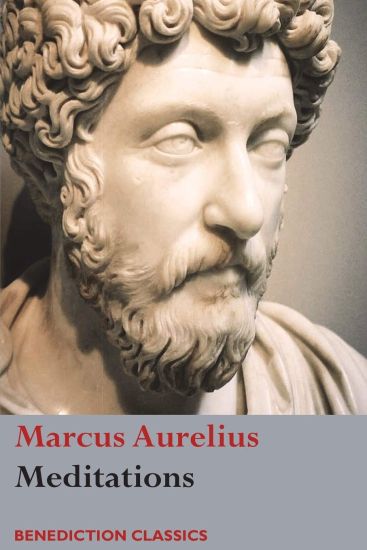
Meditations is a series of personal reflections by Marcus Aurelius, Roman Emperor 161-180 CE, written over a series of years in far-flung places as he led the Romans in military campaigns, quashed revolts, and dealt with the other tribulations of governing the Empire. It is best described as a spiritual journal, containing a record of the emperor's philosophical exercises.
Meditations is a series of personal reflections by Marcus Aurelius, Roman Emperor 161-180 CE, written over a series of years in far-flung places as he led the Romans in military campaigns, quashed revolts, and dealt with the other tribulations of governing the Empire. It is best described as a spiritual journal, containing a record of the emperor's philosophical exercises.
The Meditations is divided into 12 books that chronicle different periods of Marcus's life. Each book is not in chronological order and it was written for no one but himself. The style of writing that permeates the text is one that is simplified, straightforward, and perhaps reflecting Marcus's Stoic perspective on the text. Depending on the English translation, Marcus's style is not viewed as anything regal or belonging to royalty, but rather a man among other men which allows the reader to relate to his wisdom. A central theme to Meditations is the importance of analyzing one's judgment of self and others and the development of a cosmic perspective. As he said "You have the power to strip away many superfluous troubles located wholly in your judgment, and to possess a large room for yourself embracing in thought the whole cosmos, to consider everlasting time, to think of the rapid change in the parts of each thing, of how short it is from birth until dissolution, and how the void before birth and that after dissolution are equally infinite". He advocates finding one's place in the universe and sees that everything came from nature, and so everything shall return to it in due time. Another strong theme is of maintaining focus and to be without distraction all the while maintaining strong ethical principles such as "Being a good man". His Stoic ideas often involve avoiding indulgence in sensory affections, a skill which will free a man from the pains and pleasures of the material world. He claims that the only way a man can be harmed by others is to allow his reaction to overpower him. An order or logos permeates existence. Rationality and clear-mindedness allow one to live in harmony with the logos. This allows one to rise above faulty perceptions of "good" and "bad".
Meditations (Medieval Greek: literally " that which is] to himself") is a series of personal writings by Marcus Aurelius, Roman Emperor from 161 to 180 AD, recording his private notes to himself and ideas on Stoic philosophy.Each RADLEY CLASSIC is a meticulously restored, luxurious and faithful reproduction of a classic book; produced with elegant text layout, clarity of presentation, and stylistic features that make reading a true pleasure. Special attention is given to legible fonts and adequate letter sizing, correct line length for readability, generous margins and triple lead (lavish line separation); plus we do not allow any mistakes/changes to creep into the original author's words. Visit RADLEY BOOKS at www.radleybooks.com to see more classic book titles in this series.
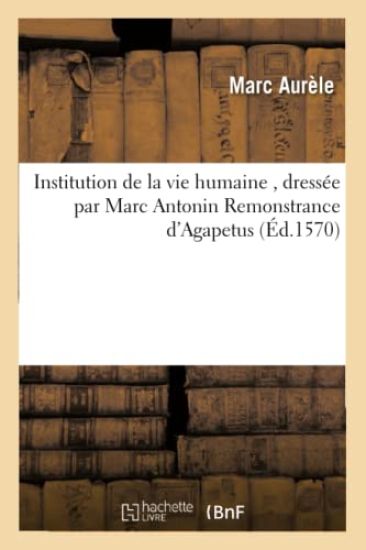
Institution de la vie humaine, dressee par Marc Antonin... Remonstrance d'Agapetus, evesque, a l'empereur Justinian de l'office d'un empereur ou roy. elegie de Solon, ... sur le fait et vie des humains... le tout traduit par Pardoux Du Prat, ...Date de l'edition originale: 1570Comprend: Remonstrance d'Agapetus, ... a l'empereur Justinian, de l'office d'un empereur ou roy... Traduit par Pardoux du Prat...Ce livre est la reproduction fidele d'une oeuvre publiee avant 1920 et fait partie d'une collection de livres reimprimes a la demande editee par Hachette Livre, dans le cadre d'un partenariat avec la Bibliotheque nationale de France, offrant l'opportunite d'acceder a des ouvrages anciens et souvent rares issus des fonds patrimoniaux de la BnF.Les oeuvres faisant partie de cette collection ont ete numerisees par la BnF et sont presentes sur Gallica, sa bibliotheque numerique.En entreprenant de redonner vie a ces ouvrages au travers d'une collection de livres reimprimes a la demande, nous leur donnons la possibilite de rencontrer un public elargi et participons a la transmission de connaissances et de savoirs parfois difficilement accessibles.Nous avons cherche a concilier la reproduction fidele d'un livre ancien a partir de sa version numerisee avec le souci d'un confort de lecture optimal. Nous esperons que les ouvrages de cette nouvelle collection vous apporteront entiere satisfaction.Pour plus d'informations, rendez-vous sur www.hachettebnf.fr
Meditations (literally "things to one's self") is a series of personal writings by Marcus Aurelius, Roman Emperor from 161 to 180 AD, recording his private notes to himself and ideas on Stoic philosophy.