Kirjojen hintavertailu. Mukana 12 657 676 kirjaa ja 12 kauppaa.

Kirjailija

Marcus Aurelius

Kirjat ja teokset yhdessä paikassa: 338 kirjaa, julkaisuja vuosilta 1890-2027, suosituimpien joukossa Itselleni. Vertaile teosten hintoja ja tarkista saatavuus suomalaisista kirjakaupoista.

338 kirjaa

Kirjojen julkaisuhaarukka 1890-2027.

Meditations

Meditations

Marcus Aurelius

Createspace Independent Publishing Platform
2016
nidottu
Packaged in handsome, affordable trade editions, Clydesdale Classics is a new series of essential works. From the musings of intellectuals such as Thomas Paine in Common Sense to the striking personal narrative of Harriet Jacobs in Incidents in the Life of a Slave Girl, this new series is a comprehensive collection of our intellectual history through the words of the exceptional few. Meditations is a collection of twelve books written by Roman Emperor Marcus Aurelius. The books were originally compiled in the form of private journals. Marcus Aurelius used these notes as personal guides to live by and to better himself as a ruler. He compiled these journals during his time as emperor, and while they were not intended for public consumption, there are valuable lessons to be gleaned from his wisdom. The entries include his views of stoicismthe Hellenistic philosophy devoid of destructive emotions that could tamper with logicand its practical use in ruling and military tactics. Completely unabridged, with a new foreword written by Huffington Post writer Carolyn Gregoire, this publication of Meditations is an all-encompassing collection of Marcus Aurelius s works."
Meditations

Meditations

Marcus Aurelius

Createspace Independent Publishing Platform
2016
nidottu
The Meditations is divided into 12 books that chronicle different periods of Marcus's life. Each book is not in chronological order and it was written for no one but himself. The style of writing that permeates the text is one that is simplified, straightforward, and perhaps reflecting Marcus's Stoic perspective on the text. Depending on the English translation, Marcus's style is not viewed as anything regal or belonging to royalty, but rather a man among other men which allows the reader to relate to his wisdom. A central theme to Meditations is to analyze your judgment of self and others and developing a cosmic perspective. As he said "You have the power to strip away many superfluous troubles located wholly in your judgment, and to possess a large room for yourself embracing in thought the whole cosmos, to consider everlasting time, to think of the rapid change in the parts of each thing, of how short it is from birth until dissolution, and how the void before birth and that after dissolution are equally infinite". He advocates finding one's place in the universe and sees that everything came from nature, and so everything shall return to it in due time. It seems at some points in his work that we are all part of a greater universal presence thus taking a communitarian approach rather than having an individualist perspective. Another strong theme is of maintaining focus and to be without distraction all the while maintaining strong ethical principles such as "Being a good man". His Stoic ideas often involve avoiding indulgence in sensory affections, a skill which will free a man from the pains and pleasures of the material world. He claims that the only way a man can be harmed by others is to allow his reaction to overpower him. An order or logos permeates existence. Rationality and clear-mindedness allow one to live in harmony with the logos. This allows one to rise above faulty perceptions of "good" and "bad".
Marcus Aurelius in Love

Marcus Aurelius in Love

Marcus Aurelius; Marcus Cornelius Fronto

University of Chicago Press
2016
nidottu
In 1815 a manuscript containing one of the long-lost treasures of antiquity was discovered—the letters of Marcus Cornelius Fronto, reputed to have been one of the greatest Roman orators. But this find disappointed many nineteenth-century readers, who had hoped for the letters to convey all of the political drama of Cicero’s. That the collection included passionate love letters between Fronto and the future emperor Marcus Aurelius was politely ignored—or concealed. And for almost two hundred years these letters have lain hidden in plain sight.Marcus Aurelius in Love rescues these letters from obscurity and returns them to the public eye. The story of Marcus and Fronto began in 139 CE, when Fronto was selected to instruct Marcus in rhetoric. Marcus was eighteen then and by all appearances the pupil and teacher fell in love. Spanning the years in which the relationship flowered and died, these are the only love letters to survive from antiquity—homoerotic or otherwise. With a translation that reproduces the effusive, slangy style of the young prince and the rhetorical flourishes of his master, the letters between Marcus and Fronto will rightfully be reconsidered as key documents in the study of the history of sexuality and classics.
Meditations

Meditations

Marcus Aurelius

Lulu.com
2016
sidottu
The influence Meditations has had over centuries of thought is immeasurable. This "unendingly moving and inspiring" work is often cited alongside Jean Jacques Rousseau's Confessions and St. Augustine's autobiography in discussions of the most profoundly spiritual works outside of the Bible.
Meditations

Meditations

Marcus Aurelius

Lulu.com
2016
nidottu
The influence Meditations has had over centuries of thought is immeasurable. This "unendingly moving and inspiring" work is often cited alongside Jean Jacques Rousseau's Confessions and St. Augustine's autobiography in discussions of the most profoundly spiritual works outside of the Bible.
Meditations

Meditations

Marcus Aurelius

Createspace Independent Publishing Platform
2016
nidottu
Meditations'that which is to himself'By Marcus AureliusTranslated by George LongMARCUS AURELIUS ANTONINUSTHE ROMAN EMPERORMarcus Aurelius (26 April 121 - 17 March 180 AD) was Roman Emperor from 161 to 180. He ruled with Lucius Verus as co-emperor from 161 until Verus' death in 169. He was the last of the Five Good Emperors, and is also considered one of the most important Stoic philosophers.During his reign, the Empire defeated a revitalized Parthian Empire in the East: Aurelius' general Avidius Cassius sacked the capital Ctesiphon in 164. In central Europe, Aurelius fought the Marcomanni, Quadi, and Sarmatians with success during the Marcomannic Wars, although the threat of the Germanic tribes began to represent a troubling reality for the Empire. A revolt in the East led by Avidius Cassius failed to gain momentum and was suppressed immediately.Marcus Aurelius' Stoic tome Meditations, written in Greek while on campaign between 170 and 180, is still revered as a literary monument to a philosophy of service and duty, describing how to find and preserve equanimity in the midst of conflict by following nature as a source of guidance and inspiration.Meditations is a series of personal writings by Marcus Aurelius, Roman Emperor from 161 to 180 AD, recording his private notes to himself and ideas on Stoic philosophy.Marcus Aurelius wrote the 12 books of the Meditations in Koine Greek as a source for his own guidance and self-improvement. It is possible that large portions of the work were written at Sirmium, where he spent much time planning military campaigns from 170 to 180. Some of it was written while he was positioned at Aquincum on campaign in Pannonia, because internal notes tell us that the first book was written when he was campaigning against the Quadi on the river Granova (modern-day Hron) and the second book was written at Carnuntum.It is unlikely that Marcus Aurelius ever intended the writings to be published and the work has no official title, so "Meditations" is one of several titles commonly assigned to the collection. These writings take the form of quotations varying in length from one sentence to long paragraphs.
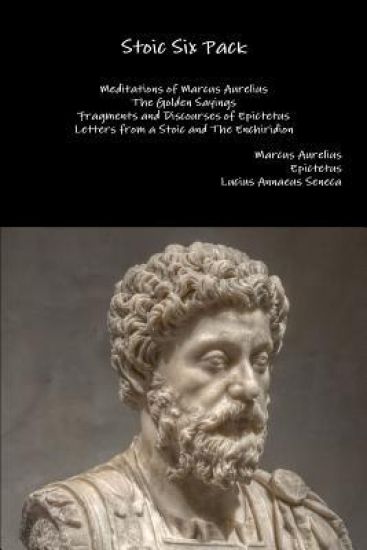
Stoic Six Pack: Meditations of Marcus Aurelius the Golden Sayings Fragments and Discourses of Epictetus Letters from a Stoic and the Enchiridion
Stoic Six Pack brings together the six essential texts of Stoic Philosophy: Meditations by Marcus Aurelius, The Golden Sayings of Epictetus, Fragments of Epictetus, Selected Discourses of Epictetus, Seneca's Letters from a Stoic and The Enchiridion of Epictetus.
Stoic Six Pack: Meditations of Marcus Aurelius the Golden Sayings Fragments and Discourses of Epictetus Letters from a Stoic and the Enchiridion
Stoic Six Pack brings together the six essential texts of Stoic Philosophy: Meditations by Marcus Aurelius, The Golden Sayings of Epictetus, Fragments of Epictetus, Selected Discourses of Epictetus, Seneca's Letters from a Stoic: Epistulae Morales Ad Lucilium and The Enchiridion of Epictetus.
Meditations

Meditations

Marcus Aurelius

Lulu.com
2015
sidottu
Meditations is a series of personal reflections by Marcus Aurelius, Roman Emperor 161-180 CE, written over a series of years in far-flung places as he led the Romans in military campaigns, quashed revolts, and dealt with the other tribulations of governing the Empire. It is best described as a spiritual journal, containing a record of the emperor's philosophical exercises. Aurelius wrote the 12 books of the Meditations as a source for his own guidance and self-improvement. In it he sets forth his ideas on Stoic philosophy. The influence Meditations has had over centuries of thought is immeasurable. This "unendingly moving and inspiring" work is often cited alongside Jean Jacques Rousseau's Confessions and St. Augustine's Confessions in discussions of the most profoundly spiritual works outside of the Bible. Recently, former U.S. President Bill Clinton called Meditations his favorite book.
Meditations

Meditations

Marcus Aurelius

Createspace Independent Publishing Platform
2015
nidottu
A central theme to Meditations is to analyze your judgement of self and others and developing a cosmic perspective. As he said "You have the power to strip away many superfluous troubles located wholly in your judgement, and to possess a large room for yourself embracing in thought the whole cosmos, to consider everlasting time, to think of the rapid change in the parts of each thing, of how short it is from birth until dissolution, and how the void before birth and that after dissolution are equally infinite".
Meditations

Meditations

Marcus Aurelius

Penguin Classics
2014
sidottu
Originally written only for his personal consumption, Marcus Aurelius's Meditations has become a key text in the understanding of Roman Stoic philosophy. This Penguin Classics edition is translated with notes by Martin Hammond and an introduction by Diskin Clay.Written in Greek by an intellectual Roman emperor without any intention of publication, the Meditations of Marcus Aurelius offer a wide range of fascinating spiritual reflections and exercises developed as the leader struggled to understand himself and make sense of the universe. Spanning from doubt and despair to conviction and exaltation, they cover such diverse topics as the question of virtue, human rationality, the nature of the gods and Aurelius's own emotions. But while the Meditations were composed to provide personal consolation, in developing his beliefs Marcus also created one of the greatest of all works of philosophy: a series of wise and practical aphorisms that have been consulted and admired by statesmen, thinkers and ordinary readers for almost two thousand years.Martin Hammond's new translation fully expresses the intimacy and eloquence of the original work, with detailed notes elucidating the text. This edition also includes an introduction by Diskin Clay, exploring the nature and development of the Meditations, a chronology, further reading and full indexes.Marcus Aelius Aurelius Antoninus (121-80) was adopted by the emperor Antoninus Pius and succeeded him in 161, (as joint emperor with adoptive brother Lucius Verus). He ruled alone from 169, and spent much of his reign in putting down various rebellions, and was a persecutor of Christians. His fame rest, above all, on his Meditations, a series of reflections, strongly influenced by Epictetus, which represent a Stoic outlook on life. He was succeeded by his natural son, thus ending the period of the adoptive emperors.If you enjoyed Meditations, you might like Seneca's Letters from a Stoic, also available in Penguin Classics.