Kirjojen hintavertailu. Mukana 12 390 323 kirjaa ja 12 kauppaa.

Kirjailija

Martyn Hammersley

Kirjat ja teokset yhdessä paikassa: 51 kirjaa, julkaisuja vuosilta 1990-2025, suosituimpien joukossa Kvalitative metoder. Vertaile teosten hintoja ja tarkista saatavuus suomalaisista kirjakaupoista.

51 kirjaa

Kirjojen julkaisuhaarukka 1990-2025.

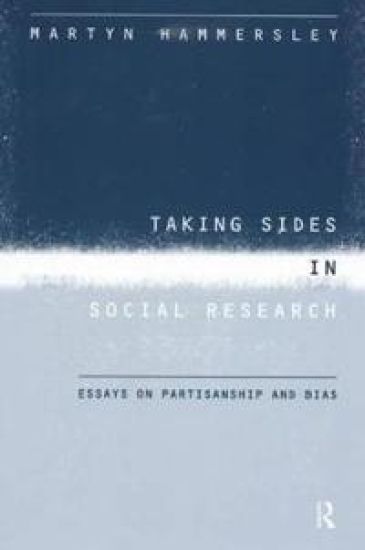
Taking Sides in Social Research

Taking Sides in Social Research

Martyn Hammersley

Routledge
1999
sidottu
In the past it was generally taken for granted that the goal of social research was the production of objective knowledge; and that this required a commitment to value neutrality. In more recent times, however, both these ideals have come to be challenged, and it is often argued that all research is inevitably political in its assumptions and effects. In this major contribution to the debate, Martyn Hammersley assesses the arguments from the classic and still influential contributions of C. Wright Mills, Howard Becker and Alvin Gouldner to the present day. He concludes that the case for partisanship is not convincing, and that an intelligent and sceptical commitment to the principles of objectivity and value neutrality must remain an essential feature of research.
Taking Sides in Social Research

Taking Sides in Social Research

Martyn Hammersley

Routledge
1999
nidottu
In the past it was generally taken for granted that the goal of social research was the production of objective knowledge; and that this required a commitment to value neutrality. In more recent times, however, both these ideals have come to be challenged, and it is often argued that all research is inevitably political in its assumptions and effects. In this major contribution to the debate, Martyn Hammersley assesses the arguments from the classic and still influential contributions of C. Wright Mills, Howard Becker and Alvin Gouldner to the present day. He concludes that the case for partisanship is not convincing, and that an intelligent and sceptical commitment to the principles of objectivity and value neutrality must remain an essential feature of research.
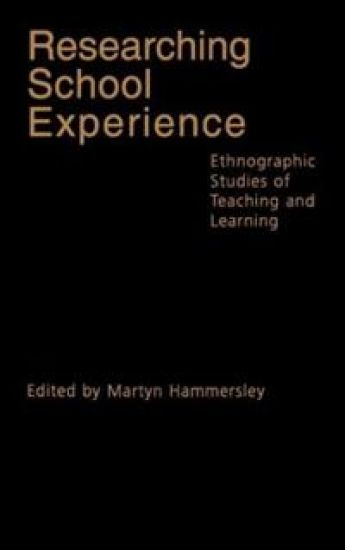
Researching School Experience

Researching School Experience

Martyn Hammersley

Routledge Falmer
1999
nidottu
There is a tendency in much educational thinking to view pupils in passive terms, as the material on which schools operate. This damaging view is challenged here. Significant recent research shows the effects of changing educational conditions on the experience of teaching and learning in schools. By redressing the balance and acknowledging the affective side of pupils and their learning, this book shows that improved understanding leads to improved teaching. Contributions from Stephen Ball, Martyn Descombe, Ann Filer, Andy Hargreaves, Bob Jeffrey, Geoff Troman, Andrew Pollard and Peter Woods.
Researching School Experience

Researching School Experience

Martyn Hammersley

Routledge Falmer
1999
sidottu
There is a tendency in much educational thinking to view pupils in passive terms, as the material on which schools operate. This damaging view is challenged here. Significant recent research shows the effects of changing educational conditions on the experience of teaching and learning in schools. By redressing the balance and acknowledging the affective side of pupils and their learning, this book shows that improved understanding leads to improved teaching. Contributions from Stephen Ball, Martyn Descombe, Ann Filer, Andy Hargreaves, Bob Jeffrey, Geoff Troman, Andrew Pollard and Peter Woods.
Constructing Educational Inequality

Constructing Educational Inequality

Peter Foster; Gomm Roger; Martyn Hammersley

TAYLOR FRANCIS LTD
1995
sidottu
The issue of educational opportunity has long been of public concern and a major focus for eduational research. As a result, there is now a substantial body of research findings in this field, both quantitative and qualitative.; This work relates to various levels of the educational system and to different categories of student, but particularly social class, gender, ethnicity and race. The central trend has been to find persisting inequalities despite reform at system, institutional and classroom levels. Furthermore, the educational system is frequently portrayed as playing a key role in reproducing wider social and economic inequalities.; This book examines the status of educational inequality as a social problem, explores the conceptual issues surrounding it, assesses a representative sample of recent research, and seeks to clarify the relevant methodological ground rules, thereby laying the basis for future research in the field.
Constructing Educational Inequality

Constructing Educational Inequality

Peter Foster; Roger Gomm; Martyn Hammersley

Routledge Falmer
1995
nidottu
The issue of educational opportunity has long been of public concern and a major focus for eduational research. As a result, there is now a substantial body of research findings in this field, both quantitative and qualitative.; This work relates to various levels of the educational system and to different categories of student, but particularly social class, gender, ethnicity and race. The central trend has been to find persisting inequalities despite reform at system, institutional and classroom levels. Furthermore, the educational system is frequently portrayed as playing a key role in reproducing wider social and economic inequalities.; This book examines the status of educational inequality as a social problem, explores the conceptual issues surrounding it, assesses a representative sample of recent research, and seeks to clarify the relevant methodological ground rules, thereby laying the basis for future research in the field.
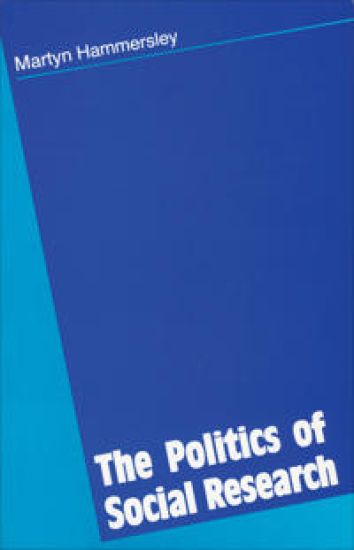
The Politics of Social Research

The Politics of Social Research

Martyn Hammersley

SAGE Publications Ltd
1995
nidottu
Is social research political? Should it be political? What are the implications of the politicization of social research? Recent years have seen a growing range of challenges to the idea that research should be governed by the principle of value neutrality. Critical, feminist, antiracist and postmodernist analyses have argued that social research is intrinsically political. In this stimulating and often controversial book, Martyn Hammersley weighs the arguments offered in support of these positions. He considers the fundamental issues that the debate raises about the nature of social research, its political dimensions and its contemporary relevance. At the same time he provides a robust defence of value neutrality as a constitutive principle of social research, and makes a reassessment of the role of research in modern societies. Praise for The Politics of Social Research `For anyone interested in the nature of social research, who has enough grasp of the issues to access the text, this book is a must' - British Journal of Educational Psychology `All in all Hammersley has produced a text which provides us with much to think about. As I have said, certain chapters will, no doubt, attract considerable debate. Almost all of the chapters could stand alone but the broad political theme used to bring chapters and topics together works well almost always' - Local Government Studies `Not only is Hammersley a leading exponent of sociological research, he is also a key writer and thinker on the problems of undertaking research. This collection, some of which has been published elsewhere and some not, therefore is a welcome addition to the literature on social research... interesting and well-argued' - Disability and Society
The Politics of Social Research

The Politics of Social Research

Martyn Hammersley

SAGE Publications Ltd
1995
sidottu
Is social research political? Should it be political? What are the implications of the politicization of social research? Recent years have seen a growing range of challenges to the idea that research should be governed by the principle of value neutrality. Critical, feminist, antiracist and postmodernist analyses have argued that social research is intrinsically political. In this stimulating and often controversial book, Martyn Hammersley weighs the arguments offered in support of these positions. He considers the fundamental issues that the debate raises about the nature of social research, its political dimensions and its contemporary relevance. At the same time he provides a robust defence of value neutrality as a constitutive principle of social research, and makes a reassessment of the role of research in modern societies. Praise for The Politics of Social Research `For anyone interested in the nature of social research, who has enough grasp of the issues to access the text, this book is a must' - British Journal of Educational Psychology `All in all Hammersley has produced a text which provides us with much to think about. As I have said, certain chapters will, no doubt, attract considerable debate. Almost all of the chapters could stand alone but the broad political theme used to bring chapters and topics together works well almost always' - Local Government Studies `Not only is Hammersley a leading exponent of sociological research, he is also a key writer and thinker on the problems of undertaking research. This collection, some of which has been published elsewhere and some not, therefore is a welcome addition to the literature on social research... interesting and well-argued' - Disability and Society
What's Wrong With Ethnography?

What's Wrong With Ethnography?

Martyn Hammersley

Routledge
1991
nidottu
This stimulating and refreshing study, written by one of the leading commentators in the field, provides novel answers to these crucial questions. "What's Wrong With Ethnography provides a fresh look at the rationale for and distinctiveness of ethnographic research in sociology, education and related fields, and succeeds in slaying a number of currently fashionable sacred cows. Relativism, critical theory, the uniqueness of the case study and the distinction between qualitative and quantitative research are all examined and found wanting as a basis for informed ethnography. The policy and political implications of ethnography are a particular focus of attention. The author compels the reader to reexamine some basic methodological assumptions in an exciting way", Martin Bulmer, London School of Economics.
Dilemma Qualitative Method

Dilemma Qualitative Method

Martyn Hammersley

Routledge
1990
nidottu
First Published in 1990. Originally published in 1989, The Dilemma of Qualitative Method is a stimulating guide to the discussion of qualitative versus quantitative approaches to social research, originated in nineteenth-century debates about the relationship between the methods of history and natural science. One of the key theorists in this area was Chicago sociologist Herbert Blumer. The book analyses the historical context of the dispute and provides a detailed account and systematic analysis Blumer's methodological writings including his doctoral thesis. The strategies for qualitative research advocated by Blumer within the Chicago tradition are reviewed and assessed.