Kirjojen hintavertailu. Mukana 12 123 303 kirjaa ja 12 kauppaa.

Kirjailija

Michael J. O'Brien

Kirjat ja teokset yhdessä paikassa: 30 kirjaa, julkaisuja vuosilta 1937-2026, suosituimpien joukossa The Importance of Small Decisions. Vertaile teosten hintoja ja tarkista saatavuus suomalaisista kirjakaupoista.

Mukana myös kirjoitusasut: Michael J O'Brien, Michael J. O Brien

30 kirjaa

Kirjojen julkaisuhaarukka 1937-2026.

The Importance of Small Decisions

The Importance of Small Decisions

Michael J. O'Brien; R. Alexander Bentley; William A. Brock; John Maeda

MIT Press
2019
sidottu
How people make decisions in an era of too much information and fake news.Humans originally evolved in a world of few choices. Prehistoric, preindustrial, and predigital eras required fewer decisions than today's all-access, always-on world of too much information. Economists have largely discarded the idea that agents act rationally and the market follows suit. It seems that no matter how small or innocuous a decision might seem, there's almost no way to guess the effect it might have. The authors of The Importance of Small Decisions view decisions and their outcomes from a different perspective: as key elements in the evolution of culture. In this trailblazing book, they examine different kinds of decisions and map the outcomes, both short- and long-term. Drawing on this, they introduce a map of social behavior that captures the essential elements of human decision-making.The authors look at the New England Patriots' decision in 2000 to draft an underachieving college quarterback named Tom Brady; they consider Warren Buffett's investment strategy; and they chart the "dancing landscape" of a college applicant's decision-making environment. Finally, they show that decisions can be ranked according to transparency of choice and social influence. When fake news seems indistinguishable from real news and when the internet offers a cacophony of voices, they warn, we can't afford to crowdsource our decisions.

A Hidden Phase of American History

A Hidden Phase of American History

Michael J O'Brien

University Press of the Pacific
2004
pokkari
This comprehensive contribution to the large part Irish and Irish-Americans played in the American Revolution covers genealogy, battles, fraternal organizations, and Irish friendship with George Washington.It is a refutation of Bancroft and Lodge by the historiographer of the American Irish Historical Society, with analysis of early Irish emigration to the colonies, the sympathies of the Irish with the Revolution, and the role played by the Irish in the Revolution. The appendix lists first officers, then non-commissioned officers of the American Army and Navy of the Revolution of Irish birth and descent.
Applying Evolutionary Archaeology

Applying Evolutionary Archaeology

Michael J. O'Brien; R. Lee Lyman

Kluwer Academic/Plenum Publishers
2000
sidottu
Anthropology, and by extension archaeology, has had a long-standing interest in evolution in one or several of its various guises. Pick up any lengthy treatise on humankind written in the last quarter of the nineteenth century and the chances are good that the word evolution will appear somewhere in the text. If for some reason the word itself is absent, the odds are excellent that at least the concept of change over time will have a central role in the discussion. After one of the preeminent (and often vilified) social scientists of the nineteenth century, Herbert Spencer, popularized the term in the 1850s, evolution became more or less a household word, usually being used synonymously with change, albeit change over extended periods of time. Later, through the writings of Edward Burnett Tylor, Lewis Henry Morgan, and others, the notion of evolution as it applies to stages of social and political development assumed a prominent position in anthropological disc- sions. To those with only a passing knowledge of American anthropology, it often appears that evolutionism in the early twentieth century went into a decline at the hands of Franz Boas and those of similar outlook, often termed particularists. However, it was not evolutionism that was under attack but rather comparativism— an approach that used the ethnographic present as a key to understanding how and why past peoples lived the way they did (Boas 1896).
Applying Evolutionary Archaeology

Applying Evolutionary Archaeology

Michael J. O'Brien; R. Lee Lyman

Kluwer Academic/Plenum Publishers
2000
nidottu
Anthropology, and by extension archaeology, has had a long-standing interest in evolution in one or several of its various guises. Pick up any lengthy treatise on humankind written in the last quarter of the nineteenth century and the chances are good that the word evolution will appear somewhere in the text. If for some reason the word itself is absent, the odds are excellent that at least the concept of change over time will have a central role in the discussion. After one of the preeminent (and often vilified) social scientists of the nineteenth century, Herbert Spencer, popularized the term in the 1850s, evolution became more or less a household word, usually being used synonymously with change, albeit change over extended periods of time. Later, through the writings of Edward Burnett Tylor, Lewis Henry Morgan, and others, the notion of evolution as it applies to stages of social and political development assumed a prominent position in anthropological disc- sions. To those with only a passing knowledge of American anthropology, it often appears that evolutionism in the early twentieth century went into a decline at the hands of Franz Boas and those of similar outlook, often termed particularists. However, it was not evolutionism that was under attack but rather comparativism— an approach that used the ethnographic present as a key to understanding how and why past peoples lived the way they did (Boas 1896).
Seriation, Stratigraphy, and Index Fossils

Seriation, Stratigraphy, and Index Fossils

Michael J. O'Brien; R. Lee Lyman

Kluwer Academic/Plenum Publishers
1999
sidottu
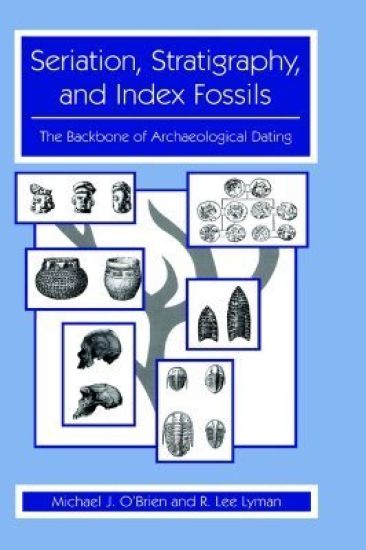
It is difficult for today's students of archaeology to imagine an era when chronometric dating methods were unavailable. However, even a casual perusal of the large body of literature that arose during the first half of the twentieth century reveals a battery of clever methods used to determine the relative ages of archaeological phenomena, often with considerable precision. Stratigraphic excavation is perhaps the best known of the various relative-dating methods used by prehistorians. Although there are several techniques of using artifacts from superposed strata to measure time, these are rarely if ever differentiated. Rather, common practice is to categorize them under the heading `stratigraphic excavation'. This text distinguishes among the several techniques and argues that stratigraphic excavation tends to result in discontinuous measures of time - a point little appreciated by modern archaeologists. Although not as well known as stratigraphic excavation, two other methods of relative dating have figured important in Americanist archaeology: seriation and the use of index fossils. The latter (like stratigraphic excavation) measures time discontinuously, while the former - in various guises - measures time continuously. Perhaps no other method used in archaeology is as misunderstood as seriation, and the authors provide detailed descriptions and examples of each of its three different techniques. Each method and technique of relative dating is placed in historical perspective, with particular focus on developments in North America, an approach that allows a more complete understanding of the methods described, both in terms of analytical technique and disciplinary history. This text will appeal to all archaeologists, from graduate students to seasoned professionals, who want to learn more about the backbone of archaeological dating.
The Rise and Fall of Culture History

The Rise and Fall of Culture History

R. Lee Lyman; Michael J. O'Brien; Robert C. Dunnell

Kluwer Academic/Plenum Publishers
1997
sidottu
VJver forty years ago Gordon R. Willey (1953b:361) stated that "[t]he objectives of archeology ...are approached by the study and manipulation of three basic factors: form, space, and time. " A few years later, Albert C. Spaulding (1960b:439) repeated this thought using different words: "[AJrchaeology can be defined minimally as the study of the interrelation- ship of form, temporal locus, and spatial locus exhibited by artifacts. In other words, archaeologists are always concerned with these interrelation- ships, whatever broader interests they may have, and these interrelation- ships are the special business of archaeology. " Many of the means Americanist archaeologists use to examine formal variation in artifacts and the distribution of that variation across space and through time were formulated early in the twentieth century. The analytical tenets, or principles, underlying the various methods and techniques were formalized and axiomatized in later years such that by the 1930s they con- stituted the first formal paradigm for Americanist archaeology-a paradigm commonly termed culture history. This paradigm began with a very specific goal-to document the history of the development of prehistoric cultures in the Americas. Although it fell from favor in the 1960s, many of its central tenets were carried over to newer paradigms and thus continue to be fun- damental within Americanist archaeology. With Willey's and Spaulding's conceptions as our guide, we elsewhere reprinted (Lyman et al.
The Rise and Fall of Culture History

The Rise and Fall of Culture History

R. Lee Lyman; Michael J. O'Brien; Robert C. Dunnell

Kluwer Academic/Plenum Publishers
1997
nidottu
VJver forty years ago Gordon R. Willey (1953b:361) stated that "[t]he objectives of archeology ...are approached by the study and manipulation of three basic factors: form, space, and time. " A few years later, Albert C. Spaulding (1960b:439) repeated this thought using different words: "[AJrchaeology can be defined minimally as the study of the interrelation- ship of form, temporal locus, and spatial locus exhibited by artifacts. In other words, archaeologists are always concerned with these interrelation- ships, whatever broader interests they may have, and these interrelation- ships are the special business of archaeology. " Many of the means Americanist archaeologists use to examine formal variation in artifacts and the distribution of that variation across space and through time were formulated early in the twentieth century. The analytical tenets, or principles, underlying the various methods and techniques were formalized and axiomatized in later years such that by the 1930s they con- stituted the first formal paradigm for Americanist archaeology-a paradigm commonly termed culture history. This paradigm began with a very specific goal-to document the history of the development of prehistoric cultures in the Americas. Although it fell from favor in the 1960s, many of its central tenets were carried over to newer paradigms and thus continue to be fun- damental within Americanist archaeology. With Willey's and Spaulding's conceptions as our guide, we elsewhere reprinted (Lyman et al.
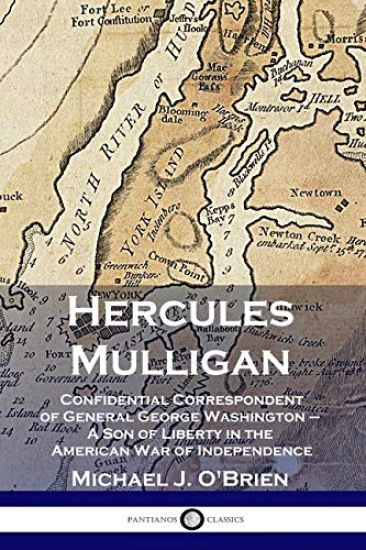
Hercules Mulligan: Confidential Correspondent of General George Washington - A Son of Liberty in the American War of Independence
Hercules Mulligan was a master spy who answered to George Washington, being instrumental to saving the revolutionary leader from capture during the War of Independence.The young Mulligan grew up at a time when agitation over Britain's taxation of the American colonies was rising; born in Ireland, he moved to the colonies at the age of six, and considered himself not merely a colonist, but a patriot of the impending nation. Able with dialogue and persuasion, it was Mulligan who convinced the young Alexander Hamilton to join the patriotic movement for independence.During the War of Independence, Mulligan continued to work as a tailor in New York. Such work was ideal for knowledge gathering; many of the British officers would attend his shop, and from the dates they wished to collect their new or updated uniforms, Mulligan was able to pass along information about the deployment of certain regiments. A fortunate visit late one night by a British officer demanding service yielded vital knowledge of a daring plot to ambush and capture George Washington: by informing the revolutionary leader ahead of time, General Washington's capture was averted.Mulligan is often termed an 'unsung hero', as his deeds - crucial to the war effort - have faded from memory over time. This biography not only tells of Mulligan's importance, but includes in the appendix the man's own written narrative upon his deeds.
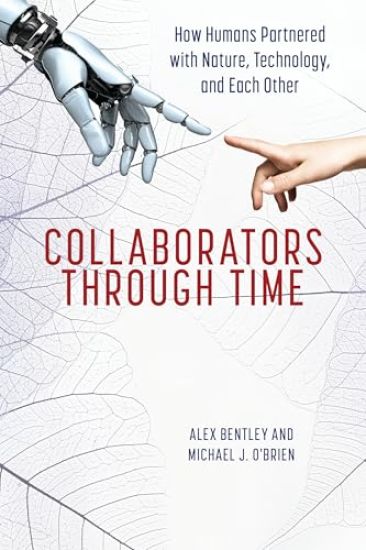
Collaborators through Time

Collaborators through Time

R. Alexander Bentley; Michael J. O'Brien

BLOOMSBURY PUBLISHING PLC
2026
sidottu
Spanning 2 million years, this book examines how humans partnered with nature, technology, and each other to shape their world, from evolutionary origins and ancient innovations to the rise of artificial intelligence. This book examines how humans collaborated with other entities, expanding in scale from individuals to other species of Homo, and further to the formation of groups, interactions with organisms, connections with past generations, and the transformative role of technology. Through dozens of vivid examples—from the lives of Neanderthals to the origins of agriculture, the impact of ancient diseases, the practices of shamans, Bronze Age innovations, global trade routes, and the products of the world’s first cities—this narrative illuminates the intricate web of partnerships that defined human history. The final chapter delves into artificial intelligence, illustrating how its evolution mirrors the co-evolution of humans with technologies. AI’s rapid development of learning and collaborative abilities echoes humanity’s own adaptive journey, albeit at an accelerated pace. Richly illustrated with over 50 full-color figures, this book offers a visually engaging and intellectually stimulating journey through the partnerships that have shaped our world, from the dawn of prehistory to the cutting edge of AI.
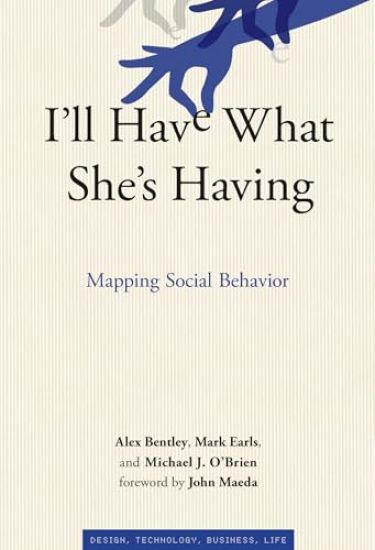
I'll Have What She's Having

I'll Have What She's Having

R. Alexander Bentley; Mark Earls; Michael J. O'Brien; John Maeda

MIT PRESS LTD
2025
pokkari
How we learn from those around us: an essential guide to understanding how people behave. Humans are, first and foremost, social creatures. And this, according to the authors of I'll Have What She's Having, shapes--and explains--most of our choices. We're not just blindly driven by hard-wired instincts to hunt or gather or reproduce; our decisions are based on more than "nudges" exploiting individual cognitive quirks. I'll Have What She's Having shows us how we use the brains of others to think for us and as storage space for knowledge about the world. The story zooms out from the individual to small groups to the complexities of populations. It describes, among other things, how buzzwords propagate and how ideas spread; how the swine flu scare became an epidemic; and how focused social learning by a few gets amplified as copying by the masses. It describes how ideas, behavior, and culture spread through the simple means of doing what others do. It is notoriously difficult to change behavior. For every "Yes We Can" political slogan, there are thousands of "Just Say No" buttons. I'll Have What She's Having offers a practical map to help us navigate the complex world of social behavior, an essential guide for anyone who wants to understand how people behave and how to begin to change things.
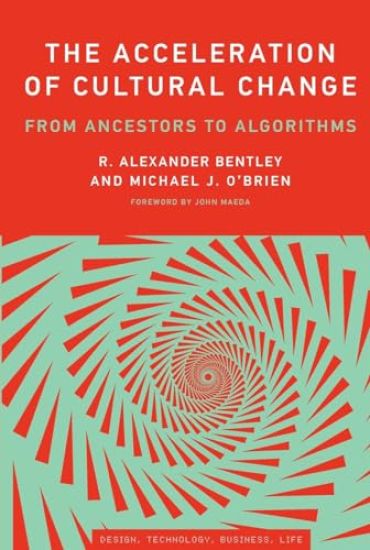
The Acceleration of Cultural Change

The Acceleration of Cultural Change

R. Alexander Bentley; Michael J. O'Brien; John Maeda

MIT PRESS LTD
2024
pokkari
How culture evolves through algorithms rather than knowledge inherited from ancestors. From our hunter-gatherer days, we humans evolved to be excellent throwers, chewers, and long-distance runners. We are highly social, crave Paleolithic snacks, and display some gendered difference resulting from mate selection. But we now find ourselves binge-viewing, texting while driving, and playing Minecraft. Only the collective acceleration of cultural and technological evolution explains this development. The evolutionary psychology of individuals--the drive for "food and sex"--explains some of our current habits, but our evolutionary success, Alex Bentley and Mike O'Brien explain, lies in our ability to learn cultural know-how and to teach it to the next generation. Today, we are following social media bots as much as we are learning from our ancestors. We are radically changing the way culture evolves. Bentley and O'Brien describe how the transmission of culture has become vast and instantaneous across an Internet of people and devices, after millennia of local ancestral knowledge that evolved slowly. Long-evolved cultural knowledge is aggressively discounted by online algorithms, which prioritize popularity and recency. If children are learning more from Minecraft than from tradition, this is a profound shift in cultural evolution. Bentley and O'Brien examine the broad and shallow model of cultural evolution seen today in the science of networks, prediction markets, and the explosion of digital information. They suggest that in the future, artificial intelligence could be put to work to solve the problem of information overload, learning to integrate concepts over the vast idea space of digitally stored information.