Kirjojen hintavertailu. Mukana 12 657 676 kirjaa ja 12 kauppaa.

Kirjailija

Michael Roberts

Kirjat ja teokset yhdessä paikassa: 64 kirjaa, julkaisuja vuosilta 1902-2026, suosituimpien joukossa Hot Type, Cold Beer and Bad News: A Cleveland Reporter's Journey Through the 1960s. Vertaile teosten hintoja ja tarkista saatavuus suomalaisista kirjakaupoista.

64 kirjaa

Kirjojen julkaisuhaarukka 1902-2026.

The Swedish Imperial Experience 1560–1718

The Swedish Imperial Experience 1560–1718

Michael Roberts

Cambridge University Press
1984
pokkari
In his Wiles Lectures for 1977 Professor Roberts examines some of the problems raised by Sweden's brief career as a great power, and seeks to answer some of the questions that flow from them. Were the underlying considerations which prompted the unexpected development geopolitical, or social, or economic? How was it possible to produce the financial resources and the manpower which the enterprise demanded? How far was seventeenth-century Sweden a militarized society? What importance had official propaganda and national myths? Did the consititutional situation help to make an expansionist foreign policy easier? The structure of the empire is next examined: its administration, the ties that held it together, the differing interests of the provinces, the varying responses of the metropolitan power was there, in fact, anything deserving the name of an imperial policy? How did the provinces view the Swedish connexion? In a final chapter the author tries to answer the question why, if Sweden could acquire an empire without undue strain, she could not retain it; why the collapse was so rapid and so total; and whether her career as a great power had real relevance to the country's subsequent history. On almost all these topics little information is available in English, and no comparable treatment of them on this scale exists in any language.
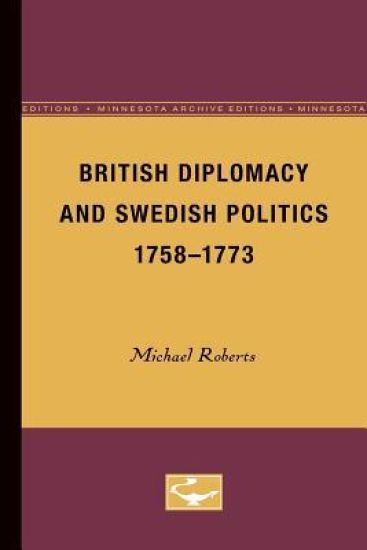
British Diplomacy and Swedish Politics, 1758-1773

British Diplomacy and Swedish Politics, 1758-1773

Michael Roberts

University of Minnesota Press
1980
nidottu
British Diplomacy and Swedish Politics, 1758–1773 was first published in 1980. Minnesota Archive Editions uses digital technology to make long-unavailable books once again accessible, and are published unaltered from the original University of Minnesota Press editions.This book has three objectives; to shed light on the central issue in British foreign policy during a period inadequately explored by historians; to present, for the first time in English, an account of the dramatic last decade of Swedish "liberty" and its final overthrow by Gustavus III; and finally, to direct the attention of historians to the career of Sir John Goodricke—a diplomat whom Lor Rochford called "the best man we have abroad; you can trust him with anything—except money."These themes are in fact inextricably linked. For Great Britain, emerging from the Seven Years War victorious but isolated, needed to safeguard her trade with Russia and British statesmen felt that an Anglo-Russian alliance could best be achieved by first concluding a treaty with Sweden to which Russia would adhere. To achieve this aim, it was essential to break French influence in Stockholm, to oust the francophile Hats from power, and to install their anglophile rivals the Caps. Thus Swedish party politics, and the Swedish constitutions, unexpectedly became matters of great consequence in Whitehall. To win the necessary victory in Stockholm Britain needed a minister of peculiar talents and no little ability. Sir John Goodricke was such a minister. And the record of his exertions, and of his eventual failure, is necessary to any proper understanding of British policy in the postwar decade.This book is an important contribution to both British and Scandinavian history and, since it also illuminates the subject of European political relations in the eighteenth century, it will be welcomed by diplomatic historians and specialists in eighteenth-century studies as well. Michael Roberts tells his story with customary verve and grace, and effectively refutes any idea that diplomatic history need be dull.
British Diplomacy and Swedish Politics, 1758–1773
"British Diplomacy and Swedish Politics, 1758 1773 " was first published in 1980. Minnesota Archive Editions uses digital technology to make long-unavailable books once again accessible, and are published unaltered from the original University of Minnesota Press editions.This book has three objectives; to shed light on the central issue in British foreign policy during a period inadequately explored by historians; to present, for the first time in English, an account of the dramatic last decade of Swedish "liberty" and its final overthrow by Gustavus III; and finally, to direct the attention of historians to the career of Sir John Goodricke a diplomat whom Lor Rochford called "the best man we have abroad; you can trust him with anything except money."These themes are in fact inextricably linked. For Great Britain, emerging from the Seven Years War victorious but isolated, needed to safeguard her trade with Russia and British statesmen felt that an Anglo-Russian alliance could best be achieved by first concluding a treaty with Sweden to which Russia would adhere. To achieve this aim, it was essential to break French influence in Stockholm, to oust the francophile Hats from power, and to install their anglophile rivals the Caps. Thus Swedish party politics, and the Swedish constitutions, unexpectedly became matters of great consequence in Whitehall. To win the necessary victory in Stockholm Britain needed a minister of peculiar talents and no little ability. Sir John Goodricke was such a minister. And the record of his exertions, and of his eventual failure, is necessary to any proper understanding of British policy in the postwar decade.This book is an important contribution to both British and Scandinavian history and, since it also illuminates the subject of European political relations in the eighteenth century, it will be welcomed by diplomatic historians and specialists in eighteenth-century studies as well. Michael Roberts tells his story with customary verve and grace, and effectively refutes any idea that diplomatic history need be dull."