Kirjojen hintavertailu. Mukana 12 390 323 kirjaa ja 12 kauppaa.

Kirjailija

Muhammad Iqbal

Kirjat ja teokset yhdessä paikassa: 57 kirjaa, julkaisuja vuosilta 2004-2026, suosituimpien joukossa Six Lectures on the Reconstruction of Religious Thought in Islam. Vertaile teosten hintoja ja tarkista saatavuus suomalaisista kirjakaupoista.

57 kirjaa

Kirjojen julkaisuhaarukka 2004-2026.

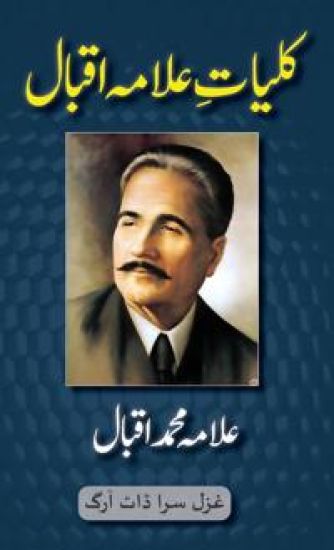
Kulliyat-e-Allama Iqbal

Kulliyat-e-Allama Iqbal

Muhammad Iqbal

Ghazal Sara Dot Org
2022
pokkari
This collection contains all the four books by Sir Allama Mohammad Iqbal.Sir Muhammad Iqbal's The Call of the Marching Bell (بانگِ درا, bang-e-dara), his first collection of Urdu poetry, was published in 1924. It was written in three distinct phases of his life. The poems he wrote up to 1905-the year he left for England-reflect patriotism and the imagery of nature, including the Urdu language patriotic "Saare Jahan se Accha", and "Tarana-e-Milli" ("The Song of the Community"). The second set of poems date from 1905 to 1908, when Iqbal studied in Europe, and dwell upon the nature of European society, which he emphasized had lost spiritual and religious values. This inspired Iqbal to write poems on the historical and cultural heritage of Islam and the Muslim community, with a global perspective. Iqbal urges the entire Muslim community, addressed as the Ummah, to define personal, social and political existence by the values and teachings of Islam.Iqbal's works were in Persian for most of his career, but after 1930 his works were mainly in Urdu. His works in this period were often specifically directed at the Muslim masses of India, with an even stronger emphasis on Islam and Muslim spiritual and political reawakening. Published in 1935, Bal-e-Jibril بالِ جبریل (Wings of Gabriel) is considered by many critics as his finest Urdu poetry and was inspired by his visit to Spain, where he visited the monuments and legacy of the kingdom of the Moors. It consists of ghazals, poems, quatrains and epigrams and carries a strong sense of religious passion.Zarb-i-Kalim ضربِ کلیم (or The Rod of Moses) is another philosophical poetry book of Allama Iqbal in Urdu, it was published in 1936, two years before his death. In which he described as his political manifesto. It was published with the subtitle "A Declaration of War Against the Present Times. Muhammad Iqbal argues that modern problems are due to the godlessness, materialism, and injustice of modern civilization, which feeds on the subjugation and exploitation of weak nations, especially the Indian Muslims.Iqbal's final work was Armughan-e-Hijaz ارمغانِ حجاز (The Gift of Hijaz), published posthumously in 1938. The first part contains quatrains in Persian, and the second part contains some poems and epigrams in Urdu. The Persian quatrains convey the impression that the poet is travelling through the Hijaz in his imagination. The profundity of ideas and intensity of passion are the salient features of these short poems
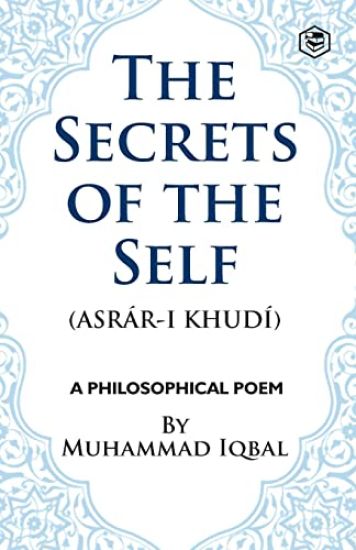
The Secrets of the Self

The Secrets of the Self

Muhammad Iqbal

SANAGE PUBLISHING HOUSE LLP
2022
sidottu
Asrar-i-Khudi (Persian: اسرار خودی, The Secrets of the Self; published in Persian, 1915) was the first philosophical poetry book of Allama Iqbal, the great poet-philosopher of British India. This book deals mainly with the "Self" in relation to the universe, how it is the inner power and soul of each individual human. It instructs on how to improve the Self through Love and willpower, which can then help one control the forces within the universe.
The Secrets of the Self

The Secrets of the Self

Muhammad Iqbal

SANAGE PUBLISHING HOUSE LLP
2022
nidottu
Asrar-i-Khudi (Persian: اسرار خودی, The Secrets of the Self; published in Persian, 1915) was the first philosophical poetry book of Allama Iqbal, the great poet-philosopher of British India. This book deals mainly with the "Self" in relation to the universe, how it is the inner power and soul of each individual human. It instructs on how to improve the Self through Love and willpower, which can then help one control the forces within the universe.
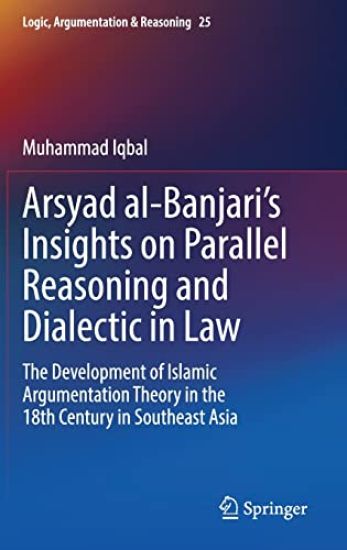
Arsyad al-Banjari’s Insights on Parallel Reasoning and Dialectic in Law
This book provides an epistemological study of the great Islamic scholar of Banjarese origin, Syeikh Muhammad Arsyad al-Banjari (1710-1812) who contributed to the development of Islam in Indonesia and, in general, Southeast Asia. The work focuses on Arsyad al-Banjari’s dialectical use and understanding of qiyas or correlational inference as a model of parallel reasoning or analogy in Islamic jurisprudence. This constituted the most prominent instrument he applied in his effort of integrating Islamic law into the Banjarese society.This work studies how Arsyad al-Banjari integrates jadal theory or dialectic in Islamic jurisprudence, within his application of qiyas. The author develops a framework for qiyas which acts as the interface between jadal, dialogical logic, and Per Martin-Löf’s Constructive Type Theory (CTT). One of the epistemological results emerging from the present study is that the different forms of qiyas applied by Arsyad al-Banjari represent an innovativeand sophisticated form of reasoning. The volume is divided into three parts that discuss the types of qiyas as well their dialectical and argumentative aspects, historical background and context of Banjar, and demonstrates how the theory of qiyas comes quite close to the contemporary model of parallel reasoning for sciences and mathematics developed by Paul Bartha (2010). This volume will be of interest to historians and philosophers in general, and logicians and historians of philosophy in particular.
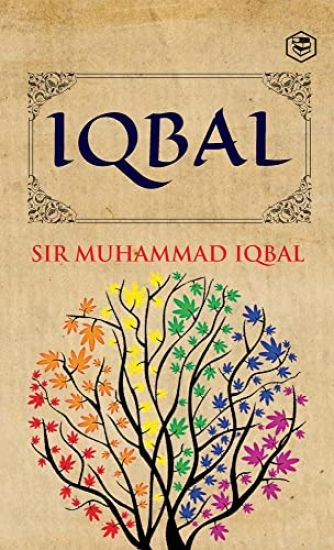
Iqbal

Iqbal

Muhammad Iqbal

SANAGE PUBLISHING HOUSE LLP
2022
pokkari
A finest collection of Poems by Muhammad Iqbal having 27 Poems such as "A Cow and a Goat", "A Mountain and a Squirrel", "Mirza Ghalib", "Sympathy", "The Candle", "The Cloud on the Mountain", "The Intellect and the Heart", "The Painful Wail", "The Withered Rose", "A Longing", "A Spider and A Fly", "Jawab-e-Shikwa (Response to the Complaint)", "Pathos of Love", "The Age of Infancy", "The Candle and The Moth", "The Colorful Rose", "The Interrogation Of The Dead", "The Sun", "A Mother's Dream", "Shikwaa (The Complaint)", "The Bird's Complaint", "The Child's Invocation", "The Crescent", "The Morning Sun", "The Tomb-stone of Saiyyid", "The Himalayas" & "Said The Coal To A Diamond".
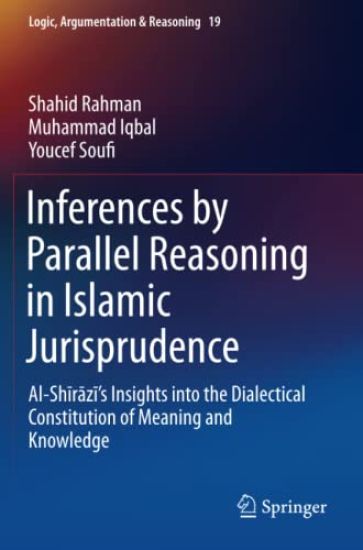
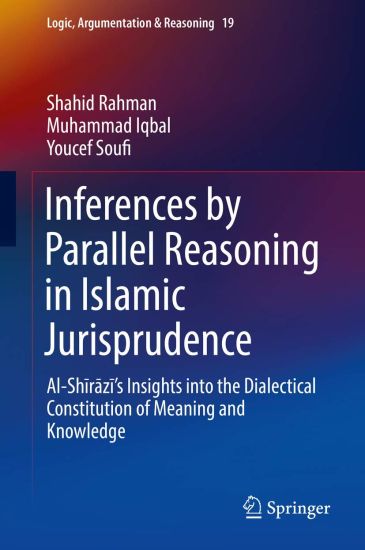
Inferences by Parallel Reasoning in Islamic Jurisprudence

Inferences by Parallel Reasoning in Islamic Jurisprudence

Shahid Rahman; Muhammad Iqbal; Youcef Soufi

Springer Nature Switzerland AG
2021
nidottu
This monograph proposes a new (dialogical) way of studying the different forms of correlational inference, known in the Islamic jurisprudence as qiyas. According to the authors’ view, qiyas represents an innovative and sophisticated form of dialectical reasoning that not only provides new epistemological insights into legal argumentation in general (including legal reasoning in Common and Civil Law) but also furnishes a fine-grained pattern for parallel reasoning which can be deployed in a wide range of problem-solving contexts and does not seem to reduce to the standard forms of analogical reasoning studied in contemporary philosophy of science and argumentation theory. After an overview of the emergence of qiyas and of the work of al-Shirazi penned by Soufi Youcef, the authors discuss al-Shirazi’s classification of correlational inferences of the occasioning factor (qiyas al-'illa). The second part of the volume deliberates on the system of correlational inferences by indication and resemblance (qiyas al-dalala, qiyas al-shabah). The third part develops the main theoretical background of the authors’ work, namely, the dialogical approach to Martin-Löf's Constructive Type Theory. The authors present this in a general form and independently of adaptations deployed in parts I and II. Part III also includes an appendix on the relevant notions of Constructive Type Theory, which has been extracted from an overview written by Ansten Klev. The book concludes with some brief remarks on contemporary approaches to analogy in Common and Civil Law and also to parallel reasoning in general.
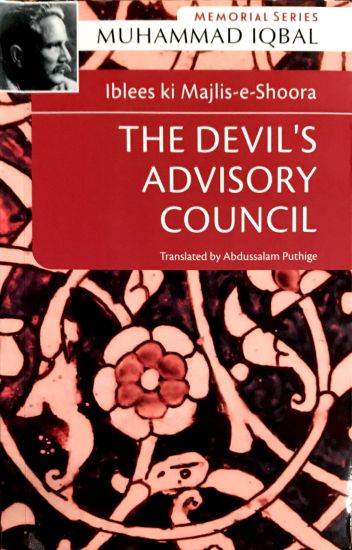
Iblees KI Majlis-E-Shoora: The Devil's Advisory Council
Iblees ki Majlis-e-Shoora is a conversation between Iblees (the devil) and the five members of his advisory council. It is one of the final works of Allama Iqbal. The work consists of 64 amazingly dramatized, well composed couplets. Here, Iblees presides over the clandestine session and leads the conversation. He boasts how successfully he has mislead Mankind throughout history by introducing ideas and doctrines such as Imperialism, Capitalism, Fascism etc., which have ultimately landed the human society in ruins. His advisers point towards a few emerging trends such as Western democracy and Marxism that they saw as potential threats to the evil regime of Iblees. Summarily dismissing all these apprehensions of his advisers, Iblees concludes, that the revolutionary spirit of Islam is the greatest threat to his evil empire and hence the most crucial task ahead was to stop the waves of Muslim resurgence. He instructs them to keep the followers of Islam totally preoccupied with vain spiritual rituals, complex philosophical debates and narrow theological intricacies.Allama Iqbal, an advocate of universal human fraternity, envisaged the revival of the original Islamic civilization, globally. His works, exposed the limitations of the socio-political and economic concepts introduced by the West.
Inferences by Parallel Reasoning in Islamic Jurisprudence

Inferences by Parallel Reasoning in Islamic Jurisprudence

Shahid Rahman; Muhammad Iqbal; Youcef Soufi

Springer Nature Switzerland AG
2020
sidottu
This monograph proposes a new (dialogical) way of studying the different forms of correlational inference, known in the Islamic jurisprudence as qiyas. According to the authors’ view, qiyas represents an innovative and sophisticated form of dialectical reasoning that not only provides new epistemological insights into legal argumentation in general (including legal reasoning in Common and Civil Law) but also furnishes a fine-grained pattern for parallel reasoning which can be deployed in a wide range of problem-solving contexts and does not seem to reduce to the standard forms of analogical reasoning studied in contemporary philosophy of science and argumentation theory. After an overview of the emergence of qiyas and of the work of al-Shirazi penned by Soufi Youcef, the authors discuss al-Shirazi’s classification of correlational inferences of the occasioning factor (qiyas al-'illa). The second part of the volume deliberates on the system of correlational inferences by indication and resemblance (qiyas al-dalala, qiyas al-shabah). The third part develops the main theoretical background of the authors’ work, namely, the dialogical approach to Martin-Löf's Constructive Type Theory. The authors present this in a general form and independently of adaptations deployed in parts I and II. Part III also includes an appendix on the relevant notions of Constructive Type Theory, which has been extracted from an overview written by Ansten Klev. The book concludes with some brief remarks on contemporary approaches to analogy in Common and Civil Law and also to parallel reasoning in general.
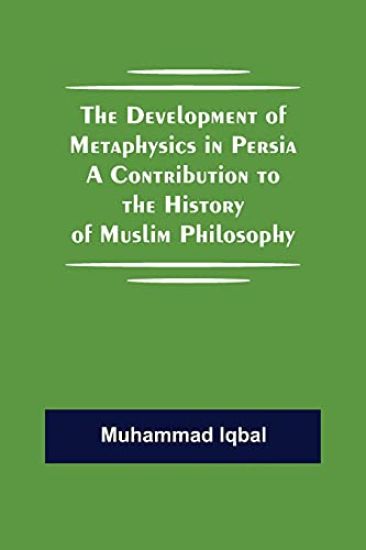
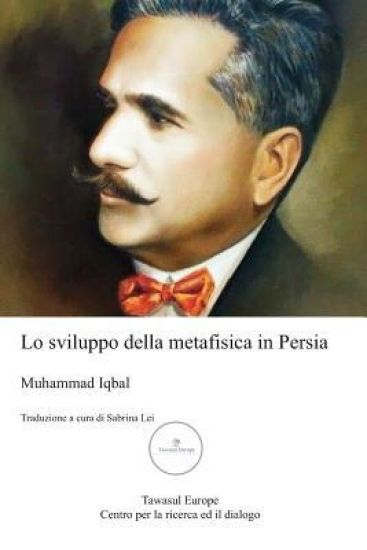
Lo Sviluppo Della Metafisica in Persia: Un Contributo Alla Storia Della Filosofia Islamica
In questo studio Muhammad Iqbal analizza la storia del pensiero metafisico persiano prima e dopo l'incontro con l'Islam, esaminandone le caratteristiche peculiari e la relazione sia di complementarit che di opposizione rispetto agli assunti principali della filosofia greca. Il testo, pur nella sua brevit , ha un carattere esaustivo e propedeutico a studi successivi. Per questa ragione, pu essere considerato uno strumento importante per gli studiosi del pensiero filosofico occidentale ed orientale, oltre che una lettura affascinante ed informativa per il lettore comune che desiderasse approfondire la conoscenza di questi argomenti.
Bang-E-Dara ( Urdu Edition )

Bang-E-Dara ( Urdu Edition )

Muhammad Iqbal

Createspace Independent Publishing Platform
2018
nidottu
Bang-e-Dara (The Call of the Marching Bell) published in Urdu in 1924, was the first Urdu philosophical poetry book by Allama Iqbal, one of the great poet-philosophers of the Indian subcontinent
Armaghan-I-Hijaz ( Urdu Edition )

Armaghan-I-Hijaz ( Urdu Edition )

Muhammad Iqbal

Createspace Independent Publishing Platform
2018
nidottu
Armaghan-i-Hijaz (Gift from Hijaz; published in Persian, 1938) was a philosophical poetry book of Allama Iqbal, the great poet-philosopher of Islam. This work, published a few months after the poet's death, is a fairly small volume containing verses in both Persian and Urdu. It is incomplete, although this is not readily apparent to the reader; for Iqbal left some gaps in the book which he intended to fill when he made the pilgrimage to Mecca. The title means "Gift from the Hijaz." He had long wished to undertake the journey to the Arabian Peninsula to perform the Hajj and to visit the tomb of Muhammad, but was prevented from doing so by continuous illness during the last years of his life. Iqbal began composing the Armaghan as a gift to take to the Hijaz, intending to publish it on his return to India as a "Gift from the Hijaz" to his countrymen.
Asrar-I-Khudi ( Persian Edition )

Asrar-I-Khudi ( Persian Edition )

Muhammad Iqbal

Createspace Independent Publishing Platform
2018
nidottu
Asrar-i-Khudi (The Secrets of the Self; published in Persian, (1915) was the first philosophical poetry book of Allama Iqbal, the great poet-philosopher of Pakistan. This book deals mainly with the individual, while his second book Rumuz-i-Bekhudi discusses the interaction between the individual and society.In 1915, he published his first collection of poetry, the Asrar-e-Khudi (Secrets of the Self) in Persian. The poems emphasise the spirit and self from a religious, spiritual perspective. Many critics have called this Iqbal's finest poetic work.
Bal-I-Jibril ( Urdu Edition )

Bal-I-Jibril ( Urdu Edition )

Muhammad Iqbal

Createspace Independent Publishing Platform
2018
nidottu
Bal-i-Jibril ( Gabriel's Wing; published in Urdu, 1935) was a philosophical poetry book of Allama Iqbal, the great South Asian poet-philosopher, and the national poet of Pakistan.Some of the verses had been written when Iqbal visited Britain, Italy, Egypt, Palestine, France, Spain and Afghanistan, including one of Iqbal's best known poems The Mosque of Cordoba. The work contains 15 ghazals addressed to God and 61 ghazals and 22 quatrains dealing the ego, faith, love, knowledge, the intellect and freedom. The poet recalls the past glory of Muslims as he deals with contemporary political problems.
Zarb-I-Kalim ( Urdu Edition )

Zarb-I-Kalim ( Urdu Edition )

Muhammad Iqbal

Createspace Independent Publishing Platform
2018
nidottu
Zarb-i-Kalim (or The Rod of Moses) is a philosophical poetry book of Allama Iqbal in Urdu, a poet-philosopher of the Indian subcontinent. It was published in 1936, two years before his death. This is third collection of Allama Sir Muhammad Iqbal's poetry, which described as his political manifesto. It was published with the subtitle "A Declaration of War Against the Present Times." Muhammad Iqbal who also known as "Poet of the East" argues that modern problems are due to the godlessness, materialism and injustice of modern civilisation, which feeds on the subjugation and exploitation of weak nations, especially the Indian Muslims.