Kirjojen hintavertailu. Mukana 12 390 323 kirjaa ja 12 kauppaa.

Kirjailija

Naomi Mitchison

Kirjat ja teokset yhdessä paikassa: 53 kirjaa, julkaisuja vuosilta 1983-2026, suosituimpien joukossa Behold Your King. Vertaile teosten hintoja ja tarkista saatavuus suomalaisista kirjakaupoista.

53 kirjaa

Kirjojen julkaisuhaarukka 1983-2026.

Graeme and the Dragon and other stories for young readers
During the second half of the Twentieth Century, Mitchison wrote a succession of books for younger readers, which are now brought together in five volumes within The Naomi Mitchison Library. This volume brings together the longer story collections Graeme and the Dragon (1954), Little Boxes (1956), Henny and Crispies (1964), and Sun and Moon (1970) together with the short Highland Holiday (1967).
The Rib of the Green Umbrella and Karensgaard
During the second half of the Twentieth Century, Mitchison wrote a succession of books for younger readers, which are now brought together in five volumes within The Naomi Mitchison Library. This volume contains two books. Firstly, the straightforward tale of a family's Resistance in Italy during the Second World War, The Rib of the Green Umbrella (1960). Secondly, Karensgaard, from 1961, a story that traces a Danish family through several generations, into the Resistance in Denmark, and the subsequent years.
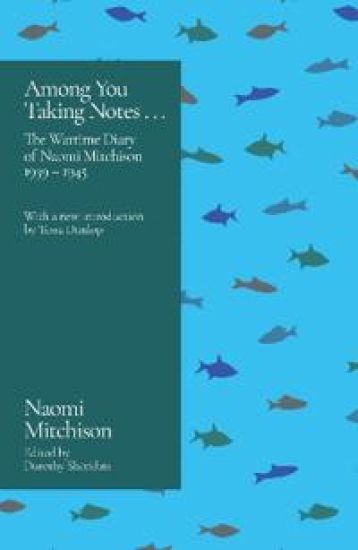
Among You Taking Notes...

Among You Taking Notes...

Naomi Mitchison

ORION PUBLISHING CO
2022
pokkari
'As in a good novel, the people, their feelings and reactions are instantly recognisable and as fresh and immediate today as they were then' GUARDIAN'She writes vividly and movingly' DAILY TELEGRAPH26th September 1939. I am beginning to wonder whether the point of a place like this may be that it will keep alive certain ideas of freedom which might easily be destroyed in the course of this totalitarian war...Born in Edinburgh, Naomi Mitchison spent most of the Second World War in the fishing village of Carradale on Kintyre, her home until her death aged 101. Her life was crowded with incident, and her attitudes to events predictably forceful, original and honest.Throughout the war she kept a diary at the request of the research organisation Mass Observation, in which she recorded both the momentous events of the time, and also how one (albeit extraordinary) family and their friends lived, what they hoped for and what actually happened. Her diaries developed far beyond the confines of a social document.Written with the passion of a poet combined with the intellectual curiosity of a radial thinker, they provide a unique and valuable document of the period.
Barbarian Stories, with The Hostages, and Boys and Girls and Gods
This volume brings together the stories from Barbarian Stories, published in 1929, The Hostages (1930) and Boys and Girls and Gods (1931). They are: The barley field, Steague Fort, Niempsor Kar, A matter of no importance, Arminius in the cherry tree, Mascaret, Laeta, The amphitheatre at Pola, 'I'm a Business Man', The Konung of white walls, 'Oh gay are the garlands ', The goat, Nuts in May, The Hostages, A Little Girl Lost, Cottia went to Bibracte, Quintus getting well, Maiden Castle, In patria potestate, Bread and water, The first breaking of England, The Prince, The founding of the new city, The war ship sails, To the glory of Ashur, The first morning, The saving of Cyrus, The lady of the city, At Plane-Tree Grove, Over the hills and far away, and The garden of Epicuros.
What Do You Think Yourself? with A Girl Must Live
This volume contains the short stories and poems from What Do you Think Yourself?, published in 1982, and A Girl Must Live, published in 1990.From What Do You Think Yourself? they are: Orkney Story; The Black Jacket; The Sea Horse; The Hill Modipe; The Red Fellows; The Warning; Call Me; The Return; What Do You Think Yourself?; Social Readjustment; Should We Believe Postie?; Interview; and Remember Me/ From A Girl must Live. they are: A Girl Must Live; Nagli's First Princess; Endangered Species; Out of the West; The Son's Story; Telling to the Master; Nobody likes a Refugee; The Money They Must Have Spent; Death of a Peculiar Boar; If A Thing Can Be Done Once; A Little Old Lady; A Matter of Behaviour; Thirty Pieces; The Child Jason is brought to Chiron; Valley of the Kings; Siren Night; London Burning; Comfort; The Talking Oats; Buganda History; Absence of Indians; Mary and Joe; Take-over; Far from Millicentral Station; Miss Omega Raven; The Factory; Like It Was; After the Accident; Out of the Deeps; The Valley of Bushes; Somewhere Else; Conversation with an Improbable Future; What Kind of Lesson?; One Couldn't Tell the Papers; and Rat-World.
When the Bough Breaks with Black Sparta

When the Bough Breaks with Black Sparta

Naomi Mitchison

Zeticula Ltd
2022
pokkari
This volume brings together the stories and poems from When the Bough Breaks, published in 1924, and Black Sparta, published in 1928. They are: A Sophist in love; 'A wood near Athens'; Arrow-struck; Babes in the wood; Black Sparta; Charilas, in exile, remembers Sparta; Coming into the bay; Cottia went to Bibracte; Got to put up with it now; Krypteia; O Lucky Thessaly ; Peace; Philist 's weaving song; Plutarch, in a letter to his brother Lamprias; Professor Whitehead and the poets; Pythian XI; Song; Sophrosyne Castle; Take back your bay wreath; The child Jason is brought to Chiron; The Chosen-by-lot; The epiphany of Poie ssa; The exiled oligarchs are driven out of the city; The heart and the head; The highbrow; The Hostages; The lamb misused; The Man from Alesia; The story of Myrto; The Triumph of Faith; Things without remedy; When the Bough Breaks; 'Who will you have for nuts in May?; Wise Diotima.
To the Chapel Perilous

To the Chapel Perilous

Naomi Mitchison

Zeticula Ltd
2021
nidottu
In his 1999 Introduction to the first reprint of this novel from 1955 - a year of the Cold War that began with the Baghdad Pact and ended with the official start of the Vietnam War - Raymond H. Thompson described Naomi Mitchison's contribution to the Arthurian tradition as 'not only a comic masterpiece, but a guidebook into spiritual growth'. She achieves this by drawing on her own experience as a journalist to explore the fantastic events surrounding King Arthur and the Holy Grail through the eyes of two young reporters - on competing newspapers, with mid-twentieth century values and skills - as they follow the breaking stories and conflicting accounts of the grail quest. Michael Amey, who writes the Introduction to this new edition, points out that her approach was not universally liked by her fellow writers. Tolkien for one objected to her introduction of 'a curious and disturbing blend' of journalists and 'dwarfs with photographic apparatus'. Amey himself argues that To the Chapel Perilous is in name and fact a 'call to adventure' in which Mitchison sets out 'to tell a story of how stories are told'.
The Oath-Takers, and Sea-Green Ribbons

The Oath-Takers, and Sea-Green Ribbons

Naomi Mitchison

Zeticula Ltd
2021
nidottu
'We story-tellers have a delightful time playing with history, perhaps finding something fascinating, perhaps making dreadful mistakes.' Here, in The Oath-Takers, the 'central maypole round which the people ... must swing and fall' is Charlemagne, and one of 'the people' a young man who makes his journey to manhood in a world of feudalism and a powerful Church. In the second short novel, Sea-Green Ribbons, the reader enters the political, religious and social tumult of the English Civil War through the story and choices of a young woman, Sarah, from a radical Leveller family in London.
Other People's Worlds, and Mucking Around

Other People's Worlds, and Mucking Around

Naomi Mitchison

Zeticula Ltd
2021
pokkari
In 1957, Naomi Mitchison enjoyed two months 'of observation and thought' as she travelled in parts of postcolonial West Africa. She was the guest of friends new and old and, in Ghana, stayed at the Press Hotel, in her then role as a correspondent with The Manchester Guardian. Her reflections are presented in chapters - on social bars and classes, language, words, history, religion, morals, education, politics, clothes, art and music - as she pulls together her view of the ways in which 'Other People's Worlds', at different stages of development, impact on one another. 'Perhaps', she concludes, 'it is really everyone's world'. Fasten your seat belts, for the delights of Naomi Mitchison's 1981 overview of her travel writing from the 1920s onwards. Drawn from her writings as an author, journalist, letter writer and diarist 'Mucking Around. Five Continents over Fifty Years' is the memoir of an enthusiastic traveller and outspoken observer of 'other countries' - that is, countries across the world as visited from Scotland. The accounts are divided into four sections or bearings: South-West-by-North, West-by-East, East-by-South-East and South.
Early in Orcadia

Early in Orcadia

Naomi Mitchison; Isobel Murray

Zeticula Ltd
2021
nidottu
Early in Orcadia was first published in 1987, and consists of five stories, set hundreds of years apart in time and dealing with different characters, but connected by their location in a particular corner of Orkney during the period known as the Stone Age. Mitchison links them formally by interpolating passages of fact and explanation between the fictional episodes, and by speculating in her own voice about what happened in prehistory, as far as it can be known from archaeological research, and how it fits in with the world of today. The slightly awkward jumps from one story to the next indicate that the development of the human race was not a completely smooth and seamless process. There must have been significant moments when a highly important discovery or invention took place. The structure of the book is demonstrating its theme - that there are sudden advances but just one story running from the earliest times to the present day, and it is the story of humankind. From the Introduction.
Five Men and a Swan

Five Men and a Swan

Naomi Mitchison

Zeticula Ltd
2021
nidottu
This collection, which Naomi Mitchison published in 1957, is recognisably a 'Carradale book', containing as it does vivid and realistic stories and poems of the landscape and the people. Mitchison had moved to the village in Kintyre, on the west coast of Scotland, some twenty years before and was still much involved in its affairs, supporting the fishing fleet and running her own small farm. Yet, as Moira Burgess suggests in her Introduction to this new edition, these thirteen stories and fourteen interspersed short poems and songs do not make a straightforward, celebratory, collection. The first five stories have historical settings in Caithness and Orkney, with the rest set in the contemporary West Highlands - some drawing on Highland myth and legend. And then, as Burgess writes, 'tucked modestly and apparently at random' is 'Five Men and a Swan' - 'a fine story, probably her best, a classic of Scottish literature'. Mitchison's years of intense involvement with the community were in fact drawing to an end. From the early 1960s onwards, she applied her energy and enthusiasm to the cause of the Bakgatla tribe in the newly independent country of Botswana. Her writing would turn to African themes, and, in 'a marvellous late flourish', to science fiction. Seen in this light, the book may be not so much a celebration as a coda to Mitchison's Carradale years.
The Fourth Pig

The Fourth Pig

Naomi Mitchison

Princeton University Press
2019
pokkari
An enchanting collection that introduces the author and activist Naomi Mitchison to a new generation of readersThe Fourth Pig, originally published in 1936, is a wide-ranging collection of fairy tales, poems, and ballads that reflect the hopes and forebodings of their era but also resonate with those of today. From a retelling of “Hansel and Gretel” to the experimental title story, a dark departure from “The Three Little Pigs,” this book is a testament to the talents of Naomi Mitchison (1897–1999), who was an irrepressible phenomenon—a prominent Scottish political activist as well as a prolific author. Mitchison’s work, exemplified by the tales in this superb new edition, is stamped with her characteristic sharp wit, magical invention, and vivid political and social consciousness. Marina Warner, the celebrated scholar of myths and fairy tales and writer of fiction, provides an insightful introduction to Mitchison as a remarkable writer and personality.
The Bull Calves

The Bull Calves

Naomi Mitchison

Kennedy And Boyd
2013
pokkari
"The Bull Calves" was researched and written during the Second World War. This is very surprising, as Naomi Mitchison was tremendously busy at her home in Carradale, Kintyre, keeping open house for evacuees and refugees, running the farm and driving the tractor, organising the local Labour Party, and writing and producing for the dramatic society - and so on. She also wrote a diary for Mass Observation, of more than a million words. But she had to take her time with the novel and plan it more carefully than she usually had time for. She wanted to give Scotland and the world a message, of the need for peace and working together after a bitter war. She chose to write about the aftermath of the Jacobite rising of 1745, and set her novel at Gleneagles, on the Highland line, with her characters her own ancestors. A very personal prefatory poem indicates that the whole operation was very close to her heart, and the ensuing novel is her best historical novel, and still topical today. With an Introduction by Isobel Murray.
We Have Been Warned

We Have Been Warned

Naomi Mitchison

Kennedy And Boyd
2012
pokkari
This is Naomi Mitchison's least successful novel, and new readers should not start here! It is shaped by her own life and fears in her own experience in 1931, and is the first of her novels and stories not to have a historical setting. Mitchison was appalled by the rise of fascism in Germany and Italy, and wanted to warn the world. She was rather dismayed by the results of the Russian Revolution, of which she had once had great hopes. She also poured all her most personal feelings into the novel, and covered a plethora of subjects - not only free love, abortion and rape, but the unmentionable discussion of marital infidelity, trouser buttons and rubber goods. Her own love life was so complex that she divided it between two sisters in the novel! It spent two years being censored by the publisher while she championed it, but it was crowded, over-written, hectic and unbalanced. It is poor, but Mitchison-lovers will find it impossible to put down. Isobel Murray is Emeritus Professor of Modern Scottish Literature at the University of Aberdeen
The Delicate Fire

The Delicate Fire

Naomi Mitchison

Kennedy And Boyd
2012
pokkari
The Delicate Fire illustrates a fundamental change in Naomi Mitchison's work. The early stories are set in ancient Greece, like many before them. But here Mitchison effectively says farewell to that setting with accounts of the worlds of Sappho and 'Lovely Mantinea'. By the end, she seems wholly turned to the twentieth century - a new departure for her - tackling subjects such as the General Strike of 1926 and contemporaneous Hunger marches, and battles against censorship. This shift marks her politicisation, her growing fear of fascism, but more personally also the end of her long affair with a distinguished scholar of the ancient world. She turns away from Greece for good. She turns to the present, and will spend the thirties warning against fascism. Isobel Murray is Emeritus Professor of Modern Scottish Literature at the University of Aberdeen
Memoirs of a Spacewoman

Memoirs of a Spacewoman

Naomi Mitchison

Kennedy And Boyd
2011
pokkari
Naomi Mitchison, daughter of a distinguished scientist, sister of geneticist J B S Haldane, was always interested in the sciences, especially genetics. Her novels did not tend to demonstrate this, and she did not publish a Science Fiction novel until almost forty years into her fiction-writing career. Isobel Murray's Introduction here argues that it is by no means 'pure' Science Fiction: the success of the novel depends not only on the extraordinarily variety of life forms its heroine encounters and attempts to communicate with on different worlds: she is also a very credible human, or Terran, with recognisibly human emotions and a dramatic emotional life. This novel works effectively for readers who usually eschew the genre and prefer more traditional narratives. Explorers like Mary are an elite class who consider curiosity to be Terrans' supreme gift, and in the novel she more than once takes risks that may destroy her life. Her voice, as she records her adventures and experiments, is individual, attractive and memorable. Isobel Murray is Emeritus Professor of Modern Scottish Literature at the University of Aberdeen.
Cloud Cuckoo Land

Cloud Cuckoo Land

Naomi Mitchison

Kennedy And Boyd
2011
pokkari
Ancient Greek history and politics fascinated Naomi Mitchison, and in particular the long antagonism or rivalry of Athens and Sparta. In this, her second novel, she investigates the two city states through Alxenor, a young man from the tiny island of Poieessa, which changes hands as the balance of power changes. He does not choose his loyalty in a theoretical way, but as he experiences rough treatment from both. By Alxenor's day, Athens had declined from the golden age of Perikles, and the city was prone to bully smaller entities, but he is forced to recognise the much worse reality of Spartan civilisation, with iron discipline, cruelty and loss of individuality. Eventually, Mitchison came to see even the twentieth century in terms of struggles between Athens and Sparta, democracy and totalitarianism. Isobel Murray is Emeritus Professor of Modern Scottish Literature at the University of Aberdeen.