Kirjojen hintavertailu. Mukana 12 390 323 kirjaa ja 12 kauppaa.

Kirjailija

Omar Khayyam

Kirjat ja teokset yhdessä paikassa: 116 kirjaa, julkaisuja vuosilta 1889-2026, suosituimpien joukossa Rubaiyât D'omar Khàyyâm. Vertaile teosten hintoja ja tarkista saatavuus suomalaisista kirjakaupoista.

Mukana myös kirjoitusasut: Omar Khayyám, Omar Khayyàm, Omar Khàyyâm

116 kirjaa

Kirjojen julkaisuhaarukka 1889-2026.

Khayyam's Tent

Khayyam's Tent

Omar Khayyam

Okcir Press (Imprint of Ahead Publishing House)
2025
pokkari
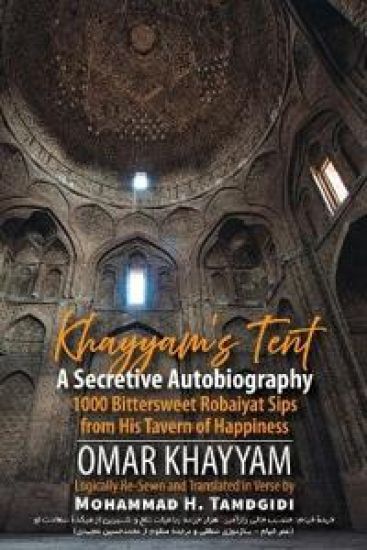
This book offers the original Robaiyat of Omar Khayyam (AD 1021-1123) as a tent of 1000 logically sewn quatrains serving the poetic Wine of his secretive autobiography. It is an epic, at once a personal, world-historical, and cosmic search for true human happiness. He composed it to be highly readable so that it can be read by all, continually, and today, before it is too late, like a prayer book or a rosary of pearls or ruby stones, since it was meant to be not only reflective but also generative of search for happiness. If you begin reading it, you must do so at least once to its end, so that in later readings any of its parts can be recalled amid the unitary architecture of its philosophical, spiritual, and scientific wisdom rendered as an astounding and most beautiful work of art. Khayyam was right; there is nothing on Earth like his Wine.His poetic "book of life" was intended to be released posthumously, so its existence was not known to his contemporaries. Following his death, it was released but became scattered and its logical unity was shattered by natural and social disasters and scribal poetry alphabetizing styles, some quatrains wandering into other poets' works and others becoming misattributed to him. The Robaiyat as shared in this book were logically re-sewn and newly translated in verse by the sociologist Mohammad H. Tamdgidi during his integrative study of all of Khayyam's works as reported in his unprecedented 12-book series Omar Khayyam's Secret: Hermeneutics of the Robaiyat in Quantum Sociological Imagination (2021-2025). Following a summary of his series' findings, Tamdgidi presents in this book nothing else but Khayyam's Robaiyat, including the Persian originals and his verse translations (his study of them having been shared in his series, especially its Books 8-11). The poems, comprising songs of doubt, hope, and joy, are logically organized to address three questions, based on the 3-phased method of inquiry Khayyam himself introduced in his other writings.Quatrains 1-338 of Part 1, Songs of Doubt, open by explaining his epic's secretiveness and address the question "Does Happiness Exist?" Their order follows a logically inductive reasoning through which Khayyam delves from surface portraits of unhappiness to their deeper chain of causes. Quatrains 339-685 of Part 2, Songs of Hope, address the second question "What Is Happiness?" Their order follows a logically deductive reasoning through which he moves from methodological to explanatory and practical quatrains. Quatrains 686-1000 of Part 3, Songs of Joy, address the third question "Why Can Happiness Exist?" Still deductively ordered, they show how happiness can be made possible through his poetry's Wine itself, realizing that one can never become truly happy by bringing sadness to others since human self and society are always twin-born and universal. Hurting another is always a hurting of that self in you that represents that other. For Khayyam, happiness can be possible by way of joyful, creative, and constructive humanizing efforts by own example, like his Robaiyat, which must also start from our inner and interpersonal todays and spread globally.Khayyam's Robaiyat represented the tent of which he was a "tentmaker," his poetic pen name having been inspired by his true birth date horoscope chart as discovered by Tamdgidi and reported in his series for the first time. The metaphor also underlies the numerical geometry of its triangular unity, proportional to the dazzling Grand Tent (Triplicity) features of his birth chart, the same way he embedded his own triangular golden rule in the mysterious design of Isfahan's North Dome. A metaphor of the Robaiyat as Simorgh (or Phoenix) songs is also hidden in its deep structure. Khayyam's Robaiyat are his Simorgh's millennial rebirth songs served in his tented tavern as 1000 sips of his bittersweet poetic Wine of happiness.
Khayyam's Tent

Khayyam's Tent

Omar Khayyam

Okcir Press (Imprint of Ahead Publishing House)
2025
sidottu
This book offers the original Robaiyat of Omar Khayyam (AD 1021-1123) as a tent of 1000 logically sewn quatrains serving the poetic Wine of his secretive autobiography. It is an epic, at once a personal, world-historical, and cosmic search for true human happiness. He composed it to be highly readable so that it can be read by all, continually, and today, before it is too late, like a prayer book or a rosary of pearls or ruby stones, since it was meant to be not only reflective but also generative of search for happiness. If you begin reading it, you must do so at least once to its end, so that in later readings any of its parts can be recalled amid the unitary architecture of its philosophical, spiritual, and scientific wisdom rendered as an astounding and most beautiful work of art. Khayyam was right; there is nothing on Earth like his Wine.His poetic "book of life" was intended to be released posthumously, so its existence was not known to his contemporaries. Following his death, it was released but became scattered and its logical unity was shattered by natural and social disasters and scribal poetry alphabetizing styles, some quatrains wandering into other poets' works and others becoming misattributed to him. The Robaiyat as shared in this book were logically re-sewn and newly translated in verse by the sociologist Mohammad H. Tamdgidi during his integrative study of all of Khayyam's works as reported in his unprecedented 12-book series Omar Khayyam's Secret: Hermeneutics of the Robaiyat in Quantum Sociological Imagination (2021-2025). Following a summary of his series' findings, Tamdgidi presents in this book nothing else but Khayyam's Robaiyat, including the Persian originals and his verse translations (his study of them having been shared in his series, especially its Books 8-11). The poems, comprising songs of doubt, hope, and joy, are logically organized to address three questions, based on the 3-phased method of inquiry Khayyam himself introduced in his other writings.Quatrains 1-338 of Part 1, Songs of Doubt, open by explaining his epic's secretiveness and address the question "Does Happiness Exist?" Their order follows a logically inductive reasoning through which Khayyam delves from surface portraits of unhappiness to their deeper chain of causes. Quatrains 339-685 of Part 2, Songs of Hope, address the second question "What Is Happiness?" Their order follows a logically deductive reasoning through which he moves from methodological to explanatory and practical quatrains. Quatrains 686-1000 of Part 3, Songs of Joy, address the third question "Why Can Happiness Exist?" Still deductively ordered, they show how happiness can be made possible through his poetry's Wine itself, realizing that one can never become truly happy by bringing sadness to others since human self and society are always twin-born and universal. Hurting another is always a hurting of that self in you that represents that other. For Khayyam, happiness can be possible by way of joyful, creative, and constructive humanizing efforts by own example, like his Robaiyat, which must also start from our inner and interpersonal todays and spread globally.Khayyam's Robaiyat represented the tent of which he was a "tentmaker," his poetic pen name having been inspired by his true birth date horoscope chart as discovered by Tamdgidi and reported in his series for the first time. The metaphor also underlies the numerical geometry of its triangular unity, proportional to the dazzling Grand Tent (Triplicity) features of his birth chart, the same way he embedded his own triangular golden rule in the mysterious design of Isfahan's North Dome. A metaphor of the Robaiyat as Simorgh (or Phoenix) songs is also hidden in its deep structure. Khayyam's Robaiyat are his Simorgh's millennial rebirth songs served in his tented tavern as 1000 sips of his bittersweet poetic Wine of happiness.
The Quatrains of Omar Khayyam of Nishapur; Translated From the Persian Into English Verse Including Quatrains Now for the First Time so Rendered
This edition presents a collection of "The Quatrains of Omar Khayyam of Nishapur" translated from the Persian into English verse. It includes quatrains rendered into English for the first time. Omar Khayyam, the renowned Persian polymath, is celebrated for his profound and contemplative verses that explore themes of life, death, fate, and the ephemeral nature of existence. This translation seeks to capture the essence and beauty of Khayyam's original work, offering readers a glimpse into the rich literary and philosophical traditions of Persia. The quatrains offer enduring wisdom and continue to resonate with readers seeking deeper meaning in the human experience. This work has been selected by scholars as being culturally important, and is part of the knowledge base of civilization as we know it. This work was reproduced from the original artifact, and remains as true to the original work as possible. Therefore, you will see the original copyright references, library stamps (as most of these works have been housed in our most important libraries around the world), and other notations in the work. This work is in the public domain in the United States of America, and possibly other nations. Within the United States, you may freely copy and distribute this work, as no entity (individual or corporate) has a copyright on the body of the work. As a reproduction of a historical artifact, this work may contain missing or blurred pages, poor pictures, errant marks, etc. Scholars believe, and we concur, that this work is important enough to be preserved, reproduced, and made generally available to the public. We appreciate your support of the preservation process, and thank you for being an important part of keeping this knowledge alive and relevant.
Omar Khayyam

Omar Khayyam

Peter Laugesen; Rasmus Christian Elling; Omar Khayyam

Bangsbohave
2025
nidottu
Hele verden anser i dag Omar Khayyam (1047/1048 - 1124/1131) som en af den persiske poesis store mestre. Det er første gang siden 1920, hvor Arthur Christensen oversatte hans digte, at Omar Khayyam er blevet oversat direkte fra persisk til dansk i et unikt og tæt samarbejde mellem digter Peter Laugesen og ph.d. i Iran-studier og lektor Rasmus Christian Elling, som også har bidraget med et efterord, der giver læseren en grundig indføring i den persiske digter. 33 digte af Omar Khayyam er Forlaget Bangsbohaves anden bog i serien af nyoversat persisk poesi. Første bog i serien var Hafez – fra vinhus til paradis, 2022.
The Sufism of the Rubáiyát, or, the Secret of the Great Paradox
The Sufism of the Rub iy t, or, the Secret of the Great Paradox, stands as a beacon in the world of books, bridging the gap between past and present. Once considered among the old books, this classic work-like so many forgotten and ancient books-has shaped our understanding of culture and history. It's a remarkable example of history books that have influenced generations, and now, through the dedication of Alpha Editions-your trusted book publisher-it's reborn in a fresh, elegant format. We've carefully retyped, redesigned, and improved this book so it's much more than just another title to read. Now you can enjoy clear, easy-to-read pages without any blurry scans or faded text. By choosing this edition, you're investing in more than a book-you're safeguarding a legacy. Your support keeps a remarkable piece of human heritage alive, ensuring its lessons and inspirations continue to resonate well into the future.
Rubaiyat of Omar Khayyam

Rubaiyat of Omar Khayyam

Omar Khayyam

ORION PUBLISHING CO
2023
pokkari
The best-loved, bestselling poem ever published - a poem that embraces the theme 'seize the moment''One thing is certain, that Life flies; One thing is certain, and the Rest is Lies'The epic, beautiful poem Rubaiyat is widely attributed to Omar Khayyam. As much a philosopher as a poet, he was a Persian astronomer, who praised the beauties of nature, the essence of love, the mysteries of existence, the limits of private life and the joys of wine.Translated in 1857 by Edward Fitzgerald it was originally published in English anonymously, but was later discovered and promoted by the Pre-Raphaelites, who would have emphathised with many of the poem's themes.Published here as part of the Great Poets series, it is without doubt one of the greatest works of literature of all time.
Rubaiyat

Rubaiyat

Omar Khayyam

Garnier Editora
2023
nidottu
Nascido em 1040 em Nichapur, na P rsia, mesma cidade em que morreu em 1120, o poeta Omar Ibn Ibrahim El Khayym foi, tamb m, astr nomo e matem tico. Rubaiy t, plural da palavra rubai, significa quadras, ou quartetos, nos quais o primeiro, o segundo e o quarto versos s o rimados e o terceiro branco. Muita gente, no Brasil e no mundo, traduziu esses versos de Khayym, mas a Edi o p e nas livrarias resultado de um longo, dedicado e minucioso trabalho do tradutor Jo o Baptista de Mello e Souza (1888-1969), que finalizou sua rdua tarefa em 1959 mas n o p de v -la publicada.