

Kirjailija
Pierre Bourdieu
Kirjat ja teokset yhdessä paikassa: 140 kirjaa, julkaisuja vuosilta 1964-2026, suosituimpien joukossa Free Exchange. Vertaile teosten hintoja ja tarkista saatavuus suomalaisista kirjakaupoista.
140 kirjaa
Kirjojen julkaisuhaarukka 1964-2026.

In this book, leading social thinker Pierre Bourdieu and the artist Hans Haacke discuss contemporary art and the relations between art, politics and society. Their dialogue ranges widely from censorship and obscenity to the social conditions of artistic creativity, and focusses on the central themes in the work of both authors.

Ökonomisches Kapital, kulturelles Kapital, soziales Kapital
Pierre Bourdieu
Reclam Philipp Jun.
2026
pokkari
Has the revolution that led from the economy of the gift, characteristic of most precapitalist societies, to the economy of modern societies been accomplished in all spheres of life, as tacitly assumed by those who claim to apply the model of the profit-optimizing agent to every practice – to art, to education and even to marriage, seen as an exchange of economic services of production and reproduction? And is it totally accomplished even at the heart of the sphere most directly concerned with economic activity – the world of business? These and many other questions are absent from the dominant economic theories, which fail to take account of the economic and social conditions under which economic agents and their universe arise. In his lectures at the Collège de France in 1987-89, Pierre Bourdieu laid bare the assumptions of the imaginary anthropology that underlies economics in its dominant form and put forward an alternative view. He replaced the notion of a pure and perfect market with the notion of an economic field structured by the unequal distribution of different forms of capital and by relations of force and symbolic struggle. He replaced homo economicus – that sovereign individual with no qualities or qualifications other than a capacity for rational calculation – with an agent endowed with enduring dispositions, fashioned by social background and experience, both individual and collective. And thus, without having to appeal to a perfectly lucid calculating mind or to the logic of bounded rationality, he was able to account for the alignment of subjective expectations and objective opportunities that confers on the great majority of economic behaviour its 'reasonable' character. Bourdieu's trenchant critique of dominant economic thought and his development of an alternative way of understanding economic activity, rooted in his notion of field and his theory of practice, will be of great interest to students and scholars in anthropology, sociology, economics and throughout the social sciences and humanities.

While Bourdieu’s work on cultural production, the reproduction of inequality and the rise of the modern state is well known, his writings on the phenomena of internationalization and imperialism have received much less attention. Bourdieu’s analyses of the international circulation of ideas and the imperialisms of the universal – where two political powers, such as the United States and France, clash on matters of cultural legitimacy – generated multiple research programmes on topics ranging from translation and scientific exchange to global economic policy. The constitution of globalized domains where national problems like unemployment, ethnicity and poverty are subjected to international import-export processes serves to naturalize the dominant vision of dominant countries and impose it on national political contexts. Freedom, democracy and human rights have been constituted as universal values and some countries claim to embody these values more than others. However, historical analysis shows that things are not so simple and that the actual content given to these values does not necessarily have the universality they claim. For example, the claim to universality of past colonial or imperial policies arouses suspicion in the eyes of some, to the point of calling into question the very idea of universality. But it is possible to move beyond the alternative between, on the one hand, a naïve belief in universality and, on the other, a disenchanted relativism that sees the universal as nothing more than a disingenuous way to legitimize particular interests. Bourdieu argues that the theory of fields enables us to move beyond this alternative by showing that the struggle for the universal can produce its own forms of universality that transcend particular interests. This volume of Bourdieu’s writings on internationalization, imperialism and the struggle for the universal will be of interest to students and scholars in sociology, anthropology, politics and the social sciences and humanities generally.
While Bourdieu’s work on cultural production, the reproduction of inequality and the rise of the modern state is well known, his writings on the phenomena of internationalization and imperialism have received much less attention. Bourdieu’s analyses of the international circulation of ideas and the imperialisms of the universal – where two political powers, such as the United States and France, clash on matters of cultural legitimacy – generated multiple research programmes on topics ranging from translation and scientific exchange to global economic policy. The constitution of globalized domains where national problems like unemployment, ethnicity and poverty are subjected to international import-export processes serves to naturalize the dominant vision of dominant countries and impose it on national political contexts. Freedom, democracy and human rights have been constituted as universal values and some countries claim to embody these values more than others. However, historical analysis shows that things are not so simple and that the actual content given to these values does not necessarily have the universality they claim. For example, the claim to universality of past colonial or imperial policies arouses suspicion in the eyes of some, to the point of calling into question the very idea of universality. But it is possible to move beyond the alternative between, on the one hand, a naïve belief in universality and, on the other, a disenchanted relativism that sees the universal as nothing more than a disingenuous way to legitimize particular interests. Bourdieu argues that the theory of fields enables us to move beyond this alternative by showing that the struggle for the universal can produce its own forms of universality that transcend particular interests. This volume of Bourdieu’s writings on internationalization, imperialism and the struggle for the universal will be of interest to students and scholars in sociology, anthropology, politics and the social sciences and humanities generally.
This slim volume contains four little-known texts by Pierre Bourdieu on the question of reflexivity, which was a key theme in his work. For Bourdieu, reflexivity was not an exercise in introspection but rather a way of applying the tools of sociology to itself. The aim is to make explicit and control the effects of the presuppositions, standpoints and dispositions that the researcher brings to the conduct of social science research. Bourdieu advocates an attitude of epistemological vigilance that helps to uncover the invisible effects of the social determinants that weigh on the researcher, effects that are difficult to perceive by the mere desire to be lucid. Questioning the social position and presuppositions of the researcher at every opportunity loosens the hold of scholastic and other biases on the outcome of research. By clarifying and illustrating the principles of reflexivity, the four texts in this volume lay the groundwork for the kind of reflexive social science that Bourdieu practised and advocated throughout his career.
This slim volume contains four little-known texts by Pierre Bourdieu on the question of reflexivity, which was a key theme in his work. For Bourdieu, reflexivity was not an exercise in introspection but rather a way of applying the tools of sociology to itself. The aim is to make explicit and control the effects of the presuppositions, standpoints and dispositions that the researcher brings to the conduct of social science research. Bourdieu advocates an attitude of epistemological vigilance that helps to uncover the invisible effects of the social determinants that weigh on the researcher, effects that are difficult to perceive by the mere desire to be lucid. Questioning the social position and presuppositions of the researcher at every opportunity loosens the hold of scholastic and other biases on the outcome of research. By clarifying and illustrating the principles of reflexivity, the four texts in this volume lay the groundwork for the kind of reflexive social science that Bourdieu practised and advocated throughout his career.
This is the third of five volumes based on the lectures given by Pierre Bourdieu at the Collége de France in the early 1980s under the title General Sociology. In these lectures, Bourdieu sets out to define and defend sociology as an intellectual discipline; in doing so he introduces and clarifies all the key concepts for which he has become so well known, concepts that continue to shape the way that sociology is practised today. In this volume, Bourdieu focuses on one of these key concepts, capital, which forms part of the trilogy of concepts – habitus, capital, field – that define the core of his theoretical approach. A field, as a social space of relatively durable relations between agents and institutions, is also a site of specific investments, which presupposes the possession of specific forms of capital and secures both material and symbolic profits. While there are many different forms of capital, two are fundamental and effective in all social fields: economic capital and cultural capital. These and other forms of capital exist only in relation to the fields in which they are deployed: the distribution of the forms and quantities of capital constitutes the structure of the field within which agents act and they confer power over the field, over the mechanisms that define the functioning of the field and over the profits engendered in the field – over, for example, the transmission of cultural capital in the educational system. An ideal introduction to one of Bourdieu’s most important concepts, this volume will be of great interest to the many students and scholars who study and use Bourdieu’s work across the social sciences and humanities, and to general readers who want to know more about the work of one of the most important sociologists and social thinkers of the twentieth century.

A key feature of those who work for the state, in the legal system and in public services is that they claim to be putting their own personal interests aside and working in a disinterested fashion, for the public good. But is disinterested behaviour possible? Can law be treated as a set of universal rules that are independent of particular interests, or is this mere ideology? Is the state bureaucracy a universal class, as Hegel thought, or a structure that serves the interests of the dominant class, as Marx claimed?In his lecture courses at the Collège de France in 1987–88 and 1988–89, Pierre Bourdieu addressed these questions by examining the formation of the legal and bureaucratic fields characteristic of the modern state, uncovering the historical and social conditions that enable a social group to form and find its own interests in the very fact of serving interests that go beyond it. For a disinterested universe to emerge, it needs both the invention of a public service, or a spirit of service to the public cause, and the creation of a social universe in which individuals can pursue a career devoted to public service and be rewarded for it. In other words, it requires a process of specialization whereby autonomous, specific fields become established in the social cosmos within which a special kind of game that follows the rules of disinterest can be played out.By reconstructing the conditions under which an interest in disinterestedness emerged, Bourdieu sheds new light on the formation of the modern state and legal system and provides a fresh perspective on the many professions in modern societies that are oriented towards the service of the common good.

Vom Rheintal ins Engadin: Das obere Rheintal zwischen Bad Ragaz und Chur. Im Hotel ?Weisskreuz? zaubert der Patron ?Bündnerfleisch-Torte?. ?Urchig? wird`s in Lenzerheide, wo es im ?Guarda Val? Carpaccio vom Kalbsschwanz gibt. Das Rezept der Bündener Nusstorte wird in Davos verraten. Der ?Capuns Walserhuus? wird im gleichnamigen Lokal serviert. Im Heudampf wird ein Lammrücken gegaart. Wo? Im ?Stüvetta Veglia? bei St. Moritz natürlich. Vom Engadin an den Lago Maggiore: Die ?Chesa Pirani? bei St. Moritz glänzt mit zwei Michelin-Sternen. Der Maloja-Pass führt ins Bergell. Im ?Albergo? Corona? zaubert Aldo Petti Hirschgeschnetzeltes mit Pappardelle. Sehr gut schmeckt das Gams-Rückenfilet mit Polenta-Talern im Hotel ?Cacciatore? in Soazza. Über Bellinzona geht es nach Ascona am Lago Maggiore mit Egli-Filets auf Pilz Risotto.



El Oficio de Sociólogo: Presupuestos Epistemológicos (Tercera Edición)
Pierre Bourdieu
Siglo MX
2023
nidottu
El " oficio" de soci logo es exactamente eso: una teor a de la construcci n sociol gica del objeto convertida en habitus. Poseer ese oficio es saber que, para tener una posibilidad de construir el objeto, hay que volver expl citos los supuestos, o incluso que lo real es relacional, que lo que existe son las relaciones, vale decir, algo que no se ve, a diferencia de los individuos o los grupos. Tomemos un ejemplo. Yo tengo el proyecto de estudiar las grandes escuelas. Ante todo, al decir " las grandes escuelas", ya hice una elecci n decisiva... A partir del momento en que digo que el objeto construido es el conjunto de las grandes escuelas, estoy frente a miles de problemas: por ejemplo, estad sticas no comparables. Y me expongo a parecer como menos cient fico que aquellos que se atienen al objeto aparente: tan grandes son las dificultades que hay que superar para captar emp ricamente el objeto construido. Pienso que nadie tiene ganas de ver el mundo social tal cual es; hay varias maneras de negarlo; est el arte, evidentemente. Pero hay incluso una forma de sociolog a que alcanza ese resultado extraordinario, hablar del mundo social como si no se hablara de l: es la sociolog a formalista, que interpone entre el investigador y lo real una pantalla de ecuaciones, por lo general mal construidas. Cuando se quiere huir del mundo tal y como es, uno puede ser m sico, puede ser fil sofo, puede ser matem tico. Pero c mo huir de l siendo soci logo? Para lograr ver y hablar del mundo tal cual es, hay que aceptar estar siempre en lo complicado, lo confuso, lo impuro, lo vago, etc., e ir as contra la idea com n del rigor intelectual.
This is the fifth and final volume based on the lectures given by Pierre Bourdieu at the Collège de France in the early 1980s under the title ‘General Sociology’. In these lectures, Bourdieu sets out to define and defend sociology as an intellectual discipline, and in doing so he introduces and clarifies all the key concepts which have come to define his distinctive intellectual approach. In this volume, Bourdieu develops his view of the social world as the site of a struggle for the legitimate vision of the world. The specific weapon used in these struggles is what Bourdieu calls symbolic capital, which is economic, cultural or social capital when perceived through suitable categories of perception. All forms of power seek to impose their own categories of perception in a way that is both recognised and misrecognised. This is how forms of power establish themselves as legitimate, because legitimacy is a force of recognition based on misrecognition, that is, recognised in a way that prevents us from recognising its arbitrariness. By rejecting the opposition between structuralist objectification and subjectivist constructivism, sociology can seek to grasp both the objective structure of social fields and the properly political strategies that agents use in order to establish and impose their viewpoint. And it can do so without forgetting that the whole world of social construction is oriented by the perception agents have of the social world, which depends on their position in the structures of social fields and their dispositions, themselves fashioned by these structures. An ideal introduction to some of Bourdieu’s most important ideas, the five volumes of this series will be of great value to students and scholars who study and use Bourdieu’s work across the social sciences and humanities, and they will be of interest to general readers who want to know more about the work of one of the most important sociologists and social thinkers of the twentieth century.

This is the second of five volumes based on the lectures given by Pierre Bourdieu at the Collège de France in the early 1980s under the title 'General Sociology'. In these lectures, Bourdieu sets out to define and defend sociology as an intellectual discipline, and in doing so he introduces and clarifies all the key concepts which have come to define his distinctive intellectual approach. In this volume, Bourdieu focuses on two of his most important and influential concepts: habitus and field. For the social scientist, the object of study is neither the individual nor the group but the relation between these two manifestations of the social in bodies and in things: that is, the obscure, dual relation between the habitus – as a system of schemas of perception, appreciation and action – and the field as a system of objective relations and a space of possible actions and struggles aimed at preserving or transforming the field. The relation between the habitus and the field is a two-way process: it is a relation of conditioning, where the field structures the habitus, and it is also a relation of knowledge, with the habitus helping to constitute the field as a world that is endowed with meaning and value. The specificity of social science lies in the fact that it takes as its object of knowledge a reality that encompasses agents who take this same reality as the object of their own knowledge. An ideal introduction to some of Bourdieu's most important concepts and ideas, this volume will be of great interest to the many students and scholars who study and use Bourdieu's work across the social sciences and humanities, and to general readers who want to know more about the work of one of the most important sociologists and social thinkers of the 20th century.

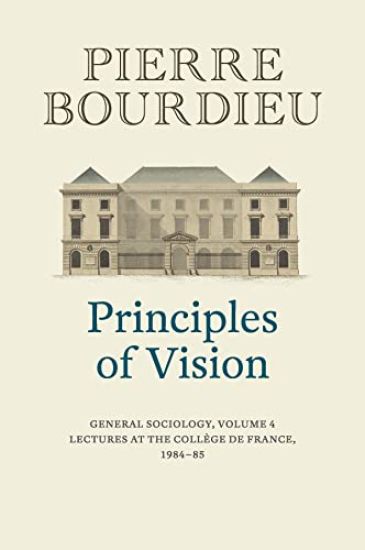
This is the fourth of five volumes based on the lectures given by Pierre Bourdieu at the Collège de France in the early 1980s under the title ‘General Sociology’. In these lectures, Bourdieu sets out to define and defend sociology as an intellectual discipline, and in doing so he introduces and clarifies all the key concepts which have come to define his distinctive intellectual approach. Having elaborated the concepts of habitus and field in previous volumes, Bourdieu now undertakes an analysis of the relations between them, showing that social fields are objects of perception and knowledge for the agents engaged in them. The field of forces is the source of different visions of the social world, visions that are linked to agents’ positions via the specific interests that motivate them and the habitus that is, at least partly, the product of the determining factors associated with their position. This relation between the world perceived and our cognitive structures explains why the social world commonly appears as self-evident. Visions of the social world are necessarily different and often antagonistic, and the field of forces is at once the source and the goal of struggles over its present and future being: the struggle for the legitimate principle of vision and division helps to transform or conserve the field of forces that underlies the agents' standpoints. An ideal introduction to some of Bourdieu’s most important ideas, this volume will be of great interest to students and scholars who study and use Bourdieu’s work across the social sciences and humanities, and to general readers who want to know more about the work of one of the most important sociologists and social thinkers of the 20th century.