Kirjojen hintavertailu. Mukana 12 142 964 kirjaa ja 12 kauppaa.
Kirjailija
Richard Paul
Kirjat ja teokset yhdessä paikassa: 42 kirjaa, julkaisuja vuosilta 1875-2022, suosituimpien joukossa A Critical Thinker's Guide to Educational Fads. Vertaile teosten hintoja ja tarkista saatavuus suomalaisista kirjakaupoista.
This volume of the Thinker's Guide Library uncovers current well-intentioned educational trends (such as No Child Left Behind and Common Core) that inefficiently fragment energy and resources in our K-12 education systems. Critiquing the basic idea behind each of these fads illuminates their real motivations and provides for holistic use.
As a supplement to other volumes in the Thinker's Guide Library, this book provides a framework by which to assess the integration of critical thinking into an educational system The critical thinking competency standards articulated in this guide serve as a resource for teachers, curriculum designers, administrators and accrediting bodies.
This powerful book introduces core critical thinking concepts and principles as an empowering problem-solving framework for every profession, course of study, and indeed every area of life. The Miniature Guide to Critical Thinking Concepts and Tools distills the groundbreaking work of Richard Paul and Linda Elder, targeting how to deconstruct thinking through the elements of reasoning and how to assess the quality of our thinking. The eighth edition of this guide further details the foundations of critical thinking and how they can be applied in instruction to improve teaching and learning at all levels; it also reveals how we can learn to identify and avoid egocentric and sociocentric thought, which lead to close-mindedness, self-deception, arrogance, hypocrisy, greed, selfishness, herd mentality, prejudice, and the like. With more than half a million copies sold, Richard Paul and Linda Elder’s bestselling book in the Thinker’s Guide Library is used in secondary and higher education courses and professional development seminars across the globe. In a world of conflicting information and clashing ideologies, this guide clears a path for advancing fairminded critical societies.
Writing is essential to learning. One cannot be educated and yet unable to communicate one's ideas in written form. But, learning to write can occur only through a process of cultivation requiring intellectual discipline. As with any set of complex skills, there are fundamentals of writing that must be internalized and then applied using one's thinking. This guide focuses on the most important of those fundamentals.
The relationship between criticality and creativity is commonly misunderstood. Critical and creative thought are both achievements of thought. Creativity masters a process of making or producing, criticality a process of assessing or judging. The very definition of the word "creative" implies a critical component (e.g., "having or showing imagination and artistic or intellectual inventiveness"). When engaged in high-quality thought, the mind must simultaneously produce and assess, both generate and judge the products it fabricates. In short, sound thinking requires both imagination and intellectual standards. Throughout this guide we elaborate on the essential idea that intellectual discipline and rigor are at home with originality and productivity, and also that these supposed poles of thinking (critical and creative thought) are inseparable aspects of excellence of thought. Whether we are dealing with the most mundane intellectual acts of the mind or those of the most imaginative artist or thinker, the creative and the critical are interwoven. It is the nature of the mind to create thoughts, though the quality of that creation varies enormously from person to person, as well as from thought to thought. Achieving quality requires standards of quality - and hence, criticality. We believe that creative thinking, especially, must be demystified and brought down to earth. For this reason, we deal with it in this guide not only in terms of its highest manifestation (in the work of geniuses), but also in its most humble manifestations (in everyday perception and thought). There are ways to teach simultaneously for both creative and critical thinking. To do so requires that we focus on these terms in practical, everyday contexts, that we keep their central meanings in mind, that we seek insight into how they overlap and interact with one another. When we understand critical and creative thought truly and deeply, we recognize them a
An original approach to the identification of fallacies focusing on their relationship to human self deception, mental trickery, and manipulation. Introduces the concept of fallacies and details 44 foul ways to win an argument.
Current edition descriptionWritten by two of the leading experts in critical thinking, this book focuses on an integrated, universal concept of critical thinking that is both substantive and applicable to any and every situation in which human thinking is necessary. It provides readerse with the basic intellectual tools needed for life-long learning, helping them understand the mind and how its three functions — thinking, feeling, motivation — influence and are influenced by one another. This book fosters the development of fair-minded critical thinking. Features the intellectual standards: clarity, precision, accuracy, logicalness, significance, depth, breadth, and fairness; The importance of good questioning; and intellectual tools to read for deep and lasting comprehension, and to write in ways that show clarity of reasonability of thought. For all that want to improve their critical thinking skills to apply to their job or life.The text features:Think for Yourself activities – throughout each chapter. (Ex. pp 29, 127).~Help students take ownership of basic concepts as they learn them.Practical and learnable format.~Simplifies complex ideas to make learning easier for students.Focus on thinking across the disciplines. (Ex. pp 119-120).~Helps students to think within the various disciplines, rather than memorizing facts. Students are taught to learn to think like an historian, like a scientist, like a psychologist, etc.Critical thinking focus – When students internalize intellectual standards – such as clarity, precision, accuracy, logicalness, significance, depth, breadth, and fairness – they use them on a daily basis to upgrade their thinking, and to assess the thinking of others. (Ex. 12, 152).~Gives students intellectual standards they can use in every dimension of their thinking.Features intellectual tools to read for deep and lasting comprehension, and to write in ways that show clarity of reasonability of thought. (Ex. 133).~Teaches students to read closely and write substantively.Good questions are the key to good thinking – Thinkers who know how to ask relevant questions in context are better able to think their way through complex issues. (Ex. pp 83, 87, 93).~Teaches students to ask the questions the best thinkers ask.Website – www.criticalthinking.org.~Links students to the world’s largest and most prestigious critical thinking website and provides forums for student and faculty discussions.International approach – with translations into German, French, Spanish, Japanese, Chinese, Russian, and Malay.~Provides students with the opportunity to read portions of the text in their native language."This book is well-written, lucid and contains abundant examples and applications that not only enliven the subject matter but present relevant contexts for building understanding and advanced critical thinking. In addition, it is faithful to the complexity and work required to improve one's thinking. It does not soft-pedal the challenge but actually throws down the gauntlet to the worthy Reader to pick it up."--Stephen J. Knopp, Ph.D., Ohio University "This concise version is a more comprehensive and robust textbook. Many Critical Thinking books cover thinking from a narrow angle, but Paul and Elder offer a model of critical thinking that can be applied not only to academic disciplines but also to life in general."--Connie Wolfe, Surry Community College
This book is ideal for one- or two-semester or two- orthree-quarter courses covering topics in college algebra, finite mathematics,and calculus for students in business, economics, and the life and socialsciences. Introductory Mathematical Analysis for Business, Economics, and the Life andSocial Sciences provides a mathematical foundation for students in avariety of fields and majors. The authors establish an emphasis on algebraiccalculations that sets this text apart from other introductory, appliedmathematics books. Because the process of calculating variables builds skillsin mathematical modeling, this emphasis paves the way for students to solvereal-world problems that use calculus. The book’s comprehensivestructure—covering college algebra in Chapters 0 through 4, finite mathematicsin Chapters 5 through 9, and calculus in Chapters 10 through 17—offersinstructors flexibility in how they use the material based on the coursethey’re teaching, the semester they’re at, or what the students’ backgroundallows and their needs dictate.
This book is ideal for one- or two-semester or two- orthree-quarter courses covering topics in college algebra, finite mathematics,and calculus for students in business, economics, and the life and socialsciences. Introductory Mathematical Analysis for Business, Economics, and the Life andSocial Sciences provides a mathematical foundation for students in avariety of fields and majors. The authors establish an emphasis on algebraiccalculations that sets this text apart from other introductory, appliedmathematics books. Because the process of calculating variables builds skillsin mathematical modeling, this emphasis paves the way for students to solvereal-world problems that use calculus. The book’s comprehensivestructure—covering college algebra in Chapters 0 through 4, finite mathematicsin Chapters 5 through 9, and calculus in Chapters 10 through 17—offersinstructors flexibility in how they use the material based on the coursethey’re teaching, the semester they’re at, or what the students’ backgroundallows and their needs dictate.
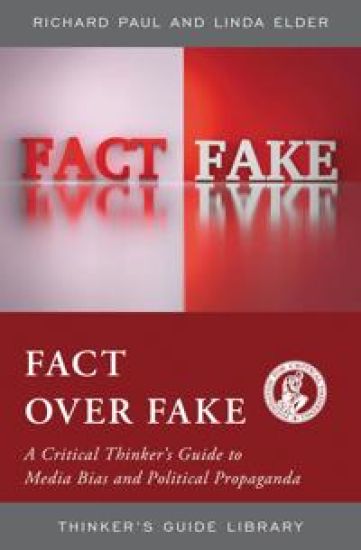
Today’s instantaneous and ever-present news stream frequently presents a sensationalized or otherwise distorted view of the world, demanding constant critical engagement on the part of everyday citizens.The Critical Thinker’s Guide to Bias, Lies, and Politics in the News reveals the power of critical thinking to make sense of overwhelming and often subjective media by detecting ideology, slant, and spin at work. Building off the Richard Paul and Linda Elder framework for critical thinking, Elder focuses on the internal logic of the news as well as societal influences on the media while illustrating essential elements of trustworthy journalism. With up-to-date discussions of social media, digital journalism, and political maneuvering inside and outside the fourth estate, Fact or Fake is an essential handbook for those who want to stay informed but not influenced by our modern news reporting systems.
Today’s instantaneous and ever-present news stream frequently presents a sensationalized or otherwise distorted view of the world, demanding constant critical engagement on the part of everyday citizens.The Critical Thinker’s Guide to Bias, Lies, and Politics in the News reveals the power of critical thinking to make sense of overwhelming and often subjective media by detecting ideology, slant, and spin at work. Building off the Richard Paul and Linda Elder framework for critical thinking, Elder focuses on the internal logic of the news as well as societal influences on the media while illustrating essential elements of trustworthy journalism. With up-to-date discussions of social media, digital journalism, and political maneuvering inside and outside the fourth estate, Fact or Fake is an essential handbook for those who want to stay informed but not influenced by our modern news reporting systems.
Use better thinking to empower yourself, discover opportunities, avoid disastrous mistakes, build wealth, and achieve your biggest goals! This is your complete, up-to-the-minute blueprint for assessing and improving the way you think about everything – from business decisions to personal relationships. Drs. Richard W. Paul and Linda Elder, of the Center for Critical Thinking, offer specific guidance for making more intelligent decisions, and overcoming the irrationalities and sociocentric limits we all face. Discover which of the "six stages" of thinking you’re in and learn how to think with clarity, relevance, logic, accuracy, depth, significance, precision, breadth, and fairness. Master strategic thinking skills you can use everywhere and learn how to critically assess what experts tell you. Packed with new examples and exercises, this guide won’t just help you think more effectively: it will help you use those skills to empower yourself, discover new opportunities, avoid disastrous mistakes, and grow your wealth. Above all, it will help you gain the confidence and clarity you need to pursue and achieve your most important goals in life – whatever they are!
NOTE: Before purchasing, check with your instructor to ensure you select the correct ISBN. Several versions of Pearson's MyLab & Mastering products exist for each title, and registrations are not transferable. To register for and use Pearson's MyLab & Mastering products, you may also need a Course ID, which your instructor will provide. Haeussler, Paul, and Wood establish a strong algebraic foundation that sets this text apart from other applied mathematics texts, paving the way for students to solve real-world problems that use calculus. Emphasis on developing algebraic skills is extended to the exercises—including both drill problems and applications. The authors work through examples and explanations with a blend of rigor and accessibility. In addition, they have refined the flow, transitions, organization, and portioning of the content over many editions to optimize manageability for teachers and learning for students. The table of contents covers a wide range of topics efficiently, enabling instructors to tailor their courses to meet student needs.
For students studying college algebra, finite mathematics, and calculus. Haeussler, Paul, and Wood establish a strong algebraic foundation that sets this text apart from other applied mathematics texts, paving the way for students to solve real-world problems that use calculus. Emphasis on developing algebraic skills is extended to the exercises - including both drill problems and applications. The authors work through examples and explanations with a blend of rigor and accessibility. In addition, they have refined the flow, transitions, organisation, and portioning of the content over many editions to optimise manageability for teachers and learning for students. The table of contents covers a wide range of topics efficiently, enabling instructors to tailor their courses to meet student needs.
The Space Age began just as the struggle for civil rights forced Americans to confront the long and bitter legacy of slavery, discrimination, and violence against African Americans. Presidents John F. Kennedy and Lyndon Johnson utilized the space program as an agent for social change, using federal equal employment opportunity laws to open workplaces at NASA and NASA contractors to African Americans while creating thousands of research and technology jobs in the Deep South to ameliorate poverty. We Could Not Fail tells the inspiring, largely unknown story of how shooting for the stars helped to overcome segregation on earth.Richard Paul and Steven Moss profile ten pioneer African American space workers whose stories illustrate the role NASA and the space program played in promoting civil rights. They recount how these technicians, mathematicians, engineers, and an astronaut candidate surmounted barriers to move, in some cases literally, from the cotton fields to the launching pad. The authors vividly describe what it was like to be the sole African American in a NASA work group and how these brave and determined men also helped to transform Southern society by integrating colleges, patenting new inventions, holding elective office, and reviving and governing defunct towns. Adding new names to the roster of civil rights heroes and a new chapter to the story of space exploration, We Could Not Fail demonstrates how African Americans broke the color barrier by competing successfully at the highest level of American intellectual and technological achievement.