Kirjojen hintavertailu. Mukana 12 390 323 kirjaa ja 12 kauppaa.

Kirjailija

Robert A. Stebbins

Kirjat ja teokset yhdessä paikassa: 30 kirjaa, julkaisuja vuosilta 1990-2025, suosituimpien joukossa Why We Love to Tour. Vertaile teosten hintoja ja tarkista saatavuus suomalaisista kirjakaupoista.

30 kirjaa

Kirjojen julkaisuhaarukka 1990-2025.

Why We Love to Tour

Why We Love to Tour

Robert A. Stebbins

Emerald Publishing Limited
2025
sidottu
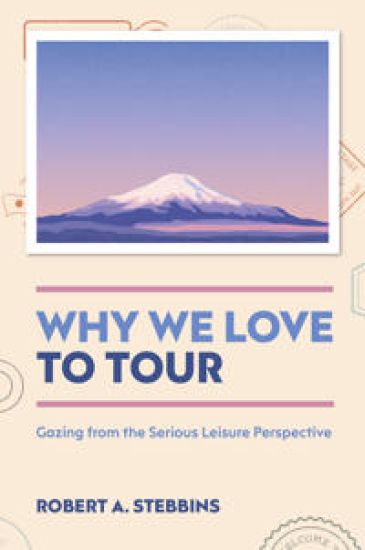
Why We Love to Tour: Gazing from the Serious Leisure Perspective offers a fresh and nuanced exploration of tourism, distinct from traditional industry-focused narratives. Stebbins delves into tourism as a rich tapestry of leisure activities that provide personal satisfaction and self-fulfilment, framed within the social worlds and lifestyles that accompany these pursuits. This book expands and enriches the gaze, tracing leisure experiences across serious pursuits in art, science, sports, and entertainment; casual leisure in activities like sightseeing and nature exploration; and project-based leisure through unique, one-time adventures such as climbing Mount Fuji, visiting Paris, or swimming with dolphins. Why We Love to Tour thus complements and extends the understanding of the tourist gaze, making it a valuable resource for academics as a monograph, for upper-division undergraduate and graduate students as supplementary reading, and for professionals within the tourism industry seeking deeper insights into the motivations driving modern tourists.
Project-Based Leisure

Project-Based Leisure

Robert A. Stebbins

Springer International Publishing AG
2023
nidottu
This short book discusses the relatively new concept of project-based leisure in leisure research, and relates it to individual and community well-being and quality of life. The book defines PBL as a short-term, reasonably complicated, one-off or occasional, though infrequent, creative undertaking carried out in free time, or time free of disagreeable obligation. Such leisure requires considerable planning, effort, and sometimes skill or knowledge. The book discusses how PBL contributes to subjective well-being, though doing so more modestly than serious leisure and occupational devotion. The book surveys existing field research of the author’s own and other studies, and provides original insights on how PBL activities can be used to generate community involvement and subjective well-being.
Leisure Lifestyles

Leisure Lifestyles

Robert A. Stebbins

Emerald Publishing Limited
2021
sidottu
Acknowledging that the challenge facing social science is how to inject some order into the common-sense notion of leisure lifestyles, this book, written by a major player in the field of leisure, considers how to turn the study of both serious and casual leisure into a useful concept for guiding research. Developing the common-sense notion that leisure lifestyles have time and space dimensions, Stebbins delves into distinctive leisure lifestyles which occur around particular free-time activities such as the serious ones where participants must routinely train, practice, rehearse, gather information, and those that are casual such as bingo, lunches with colleagues, and outings of small walking groups. Demonstrating the nuances of each, and analysing how serious activities are structured along the lines of the social world in which every lifestyle is embedded, this book revolutionises the idea of leisure lifestyle, turning it into a workable concept for guiding research, while also enriching our understanding of what it means. Striving to meet the test of a critical challenge in the field, this book is a refreshing new addition to the work on leisure, from a highly-respected and established scholar.
Pondering Everyday Life

Pondering Everyday Life

Robert A. Stebbins

Springer Nature Switzerland AG
2021
nidottu
This pivot provides a conceptual statement of an approach to understanding the interrelationships of work, leisure, and “chore” activities in daily life, and how they are managed in practice. Drawing on the sociology of everyday life, Stebbins puts forward the notion of Pondering Everyday Life (PEA), a thinking process/activity in which we routinely understand, coordinate, organize, remember, and compare our involvements in work, leisure, and non-work obligations. This perspective demonstrates how the interrelation between these three domains helps bring meaning and continuity to everyday life. As a micro- and meso-level conception that takes into account social, cultural and historic context, Stebbins contemplates how and what PEA can tell us about an individual’s view of their own life. Pondering Everyday Life will be of interest to students and scholars across leisure studies, social psychology, and the sociology of leisure and work.
Non-Work Obligations

Non-Work Obligations

Robert A. Stebbins

Emerald Publishing Limited
2021
sidottu
The world of non-work obligations - defined as disagreeable activities that are neither work nor leisure - is a territory of social life that has largely been ignored by scholars of work and leisure alike. The exception to this rule is Robert A. Stebbins, who over the years has written extensively on the significance of non-work obligations and the mundane and often disagreeable tasks that we are all compelled to face in our daily lives. In this new book, Stebbins brings together years of writing and research on this topic to forcefully argue that the current research interest in work-life balance can no longer afford to ignore the effects that non-work obligation has on it. He contends that, whether we like it or not, non-work obligations bear heavily on both our work and leisure. Having to deal with disagreeable tasks and objectionable people on a daily basis, without the support of any outside agency, can seriously undermine our well-being, and it is only through recourse to voluntary simplicity that we can hope to limit the harmful impact of non-work obligations. Written both as a guide to happy living and as a powerful rejoinder to conventional orthodoxy in the fields of leisure and work studies, the book is essential reading for both the general reader and scholars of leisure, consumer, work and happiness studies.
The Serious Leisure Perspective

The Serious Leisure Perspective

Robert A. Stebbins

Springer Nature Switzerland AG
2020
nidottu
The Serious Leisure Perspective (SLP) is a theoretic framework developed by Robert A. Stebbins in 1973, that brings together three main forms of leisure known as serious leisure, casual leisure, and project-based leisure. The SLP has evolved considerably since 1973, and this textbook provides a synthesis of the many concepts and propositions, as well as the data supporting them. In this overview, Stebbins organizes the entire framework along conceptual lines, with careful attention to level of empirical support and validation of each concept, presenting an up-to-date version of the SLP that allows interested students and researchers of social psychology, sociology, and leisure studies, to pinpoint exact elements of the theory, the empirical base and its application.
Pondering Everyday Life

Pondering Everyday Life

Robert A. Stebbins

Springer Nature Switzerland AG
2020
sidottu
This pivot provides a conceptual statement of an approach to understanding the interrelationships of work, leisure, and “chore” activities in daily life, and how they are managed in practice. Drawing on the sociology of everyday life, Stebbins puts forward the notion of Pondering Everyday Life (PEA), a thinking process/activity in which we routinely understand, coordinate, organize, remember, and compare our involvements in work, leisure, and non-work obligations. This perspective demonstrates how the interrelation between these three domains helps bring meaning and continuity to everyday life. As a micro- and meso-level conception that takes into account social, cultural and historic context, Stebbins contemplates how and what PEA can tell us about an individual’s view of their own life. Pondering Everyday Life will be of interest to students and scholars across leisure studies, social psychology, and the sociology of leisure and work.
Social Worlds and the Leisure Experience

Social Worlds and the Leisure Experience

Robert A. Stebbins

Emerald Publishing Limited
2018
nidottu
Scholars in leisure studies have amassed an impressive record of knowledge bearing on the social worlds of diverse serious pursuits, yet this sphere of modern life still needs a coherent statement about what social worlds consist of, what they do, and where they fit in social theory. The core activities at the base of the leisure experience are pursued within the social world that encompasses such activity. To understand more fully why people are attracted to and continue with a serious pursuit, we must also understand its social world. This concept is anchored in social theory and, in the domain of leisure, the serious leisure perspective. The social world and its accompanying ethos are centrally implicated as one of six distinctive qualities of the serious pursuits. Taking inspiration from Anselm Strauss, this book discusses the members of leisure social worlds and the activities they enthusiastically pursue, as well as examining the culture and communications of these worlds.
Leisure’s Legacy

Leisure’s Legacy

Robert A. Stebbins

Springer International Publishing AG
2018
nidottu
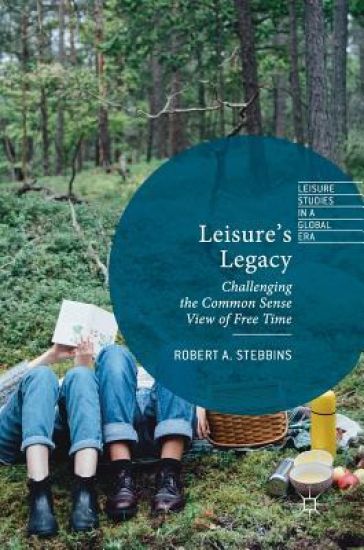
This book illustrates how leisure, as with other complex ideas that hold currency in today’s world, suffers at the level of common sense, due to a combination of oversimplification, moral depreciation, and even lack of recognition.Leisure’s modern legacy is both profound and immense, as a product of approximately 45 years of steady research, application and theory development. The common sense view of free-time activities, therefore, can and should be challenged. Stebbins provides this confrontation by tackling four particular themes: that gatekeepers within the institutions of higher education and funding agencies for research often fail to attach adequate resources to the idea of leisure; that the general population are guided by certain common sense definitions and largely unaware of how an informed view of free time could be beneficial; that practitioners within certain fields continue to refuse to engage with the idea of leisure despite its benefitfor their clients; and that the weak reception of the science of leisure within mainstream social sciences suggests a similarly warped understanding of how people use their free time.Leisure’s Legacy will be of interest to scholars of Leisure Studies and all those wishing to learn more about the vital importance of leisure in modern Western society.
The Idea of Leisure

The Idea of Leisure

Robert A. Stebbins

Routledge
2017
nidottu
A range of thinkers in philosophy, religion, and the social sciences have argued that thanks to science, technology, and the organization of society, the human condition has improved and will continue to do so. People are becoming progressively happier and enjoying an ever-improving quality of life, they say, mostly because they are putting their skills and reason to work. The Idea of Leisure is based on the assumption that leisure also fits into the social order, and it provides a singular vector by which to measure progress, even though it is rarely mentioned in writings about the idea of progress.Robert A. Stebbins believes that leisure fosters positive development in both the individual and community. Progress through free-time activity may sometimes be hard to grasp because of the all-too-common manifestations of deviant behavior from schoolyard bullying to date rape. Despite these examples, the vast majority of leisure activities often have profound, positive consequences for participants and society. Stebbins makes a solid case for linking leisure with progress.Although leisure has huge importance for humanity, observations about the idea of leisure as part of the idea of progress have been sporadic. It is no accident that the World Leisure Organization promotes the motto: "Leisure: integral to social, cultural, and economic development." Nor is it an accident that Article 24 of the United Nations Universal Declaration of Human Rights declares that: "Everyone has the right to rest and leisure, including reasonable limitation of working hours and periodic holidays with pay." For whole nations to find satisfaction and self-fulfillment based on leisure would be a true sign of progress. Stebbins' book offers original insight into this basic human requirement.
Leisure Activities in Context

Leisure Activities in Context

Robert A. Stebbins

Routledge
2017
nidottu
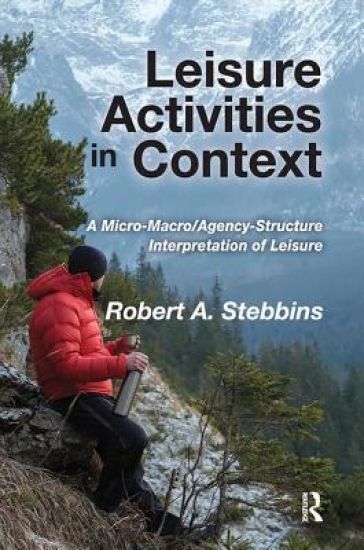
There have been many analyses of leisure, drawing on the social, historical, cultural, temporal, and geographical contexts in which acts of leisure are pursued. Yet these studies lack a theoretical framework that can explain how leisure studies interact in various social contexts (cultural, temporal, or geographical), or as Robert A. Stebbins conceptualizes it, at levels of society. Here Stebbins explores leisure studies at society's micro, meso, and macro levels. He considers all three as they manifest themselves in the everyday pursuit of leisure, while focusing on the heretofore neglected middle, which he calls the meso side of life. Stebbins not only draws these perspectives together, but does something no one else has: he focuses on the big picture of leisure. Leisure Activities in Context examines the entire micro-macro/agency-structure dimension, using theory and research from leisure studies and the sociology of leisure as the vehicles to accomplish this. This book will be a useful theoretical sourcebook on the study of leisure because it provides a blueprint of issues that scholars and students can use to draw deeper meaning from their own studies, and a framework for future research.
Leisure’s Legacy

Leisure’s Legacy

Robert A. Stebbins

Springer International Publishing AG
2017
sidottu
This book illustrates how leisure, as with other complex ideas that hold currency in today’s world, suffers at the level of common sense, due to a combination of oversimplification, moral depreciation, and even lack of recognition.Leisure’s modern legacy is both profound and immense, as a product of approximately 45 years of steady research, application and theory development. The common sense view of free-time activities, therefore, can and should be challenged. Stebbins provides this confrontation by tackling four particular themes: that gatekeepers within the institutions of higher education and funding agencies for research often fail to attach adequate resources to the idea of leisure; that the general population are guided by certain common sense definitions and largely unaware of how an informed view of free time could be beneficial; that practitioners within certain fields continue to refuse to engage with the idea of leisure despite its benefitfor their clients; and that the weak reception of the science of leisure within mainstream social sciences suggests a similarly warped understanding of how people use their free time.Leisure’s Legacy will be of interest to scholars of Leisure Studies and all those wishing to learn more about the vital importance of leisure in modern Western society.
Work and Leisure in the Middle East

Work and Leisure in the Middle East

Robert A. Stebbins

Routledge
2017
nidottu
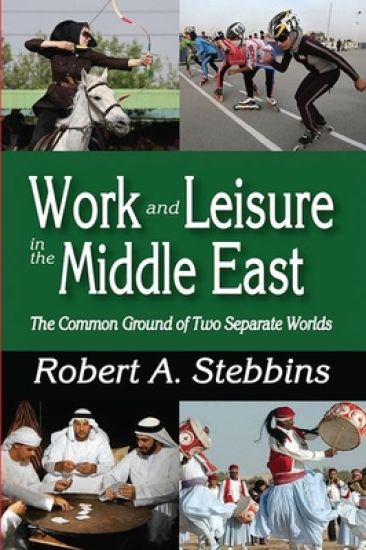
Community involvement and leisure are rarely mentioned in mass media coverage of the Middle East and North Africa.Yet leisure and community involvement form a part of life in the region, and are becoming increasingly significant as modernization becomes pervasive. This work seeks to examine how the interconnection of work and leisure operates in a culture far removed from North American or European traditions.Robert A. Stebbins argues that the Middle East is a region in the throes of a developmental crisis, one of cultural underdevelopment. He indicates that while leisure and community involvement may be labeled as largely trivial activities, they in fact involve a nexus that crosses with the labor process. Discussing activities as diverse as theater and falconry, rotary clubs and brutal leisure‘such as acts of terrorism and revolutionary violence Stebbins offers a variety sufficient enough to confirm that cultural development through leisure, work, and community involvement has been possible.To provide the background for this argument, Stebbins explains what community involvement is, how it fosters cultural development, and offers a look at contemporary leisure and work in a changing economic climate. This is a unique look both at community involvement in the Middle East and how it has affected the cultural, political, and religious crisis. The book concludes by proposing that a new view of work and leisure may serve to override social divisions and traditional impediments to cultural development.
From Humility to Hubris among Scholars and Politicians

From Humility to Hubris among Scholars and Politicians

Robert A. Stebbins

Emerald Publishing Limited
2017
nidottu
A main theme running through this book is that we cannot understand the virtues of humility and modesty without an equally good understanding of the vices of hubris and conceit. All four attitudes express self-esteem, which flourishes in the soil of achievement. Achievement is valued in any challenging field, be it art, science, sport, entertainment, business, politics, religion, or administration. And it is for this reason alone that achievers are inclined to discuss their excellence or may be forced to discuss it when others inquire about it or remark on it. By these routes achievement and self-esteem surface frequently in the diverse academic and political exchanges that spawn humility/modesty or hubris/conceit.Achievement in a respectable activity can be a wonderful personal milestone bathed in positive emotions, where in the modern world individualism and individuation are widely valued. It may also be wonderful for other people in the achiever’s family, social network, community, or society when they are favorably affected. But in this book, when refracted through three additional analytic lenses – individualism and individuality, big- vs small-picture thinking, and tolerance and compromise – the expression of achievement-based self-esteem takes on some startling new dimensions. One of them is that, at the hubris/conceit end of the continuum of the expression of self-esteem, discussion risks becoming uncivil, owing to the disagreeable ways that achievement is sometimes conveyed (e.g., boasting, name calling, depreciating others’ related achievements). Moreover, such can turn out to be enormously unproductive. Or as Leo Tolstoy once put it: “Conceit is incompatible with understanding.”
Leisure Activities in Context

Leisure Activities in Context

Robert A. Stebbins

AldineTransaction
2017
sidottu
There have been many analyses of leisure, drawing on the social, historical, cultural, temporal, and geographical contexts in which acts of leisure are pursued. Yet these studies lack a theoretical framework that can explain how leisure studies interact in various social contexts (cultural, temporal, or geographical), or as Robert A. Stebbins conceptualizes it, at levels of society. Here Stebbins explores leisure studies at society's micro, meso, and macro levels. He considers all three as they manifest themselves in the everyday pursuit of leisure, while focusing on the heretofore neglected middle, which he calls the meso side of life. Stebbins not only draws these perspectives together, but does something no one else has: he focuses on the big picture of leisure. Leisure Activities in Context examines the entire micro-macro/agency-structure dimension, using theory and research from leisure studies and the sociology of leisure as the vehicles to accomplish this. This book will be a useful theoretical sourcebook on the study of leisure because it provides a blueprint of issues that scholars and students can use to draw deeper meaning from their own studies, and a framework for future research.
Leisure and the Motive to Volunteer: Theories of Serious, Casual, and Project-Based Leisure
Volunteering and its nonprofit organizations have commonly been analyzed in economic terms, with volunteering being referred to as "unpaid (productive) work". This economic definition has been around far longer than that of volunteering conceived of as leisure, which is discussed as the volitional definition. By means of a lengthy literature review, this book sets out the theoretical and empirical contributions of the serious leisure perspective to understanding volunteer motivation. This second approach began more than 40 years ago. It answers the key motivational question of why people engage in unpaid productive work, laborious or not. Since in this conception payment in cash or in kind is not an incentive to perform such work, what encourages people to volunteer? The serious leisure perspective, unlike mainstream economics, can shed considerable light on this question.
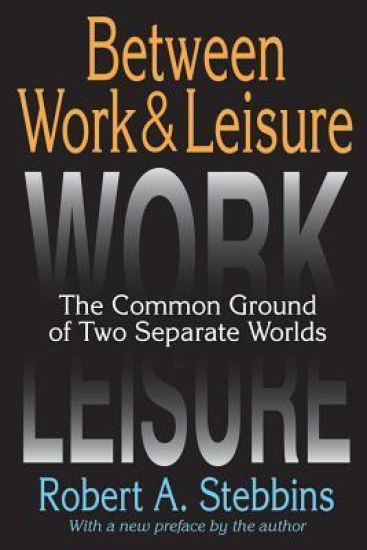
Between Work and Leisure

Between Work and Leisure

Robert A. Stebbins

AldineTransaction
2014
nidottu
Between Work and Leisure aims to debunk the prevailing myth that work and leisure are separate and mutually antagonistic spheres of life. Stebbins shows that a close relationship between leisure and work is positive, offering people the possibility of finding joy in work just as they do in leisure.Occupational devotion, as Stebbins defines it, is a strong and positive attachment to a form of self-enhancing work, where the sense of achievement is high and the core activity, or set of tasks, is endowed with such intense appeal that the line between work and leisure is virtually erased. This volume examines conditions that attract people to their work in this profound way, and the many exceptional values and intrinsic rewards they realize there.Stebbins frames occupational devotion in four broad social contexts—history, religion, work, and leisure—and then considers the further subdivisions of gender, social class, and social character. The heart of the book uses research findings on leisure to develop a powerful critique of those who describe deeply felt commitment to work as "workaholic" behavior. He also examines what happens when money becomes a dominant factor in work and the social implications of the compatibility of work and serious leisure using exploratory research to identify their shared motivational factors.
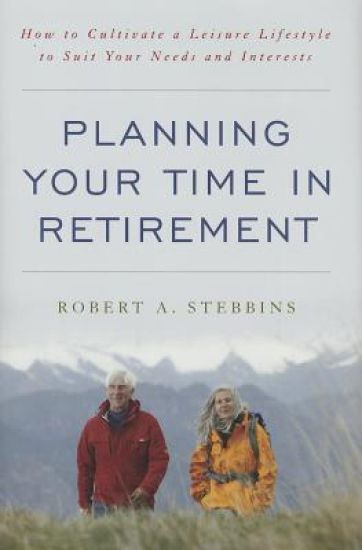
Planning Your Time in Retirement

Planning Your Time in Retirement

Robert A. Stebbins

Rowman Littlefield
2013
sidottu
Much of what is written about getting old has a negative feel to it, which is certainly not entirely unjustified. Health may begin to fail. Finances may become tighter as income dwindles or stops altogether. Family and friends may move away or move on. But the retirement years do not have to be negative or bleak. Within this “dark scenario,” a positive existence is possible. Planning Your Time in Retirement focuses on the variety of free-time activities available to retirees as related to their physical, social, and economic situation in old age, helping readers find out what their passions are, what the possibilities might be, and how to cultivate their own leisure lifestyle. For some retirees, a post-work existence consisting of fun works well, for they have managed to shape an interesting casual leisure lifestyle based on easygoing activities that make them happy. Seldom included in the popular image of leisure, however, are other types of leisure that are also widely available to retirees. Regardless of means, the retirement years can consist of activities and pastimes that fulfill the interests and pursuits of any retiree. A variety of exciting leisure activities exists, which retirees may pursue within their financial, physical, mental, and geographic limits. This book provides a guide—the serious leisure perspective—for exploring these activities and choosing those that fit one’s tastes, aptitudes, and abilities. At its most appealing, a leisure lifestyle includes a balance of easy-to-do casual interests as well as serious ones that require knowledge, effort, and perseverance. For some, enjoyment and fulfillment may come from engaging in volunteer work, while for others it may involve leisure activities from which they gain some form of payment. By employing the notion of positive simplicity—simple living in the domain of leisure—many people at this stage of life can delight in these final years. While time and money cannot be ignored, finding those activities that allow for engagement, reward, and simplicity can result in days, even years, of leisure that is meaningful, enjoyable, healthy, and empowering.