Kirjojen hintavertailu. Mukana 12 390 323 kirjaa ja 12 kauppaa.

Kirjailija

Robert Forsyth

Kirjat ja teokset yhdessä paikassa: 39 kirjaa, julkaisuja vuosilta 2008-2026, suosituimpien joukossa Ju 52/3m Bomber and Transport Units 1936-41. Vertaile teosten hintoja ja tarkista saatavuus suomalaisista kirjakaupoista.

39 kirjaa

Kirjojen julkaisuhaarukka 2008-2026.

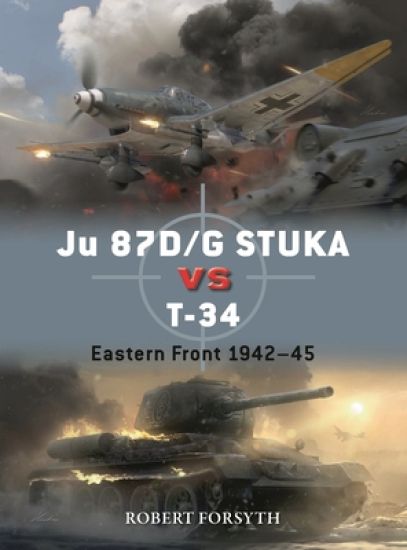
Ju 87D/G STUKA versus T-34

Ju 87D/G STUKA versus T-34

Robert Forsyth

BLOOMSBURY PUBLISHING PLC
2023
nidottu
An examination of two of the most high-profile air and land weapons to be deployed on the Eastern Front in World War II.In late 1942, as part of its attempts to strike back at ever-increasing numbers of Soviet tanks, the German air ministry authorised the development of an adaptation and enhancement of the longspan Junkers Ju 87D-5 Stuka dive-bomber. The aircraft was duly fitted with two underwing pods containing 37 mm BK cannon – an antiaircraft cannon with its origins dating back to 1933. The solid, slow, Ju 87 airframe offered the Luftwaffe an ideal platform for specialist, low level, ‘tank-killing’ operations. Despite the wealth of experience possessed by some of the Luftwaffe’s ground-attack and dive-bomber aces, knocking out T-34 tanks from the air was a demanding and difficult process. Nevertheless, some Luftwaffe pilots notched up impressive tank scores, and the Ju 87 is credited with the destruction of more than 100 tanks across the central and southern sectors of the Eastern Front, including during the Battle of Kursk. Including personal accounts from Stuka pilots and biographies of the anti-tank aces, together with detailed photographs of the cannon installation into the Ju 87G and details of the construction of the T-34 illustrated using specially commissioned artwork, this book covers the epic clash of two legendary machines of World War II.
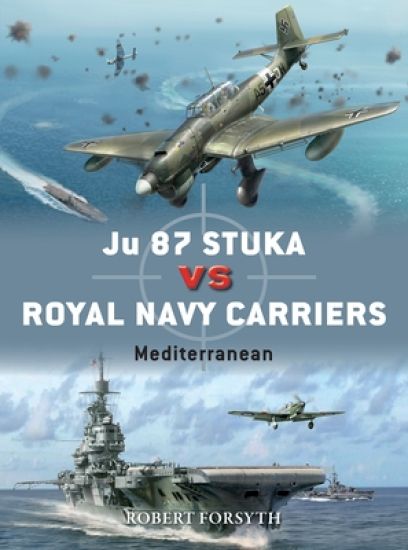
Ju 87 Stuka vs Royal Navy Carriers

Ju 87 Stuka vs Royal Navy Carriers

Robert Forsyth

Osprey Publishing
2021
nidottu
Ju 87 dive-bombers, originally developed for pin-pointing bombing missions against land targets and Allied naval vessels were deployed by both the Luftwaffe and the Regia Aeronautica against the Allied forces. Included in such a target were perhaps the greatest prize of all for a Stuka pilot: a British aircraft carrier.This superbly illustrated book looks at the duel between the Ju 87 Stuka and the aircraft carriers of the Royal Navy. Despite their gun protection (‘pompoms’)and their squadrons of fighters, these immense and mighty vessels proved irresistible targets to determined and experienced Stuka aces as they endeavoured to stop British naval intervention in the campaigns in Norway, Malta and Crete. By 1941, the Ju 87 had become known by the British as a fearsome aircraft following its operations in France, specifically at Dunkirk, as well as in the Balkans. For the Luftwaffe, it was an aircraft in which they still had great confidence despite its mauling in the Battle of Britain during the summer of 1940. This book examines the key attributes and shortcomings of both aircraft and carrier by analysing various compelling episodes including the dramatic attacks on Ark Royal by Stukageschwader (St.G) 1 off Norway in April 1940, the strikes by the Luftwaffe’s St.G 1, St.G 2 and the Regia Aeronautica’s 237° Squadriglia against Illustrious in Malta harbour. Aside from outstanding photography and artwork, this volume also include numerous personal accounts from Stuka crews, the pilots of carrier-borne fighters opposing them and the sailors embarked in the various carriers that came under attack.
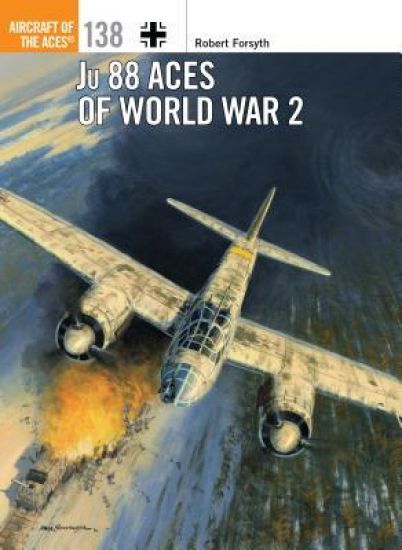
Ju 88 Aces of World War 2

Ju 88 Aces of World War 2

Robert Forsyth

Osprey Publishing
2019
nidottu
Initially designed as a fast medium bomber, the Junkers Ju 88 was also used as a Zerstörer heavy fighter by the Luftwaffe. It saw its combat debut over Poland in 1939, and heavy fighter variants saw action on every front up to VE Day. The ultimate Ju 88 fighter variant was the G-model of 1944, which boasted a FuG 220 or 227 radar, an astounding array of cannon and machine gun armament and advanced Junkers Jumo or BMW engines. A dedicated nightfighter, the first Ju 88G-1s entered service with the Nachtjagd in the summer of 1944, replacing Ju 88C/Rs as well as some Bf 110Gs. Despite suffering heavy losses in the final months of the war, Ju 88Gs also inflicted serious casualties on Bomber Command throughout the war.From patrolling over the Bay of Biscay, to the Arctic circle opposing Allied convoys and, most successfully, as radar-equipped nightfighters engaging RAF heavy bombers during defence of the Reich operations from late 1941, this is the story of the Ju 88 aces who menaced Allied aircraft and shipping throughout World War 2.
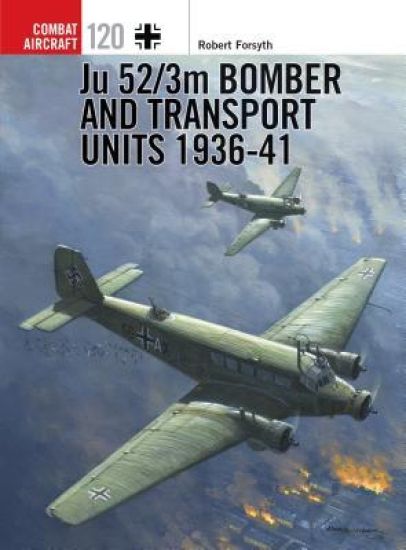
Ju 52/3m Bomber and Transport Units 1936-41

Ju 52/3m Bomber and Transport Units 1936-41

Robert Forsyth

Osprey Publishing
2017
nidottu
The all-metal Junkers Ju 52/3m enjoyed a solid – indeed, revered – reputation amongst its crews and the troops and paratroopers who used and depended on it. For more than ten years, it saw service as a successful military transport, with its distinctive, three-engined design and corrugated metal construction becoming instantly recognisable. It was a mainstay in the Luftwaffe’s inventory, first seeing service in the 1930s in bombing and transport operations in the Spanish Civil War, and subsequently during the German invasion of Poland. It then served on every front on which the Luftwaffe was deployed until May 1945. The Junkers served as a stalwart transport, confronting both freezing temperatures and ice, and heat and dust, lifting men, animals, food and supplies vital for German military operations. This, the first of two books on the Ju 52/3m, details its service as a bomber in Spain and in South America, followed by its pivotal role in early war operations during the invasions of Poland and France, the airborne invasion of Crete and the early stages of Operation Barbarossa.
Fw 190 Schlacht Units

Fw 190 Schlacht Units

Robert Forsyth

BLOOMSBURY PUBLISHING PLC
2026
nidottu
An illustrated account of the Fw 190 'tank-buster' and its operations on the Eastern, Western and Mediterranean Fronts from 1942–45. The Fw 190 offered the Luftwaffe a reliable successor to the Ju 87 Stuka, able to operate from primitive forward airfields in both the freezing winters of the Soviet Union and the desert heat of North Africa. Converted by Focke-Wulf from a radial-engined fighter into a deadly fighter-bomber and ground-attack aircraft, it used its aerial gun platform, wide-tracked undercarriage and powerful BMW engines to devastating effect on the Eastern, Western and Mediterranean Fronts between 1942 and 1945. In this new study, leading Luftwaffe historian Robert Forsyth examines all aspects of the Fw 190 and its career as a ‘tank-buster’, detailing the considerable damage it wrought upon Allied armour, troop concentrations, bridges and road junctions. First-hand accounts from Schlachtflieger pilots bring to life the operational and tactical histories of the aircraft, and are complemented by archive photos and newly commissioned artwork that vividly demonstrates its technical and ballistic assets.
Defenders of the Reich

Defenders of the Reich

Robert Forsyth

BLOOMSBURY PUBLISHING PLC
2025
sidottu
The story of the Luftwaffe fighter arm’s desperate defence of the Third Reich from the growing Allied bomber offensive in World War II.The Reichsverteidigung (Defence of the Reich) was a do or die campaign that saw the very best fighter pilots in the Luftwaffe attempt to defend German skies from increasingly large formations of RAF and USAAF medium and heavy bombers. Flying both piston-engined and, eventually, the first jet-engined fighters to see operational service, the Jagdflieger employed a wide range of weapons and tactics in an effort to blunt the Allied air offensive across Nazi Germany and Occupied Europe. Defenders of the Reich focusses on the story of the pilot, his aircraft, his weaponry, his draining, dangerous missions and Luftwaffe tactics against the USAAF and the RAF bombers from the summer of 1942 through to VE Day. They fought until they were all but obliterated as USAAF and RAF fighters decimated their ranks in the air and targeted their airfields in devastating strafing attacks.leading Luftwaffe historian Robert Forsyth uses German and Allied archival documents coupled with interviews with former Jagdwaffe pilots, to tell the history of this last-ditch aerial campaign from the perspective of the Luftwaffe.
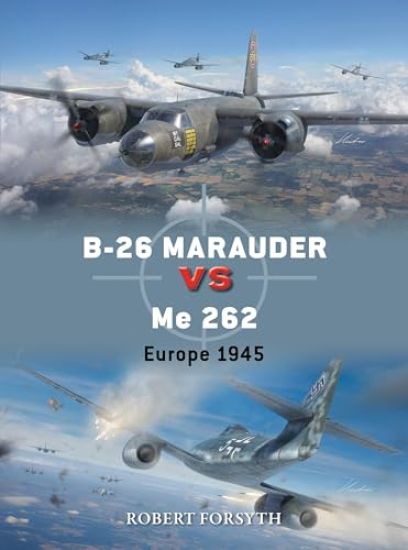
B-26 Marauder vs Me 262

B-26 Marauder vs Me 262

Robert Forsyth

BLOOMSBURY PUBLISHING PLC
2025
nidottu
An illustrated account of the clashes between the Luftwaffe’s Me 262, the first operational jet fighter, and the USAAF’s B-26 Marauder bomber during the final months of the war in Europe.As the world’s first jet-engined fighter aircraft, the Luftwaffe’s Messerschmitt Me 262 heralded a new dawn in design, performance, and combat capability upon its operational debut in 1944, outclassing its Allied counterparts for both speed and firepower. The skies over Austria and southern Germany saw the Me 262 enter savage aerial clashes as fighter ace Adolf Galland’s JV 44 engaged three USAAF bomber groups, targeting their formidable – but ill-prepared – Martin B-26 Marauders with often devastating results.In this dramatic new study, Luftwaffe historian Robert Forsyth examines how USAAF crews in twin-engined Marauders endeavoured to fulfil their bombing missions while jet pilots in Me 262s attacked with 30 mm MK 108 nose-mounted cannon and, eventually, 55 mm R4M air-to-air rockets. First-hand accounts, newly commissioned artwork and archive photography enhance the fascinating and action-packed story of these two aircraft and the fearsome combat that was waged between them.
Me 262 Units in Combat

Me 262 Units in Combat

Robert Forsyth

BLOOMSBURY PUBLISHING PLC
2024
nidottu
An illustrated account of the first jet-powered combat aircraft, the Messerschmitt Me 262, and its short but action-packed career during World War 2.Powered by the Jumo 004 jet engine, the Me 262 outclassed anything the Allies had in terms of speed and firepower, offering, as an interceptor, a formidable punch with four 30 mm MK 108 nose-mounted cannon. Such a blend of armament and speed allowed the Me 262A-1a not just to inflict carnage on the Allied heavy bomber formations, but also to evade their fighter escorts – even the later marks of Spitfire and the formidable American P-51 Mustang.In this new study, Luftwaffe historian Robert Forsyth utilises first-hand accounts from Me 262 pilots to chronicle actions against Allied bombers and their escorts, as well as detailing hit-and-run bomber attacks on road junctions, Allied airfields, vehicle columns, troop assemblies and supply dumps. All of these aspects of the Me 262 are enhanced by vivid illustrations, including archival photographs and specially commissioned profile artworks.
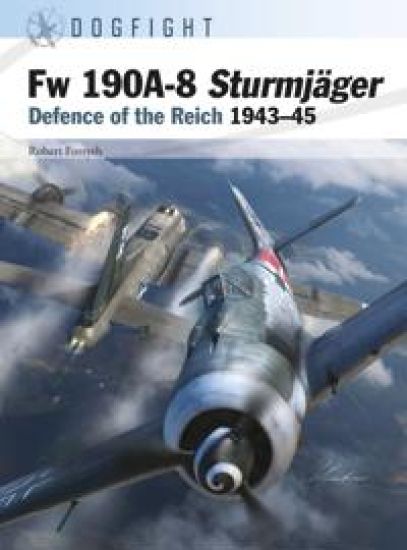
Fw 190 Sturmjäger

Fw 190 Sturmjäger

Robert Forsyth

BLOOMSBURY PUBLISHING PLC
2024
nidottu
An illustrated account of how the USAAF's might was challenged by the Jagdflieger and their heavily armed, and armoured, Fw 190A-8 Sturmjäger.Developed from one of the finest fighters of World War II, the radial-engined Fw 190A-8 was conceived as a heavy assault aircraft and armed accordingly. Its mission was to provide a response to the increasing numbers of USAAF B-17 and B-24 bombers operating against targets in the western and central Reich. This book explores the fascinating feats of the men flying the Fw 190A-8 and its subvariants. These pilots were given exceptional training and many were volunteers, some of whom were willing to sign oaths that they would bring down a bomber at all costs – even if it meant ramming the enemy aircraft. Using first-hand accounts, archival photos, full-colour illustrations, maps and tactical diagrams, acclaimed Luftwaffe expert Robert Forsyth puts readers in the cockpit of a Sturmjäger defending the Fatherland from USAAF bombers protected by powerful Allied escort fighters.
Me 163 vs Allied Heavy Bombers

Me 163 vs Allied Heavy Bombers

Robert Forsyth

BLOOMSBURY PUBLISHING PLC
2024
nidottu
An illustrated account of the dramatic engagement between the Luftwaffe’s Me 163 units and Allied bombers during the closing years of World War II.In the summer of 1944, US Army Air Force (USAAF) aircrews flying over the Third Reich reported observing small, high-speed ‘batlike’ aircraft flying close to their formations. The Luftwaffe’s extraordinary Messerschmitt Me 163 rocket-powered interceptor was making its devastating debut with Jagdgeschwader (JG) 400. Capable of reaching high altitudes in the shortest possible time by using a volatile rocket fuel, the Me 163 was the Luftwaffe’s most impressive yet dangerous aircraft, and the fastest in the world. Luftwaffe expert Robert Forsyth details the testing of the aircraft and its lethal SG 500 ‘Fighter Fist’ weapons system, as well as its deployment against the B17s and B24s of the USAAF’s Eighth Air Force and, from late 1944, the Lancasters and Halifaxes of RAF Bomber Command. These duels started a deadly form of warfare, with the bomber squadrons striking at Germany’s synthetic oil refineries and jet airfields, and the Me 163s of JG 400 trying to stop them using cutting-edge aeronautical technology.Using specially commissioned artwork, original photographs and rare first-hand interviews with the pilots that fought the decisive dogfights, this exciting book describes the pivotal encounters over Northern Europe.
Me 262

Me 262

Robert Forsyth

BLOOMSBURY PUBLISHING PLC
2023
nidottu
Using rare first-hand accounts from Me 262 pilots, Robert Forsyth examines what it was like to fly the world’s most advanced interceptor in the deadly skies over Germany in 1944–45. Right from its operational debut in the summer of 1944, the Me 262 outclassed anything the Allies had in terms of speed and firepower ratio, offering a formidable punch with four 30 mm Mk 108 nose-mounted cannon, and a Jumo 004 jet engine. The problem the Luftwaffe faced, however, was one of numbers. Towards the end of the war, availability of machines and trained pilots was scarce, and it is only thanks to the exploits of a handful of veteran Jagdwaffe aces such as Adolf Galland, Walter Krupinski and Johannes Steinhoff, that the aircraft made a significant impact on the air war and was the source of considerable concern to the Allies. Filled with specially commissioned artwork including action-packed ribbon diagrams, battlescenes, armament views and maps, Robert Forsyth offers the definitive technical and historical guide to the state-of-the-art Me 262, using rare photographs and pilots’ first-hand accounts.
To Save An Army

To Save An Army

Robert Forsyth

BLOOMSBURY PUBLISHING PLC
2022
sidottu
Using the diaries of Luftwaffe commanders, rare contemporary photographs and other previously unpublished sources, Robert Forsyth analyzes the human, strategic, tactical and technical elements of one of the most dramatic operations arranged by the Luftwaffe.Stalingrad ranks as one of the most infamous, savage and emotive battles of the 20th century. It has consumed military historians since the 1950s and has inspired many books and much debate. This book tells the story of the operation mounted by the Luftwaffe to supply, by airlift, the trapped and exhausted German Sixth Army at Stalingrad in the winter of 1942/43.The weather conditions faced by the flying crews, mechanics, and soldiers on the ground were appalling, but against all odds, and a resurgent and active Soviet air force, the transports maintained a determined presence over the ravaged city on the Volga, even when the last airfields in the Stalingrad pocket had been lost.Yet, even the daily figure of 300 tons of supplies, needed by Sixth Army just to subsist, proved over-ambitious for the Luftwaffe which battled against a lack of transport capacity, worsening serviceability, and increasing losses in badly needed aircraft.Using previously unpublished diaries, original Luftwaffe reports and specially commissioned artwork, this gripping battle is told in detail through the eyes of the Luftwaffe commanders and pilots who fought to keep the Sixth Army alive and supplied.
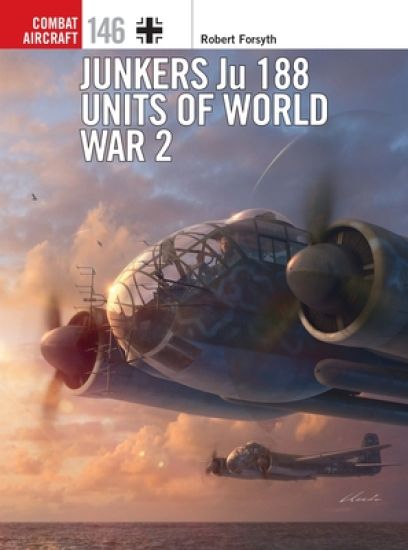
Junkers Ju 188 Units of World War 2

Junkers Ju 188 Units of World War 2

Robert Forsyth

BLOOMSBURY PUBLISHING PLC
2022
nidottu
This volume examines the history and development of the Ju 188 twin-engined aircraft, the Luftwaffe’s attempt to enhance and improve its peerless Ju 88.The Junkers Ju 188 was the epitome of mid-war German twin-engined aircraft design, representing the enhancement of an earlier type and incorporating increased performance and technological sophistication. As part of the 1939 ‘Bomber B’ programme, it was intended as a replacement for the Ju 88 and He 111 medium bombers, taking advantage of uprated Jumo and BMW engines and incorporating a radically redesigned cockpit area with all-round visibility for high-speed bombing, torpedo-bomber carrying, FuG 200 radar, and camera-equipped reconnaissance operations. What emerged, from the autumn of 1943, was a sophisticated bomber and reconnaissance aircraft–and intended nightfighter. After operational trials, the Ju 188 equipped three bomber Geschwader and several long-range reconnaissance Staffeln in the East and Italy, conducting operations over Britain and the Western Front as well as Russia and the Mediterranean.This comprehensive study charts the design, development, and deployment of an advanced aircraft which was ultimately overshadowed by improvements to the aeroplane it was designed to replace. Supported by specially commissioned illustrations and contemporary photography, this is the essential guide to the Junkers Ju 188.
Fw 190D-9

Fw 190D-9

Robert Forsyth

Osprey Publishing
2022
nidottu
This up-to-date history by leading German aviation specialist Robert Forsyth reveals what it was like to pilot the ‘long-nosed’ Dora in combat as Germany desperately battled to remain in the war.Arguably one of the finest piston-engined fighters ever built, the Focke-Wulf Fw 190D-9 raised the bar in terms of aircraft design and operational capability during World War II. Designed by Kurt Tank, the ‘long-nosed’ Fw 190D9 ‘Dora’ bettered most of the fighters that the Allied and Soviet air forces could field when it first appeared in the skies over the Western and Eastern Fronts in 1944. Indeed, with experienced German pilots at the controls it proved to be an immediate match for even the later-mark Griffon Spitfire and the P-51D/K. Well-armed, with two 13mm machine guns and two 20mm cannon, the D-9 began to equip Luftwaffe units from August 1944. Later on in the war, one of the key missions of the D-9 was to provide top cover for Me 262 jet fighters when they were at their most vulnerable during take-off and landing. Featuring first-hand accounts, photographs, artwork and innovative and colourful 3D ribbon diagrams, this fascinating volume portrays what it was like to fly the superlative Fw 190D-9 in combat, providing a realistic insight in to how German pilots used the superb Focke-Wulf aircraft in combat against American, British and Russian fighters in the Defence of the Reich in 1944–45.
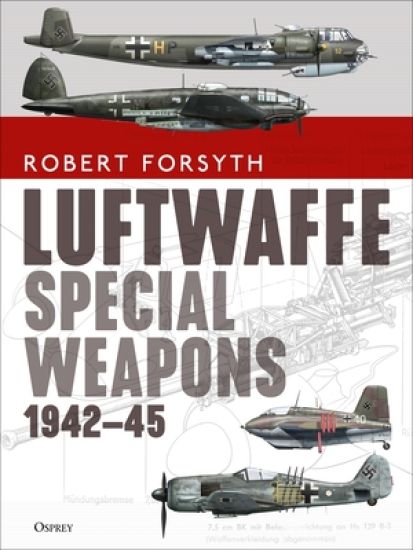
Luftwaffe Special Weapons 1942–45

Luftwaffe Special Weapons 1942–45

Robert Forsyth

Osprey Publishing
2021
sidottu
A highly illustrated study of some of the weapons developed by Nazi Germany to equip the Luftwaffe in their desperate war against the encroaching Allied forces.As the course of World War II turned against the Third Reich after Stalingrad some of the most inventive and radical proposals, and designs, were put forward by armaments manufacturers, scientists and technicians, aircrew and even private individuals to the Reichsluftministerium (German Air Ministry) for consideration. Some proposals were destined never to leave the drawing board, while others not only underwent trials but were issued to operational units and used in action.In this fascinating new book, leading Luftwaffe historian Robert Forsyth examines the many different types of weapons that comprised the Luftwaffe’s increasingly potent arsenal during the second half of the war. This was the period that saw the development and adoption of aerial torpedoes, wire-guided rockets and missiles, batteries fired by photo-electric cells, chemical weapons, composite bombers and air-launched flying bombs.
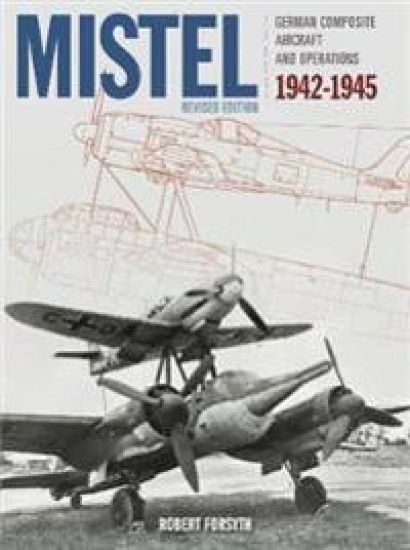
Mistel

Mistel

Robert Forsyth

Crecy Publishing
2020
sidottu
This is a revised and reworked edition of the author's long out of print 2001 study of the origins, development and operations of Germany's composite aircraft during the World War II. Known as the 'Mistel' concept, the designs were originally intended for use in peacetime as a means of extending the range of aircraft, but in 1942 a small team of pilots and engineers adapted the idea for military usage. Comprising Bf 109 or Fw 190 fighters as upper components mounted on top of 'war-weary' Ju 88 airframes fitted with massive hollow-charge warheads replacing their cockpit sections, these extraordinary machines were deployed for the first time off Normandy in July 1944. They were later used in sporadic missions over the Western Front before the Luftwaffe used them in numbers in a last-ditch attempt to try to halt the Soviet advances across the Oder, Warthe and Neisse rivers during the last weeks of the war. The Mistel's size and hazardous nature meant that only experienced pilots could fly it, but despite its complexity, it handled well and its control systems were remarkably sophisticated and responsive. This fascinating and exhaustive study is accompanied by hundreds of rare photographs as well as maps, color artwork and detailed technical drawings.
Arado Ar 234 Bomber and Reconnaissance Units

Arado Ar 234 Bomber and Reconnaissance Units

Robert Forsyth; Nick Beale

Osprey Publishing
2020
nidottu
When the revolutionary twin jet-powered Arado Ar 234 first appeared in the skies over north-west Europe in the summer of 1944, it represented the state-of-the-art in terms of aeronautical and technical development. The Ar 234 was a formidable aircraft – powered by Jumo 004Bs, the same engine used by the Me 262, and with a maximum speed of 735 km/h and range of 1600 km/h, it was very difficult for the Allies to ‘catch’. Here was a machine that with its superior speed could operate with impunity as both a bomber and in the reconnaissancerole. As such, the aircraft became the world’s first reconnaissance jet, undertaking secret, high-speed, high-altitude observation missions for the German High Command over the Allied beachheads in Normandy and other Allied strongholds. Astonishingly, in September 1944 and as late as 1945, lone Ar 234s conducted reconnaissance flights over British ports and theMediterranean. The aircraft was equally efficient as a jet bomber – although the Ar 234B-2 bomber variant carried no defensive gun armament, it was able to deliver 1000 kg of bombs at high-speed and at either low- or high-level with considerable and devastating accuracy.This highly detailed title from renowned aviation historian Robert Forsyth explores the history of this incredible aircraft, from its development in the early 1940s to its deployment in both reconnaissance and bomber roles throughout the rest of the war. The masterful text is supported by stunning, specially commissioned artwork.
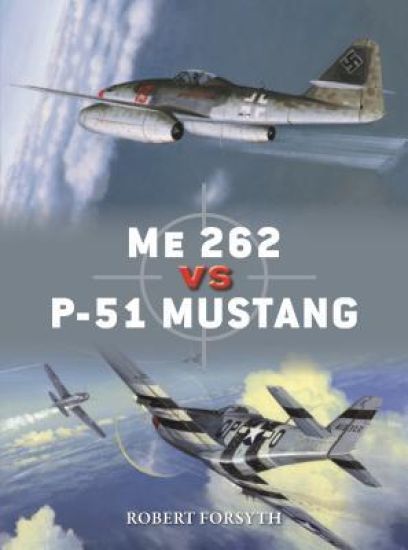
Me 262 vs P-51 Mustang

Me 262 vs P-51 Mustang

Robert Forsyth

Osprey Publishing
2019
nidottu
Arguably two of the finest fighters built during the course of World War II, the Me 262 and P-51 Mustang heralded new dawns in aircraft performance. Making its operational debut in the summer of 1944, and powered by the Jumo 004 jet engine, the Me 262 outclassed Allied planes in terms of speed and firepower ratio, offering a formidable punch with four 30 mm MK 108 nose-mounted cannons. However, in the P-51, fitted with the Rolls-Royce (Packard) Merlin engine and drop tanks, the USAAF finally had a fighter that had the ‘legs’ to escort its heavy bombers deep into Reich airspace and back. If flown to its strengths, the P-51 was more than capable of taking on the feared Me 262 on an equal footing, despite the differences in power and top speed. Indeed, the Mustang proved to be the Luftwaffe fighter arm’s nemesis. When the P-51D sortied over Germany from the summer of 1944 onwards, it shredded through the ill-trained and depleted Gruppen of the Luftwaffe’s defence wings.This book examines the two fighters in detail, exploring their history and development and containing accurate descriptions of the combats between the P-51 Mustang and the Me 262 in what were some of the most bitter and large-scale aerial actions fought over Europe in 1944–45.
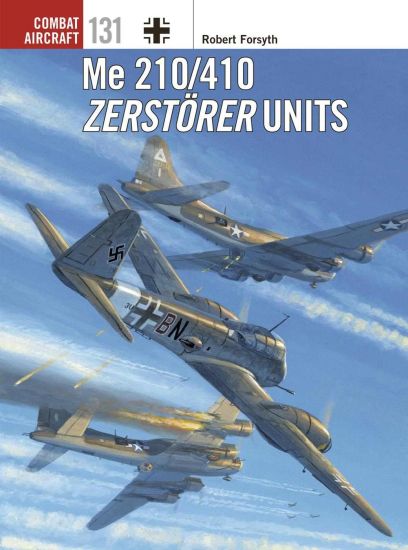
Me 210/410 Zerstörer Units

Me 210/410 Zerstörer Units

Robert Forsyth

Osprey Publishing
2019
nidottu
Intended as a progressive development of the twin-engined Bf 110 Zerstörer (‘destroyer’ or heavy fighter), the Me 210 first took to the air in September 1939. However, due to a lack of sufficient flight-testing before being declared service-ready, the Me 210 suffered from a less than satisfactory reputation in respect to its flight characteristics and weak undercarriage. After enhancements were made to the fuselage and wings, and the power of the plane was increased, the Me 210 became the Me 410 in late 1942. By this stage of the war much was expected of the two types, which were forced to fly in very dangerous skies over North Africa and in the defence of the German homeland. Both aircraft were deployed as heavy fighters, fighter-bombers, reconnaissance platforms and interceptors, seeing service with a number of different units. The Me 410 was fitted with 30 mm cannon, 21 cm underwing mortars and the colossal 5 cm BK cannon that was intended to pack a punch against the USAAF’s four-engined bombers which threatened the Reich in large numbers from 1943 onwards. In this title, supported by contemporary photography and full-colour artwork, Robert Forsyth tells the complex story of the Me 210 and 410, detailing their development and assessing their capabilities as combat aircraft.