Kirjojen hintavertailu. Mukana 12 278 493 kirjaa ja 12 kauppaa.

Kirjailija

Shaofeng Li

Kirjat ja teokset yhdessä paikassa: 3 kirjaa, julkaisuja vuosilta 2019-2024, suosituimpien joukossa Backdoor Attacks against Learning-Based Algorithms. Vertaile teosten hintoja ja tarkista saatavuus suomalaisista kirjakaupoista.

3 kirjaa

Kirjojen julkaisuhaarukka 2019-2024.

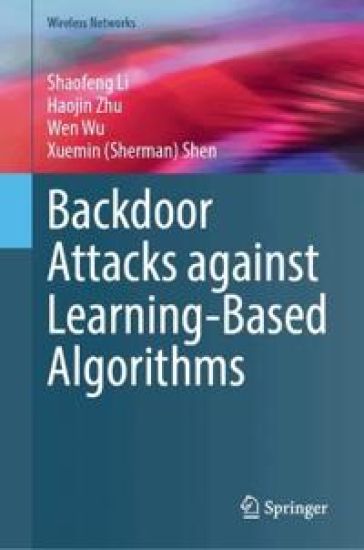
Backdoor Attacks against Learning-Based Algorithms

Backdoor Attacks against Learning-Based Algorithms

Shaofeng Li; Haojin Zhu; Wen Wu; Xuemin (Sherman) Shen

Springer International Publishing AG
2024
sidottu
This book introduces a new type of data poisoning attack, dubbed, backdoor attack. In backdoor attacks, an attacker can train the model with poisoned data to obtain a model that performs well on a normal input but behaves wrongly with crafted triggers. Backdoor attacks can occur in many scenarios where the training process is not entirely controlled, such as using third-party datasets, third-party platforms for training, or directly calling models provided by third parties. Due to the enormous threat that backdoor attacks pose to model supply chain security, they have received widespread attention from academia and industry. This book focuses on exploiting backdoor attacks in the three types of DNN applications, which are image classification, natural language processing, and federated learning.Based on the observation that DNN models are vulnerable to small perturbations, this book demonstrates that steganography and regularization can be adopted to enhance the invisibility of backdoor triggers. Based on image similarity measurement, this book presents two metrics to quantitatively measure the invisibility of backdoor triggers. The invisible trigger design scheme introduced in this book achieves a balance between the invisibility and the effectiveness of backdoor attacks. In the natural language processing domain, it is difficult to design and insert a general backdoor in a manner imperceptible to humans. Any corruption to the textual data (e.g., misspelled words or randomly inserted trigger words/sentences) must retain context-awareness and readability to human inspectors. This book introduces two novel hidden backdoor attacks, targeting three major natural language processing tasks, including toxic comment detection, neural machine translation, and question answering, depending on whether the targeted NLP platform accepts raw Unicode characters.The emerged distributed training framework, i.e., federated learning, has advantages in preserving users' privacy. It has been widely used in electronic medical applications, however, it also faced threats derived from backdoor attacks. This book presents a novel backdoor detection framework in FL-based e-Health systems. We hope this book can provide insightful lights on understanding the backdoor attacks in different types of learning-based algorithms, including computer vision, natural language processing, and federated learning. The systematic principle in this book also offers valuable guidance on the defense of backdoor attacks against future learning-based algorithms.

Task-Based Language Teaching

Task-Based Language Teaching

Rod Ellis; Peter Skehan; Shaofeng Li; Natsuko Shintani; Craig Lambert

Cambridge University Press
2019
pokkari
Task-based language teaching is an approach which differs from traditional approaches by emphasising the importance of engaging learners' natural abilities for acquiring language incidentally through the performance of tasks that draw learners' attention to form. Drawing on the multiple perspectives and expertise of five leading authorities in the field, this book provides a comprehensive and balanced account of task-based language teaching (TBLT). Split into five sections, the book provides an historical account of the development of TBLT and introduces the key issues facing the area. A number of different theoretical perspectives that have informed TBLT are presented, followed by a discussion on key pedagogic aspects - syllabus design, methodology of a task-based lesson, and task-based assessment. The final sections consider the research that has investigated the effectiveness of TBLT, addresses critiques and suggest directions for future research. Task-based language teaching is now mandated by many educational authorities throughout the world and this book serves as a core source of information for researchers, teachers and students.
Task-Based Language Teaching

Task-Based Language Teaching

Rod Ellis; Peter Skehan; Shaofeng Li; Natsuko Shintani; Craig Lambert

Cambridge University Press
2019
sidottu
Task-based language teaching is an approach which differs from traditional approaches by emphasising the importance of engaging learners' natural abilities for acquiring language incidentally through the performance of tasks that draw learners' attention to form. Drawing on the multiple perspectives and expertise of five leading authorities in the field, this book provides a comprehensive and balanced account of task-based language teaching (TBLT). Split into five sections, the book provides an historical account of the development of TBLT and introduces the key issues facing the area. A number of different theoretical perspectives that have informed TBLT are presented, followed by a discussion on key pedagogic aspects - syllabus design, methodology of a task-based lesson, and task-based assessment. The final sections consider the research that has investigated the effectiveness of TBLT, addresses critiques and suggest directions for future research. Task-based language teaching is now mandated by many educational authorities throughout the world and this book serves as a core source of information for researchers, teachers and students.