Kirjojen hintavertailu. Mukana 12 155 662 kirjaa ja 12 kauppaa.

Kirjailija

Stuart Reid

Kirjat ja teokset yhdessä paikassa: 44 kirjaa, julkaisuja vuosilta 1987-2022, suosituimpien joukossa Crown Covenant and Cromwell: The Civil Wars in Scotland 1639-1651. Vertaile teosten hintoja ja tarkista saatavuus suomalaisista kirjakaupoista.

44 kirjaa

Kirjojen julkaisuhaarukka 1987-2022.

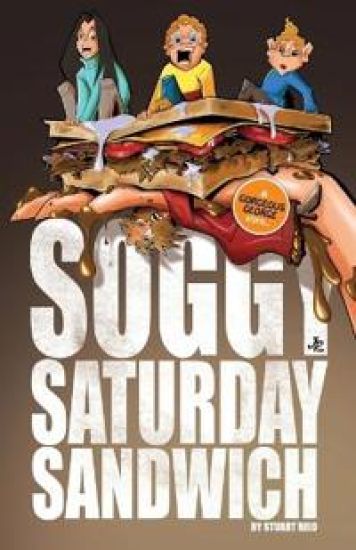
Soggy Saturday Sandwich

Soggy Saturday Sandwich

Stuart Reid

Giant Geriatric Generators Ltd
2022
pokkari
The 9th Book in the Gorgeous George series - a standalone adventureSpr3d the Chocolate - Big bottom burps and a butt-cheek clench. Stingers, and stinkers and stench. Someone's dropping whoppers, and not letting on. They're silent and violent - a really bad pong. Come on. Own up Have you ever dropped a whopper in class, and pretended it wasn't you? Yeah, we've all done it. Now, Gorgeous George and Crayon Kenny are letting them slip without warning, and Allison has been put off her dinner.There's a new chocolate spread being launched in Little Pumpington, and the whole town is going wild for it. Grandpa Jock has found the scratchiest toilet paper ever invented, and he wants to show the world what you can do with it ( and it's not for wiping bottoms )Allison's ear has been dripping with blood. George has been eating a face full of mud. And Crayon Kenny's bottom comes down with a thud There are a couple of really nasty characters who are about to get away with an entire lifetime's worth of bad behaviour. By popular demand, some chapters start with a Yuck Warning, to protect the delicate (mainly mums and dads and teachers). This story is icky, and sicky, and a little bit sticky. And here's the first warning - 'Do not stick boiled eggs up a donkey's bottom ' (this will make sense if you read the book).
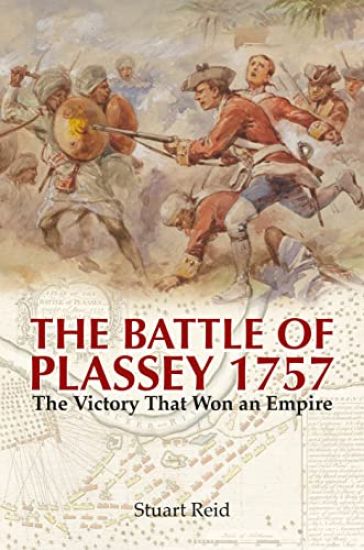
The Battle of Plassey 1757

The Battle of Plassey 1757

Stuart Reid

PEN SWORD BOOKS LTD
2022
nidottu
Britain was rapidly emerging as the most powerful European nation, a position France long believed to be her own. Yet with France still commanding the largest continental army, Britain saw its best opportunities for expansion lay in the East. Yet, as Britain's influence increased through its official trading arm, the East India Company, the ruler of Bengal, Nawab Siraj-ud-daulah, sought to drive the British out of the sub-continent and turned to France for help. The ensuing conflict saw intimate campaigns fought by captains and occasionally colonels and by small companies rather than big battalions. They were campaigns fought by individuals rather than anonymous masses; some were heroes, some were cowards and most of them were rogues on the make. The story is not only about Robert Clive, a clerk from Shropshire who became to all intents and purposes an emperor, but also about Eyre Coote an Irishman who fought with everyone he met, about Alexander Grant a Jacobite who first escaped from Culloden and then, Flashman-like was literally the last man into the last boat to escape Calcutta and the infamous Black Hole. The fighting culminated in Robert Clive's astonishing victory at Plassey where just 3,000 British and sepoy troops defeated Siraj-ud-Daulah's Franco-Bengali army of 18,000 in the space of only forty minutes. The victory at Plassey in 1757 established Britain as the dominant force in India, the whole of which gradually come under British control and became the most prized possession in its empire. Few battles in history have ever had such profound consequences.
Egypt 1801

Egypt 1801

Stuart Reid

Frontline Books
2021
sidottu
The first campaign medal awarded to British soldiers is reckoned to be that given to those men who fought at Waterloo in 1815, but a decade and a half earlier a group of regiments were awarded a unique badge - a figure of a Sphinx - to mark their service in Egypt in 1801. It was a fitting distinction, for the successful campaign was a remarkable one, fought far from home by a British army which had so far not distinguished itself in battle against Revolutionary France, and one moreover which had the most profound consequences in the Napoleonic wars to come. In 1798 a quixotic French expedition led by a certain General Bonaparte not only to seize Egypt and consolidate French influence in the Mediterranean, but also to open up a direct route to Indian and provide an opportunity to destroy the East India Company and fatally weaken Great Britain. In the event, General Bonaparte returned to France to mount a coup which would eventually see him installed as Emperor of the French, but behind him he abandoned his army, which remained in control of Egypt, still posing a possible threat to the East India Company, until in 1801 a large but rather heterogeneous British Army led by Sir Ralph Abercrombie landed and in a series of hard-fought battles utterly defeated the French. Not only did this campaign establish the hitherto rather doubtful reputation of the British Army, and help secure India, but its capture en route of the islands of Malta gained Britain a base which would enable it to dominate the Mediterranean for the next century and a half. This little understood, but profoundly important campaign at last receives the treatment it deserves in the hands of renowned historian Stuart Reid.
Wellington's History of the Peninsular War
Though pressed many times to write about his battles and campaigns, the Duke of Wellington always replied that people should refer to his published despatches, and he refused to add further to his official correspondence, famously remarking that: The history of a battle, is not unlike the history of a ball. Some individuals may recollect all the little events of which the great result is the battle won or lost, but no individual can recollect the order in which, or the exact moment at which, they occurred, which makes all the difference as to their value or importance.' Yet Wellington did, in effect, write a history of the Peninsular War in the form of four lengthy memoranda, summarising the conduct of the war in 1809, 1810 and 1811 respectively. These lengthy accounts demonstrate Wellington's unmatched appreciation of the nature of the war in Spain and Portugal, and relate to the operations of the French and Spanish forces as well as the Anglo-Portuguese army under his command. Unlike personal diaries or journals written by individual soldiers, with their inevitably limited knowledge, Wellington was in an unparalleled position to provide a comprehensive overview of the war. Equally, the memoranda were written as the war unfolded, not tainted with the knowledge of hindsight, providing a unique contemporaneous commentary. Brought together by renowned historian Stuart Reid with reports and key despatches from the other years of the campaign, the result is the story of the Peninsular War told through the writings of the man who knew and understood the conflict in Iberia better than any other. These memoranda and despatches have never been published before in a single connected narrative. Therefore, Wellington's History of the Peninsular War 1808-1814 offers a uniquely accessible perspective on the conflict in the own words of Britain's greatest general.
Gorgeous George and the Timewarp Trouser Trumpets

Gorgeous George and the Timewarp Trouser Trumpets

Stuart Reid

Giant Geriatric Generators Ltd
2018
pokkari
Pirates, parrots, pyramids and pants full of poo Beans, boats and big bottom burps. Have you ever wanted a book so exciting it keeps you up past your bedtime? A story so mad that you're scared to put it down in case the adventure goes on inside the pages, on its own, even after you've stopped reading? Well, you've found it. Grandpa Jock has made one of his world-famous killer curries using the magic beans that his grandson George swapped for a cow costume with a small leprechaun. Mad enough for you yet? But now their bottoms are about to blow and these time travelling trouser trumpets just might transport Gorgeous George and Grandpa Jock anywhere. Or any when This book is a big ball of wibbly-wobbly, timey-wimey stuff - Who said that? - as the story loops and swoops and poops, and pops out to the shops, then meets itself coming back again. Crayon Kenny and Allison are tracking down that mad leprechaun, there's a talking parrot who never shuts up, and of course, there are two cute, fluffy, evil little kittens. And bottom burps. Lots and lots of big bottom burps. So much wind that you'll be glad that this is NOT a scratch and sniff book
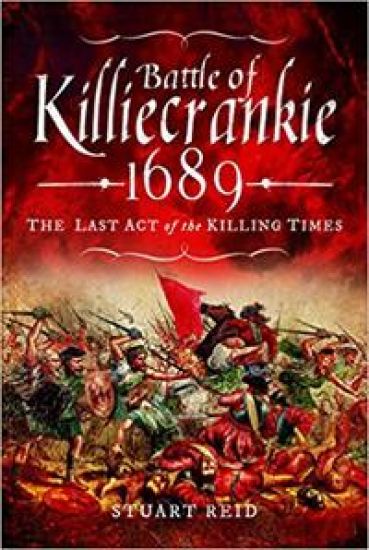
Battle of Killiecrankie 1689

Battle of Killiecrankie 1689

Stuart Reid

Frontline Books
2018
sidottu
The fifty-odd years of Scottish history dominated by the Jacobite Risings are amongst its most evocative and whilst the last battle, Culloden in 1746, is deservedly remembered as a national tragedy, the first battle on the braes of Killiecrankie was unquestionably the most dramatic. It was very much a Scottish battle. The later Jacobite risings would be launched against kings and governments in London. Killiecrankie, on the other hand, pitted Scot against Scot in the last bloody act of the bitter religious struggle known as 'The Killing Times'. Killiecrankie saw the first, and most successful, Highland Charge, as the clansmen broke the line of the Government's redcoats 'in the twinkling of an eye', and though outnumbered the Jacobites achieved a stunning victory. The Highlanders, however, suffered debilitating losses of almost one third of their strength, and their leader, John Graham the Viscount of Dundee, was killed. The Jacobites continued their advance until stopped by Government forces at the Battle of Dunkeld a little more than three weeks later. Though the Jacobites had failed, the struggle of the Highland clans to return the Catholic James, and his successors, to the throne of Scotland and England would continue for the next two generations.
British Redcoat vs French Fusilier

British Redcoat vs French Fusilier

Stuart Reid

Osprey Publishing
2016
nidottu
Providing a unique glimpse into the experiences of regular British and French infantry during the French and Indian War, Stuart Reid reveals what it was like to fight in three battles at the height of the struggle for Canada: La Belle-Famille, the Plains of Abraham and Sainte-Foy.In 1755, Britain and France both decided to escalate a low intensity frontier war that had started the previous year by dispatching regular troops to their respective colonies in North America. Far from home, both sides’ equipment and tactics were initially more suited to the European theatre. As the war ground on, however, combat doctrine evolved as both armies learned lessons that would be utilized by succeeding generations of soldiers.Packed with first-hand accounts, dramatic illustrations and a technical analysis of the changing nature of warfare on the American continent, this book puts readers in the shoes of the combatants who played a pivotal role in shaping the future of North America.
The Flintlock Musket

The Flintlock Musket

Stuart Reid

Osprey Publishing
2016
nidottu
The flintlock or firelock musket is one of the most iconic weapons in history: used on the battlefields of the English Civil War, it was then carried by both sides at Blenheim, Bunker Hill, Waterloo and the Alamo, and dominated warfare for more than 150 years, with military service as late as the American Civil War in the 1860s. Featuring specially commissioned full-colour artwork, this engaging study examines the role that the flintlock played in close-order combat on European and other battlefields around the world. Employing first-hand accounts to show how tactical doctrines were successfully developed to overcome the weapon’s inherent limitations, Stuart Reid offers a comprehensive analysis of the flintlock’s lasting impact as the first truly universal soldier’s weapon.
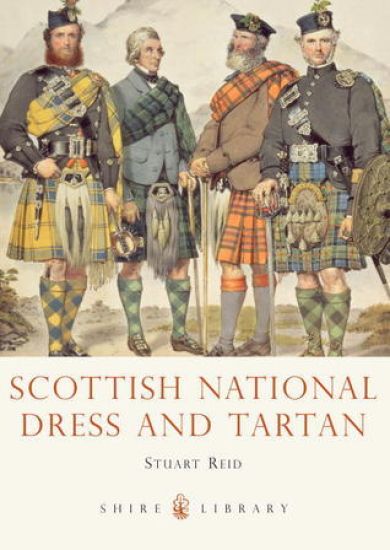
Scottish National Dress and Tartan

Scottish National Dress and Tartan

Stuart Reid

Shire Publications
2013
nidottu
Tartan is an enormously popular pattern in modern fashion. Beginning as Highland dress, it was originally peculiar to certain areas of Scotland, but is now generally accepted as its national costume: what was once ordinary working clothing of a distinctive local style has been formalised into a ceremonial dress, with tartans once woven according to the fancy of those who wore them becoming fixed with certain patterns prescribed for different families, areas or institutions. This process was not, as is popularly thought, a phenomenon begun by the romantic novels of Sir Walter Scott, but began long before as a reaction to the union with England in 1707. This book traces not only the early stages of that evolution, but the process by which the various tartans became icons of Scottish identity.
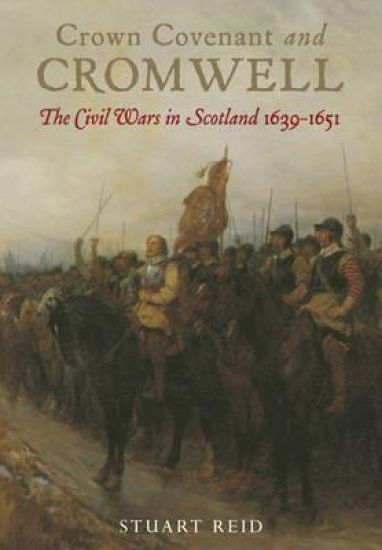
Crown Covenant and Cromwell: The Civil Wars in Scotland 1639-1651
Crown, Covenant and Cromwell is a groundbreaking military history of the Great Civil War or rather the last Anglo-Scottish War as it was fought in Scotland and by Scottish armies in England between 1639 and 1651. While the politics of the time are necessarily touched upon, it is above all the story of those armies and the men who marched in them under generals such as Alexander Leslie, the illiterate soldier of fortune who became Earl of Leven, James Graham, Marquis of Montrose and of course Oliver Cromwell, the fenland farmer and Lord Protector of England.Historians sometimes seem to regard battles as rather too exciting to be a respectable field of study, but determining just how that battle was won or lost is often just as important as unravelling the underlying reasons why it came to be fought in the first place or the consequences that followed. Here, Stuart Reid, one of Scotland's leading military historians, brings the campaigns and battles of those far off unhappy times to life in a fast-paced and authoritative narrative as never before.This book sheds welcome new light on what to many are very obscure corners of the Civil Wars and will be essential reading for students of the period.
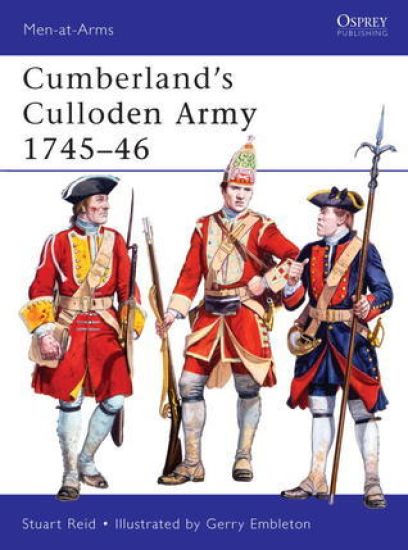
Cumberland’s Culloden Army 1745–46

Cumberland’s Culloden Army 1745–46

Stuart Reid

Osprey Publishing
2012
nidottu
In August 1745 Charles Edward Stuart, the 'Young Pretender', landed in Scotland and sparked the Second Jacobite Rising.The Jacobite forces seized Perth, then Edinburgh, where they proclaimed the Young Pretender's father King James VIII; they trounced their Hanoverian opponents at Prestonpans and crossed into England, getting as far south as Derby before withdrawing into Scotland. Far from universally popular north of the border, the Jacobite army bested another Hanoverian army at Falkirk and besieged Stirling, only to be routed by the Duke of Cumberland's army at Culloden in April 1746, a crushing defeat that ended any prospect of a Stuart restoration.Featuring full-colour artwork depicting the distinctive uniforms of Cumberland's men, this exhaustively researched study offers a wealth of detail of regimental strengths and casualties and includes an extended chronology that places individual units in specific places throughout the campaign that culminated at Culloden.
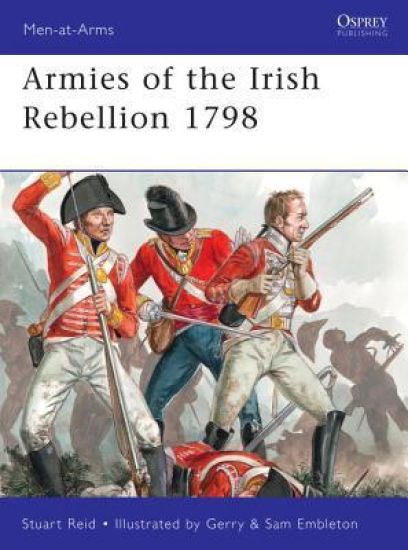
Armies of the Irish Rebellion 1798

Armies of the Irish Rebellion 1798

Stuart Reid

Osprey Publishing
2011
nidottu
In 1798, the Irish rose up against the corrupt English government run out of Dublin.Joined by both Protestants and Catholics, the rebellion quickly spread across the country. Although the Irish peasantry were armed mostly with pikes, they were able to overwhelm a number of small, isolated British outposts. However, even with the half-hearted assistance of the French, the Irish could not compete with the organized ranks of the British Army when under competent leadership. In a brutal turning of the tide, the Redcoats plowed through the rebels.In just three months, between 15,000 and 30,000 people died, most of them Irish. This book tells the story of this harsh, but fascinating, period of Irish history and covers the organization and uniforms of the forces involved.
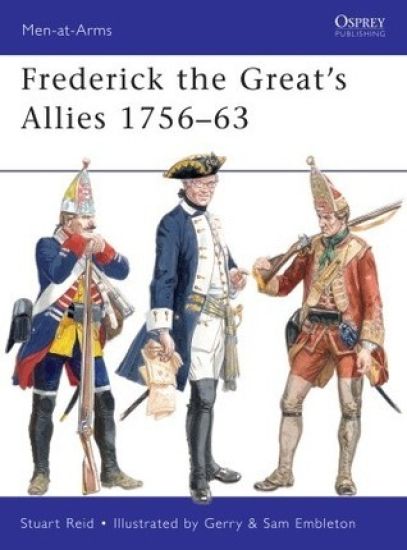
Frederick the Great’s Allies 1756–63

Frederick the Great’s Allies 1756–63

Stuart Reid

Osprey Publishing
2010
nidottu
The Seven Years' War in Germany was characterised by an increasing use of 'light' troops in conjunction with regular infantry and cavalry as part of an ongoing evolution in military tactics. This book draws attention to these tactical developments and also provides an analysis of the allied army that fought alongside Frederick the Great in Germany. Composed of troops from the electorate of Hanover and contingents from Hessen-Kassel, Brunswick and Prussia, this force was funded by Britain and led by a Prussian officer, Prince Ferdinand of Brunswick. Later, British troops joined this army as it operated throughout western Germany, and together the allied army won a great victory at the famous battle of Minden in 1759.
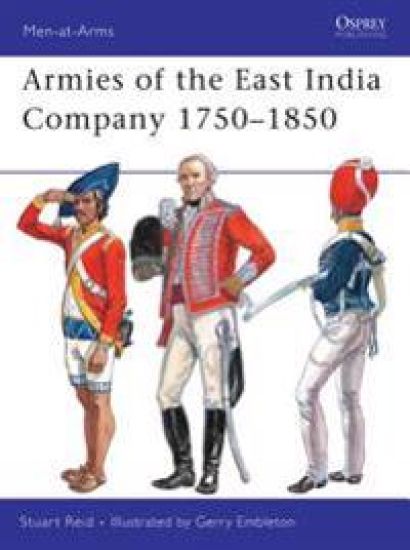
Armies of the East India Company 1750–1850
Contrary to popular belief, the capture of India was not accomplished by the British Army, but by the private armies of the East India Company, which grew in size to become larger than that of any European sovereign state. This is the history of this army, examining the many conflicts they fought, their equipment and training, with its regiments of horse, foot and guns, which rivalled those of most European powers. The uniforms, combining traditional Indian and British dress are illustrated in detail and make for a colourful account of a private band of adventurers that successfully captured the jewel of the British Empire.