Kirjojen hintavertailu. Mukana 12 390 323 kirjaa ja 12 kauppaa.

Kirjailija

Stuart S. Nagel

Kirjat ja teokset yhdessä paikassa: 31 kirjaa, julkaisuja vuosilta 1977-2021, suosituimpien joukossa Public Policy. Vertaile teosten hintoja ja tarkista saatavuus suomalaisista kirjakaupoista.

Mukana myös kirjoitusasut: Stuart S Nagel

31 kirjaa

Kirjojen julkaisuhaarukka 1977-2021.

Public Policy Evaluation

Public Policy Evaluation

Stuart S. Nagel

Routledge
2020
nidottu
First published in 1998, this volume examines how super-optimum decisions involve finding alternatives to controversies whereby Conservatives, Liberals, or other major groups can all come out ahead of their best initial expectations simultaneously. This book is organised in terms of concepts, methods, causes, process, substance, and the policy studies profession. Concepts clarify that policy evaluation traditionally involves: (1) Goals to be achieved; (2) Alternatives available for achieving them; (3) Relations between goals and alternatives; (4) Drawing a conclusion as to the best alternative in light of the goals, alternatives, and relations; and (5) Analysing how the conclusion would change if there were changes in the goals, alternatives, or relations. Super-optimizing also involves five related steps, but with the following improvements: (1) Goals are designed as conservative, liberal, or neutral; (2) Alternatives get the same designations; (3) Relations are simplified to indicate which alternatives are relatively high or low on each goal; (4) The conclusion involves arriving at an alternative that does better on Goal A than Alternative A, and simultaneously better on Goal B than Alternative B; and (5) The fifth step involves analysing the super-optimum or win-win alternative in terms of its feasibility as to the economic, technological, psychological, political, administrative, and legal matters.
Policy within and Across Developing Nations
First published in 1998, policy WITHIN developing nations includes: (1) Economic policy, such as economic growth without inflation or sectors of unemployment; (2)Technology policy, such as encouraging the ad option of improved technologies for health, energy, transportation, agriculture, manufacturing and the environment; (3) Social policy, such as education facilities, and merit treatment across ethnic groups, genders, age groups, economic classes, and geographical regions; (4) Political policy, such as multiple sources of ideas from different government levels, branches, interest groups, and parties; (5) Legal policy, such as compliance with the law by street people, business people, and government people. Policy ACROSS developing nations includes: (1) International economic policy, such as trade, tariffs exchange rates, and factory relocation; (2) International technology policy, such as patents, copyrights, trademarks, and other aspects of technology transfer; (3) International social policy, such as immigration, refugees, and cross-border ethnic friction; (4) International political policy, such as human rights and the role of sanctions; (5) International legal policy, such as the drug trade, human rights, business transactions, torts, and property rights across national boundaries.
Policy within and Across Developing Nations
First published in 1998, policy WITHIN developing nations includes: (1) Economic policy, such as economic growth without inflation or sectors of unemployment; (2)Technology policy, such as encouraging the ad option of improved technologies for health, energy, transportation, agriculture, manufacturing and the environment; (3) Social policy, such as education facilities, and merit treatment across ethnic groups, genders, age groups, economic classes, and geographical regions; (4) Political policy, such as multiple sources of ideas from different government levels, branches, interest groups, and parties; (5) Legal policy, such as compliance with the law by street people, business people, and government people. Policy ACROSS developing nations includes: (1) International economic policy, such as trade, tariffs exchange rates, and factory relocation; (2) International technology policy, such as patents, copyrights, trademarks, and other aspects of technology transfer; (3) International social policy, such as immigration, refugees, and cross-border ethnic friction; (4) International political policy, such as human rights and the role of sanctions; (5) International legal policy, such as the drug trade, human rights, business transactions, torts, and property rights across national boundaries.
Public Policy Evaluation

Public Policy Evaluation

Stuart S. Nagel

Routledge
2018
sidottu
First published in 1998, this volume examines how super-optimum decisions involve finding alternatives to controversies whereby Conservatives, Liberals, or other major groups can all come out ahead of their best initial expectations simultaneously. This book is organised in terms of concepts, methods, causes, process, substance, and the policy studies profession. Concepts clarify that policy evaluation traditionally involves: (1) Goals to be achieved; (2) Alternatives available for achieving them; (3) Relations between goals and alternatives; (4) Drawing a conclusion as to the best alternative in light of the goals, alternatives, and relations; and (5) Analysing how the conclusion would change if there were changes in the goals, alternatives, or relations. Super-optimizing also involves five related steps, but with the following improvements: (1) Goals are designed as conservative, liberal, or neutral; (2) Alternatives get the same designations; (3) Relations are simplified to indicate which alternatives are relatively high or low on each goal; (4) The conclusion involves arriving at an alternative that does better on Goal A than Alternative A, and simultaneously better on Goal B than Alternative B; and (5) The fifth step involves analysing the super-optimum or win-win alternative in terms of its feasibility as to the economic, technological, psychological, political, administrative, and legal matters.
Handbook of Public Policy Evaluation

Handbook of Public Policy Evaluation

Stuart S. Nagel

SAGE Publications Inc
2002
sidottu
Handbook of Public Policy Evaluation is the only book of its kind to present aspects of public policy evaluation that relate to economic, technology, social, political, international, and legal problems. Rather than looking at specific narrowly focused programs, this book emphasizes broad-based evaluation theory, study, and application, providing a rich variety of exceptional insights and ideas. Designed to facilitate integration and coherence, key features in this volume include: Systematic evaluation, measuring the policy alternatives available for achieving goals Win-win evaluation, processing policy alternatives that can enable conservatives, liberals, and other major viewpoints to all come out ahead of their best initial expectations simultaneously Policy evaluation, offering methods, examples, studies, professionalism, perspectives, concepts, trends, substance, theory, applications, dispute resolution, interdisciplinary interaction and bibliographies and applications The book targets the need for improvement in the methods, processes, and substance of public policy and opens the gate of public policy to be more effective, efficient, and equitable. Policymakers, administrators, analysts, and practitioners alike will find the Handbook a necessary resource of alternative public policies that are placed in context with a direct course to positive results.
Resolving International Disputes Through Super-Optimum Solutions
This book concerns resolving conflicts on an international level. The author states that for the purposes of this book, the dispute would have to be at the level of a war, revolution, or other dispute that involves substantial bloodshed on one or more sides, rather than a dispute that merely involves words, economic competition, or non-violent conflict. The SOS Resolution is a special kind of Win-Win dispute resolution where one where both or all sides come out ahead of even their best initial expectations simultaneously. The steps and strategies of this resolution are fully explained.
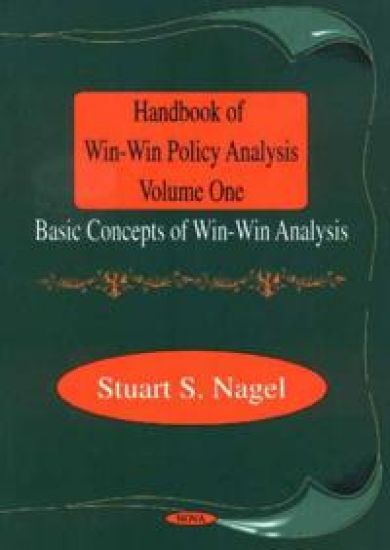
Handbook of Win-Win Policy Analysis, Volume 1

Handbook of Win-Win Policy Analysis, Volume 1

Stuart S Nagel

Nova Science Publishers Inc
2001
sidottu
This monumental handbook is dedicated to the sources of super-optimising, including: Thomas Saaty on multi-criteria decision-aiding software, Lawrence Susskind on alternative policy-dispute resolution, and Robert Reich on growth economics, which are the fields of management science, law, and social science, applied here toward building a super-optimum, win-win society.
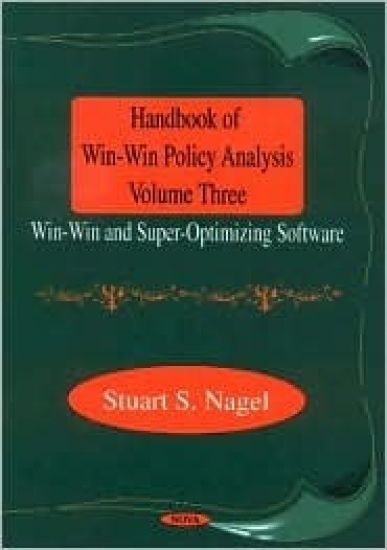
Handbook of Win-Win Policy Analysis, Volume 3

Handbook of Win-Win Policy Analysis, Volume 3

Stuart S Nagel

Nova Science Publishers Inc
2001
sidottu
This monumental handbook is dedicated to the sources of super-optimising, including: Thomas Saaty on multi-criteria decision-aiding software, Lawrence Susskind on alternative policy-dispute resolution, and Robert Reich on growth economics, which are the fields of management science, law, and social science, applied here toward building a super-optimum, win-win society.
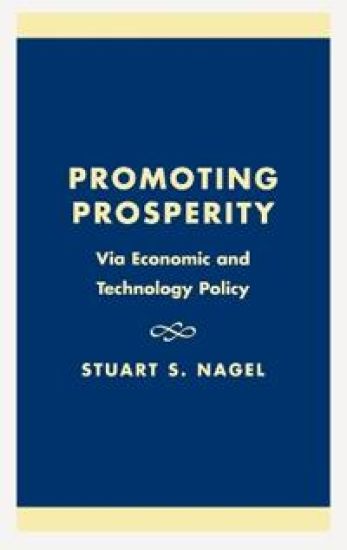
Promoting Prosperity

Promoting Prosperity

Stuart S. Nagel

Lexington Books
2000
sidottu
This is the prosperity volume in a three-volume set on peace, prosperity and democracy. The author uses specific issues such as goods exchange, immigration policy, volunteerism in technical assistance, international exchange of factories, and monetary exchange rates to construct a polyvalent framework of analysis. In this examination of economic and technology policy from both a domestic and international perspective, Stuart Nagel has created an important and lasting contribution to the field of public policy studies.
Super-Optimum Solutions and Win-Win Policy

Super-Optimum Solutions and Win-Win Policy

Stuart S. Nagel

Praeger Publishers Inc
1997
sidottu
Is there a way for people on both sides of a dispute to come out ahead? Yes, says Stuart Nagel, and he calls his method super-optimizing decision making. Instead of expecting both sides to come out ahead of their worst initial expectations, Nagel's super-optimum solutions approach (SOS) allows both to come out ahead of their best initial expectations, and to do so simultaneously. Nagel offers readers in all fields of the public sector, with diverse interests and experiences, a clear, well-illustrated introduction to the basic concepts and principles of super-optimized decision making. Emphasizing rule-making and broader policy controversies rather than individual cases of adjudication, and with less reliance on mathematics and statistics than other books on decision-making techniques, Nagel's approach is basically commonsensical and easily grasped. Decision makers in the public sector will find the book fascinating and of special importance in their daily activities. Private-sector executives will find that its approaches can indeed be adapted to their own special concerns.
Asian Development and Public Policy

Asian Development and Public Policy

Stuart S. Nagel

Palgrave Macmillan
1994
sidottu
This book analyzes various important aspects of methodology and substance regarding economic, social, and political policy in Asia directed toward achieving more effective, efficient, and equitable societal institutions. The chapters are authored by experts from within Asia and also from Asia research institutes elsewhere. The book combines practical policy significance with insightful causal and prescriptive generalizations. The emphasis is on the role of governmental decision-making and the important (but secondary) role of the marketplace, social groups, and engineering.
Asian Development and Public Policy

Asian Development and Public Policy

Stuart S. Nagel

Palgrave Macmillan
1994
nidottu
This book analyzes various important aspects of methodology and substance regarding economic, social, and political policy in Asia directed toward achieving more effective, efficient, and equitable societal institutions. The chapters are authored by experts from within Asia and also from Asia research institutes elsewhere. The book combines practical policy significance with insightful causal and prescriptive generalizations. The emphasis is on the role of governmental decision-making and the important (but secondary) role of the marketplace, social groups, and engineering.
Legal Scholarship, Microcomputers, and Super-Optimizing Decision-Making
An exciting aspect of contemporary legal scholarship is a concern for law from a global perspective across all legal fields. The book draws upon examples from North America, Western Europe, Africa, Asia, Eastern Europe, and Latin America. It refers to the basic private law fields of torts, property, contracts, and family law. It also refers to the basic public law fields of constitutional law, administrative law, criminal law, and international law. It analyzes diverse legal policy problems from a perspective that is designed to produce solutions whereby conservatives, liberals, and other major viewpoints can all come out ahead of their best initial expectations simultaneously. Such solutions can be considered an important part of an innovative concept of justice that emphasizes being effective, efficient, and equitable simultaneously, rather than compromising on any of those justice components.Another exciting aspect of contemporary legal scholarship is a concern for the use of modern technology in the form of microcomputer software that can be helpful in law teaching, practice, and research. Computer-aided instruction can supplement the case method by using what-if analysis to make changes in the goals to be achieved, alternative decisions available for achieving them, the factual relations, and other inputs to see how the decisions might change with changes in those inputs. Computer-aided law practice can be helpful in counseling, negotiation, mediation, case analysis, legal policy evaluation, and advocacy. Computer-aided research can be helpful in testing deductive or statistical models to determine how well they can explain variance across the judicial process or other legal processes.
Professional Developments in Policy Studies

Professional Developments in Policy Studies

Stuart S. Nagel; Miriam K. Mills

Praeger Publishers Inc
1993
sidottu
This is an insightful overview of what is happening at the cutting edge of professional public policy analysis. Written by a well-known expert, the survey assesses the many and varied aspects of the policy studies discipline. Stuart Nagel has provided an analysis of the profession that will be useful to practitioners and academics, as well as students and teachers, at both the undergraduate and graduate levels.This survey begins by suggesting ways for professionals to become more effective and interdisciplinary in their approaches to dealing with public policy. The author also analyzes cross-cutting governmental activities and different theoretical perspectives. He points to means for achieving policy goals, for selecting among alternative policies, and to the organizations and institutions that are concerned with public policy. A bibliography notes the most important recent publications dealing with professional developments in the field.
Computer-Aided Judicial Analysis

Computer-Aided Judicial Analysis

Stuart S. Nagel

Praeger Publishers Inc
1992
sidottu
Decision-aiding software, the underpinning of computer-aided judicial analysis, can facilitate the prediction of how cases are likely to be decided, prescribe decisions that should be reached in such cases, and help administrate more efficiently the court process. It can do so, says Nagel, by listing past cases on each row of a spreadsheet matrix, by listing predictive criteria in the columns, and in general by showing for each factual element the estimated probability of winning a case. The software aggregates the information available and deduces likely outcomes. But it can also prescribe judicial decisions by listing alternatives in the rows, the goals to be achieved in the columns, and by showing relations between alternatives in the cells. By similar means decision-aiding software can also help perform administrative tasks, such as rationally assigning judges or other personnel to cases, and by sequencing cases to reduce the time consumed by each case.In Part I, Nagel provides an overview of computer-aided analysis and the role of decision-aiding software in the legal process. In the second part he deals with judicial prediction from prior cases and from present facts; and in the third part he emphasizes the prescribing role of judges, particularly in deciding the rules that ought to be applied in civil and criminal procedures. Nagel also covers computer-aided mediation and provides a new perspective on judicial decisions. Then, in Part IV, he treats at length the process of judicial administration and how to improve its efficiency. Of particular interest to court personnel will be the benefits to be derived from reducing delays and in the docketing and sequencing of cases.
Evaluative and Explanatory Reasoning

Evaluative and Explanatory Reasoning

Stuart S. Nagel

Praeger Publishers Inc
1992
sidottu
This volume is a culmination of years of development, and the first to introduce the concepts of superoptimum evaluative and explanatory reasoning. Stuart Nagel's new Quorum book will help academic and practicing attorneys in two important ways. First, by understanding evaluative reasoning, they will gain a better grasp of the appropriate behavior to be adopted if they wish to achieve certain desired goals. Second, by understanding the elements of explanatory reasoning, they will understand how and why decisions are reached.Evaluative reasoning can take several forms. It can help decision-makers select from among several public policy choices. It can enhance individual decision-making and provide means to allocate scarce resources. It can also assist in advocating and influencing decisions, mediating disputes, representing divergent viewpoints, and in assigning people to specific tasks. Explanatory reasoning, on the other hand, will help explain public policy making, and assist users in generalizing from cases and facts, and in understanding relationships. The purpose of explanatory reasoning is also to explain why superoptimum solutions are infrequently adopted and why they are seldom successfully implemented. The use of both kinds of reasoning, says Nagel, are particularly important to those who want a better understanding and want to improve the legal system.