Kirjojen hintavertailu. Mukana 12 284 538 kirjaa ja 12 kauppaa.

Kirjailija

Sumit Ganguly

Kirjat ja teokset yhdessä paikassa: 30 kirjaa, julkaisuja vuosilta 1997-2023, suosituimpien joukossa Indian Foreign Policy (Revised Edition). Vertaile teosten hintoja ja tarkista saatavuus suomalaisista kirjakaupoista.

Mukana myös kirjoitusasut: Šumit Ganguly

30 kirjaa

Kirjojen julkaisuhaarukka 1997-2023.

The Sino-Indian Rivalry

The Sino-Indian Rivalry

Šumit Ganguly; Manjeet S. Pardesi; William R. Thompson

Cambridge University Press
2023
sidottu
Drawing on a wide body of literature on international rivalries, this comprehensive and theoretically grounded work explains the origins and evolution of the Sino-Indian rivalry. Contrary to popular belief, the authors argue that the Sino-Indian rivalry started almost immediately after the emergence of the two countries in the global arena. They demonstrate how the rivalry has systemic implications for both Asia and the global order, intertwining the positional and spatial dimensions that lie at the heart of the Sino-Indian relationship. Showing how this rivalry has evolved from the late 1940s to the present day, the essays in this collection underscore its significance for global politics and highlight how the asymmetries between India and China have the potential to escalate conflict in the future.
The Sino-Indian Rivalry

The Sino-Indian Rivalry

Šumit Ganguly; Manjeet S. Pardesi; William R. Thompson

Cambridge University Press
2023
pokkari
Drawing on a wide body of literature on international rivalries, this comprehensive and theoretically grounded work explains the origins and evolution of the Sino-Indian rivalry. Contrary to popular belief, the authors argue that the Sino-Indian rivalry started almost immediately after the emergence of the two countries in the global arena. They demonstrate how the rivalry has systemic implications for both Asia and the global order, intertwining the positional and spatial dimensions that lie at the heart of the Sino-Indian relationship. Showing how this rivalry has evolved from the late 1940s to the present day, the essays in this collection underscore its significance for global politics and highlight how the asymmetries between India and China have the potential to escalate conflict in the future.
Mending Fences

Mending Fences

Sumit Ganguly

TAYLOR FRANCIS LTD
2023
nidottu
Exploring the long history of conflict in South Asia, this book assesses the role of confidence- and security-building measures (CSBMs) in reducing tension. Using a comparative framework, the contributors draw lessons for South Asia from the experiences of the states in Cold War Europe and in the Middle East. Despite the significant historical, political and geographic differences among regions, the contributors illustrate how the implementation of CSBM's elsewhere has important implications for limiting interstate conflict in South Asia.
Mending Fences

Mending Fences

Sumit Ganguly

TAYLOR FRANCIS LTD
2021
sidottu
Exploring the long history of conflict in South Asia, this book assesses the role of confidence- and security-building measures (CSBMs) in reducing tension. Using a comparative framework, the contributors draw lessons for South Asia from the experiences of the states in Cold War Europe and in the Middle East. Despite the significant historical, political and geographic differences among regions, the contributors illustrate how the implementation of CSBM's elsewhere has important implications for limiting interstate conflict in South Asia.
The Hope And The Reality

The Hope And The Reality

Harold A Gould; Sumit Ganguly

Routledge
2021
nidottu
This book charts the relationship between the evolving governments of independent India and concurrent US presidential administrations. It provides an in-depth analysis of the motivations, external constraints and ideological agendas that characterized Indian-US relations.
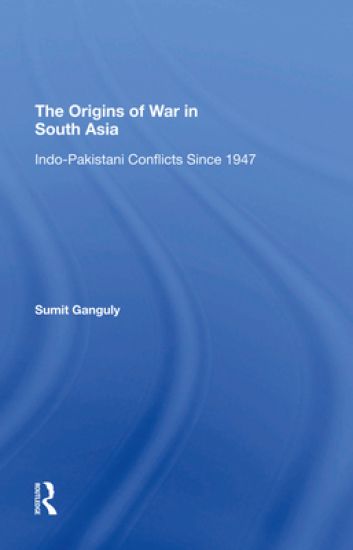
The Origins Of War In South Asia

The Origins Of War In South Asia

Sumit Ganguly

Routledge
2020
nidottu
In examining the forces that made the Indo-Pakistani relationship prone to conflict, Dr. Ganguly focusses first on the nature of the British colonial disengagement policy, a hasty and ill-conceived procedure that served to exacerbate the ideological differences between India's major political parties, the Congress and the Muslim League. Their competing views–the Congress espoused a secular polity while the League drew its inspiration from Islamic tenets–formed the basis of the two polities that emerged from the collapse of the British Indian empire. Disputes also arose over the uncertain status of Kashmir. With the lapse of the British doctrine of paramountcy (recognition of the British as the sovereign power in India), the so-called princely states had to join either India or Pakistan on the basis of geographic location and demographic composition. Kashmir posed a problem because of its location and because it had a Hindu monarch ruling a Muslim majority population. This peculiar status made it the center of a Pakistani irredentist claim. This claim was rejected by India, iintent upon demonstrating that all minorities could thrive under the aegis of secular government. Once set in motion by the interplay of domestic, regional, and systematic factors, these three forces--disengagement, ideological differences, and the conflict over Kashmir--brought the subcontinent to war in 1947-1948, 1965, and 1971. Dr. Ganguly provides a comprehensive and comparative analysis of these three Indo-Pakistani conflicts as well as an assessment of both the impact of the Soviet invasion of Afghanistan on the security of South Asia and the changes in the perceptions of that security.
The Hope And The Reality

The Hope And The Reality

Harold A Gould; Sumit Ganguly

Routledge
2019
sidottu
This book charts the relationship between the evolving governments of independent India and concurrent US presidential administrations. It provides an in-depth analysis of the motivations, external constraints and ideological agendas that characterized Indian-US relations.
The Origins Of War In South Asia

The Origins Of War In South Asia

Sumit Ganguly

Routledge
2019
sidottu
In examining the forces that made the Indo-Pakistani relationship prone to conflict, Dr. Ganguly focusses first on the nature of the British colonial disengagement policy, a hasty and ill-conceived procedure that served to exacerbate the ideological differences between India's major political parties, the Congress and the Muslim League. Their competing views–the Congress espoused a secular polity while the League drew its inspiration from Islamic tenets–formed the basis of the two polities that emerged from the collapse of the British Indian empire. Disputes also arose over the uncertain status of Kashmir. With the lapse of the British doctrine of paramountcy (recognition of the British as the sovereign power in India), the so-called princely states had to join either India or Pakistan on the basis of geographic location and demographic composition. Kashmir posed a problem because of its location and because it had a Hindu monarch ruling a Muslim majority population. This peculiar status made it the center of a Pakistani irredentist claim. This claim was rejected by India, iintent upon demonstrating that all minorities could thrive under the aegis of secular government. Once set in motion by the interplay of domestic, regional, and systematic factors, these three forces--disengagement, ideological differences, and the conflict over Kashmir--brought the subcontinent to war in 1947-1948, 1965, and 1971. Dr. Ganguly provides a comprehensive and comparative analysis of these three Indo-Pakistani conflicts as well as an assessment of both the impact of the Soviet invasion of Afghanistan on the security of South Asia and the changes in the perceptions of that security.
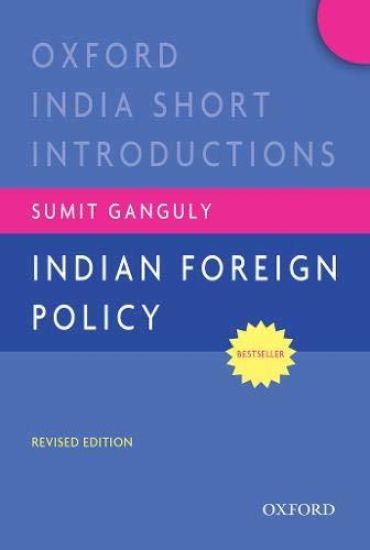
Indian Foreign Policy (Revised Edition)
Updated and revised, this short introduction has become a go-to source for its clarity and succinct account of the evolution of Indian foreign policy over seven decades of India's decolonization. It explains how the three approaches to the study of international politics-decision-making, national/domestic, and systemic/global-have helped in formulating and implementing India's foreign policies. The five chapters cover the ideational period, starting immediately after Independence and ending with the Sino-Indian border war of 1962; the period between 1962 and the end of the Cold War; India's greater acceptance of the importance of material capabilities following the end of the Cold War; current trends and debates in Indian foreign policy, including analysis on Narendra Modi's regime; and bookending the introduction by discussing challenges and the possible way ahead.
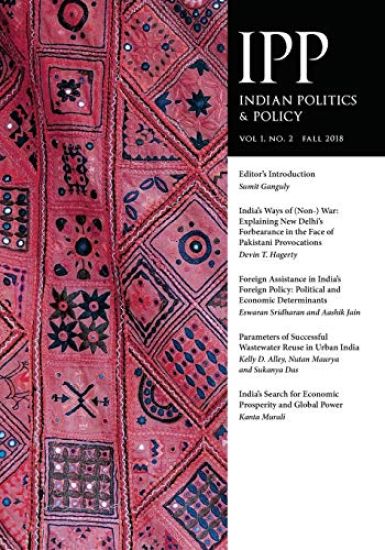
Indian Politics & Policy: Vol. 1, No. 2, Fall 2018
Indian Politics and Policy aims to be the primary journal for studying contemporary Indian politics. We will consider submissions that analyze all aspects of Indian policies and political processes. We invite original work that demonstrates theoretical rigor, sound empirical research and policy relevance. We also welcome review articles, proposals for special issues and research forums on contemporary topics. Table of Contents: Editor's Introduction Sumit Ganguly doi: 10.18278/inpp.1.2.1 India's Ways of (Non-) War: Explaining New Delhi's Forbearance in the Face of Pakistani Provocations Devin T. Hagerty doi: 10.18278/inpp.1.2.2 Foreign Assistance in India's Foreign Policy: Political and Economic Determinants Eswaran Sridharan and Aashik Jain doi: 10.18278/inpp.1.2.3 Parameters of Successful Wastewater Reuse in Urban India, Kelly D. Alley, Nutan Maurya, and Sukanya Das doi: 10.18278/inpp.1.2.4 India's Search for Economic Prosperity and Global Power, Kanta Murali doi: 10.18278/inpp.1.2.5
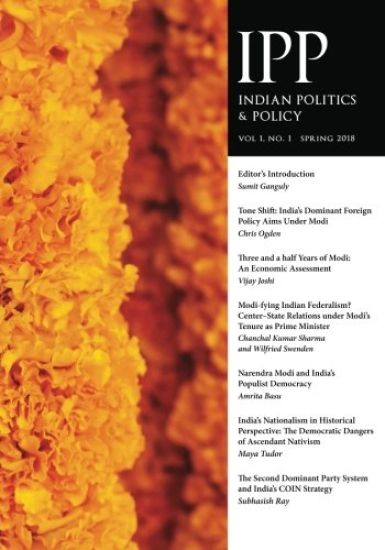
Indian Politics & Policy: Vol. 1, No. 1, Spring 2018
Indian Politics & Policy (IPP) aims to be the primary journal for studying contemporary Indian politics. We will consider submissions that analyze all aspects of Indian policies and political processes. We invite original work that demonstrates theoretical rigor, sound empirical research and policy relevance. We also welcome review articles, proposals for special issues and research forums on contemporary topics. Submissions should be sent to [email protected]. After an initial screening, the editors will send manuscripts to independent, experts in the field for double-blind reviews. Only manuscripts that are considered ready for publication will be sent for review. Indian Politics & Policy seeks to publish original research. Contributors should not submit significant portions of previously published work. In case of any question of overlap, the authors should send a copy of the earlier work to the editors to make a determination.
Deadly Impasse

Deadly Impasse

Sumit Ganguly

Cambridge University Press
2016
sidottu
What ails the Indo-Pakistani relationship? Rivalry between the two states has persisted since the partition of the British Indian Empire in 1947, and despite negotiations, four wars and multiple crises, India and Pakistan remain locked in a long-standing dispute. Evaluating relations from 1999 through to 2009, Sumit Ganguly seeks to understand this troubled relationship and why efforts at peace-making and conflict resolution, which have included unilateral Indian concessions, have not been more fruitful. Charting key sources of tension throughout the decade, including the origins and outcomes of the Kargil War in 1999, developments in the Indian-controlled portion of the state of Kashmir, the attack on the Indian parliament in December 2001 and the onset of the 2001–2 crisis, Deadly Impasse sets out to discover whether the roots of this hostile relationship stem from security dilemmas or reflect the dynamics between a status quo power and a predatory state.
Deadly Impasse

Deadly Impasse

Sumit Ganguly

Cambridge University Press
2016
pokkari
What ails the Indo-Pakistani relationship? Rivalry between the two states has persisted since the partition of the British Indian Empire in 1947, and despite negotiations, four wars and multiple crises, India and Pakistan remain locked in a long-standing dispute. Evaluating relations from 1999 through to 2009, Sumit Ganguly seeks to understand this troubled relationship and why efforts at peace-making and conflict resolution, which have included unilateral Indian concessions, have not been more fruitful. Charting key sources of tension throughout the decade, including the origins and outcomes of the Kargil War in 1999, developments in the Indian-controlled portion of the state of Kashmir, the attack on the Indian parliament in December 2001 and the onset of the 2001–2 crisis, Deadly Impasse sets out to discover whether the roots of this hostile relationship stem from security dilemmas or reflect the dynamics between a status quo power and a predatory state.
Fearful Symmetry

Fearful Symmetry

Sumit Ganguly; Devin T. Hagerty

University of Washington Press
2015
sidottu
With the nuclearization of the Indian subcontinent, Indo-Pakistani crisis behavior has acquired a deadly significance. The past two decades have witnessed no fewer than six crises against the backdrop of a vigorous nuclear arms race. Except for the Kargil war of 1998-9, all these events were resolved peacefully.Nuclear war was avoided despite bitter mistrust, everyday tensions, an intractable political conflict over Kashmir, three wars, and the steady refinement of each side's nuclear capabilities. Sumit Ganguly and Devin T. Hagerty carefully analyze each crisis, reviewing the Indian and Pakistani domestic political systems and key decisions during the relevant period.This lucid and comprehensive study of the two nations' crisis behavior in the nuclear age is the first work on Indo-Pakistani relations to take systematic account of the role played by the United States in South Asia's security dynamics over the past two decades in the context of unipolarization, and formulates a blueprint for American policy toward a more positive and productive India-Pakistan relationship.
The Snowden Reader

The Snowden Reader

Sumit Ganguly

Indiana University Press
2015
pokkari
When Edward Snowden began leaking NSA documents in June 2013, his actions sparked impassioned debates about electronic surveillance, national security, and privacy in the digital age. The Snowden Reader looks at Snowden's disclosures and their aftermath. Critical analyses by experts discuss the historical, political, legal, and ethical issues raised by the disclosures. Over forty key documents related to the case are included, with introductory notes explaining their significance: documents leaked by Snowden; responses from the NSA, the Obama administration, and Congress; statements by foreign leaders, their governments, and international organizations; judicial rulings; findings of review committees; and Snowden's own statements. This book provides a valuable introduction and overview for anyone who wants to go beyond the headlines to understand this historic episode.
The Snowden Reader

The Snowden Reader

Sumit Ganguly

Indiana University Press
2015
sidottu
When Edward Snowden began leaking NSA documents in June 2013, his actions sparked impassioned debates about electronic surveillance, national security, and privacy in the digital age. The Snowden Reader looks at Snowden's disclosures and their aftermath. Critical analyses by experts discuss the historical, political, legal, and ethical issues raised by the disclosures. Over forty key documents related to the case are included, with introductory notes explaining their significance: documents leaked by Snowden; responses from the NSA, the Obama administration, and Congress; statements by foreign leaders, their governments, and international organizations; judicial rulings; findings of review committees; and Snowden's own statements. This book provides a valuable introduction and overview for anyone who wants to go beyond the headlines to understand this historic episode.
How Rivalries End

How Rivalries End

Karen Rasler; William R. Thompson; Sumit Ganguly

University of Pennsylvania Press
2013
sidottu
Rivalry between nations has a long and sometimes bloody history. Not all political opposition culminates in war-the rivalry between the United States and the Soviet Union is one example-but in most cases competition between nations and peoples for resources and strategic advantage does lead to violence: nearly 80 percent of the wars fought since 1816 were sparked by contention between rival nations. Long-term discord is a global concern, since competing states may drag allies into their conflict or threaten to use weapons of mass destruction. How Rivalries End is a study of how such rivalries take root and flourish and particularly how some dissipate over time without recourse to war. Political scientists Karen Rasler, William R. Thompson, and Sumit Ganguly examine ten political hot spots, stretching from Egypt and Israel to the two Koreas, where crises and military confrontations have occurred over the last seven decades. Through exacting analysis of thirty-two attempts to deescalate strategic rivalries, they reveal a pattern in successful conflict resolutions: shocks that overcome foreign policy inertia; changes in perceptions of the adversary's competitiveness or threat; positive responses to conciliatory signals; and continuing effort to avoid conflict after hostilities cease. How Rivalries End significantly contributes to our understanding why protracted conflicts sometimes deescalate and even terminate without resort to war.
India, Pakistan, and the Bomb

India, Pakistan, and the Bomb

Sumit Ganguly; S. Paul Kapur

Columbia University Press
2012
pokkari
In May 1998, India and Pakistan put to rest years of speculation as to whether they possessed nuclear technology and openly tested their weapons. Some believed nuclearization would stabilize South Asia; others prophesized disaster. Authors of two of the most comprehensive books on South Asia's new nuclear era, Sumit Ganguly and S. Paul Kapur, offer competing theories on the transformation of the region and what these patterns mean for the world's next proliferators. Ganguly begins with an outcome-based approach emphasizing the results of militarized conflict. In his opinion, nuclear weapons have prevented Indo-Pakistani disputes from blossoming into full-scale war. Kapur counters with a process-based approach stressing the specific pathways that lead to conflict and escalation. From his perspective, nuclear weapons have fueled a violent cycle of Pakistani provocation and Indian response, giving rise to a number of crises that might easily have spun into chaos. Kapur thus believes nuclear weapons have been a destabilizing force in South Asia and could similarly affect other parts of the world. With these two major interpretations, Ganguly and Kapur tackle all sides of an urgent issue that has profound regional and global consequences. Sure to spark discussion and debate, India, Pakistan, and the Bomb thoroughly maps the potential impact of nuclear proliferation.
India's Foreign Policy

India's Foreign Policy

Sumit Ganguly

OUP India
2011
nidottu
This book provides a fairly comprehensive account of the evolution of India's foreign policy from 1947 to the present day. It is organized primarily in the form of India's relations with its neighbours and with key states in the global order. All the chapters in this volume utilize the level of analysis approach, a well-established conceptual scheme in the study of international politics in organizing the substantive cases. They provide crisp and lucid accounts of its developments in various parts of the world. The book is significant because there are no other viable edited volumes on the evolution of Indian foreign policy. Each chapter follows a common conceptual framework using the level of analysis approach. This framework looks at the evolution of India's foreign policy from the standpoints of systemic, national, and decision-making perspectives. In the introductory chapter, the editor carefully spells out the intellectual antecedents of the level of analysis framework in straightforward, lucid, and discursive prose, and applies to the substantive chapters in the volume.
India Since 1980

India Since 1980

Sumit Ganguly; Rahul Mukherji

Cambridge University Press
2011
sidottu
This book considers the remarkable transformations that have taken place in India since 1980, a period that began with the assassination of the formidable Prime Minister Indira Gandhi. Her death, and that of her son Rajiv seven years later, marked the end of the Nehru-Gandhi era. Although the country remains one of the few democracies in the developing world, many of the policies instigated by these earlier regimes have been swept away to make room for dramatic alterations in the political, economic and social landscape. Sumit Ganguly and Rahul Mukherji, two leading political scientists of South Asia, chart these developments with particular reference to social and political mobilization, the rise of the BJP and its challenge to Nehruvian secularism and the changes to foreign policy that, in combination with its meteoric economic development, have ensured India a significant place on the world stage.