Kirjojen hintavertailu. Mukana 12 163 093 kirjaa ja 12 kauppaa.

Kirjailija

Thomas C. Oden

Kirjat ja teokset yhdessä paikassa: 77 kirjaa, julkaisuja vuosilta 1989-2022, suosituimpien joukossa After Modernity . . . What?. Vertaile teosten hintoja ja tarkista saatavuus suomalaisista kirjakaupoista.

Mukana myös kirjoitusasut: Thomas C Oden

77 kirjaa

Kirjojen julkaisuhaarukka 1989-2022.

Romans

Romans

Gerald L. Bray; Thomas C. Oden

IVP Academic
2019
nidottu
Christianity Today Book of the Year St. Paul's Letter to the Romans has long been considered the theological high-water mark of the New Testament. It was no less regarded by the ancient church, and patristic interpreters have left us an abundance of valuable comment on Romans. This Ancient Christian Commentary on Romans collects the best and most representative of patristic commentary and homily on Romans, and it brings to the public some valuable material that has hitherto been unavailable in English translation. Outstanding among these commentators is "Ambrosiaster," the name given to the unknown Latin commentator of the late fourth century, whose enduring worth is evident to all who read him. And the extensive commentary by Origen, largely inaccessible to modern readers, is frequently and extensively presented here in English for the first time. These commentators are joined by great figures such as John Chrysostom of Constantinople, Theodore of Mopsuestia, Augustine of Hippo, Theodoret of Cyrus, and several lesser commentators such as Diodore of Tarsus and Didymus the Blind of Alexandria. This commentary on Romans (now in its second edition) provides a rare opportunity to encounter the familiar Pauline exposition of the righteousness of God as it echoes in the great Christian minds and communities of the early church.
John 11–21

John 11–21

Joel C. Elowsky; Thomas C. Oden

IVP Academic
2019
nidottu
The Gospel of John was beloved by the early church, much as it is today, for its spiritual insight and clear declaration of Jesus' divinity. Clement of Alexandria indeed declared it the "spiritual Gospel." Early disputers with heretics such as Cerinthus and the Ebionites drew on the Gospel of John to refute their heretical notions and uphold the full deity of Christ, and this Gospel more than any other was central to the trinitarian and christological debates of the fourth and fifth centuries. At the same time, the Gospel of John was also thought to be the most chronological, and even to this day it is the source of our sense of Jesus' having a three-year ministry. And John Chrysostom's Homilies on John, perhaps more than any other commentary, emphasize Christ's humanity and condescension toward the human race. In addition to the serial homilies of John Chrysostom, readers of this Ancient Christian Commentary on Scripture volume will find selections from Origen, Theodore of Mopsuestia, Cyril of Alexandria, and Augustine. These commentaries are supplemented with homiletic material from Gregory the Great, Peter Chrysologus, Caesarius, Amphilochius, Basil the Great, and Basil of Seleucia, among others. Liturgical selections derive from Ephrem the Syrian, Ambrose and Romanos the Melodist, which are further supplemented with doctrinal material from Athanasius, the Cappodocians, Hilary, and Ambrose. This rich tradition, some of which is here translated for the first time, offers a vast treasure out of which today's scribes trained for the kingdom may bring forth that which is new and what is old.
Luke

Luke

Arthur Just Jr.; Thomas C. Oden

IVP Academic
2019
nidottu
For the church fathers the Gospels did not serve as resources for individual analysis and academic study. They were read and heard and interpreted within the worshiping community. They served as sources for pastoral counsel and admonition for those who were committed to the Way. Although Matthew and John were generally the preferred Gospels, Luke, because of his particular interests and unique contributions, took pride of place during the Christmas season as well as during Easter and other major feasts. During the early patristic period, the tradition of continuous reading (lectio continua) through the Gospels developed, such that over a course of time a complete Gospel was read in sections, and sermons were preached on the readings either at weekly or midweek worship and Communion liturgies or during morning and evening prayer services. Among such sermons that have survived, this commentary includes selections from Origen and Cyril of Alexandria. Aside from sermons, we find that the fathers addressed exegetical issues in theological treatises, pastoral letters, and catechetical lectures. Among these, as in other Ancient Christian Commentary on Scripture volumes, readers will find materials ranging from East to West and from the first to the eighth centuries. Among well-known fathers cited are Ambrose, Athanasius, Augustine, the Cappadocians, John Chrysostom, John of Damascus, and Bede the Venerable. Among lesser-known fathers are John Cassian, Philoxenus of Mabbug, and Theophylact. This volume opens up a treasure house of ancient wisdom that allows these faithful witnesses, some appearing here in English translation for the first time, to speak with eloquence and intellectual acumen to the church today.
Matthew 1–13

Matthew 1–13

Manlio Simonetti; Thomas C. Oden

IVP Academic
2019
nidottu
The Gospel of Matthew stands out as a favorite biblical text among patristic commentators. The patristic commentary tradition on Matthew begins with Origen's pioneering twenty-five-volume commentary on the First Gospel in the mid-third century. In the Latin-speaking West, where commentaries did not appear until about a century later, the first commentary on Matthew was written by Hilary of Poitiers in the mid-fourth century. From that point the First Gospel became one of the texts most frequently commented on in patristic exegesis. Outstanding examples are Jerome's four-volume commentary and the valuable but anonymous and incomplete Opus imperfectum in Matthaeum. Then there are the Greek catena fragments derived from commentaries by Theodore of Heraclea, Apollinaris of Laodicea, Theodore of Mopsuestia and Cyril of Alexandria. The ancient homilies also provide ample comment, including John Chrysostom's ninety homilies and Chromatius of Aquileia's fifty-nine homilies on the Gospel of Matthew. In addition, there are various Sunday and feast-day homilies from towering figures such as Augustine and Gregory the Great as well as other fathers. In this ACCS volume, the rich abundance of patristic comment, much of it presented here in English translation for the first time, provides a bountiful and varied feast of ancient interpretation of the First Gospel.
Apocrypha

Apocrypha

Sever Voicu; Thomas C. Oden

IVP Academic
2019
nidottu
While the canonical status of the Greek and Latin Old Testament texts commented on within this volume has been understood differently within Protestant, Roman Catholic, and Orthodox traditions, their longstanding use within the Christian churches makes them worthy of careful study and reflection. As noted in the Anglican Thirty-Nine Articles of Religion, Jerome says that the church reads the Apocrypha "for example of life and instruction of manners." As a result their influence extends well beyond ecclesiastical use to literature, hymnody, music, and art. Their questioned authority has nevertheless affected the choice of books included here, not by a priori judgment but by the paucity of comment from which to choose. None of the early fathers dedicated commentaries to these texts as a whole. Despite the length of 1 and 2 Maccabees and the model they presented for Christian martyrdom, they were rarely cited or commented on. The Wisdom books received the most comment and are those best represented here. In particular, readers will find ample comment on Tobit, Wisdom of Solomon, Sirach, Baruch, the Letter of Jeremiah, the Prayer of Azariah, and the Song of the Three Young Men, Susanna, and Bel and the Dragon (the latter three all found as additions to the Hebrew and Aramaic book of Daniel). Among commentators readers will find Origen, John Chrysostom, Theodoret of Cyr, Hippolytus, Jerome, Augustine, Julius Africanus, Athanasius, Palladius, Cyril of Jerusalem, Clement of Alexandria, Bede, Rabanus Maurus, Clement of Rome, Ignatius, Cassiodorus, Ambrose, and others. This Ancient Christian Commentary on Scripture volume presents a worthy feast of patristic comment on these ancient and important texts, some of which is presented here in English translation for the first time.
The Twelve Prophets

The Twelve Prophets

Alberto Ferreiro; Thomas C. Oden

IVP Academic
2019
nidottu
"And beginning with Moses and all the prophets, [the risen Jesus] interpreted to them in all the scriptures the things concerning himself" (Lk 24:27). The church fathers mined the Old Testament throughout for prophetic utterances regarding the Messiah, but few books yielded as much messianic ore as the Twelve Prophets, sometimes known as the Minor Prophets because of the relative brevity of their writings. Encouraged by the example of the New Testament writers, the church fathers found numerous parallels between the Gospels and the prophetic books. Among the events foretold, they found not only the flight into Egypt after the nativity, the passion, and resurrection of Christ, and the outpouring of the Spirit at Pentecost, but also Judas's act of betrayal, the earthquake at Jesus' death and the rending of the temple veil. Detail upon detail brimmed with significance for Christian doctrine, including baptism and the Eucharist as well as the relation between the covenants. In this rich and vital resource you will find excerpts, some translated here into English for the first time, from more than thirty church fathers, ranging in time from Clement of Rome, Justin Martyr, and Irenaeus (late first and early second centuries) to Gregory the Great, Braulio of Saragossa, and Bede the Venerable (late sixth to early eighth centuries). Geographically the sources range from the great Cappadocians—Basil the Great, Gregory of Nazianzus, Gregory of Nyssa—John Chrysostom, Ephrem the Syrian, and Hippolytus in the East, to Ambrose, Augustine, Cyprian, and Tertullian in the West, and Origen, Cyril, and Pachomius in Egypt. This Ancient Christian Commentary on Scripture volume is a treasure trove out of which Christians may bring riches both old and new in their understanding of these ancient texts.
Ezekiel, Daniel

Ezekiel, Daniel

Kenneth Stevenson; Michael Glerup; Thomas C. Oden

IVP Academic
2019
nidottu
The books of Ezekiel and Daniel are rich in imagery that is taken up afresh in the New Testament. Echoes of Ezekiel—with its words of doom and hope, vision of a new temple, and scroll-eating prophet—are especially apparent in the book of Revelation. Daniel is most notable in supplying terminology and imagery for Jesus of Nazareth's favored self-description as "Son of man," a phrase also found in Ezekiel. The four beasts of Daniel find their counterparts in the lion, ox, man, and eagle of Ezekiel and Revelation. It is no wonder these books, despite the difficulties in interpreting them, took hold on the imagination of the early church. In this Ancient Christian Commentary on Scripture volume, over forty church fathers are cited in the commentary on Ezekiel, some of whom are here translated into English for the first time, but pride of place goes to four significant extant works: the homilies of Origen and Gregory the Great, and the commentaries of Jerome and Theodoret of Cyr, thus bridging East and West, North and South. A similar array of fathers are found within the commentary on Daniel. Extensive comments derive from the works of Theodoret of Cyr, Hippolytus, Jerome, and Isho'dad of Merv, providing a wealth of insight.
Jeremiah, Lamentations

Jeremiah, Lamentations

Dean O. Wenthe; Thomas C. Oden

IVP Academic
2019
nidottu
Jeremiah, the weeping prophet, prophesied for four decades under the last five kings of Judah—from 627 to 587 B.C. His mission: a call to repentance. Among the apostolic fathers, Jeremiah was rarely cited, but several later authors give prominent attention to him, including Origen, Theodoret of Cyr, and Jerome, who wrote individual commentaries on Jeremiah, and Cyril of Alexandria and Ephrem the Syrian, who compiled catenae. Justin and Irenaeus made use of Jeremiah to define Christians over against Jews. Athanasius made use of him in trinitarian debates. Cyril of Jerusalem, Irenaeus, Basil the Great, and Clement of Alexandria all drew on Jeremiah for ethical exhortation. Lamentations, as might be expected, quickly became associated with losses and death, notably in Gregory of Nyssa's Funeral Oration on Meletius. By extension the fathers saw Lamentations as a description of the challenges that face Christians in a fallen world. In this Ancient Christian Commentary on Scripture volume, readers will find some ancient authors translated into English here for the first time. Throughout they will gain insight and encouragement in the life of faith as seen through ancient pastoral eyes.
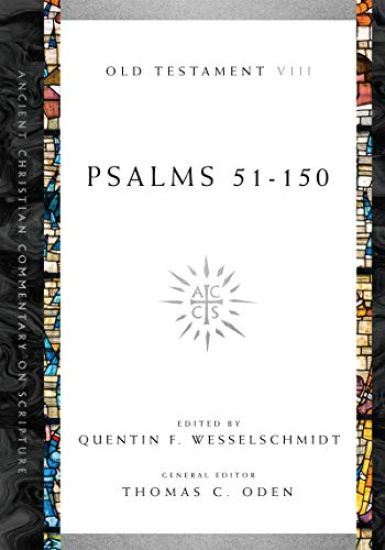
Psalms 51–150

Psalms 51–150

Quentin F. Wesselschmidt; Thomas C. Oden

IVP Academic
2019
nidottu
The Psalms have long served a vital role in the individual and corporate lives of Christians, expressing the full range of human emotions, including some that we are ashamed to admit. The Psalms reverberate with joy, groan in pain, whimper with sadness, grumble in disappointment, and rage with anger. The church fathers employed the Psalms widely. In liturgy they used them both as hymns and as Scripture readings. Within them they found pointers to Jesus both as Son of God and as Messiah. They also employed the Psalms widely as support for other New Testament teachings, as counsel on morals, and as forms for prayer. Especially noteworthy was their use of Psalms in the great doctrinal controversies. The Psalms were used to oppose subordinationism, modalism, Arianism, Apollinarianism, Nestorianism, Eutychianism, and Monophysitism, among others. More than fifty church fathers are cited in the Ancient Christian Commentary on Scripture volume from Ambrose to Zephyrinus. From the British Isles, Gaul, and the Iberian Peninsula, we find Hilary of Poitiers, Prudentius, John Cassian, Valerian of Cimiez, Salvian the Presbyter, Caesarius of Arles, Martin of Bruga, Braulio of Saragossa, and Bede. From Rome and Italy, we find Clement, Justin Martyr, Callistus, Hippolytus, Novatian, Rufinus, Maximus of Turin, Peter Chrysologus, Leo the Great, Cassiodorus, and Gregory the Great. Carthage and North Africa are represented by Tertullian, Cyprian, Augustine, and Fulgentius. Fathers from Alexandria and Egypt include Clement, Origen, Dionysius, Pachomius, Athanasius, Cyril, and Poemen. Constantinople and Asia Minor supply the Great Cappadocians—Basil the Great and the two Gregorys, from Nazianzus and Nyssa—plus Evagrius of Pontus and Nicetas of Remesiana. From Antioch and Syria we find Ephrem, John Chrysostom, Theodore of Mopsuestia, Theodoret of Cyr, Philoxenus of Mabbug, Sahdona, and John of Damascus. Finally, Jerusalem, Palestine and Mesopotamia are represented by Eusebius of Caesarea, Aphrahat, Cyril, Jacob of Sarug, Jerome, and Isaac of Nineveh. Readers of these selections, some of which appear here for the first time in English, will glean from a rich treasury of deep devotion and profound theological reflection.
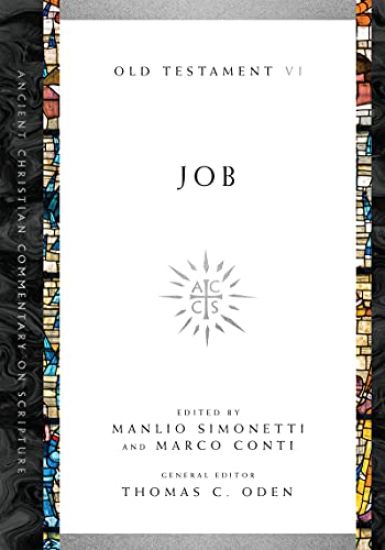
Job

Job

Manlio Simonetti; Marco Conti; Thomas C. Oden

IVP Academic
2019
nidottu
The book of Job presents its readers with a profound drama concerning innocent suffering. Such honest, forthright wrestling with the problem of evil and the silence of God has intrigued a wide gamut of readers both religious and nonreligious. Surprisingly, the earliest church fathers showed little interest in the book of Job. Not until Origen in the early third century is there much evidence of any systematic treatment of the book, and most of Origen's treatment is known to us only from the catenae. More intense interest came at the end of the fourth century and the beginning of the fifth. The excerpts in this Ancient Christian Commentary on Scripture volume focus on systematic treatment. Among Greek texts are those from Origen, Didymus the Blind, Julian the Arian, John Chrysostom, Hesychius of Jerusalem, and Olympiodorus. Among Latin sources we find Julian of Eclanum, Philip the Priest, and Gregory the Great. Among Syriac sources we find Ephrem the Syrian and Isho'dad of Merv, some of whose work is made available here for the first time in English. In store for readers of this volume is a great feast of wisdom from the ancient resources of the church with fresh relevance for today.
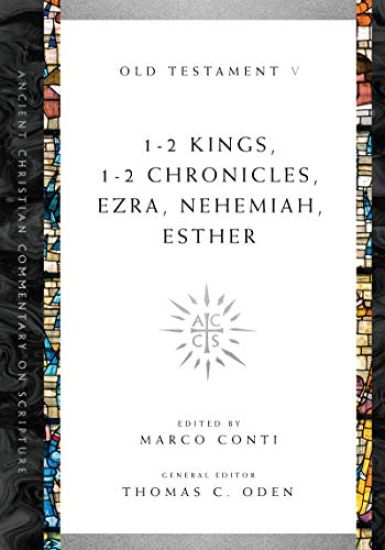
1–2 Kings, 1–2 Chronicles, Ezra, Nehemiah, Esther

1–2 Kings, 1–2 Chronicles, Ezra, Nehemiah, Esther

Marco Conti; Thomas C. Oden

IVP Academic
2019
nidottu
The church fathers, as they did in earlier books dealing with Israel's history from the time of Joshua to the united monarchy, found ample material for typological and moral interpretation in 1-2 Kings, 1-2 Chronicles, Ezra, Nehemiah and Esther. It will be immediately clear to readers of this volume that they gave much more attention to 1-2 Kings than to others; whether this was due to a certain repetitiveness in the story line or other reasons is unclear. But the narratives of wise King Solomon, the construction of the temple, the prophets Elijah and Elisha, and the fates of various faithful and unfaithful kings and other powerful people were well suited to their purposes. Among Greek commentators in this Ancient Christian Commentary on Scripture volume, readers will find Justin Martyr, Clement of Alexandria, Origen, Methodius, Eusebius of Caesarea, Athanasius, Cyril of Jerusalem, Basil the Great, Gregory of Nazianzus, John Chrysostom, Cyril of Alexandria, Theodoret of Cyr, Procopius of Gaza and John the Monk. Among Latin commentators are Tertullian, Cyprian, Novatian, Lactantius, Ambrose, Jerome, Prudentius, Augustine, Paulinus of Nola, John Cassian, Peter Chrysologus, Maximus of Turin, Salvian the Presbyter, Fulgentius of Ruspe, Caesarius of Arles, Gregory the Great, Bede and Rabanus Maurus. Syriac commentators include Aphrahat, Ephrem, Sahdona, Isaac of Nineveh and Isho'dad of Merv. Together they set before readers a table of delights and theological insights, some of which are here available to English readers for the first time.
Joshua, Judges, Ruth, 1–2 Samuel

Joshua, Judges, Ruth, 1–2 Samuel

John R. Franke; Thomas C. Oden

IVP Academic
2019
nidottu
The history of the entry into the Promised Land followed by the period of the Judges and early monarchy may not appear to readers today as a source for expounding the Christian faith. But the church fathers readily found parallels, or types, in the narrative that illumined the New Testament. An obvious link was the similarity in name between Joshua, Moses' successor, and Jesus—indeed, in Greek the names are identical. Thus Joshua was consistently interpreted as a type of Christ. So too was Samuel. David was recognized as an ancestor of Jesus, and parallels between their two lives were readily explored. And Ruth, in ready fashion, was seen as a type of the church. Among the most important sources for commentary on these books are the homilies of Origen, most of which are known to us through the Latin translations of Rufinus and Jerome. Only two running commentaries exist—one from Gregory of Nazianzus, one of the famous Cappadocian theologians, the other from Bede the Venerable. Another key source for the selections found here derives from question-and-answer format, such as Questions on the Heptateuch from Augustine, Questions on the Octateuch from Theodoret of Cyr, and Thirty Questions on 1 Samuel from Bede. The remainder of materials come from a wide variety of occasional and doctrinal writings, which make mention of these biblical texts to support their arguments. Readers will find a rich treasure trove of ancient wisdom, some of which appear here for the first time in English translation, speaking with eloquence and powerful spiritual insight to the church today.
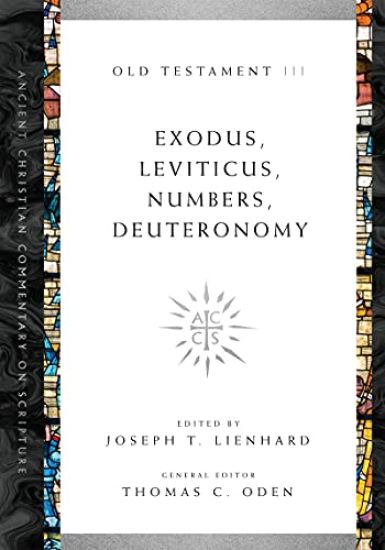
Exodus, Leviticus, Numbers, Deuteronomy

Exodus, Leviticus, Numbers, Deuteronomy

Joseph T. Lienhard; Thomas C. Oden

IVP Academic
2019
nidottu
From its inception the church has always had a Bible—the Jewish Scriptures. But Christians have not read these Scriptures in the same way the Jews did. They have read them in the light of what God did in Jesus the Christ. Thus the Jewish Scriptures became for Christian readers the Old Testament. This Ancient Christian Commentary on Scripture volume on Exodus through Deuteronomy bears ample witness to this new way of reading these ancient texts. Among the earliest interpreters whose works remain extant is Origen, who virtually single-handedly assured the Old Testament a permanent place within the Christian church through his extensive commentary and reflection. His twenty-seventh homily on Numbers is particularly noteworthy for his interpretation of the forty-two stopping places in the desert wanderings as the forty-two stages of growth in the spiritual life. Among Greek-speaking interpreters, this current volume draws widely on John Chrysostom, Clement of Alexandria, Basil the Great, Gregory of Nazianzus, Gregory of Nyssa, Cyril of Alexandria, Theodoret of Cyr, and John of Damascus. Among Latin-speaking interpreters, quotations from Augustine, Ambrose, Jerome, Paterius, Caesarius of Arles, Cassiodorus, and Isidore are found in abundance. Ephrem and Aphrahat are represented among Syriac speakers. Numerous other interpreters are present from each grouping. Varied in texture and nuance, the interpretations included in this volume display a treasure house of ancient wisdom, some appearing here in English translation for the first time, speaking with eloquence and intellectual acumen to the church today.
Genesis 12–50

Genesis 12–50

Mark Sheridan; Thomas C. Oden

IVP Academic
2019
nidottu
Genesis 12–50 recounts the history of the patriarchs—Abraham, Isaac, Jacob, and Joseph. From their mentors Paul, Peter, Stephen, and the author of the letter to the Hebrews, the early fathers learned to draw out the spiritual significance of the patriarchal narrative for Christian believers. The Alexandrian school especially followed Paul's allegorical use of the story of Sarah and Hagar as they interpreted the Genesis accounts. The Antiochene school eschewed allegorical interpretation but still set about to find moral lessons in the ancient narrative. For all of them the events pointed toward the promises of the age to come, the new age revealed in the resurrection of Jesus. Among the principal Greek-speaking commentators included within this Ancient Christian Commentary on Scripture volume, readers will find Origen, Didymus the Blind, John Chrysostom, and Cyril of Alexandria. Among the Latin-speaking interpreters they will find Ambrose of Milan, Augustine of Hippo, Caesarius of Arles, and Bede the Venerable. Ephrem the Syrian is the most commonly cited Syriac-speaking interpreter, while the fifth-century Catena on Genesis provides access to such fathers as Eusebius of Caesarea, Basil the Great, Gregory of Nazianzus, Gregory of Nyssa, Didymus of Alexandria, Epiphanius of Salamis, Irenaeus of Lyons, Eusebius of Emesa, Severian of Gabala, and Theodore of Mopsuestia among others. Varied in texture and nuance, the interpretations cited provide a wealth of ancient wisdom, some appearing here in English translation for the first time, to stimulate the mind and nourish the soul of the church today.
Proverbs, Ecclesiastes, Song of Solomon

Proverbs, Ecclesiastes, Song of Solomon

J. Robert Wright; Thomas C. Oden

IVP Academic
2019
nidottu
Among the Wisdom literature of the Old Testament, Proverbs, Ecclesiastes, and the Song of Solomon were all thought by the early church fathers to have derived from the hand of Solomon. To their minds the finest wisdom about the deeper issues of life prior to the time of God's taking human form in Jesus Christ was to be found in these books. As in all the Old Testament, they were quick to find types and intimations of Christ and his church that would make the ancient Word relevant to the Christians of their day. Of extant commentaries on Ecclesiastes none are so profound as the eight homilies of Gregory of Nyssa, even though they cover only the first three chapters of the book. Joining Gregory among those most frequently excerpted in this volume are Augustine, Ambrose, Gregory the Great, Origen, John Cassian, John Chrysostom, Athanasius, Bede the Venerable, and Jerome. Gregory of Nazianzus, Basil the Great, and Cyril of Jerusalem lead a cast of other less frequently cited fathers, and then there remains a large cast of supporting players, some of whose work is translated here into English for the first time. This Ancient Christian Commentary on Scripture volume offers a rich trove of wisdom on Wisdom for the enrichment of the church today.
The Rebirth of African Orthodoxy

The Rebirth of African Orthodoxy

Thomas C. Oden

Abingdon Press
2016
nidottu
African orthodoxy today reveals the same powerful faith that was confessed by Athanasius and Augustine seventeen centuries ago. Classic African Christian teaching in the patristic period (100-750 AD) preceded modern colonialism by over a thousand years. Many young African women and men are now reexamining these lost roots. They are hungry for accurate information about their Christian ancestors. Thomas C. Oden asks readers to recapture the resonance of a consensual orthodoxy, the harmony of voices celebrating the apostolic testimony to God's saving work in Jesus Christ, witnessed to in scripture and understood best by African interpreters of the faith. In ten seminars, Oden invites discerning readers to reclaim and reaffirm Christian faith as it emerges from thoughtful conversations between contemporary and ancient African interpreters of orthodox faith. "This new book by Tom Oden is remarkable and historic. His words challenge the worldwide church to return to the true fountain of living water, Jesus Christ. He specifically encourages us Africans to continue to seek the treasures left to us by our early church fathers and mothers in order to reshape the Christian mind now as they did in the first millennium." -The Most Rev. Dr. Mouneer Hanna Anis, Archbishop of the Episcopal/Anglican Diocese of Egypt with North Africa and the Horn of Africa "A thought-provoking book with factual evidences emphasizing the continuity of global orthodoxy that emanated in Africa and has been nurtured by Africans from the time of Mark the evangelist to the present. People yearning to discover the intellectual and classical African Christian roots will find the book very helpful." -Thomas A. Oduro, President, Good News Theological College & Seminary, Accra, Ghana "While Tom Oden writes about Africans for Africans, The Rebirth of African Orthodoxy: Return to Foundations is also addressed to all Christians everywhere who ask, 'What is God doing in the world today' The author proposes that the clue to what God is doing in the present is to be found in what God has done in the past, for 'the Holy Spirit has a history.' Tom directs us to look to Africa, where the ancient African Christian orthodoxy is being reborn in the African church today, making it a witness to the whole church everywhere." -Timothy W. Whitaker, retired bishop, Florida Conference of The United Methodist Church
A Change of Heart

A Change of Heart

Thomas C Oden

Readhowyouwant
2015
pokkari
How did one of last century's most celebrated liberals change so dramatically? In this intellectual and spiritual memoir, Thomas Oden journeys from conservative rural Methodism in Oklahoma to free - spirited theological innovation in the land of academia and back to the foundations of ancient Christianity.
A Change of Heart – A Personal and Theological Memoir

A Change of Heart – A Personal and Theological Memoir

Thomas C. Oden

Inter-Varsity Press,US
2014
sidottu
Preaching's Best Books for Preachers Best Theological Memoir from Byron Borger, Hearts and Minds Bookstore How did one of the twentieth century's most celebrated liberals have such a dramatic change of heart? After growing up in the heart of rural Methodism in Oklahoma, Thomas Oden found Marx, Nietzsche and Freud storming into his imagination. He joined the post-World War II pacifist movement and became enamored with every aspect of the 1950s' ecumenical Student Christian Movement. Ten years before America's entry into the Vietnam war he admired Ho Chi Min as an agrarian patriot. For Oden, every turn was a left turn. At Yale he earned his PhD under H. Richard Niebuhr and later met with some of the most formidable minds of the era—enjoying conversations with Gadamer, Bultmann and Pannenberg as well as a lengthy discussion with Karl Barth at a makeshift office in his hospital room. While traveling with his family through Turkey, Syria and Israel, he attended Vatican II as an observer and got his first taste of ancient Christianity. And slowly, he stopped making left turns. Oden's enthusiasms for pacifism, ecumenism and the interface between theology and psychotherapy were ambushed by varied shapes of reality. Yet it was a challenge from a Jewish scholar, his friend and mentor Will Herberg, that precipitated his most dramatic turn—back to the great minds of ancient Christianity. Later a meeting with then Cardinal Joseph Ratzinger (later Benedict XVI) planted the seeds for what became Oden's highly influential Ancient Christian Commentary on Scripture. This fascinating memoir walks us through not only his personal history but some of the most memorable chapters in twentieth-century theology.
Encyclopedia of Ancient Christianity

Encyclopedia of Ancient Christianity

Angelo Di Berardino; Thomas C. Oden; Joel C. Elowsky; James Hoover

Inter-Varsity Press,US
2014
sidottu
2014 Midwest Publishing Association Award of Excellence (Scholarly/Reference)2014 Readers' Choice Awards Honorable Mention The Encyclopedia of Ancient Christianity covers eight centuries of the Christian church and comprises 3,220 entries by a team of 266 scholars from 26 countries representing a variety of Christian traditions. It draws upon such fields as archaeology, art and architecture, biography, cultural studies, ecclesiology, geography, history, philosophy, and theology. This three-volume encyclopedia offers unparalleled, comprehensive coverage of the people, places, and ideas of ancient Christianity. The encyclopedia's A-to-Z coverage extends from "Aaron (iconography)" to "Zosimus, pope" and chronologically from Christianity's origins to Bede (d. 735) in the West and John of Damascus (d. ca. 749) in the Greek East, with detailed emphasis on the first four centuries of Christian history. This edition updates and expands on previous Italian and English-language editions with the addition of more than 500 new articles (added to the current Italian or English edition), including 30 articles exclusive to IVP's edition. Extensive cross-referencing provides ease in exploring related articles, and helpful bibliographies, including primary sources (texts, critical editions, translations) and key secondary sources (books and journal articles), give access to the very latest in-depth scholarship in countless disciplines of study. IVP's new Encyclopedia of Ancient Christianity (2014) is translated from Nuovo dizionario patristico e di antichita cristiane (2006-2008), produced by the Institutum Patristicum Augustinianum, the world's foremost center for partristic studies, under the direction of Professor Angelo Di Berardino, and it greatly updates and expands the 1992 Encyclopedia of the Early Church (Oxford University Press/James Clarke).