Kirjojen hintavertailu. Mukana 12 657 676 kirjaa ja 12 kauppaa.

Kirjailija

Tom Cooper

Kirjat ja teokset yhdessä paikassa: 73 kirjaa, julkaisuja vuosilta 2003-2026, suosituimpien joukossa Lebanese Civil War. Vertaile teosten hintoja ja tarkista saatavuus suomalaisista kirjakaupoista.

73 kirjaa

Kirjojen julkaisuhaarukka 2003-2026.

Lebanese Civil War

Lebanese Civil War

Tom Cooper; Sergio Santana

Helion Company
2022
nidottu
Once known as the ‘Switzerland of the Middle East’, an island of economic stability and social progress, Lebanon was shattered by a civil war that raged from 1975 until 1990. While Volume 1 of this mini-series concentrated on the conflict pitting the central government against different factions and alliances of Christians, Sunni and Shi’a Moslems, leftists, and the Israeli and Syrian armed forces from its beginning in 1975 until the Israeli Operation Stone of Wisdom (or Operation Litani) in 1978, Volume 2 continues with the period from 1978 until 1981. With its armed forces of a size comparable to that of the strength of the active components of the contemporary US Army and led by politicians pursuing aggressive intentions towards its northern neighbour, Israel gradually established itself in control over much of southern Lebanon and all of Lebanese airspace. In turn, Syria found itself facing not only a growing insurgency and unrest at home, but also strong opposition inside Lebanon. Moreover, a seemingly endless series of air battles with the Israeli air force exposed a growing technological gap with its primary opponent, forcing it to deploy ever larger contingents of its air defences into Lebanon. After almost culminating in a major war in 1981, the situation was defused through international pressure: nominally at least, a relatively quiet period was to follow before the next storm. Focusing on military-related developments, and containing much exclusive detail and specially commissioned illustrations, Volume 2 of Lebanese Civil War dissects the military forces of Israel, Syria and the many Lebanese militias, their equipment, intentions and capabilities, and provides a detailed, blow-by-blow account of combat operations into 1981.
Syrian Conflagration

Syrian Conflagration

Tom Cooper

HELION COMPANY
2022
pokkari
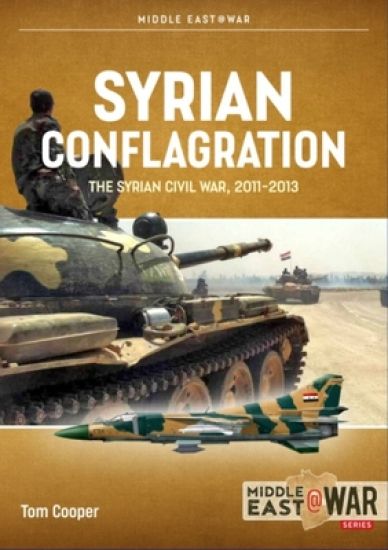
The Syrian Civil War, (the colloquial name of the ongoing conflict in Syria), has experienced an entirely unexpected transformation during its first two years. It started as unrest within the Syrian population and a series of mass demonstrations within the context of wider protest movements in the Middle East and North Africa in 2011, known as the Arab Spring. Contrary to events in Egypt, Libya, Tunisia and Yemen, where oppressive governments were toppled by the end of that year, the government of Syria deployed the full force of its military, its intelligence apparatus, and para-military groups, launching an unprecedented crackdown that resulted in the arrest, detention and killing of many thousands. Despite its brutality, this effort back-fired: it provoked mass desertions of the Syrian military and then an armed uprising. The emerging insurgency was generally successful through 2012, although failing to capture Damascus, it did secure more than half of Aleppo and Homs, the provincial capital of Raqqa, and nearly all of north-eastern and north-western Syria under its control. Although propped-up by economic and military support from the Islamic Republic of Iran and the Russian Federation, the government of Syria was nearing the brink of collapse during the first half of 2013 when, prompted by Tehran, the Hezbollah - a Shi'a Islamic militant group (and political party) from Lebanon - entered the conflict on its side. Soon after, the Hezbollah was reinforced by significant contingents of Iranian-sponsored Shi'a from Iraq, Lebanon and elsewhere, and then by volunteers from Iran, including crack units of the Islamic Revolutionary Guards Corps. Meanwhile, already split along the lines of Syria's complex demography, much of the insurgency transformed from a secular and non-sectarian movement into proxies of various foreign powers, foremost Saudi Arabia and Qatar, but also Turkey and Kuwait. Furthermore, foreign Jihadists motivated by al-Qaida joined the fray, aiming to establish an Islamist state and clandestinely cooperating with the government, they fell into the back of insurgency. Thus, an extremely complex conflict - which meanwhile not only spilled over the border into Lebanon, but is having a major impact upon Iranian-Saudi relations, and relations between the West, Iran and a number of Arab countries - came into being, the outcome of which is presently anything but predictable.Drawing on extensive research, including first hand accounts it provides a compelling overview of the first three years of the ongoing conflict in Syria. The book features around 120 photos, 16 artworks and 3-4 maps.
Wings of Iraq Volume 2

Wings of Iraq Volume 2

Tom Cooper; Milos Sipos

Helion Company
2022
nidottu
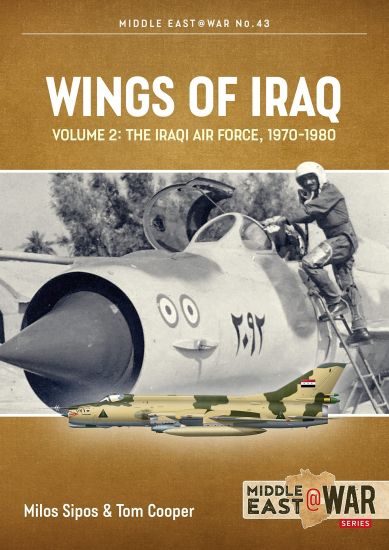
Officially established on 22 April 1931, around a core of 5 pilots and 32 aircraft mechanics, the Royal Iraqi Air Force was the first military flying service in any Arab country. Coming into being with the task of supporting the Iraqi armed forces and the British against revolts by local tribes, it saw extensive combat and gradually grew into a potent force. During the Anglo-Iraqi War of 1941, it became involved in its first conventional campaign in support of an anti-British coup but was destroyed as a fighting force. It was still recovering when deployed in combat again, this time against Israel in the course of the Palestine War of 1948-1949. During the relatively quiet decade of the 1950s, the air force experienced a rapid growth, further intensified once the monarchy was toppled during the 14 Tammuz Revolution in 1958, and once again, after two additional coups in 1963. During all of these affairs, a dozen additional coup attempts in the 1960s, and then during the long and bitter war against a Kurdish insurgency in the north, and the next clash with Israel in 1967, the Iraqi Air Force continued playing a dominant role in the fate of the country. The situation changed only little following the coup of 1968 that brought the Ba'ath Party to power. What did instrument a major change was the air force's involvement in the October 1973 Arab-Israeli War, and then the showdown with the Iranian-supported Kurdish insurgency in northern Iraq in 1974-1975. These two affairs taught the Iraqis that numbers alone did not make an air force. Correspondingly, during the second half of the 1970s, Baghdad embarked on a project based on full technology transfer from France, which was intended to result in preparing the IrAF for the 21st century. This process hardly began when the new ruler in Baghdad, Saddam Hussein at-Tikriti, led his country into an invasion of neighbouring Iran, embroiling it in a ruinous, eight-year-long war. Amazingly enough, for the first few years of that conflict, the IrAF still continued planning and growing as if there was no conflict to fight, although frequently suffering heavy losses while - due to the micromanagement from the government - de-facto fighting with one hand tied to its backs. It was only the experience of facing sustained and massive Iranian offensives of the 1984-1986 period that prompted Baghdad into unleashing the air force into an all-out campaign against the Iranian economy that effected a turn-around in the war. Almost unexpectedly, the IrAF emerged from the eight years of Iran stronger, better equipped and better trained, and more experienced than ever before. However, Saddam Hussein took care to remove all of its top commanders, and replace them with his favourites, thus de-facto castrating the most powerful branch of the Iraqi armed forces shortly before embarking upon his ultimate adventure: the invasion of Kuwait in 1990. The resulting Second Persian Gulf War of 1991 left the IrAF in tatters: mauled by sustained air strikes on its air bases, and cut off from its former sources of equipment and training, it was never to recover again, and rather vegetated for the last years of existence, pending its ultimate destruction during the US-led invasion of 2003. Although virtually 'born in battle', collecting precious combat experience and playing an important role in so many internal and external conflicts, the Iraqi Air Force remains one of the least known and most misinterpreted military services in the Middle East. Richly illustrated, Wings over Iraq provides a uniquely compact yet comprehensive guide to its operational history, its crucial officers and aircraft, and its major operations.
Florida Man

Florida Man

Tom Cooper

Random House Trade
2022
nidottu
"A riotous journey into the heart of insanity also known as the State of Florida. Bravo "--Gary Shteyngart, author of Lake Success Florida, circa 1980. Reed Crowe, the eponymous Florida Man, is a middle-aged beach bum, beleaguered and disenfranchised, living on ill-gotten gains deep in the jungly heart of Florida. When sinkholes start opening on Emerald Island, not only are Reed Crowe's seedy businesses--a moribund motel and a shabby amusement park--endangered, but so are his secrets. Crowe, amateur spelunker, begins uncovering artifacts that change his understanding of the island's history, as well as his understanding of his family's birthright as pioneering homesteaders. Meanwhile, there are other Florida men with whom Crowe must contend. Hector "Catface" Morales, a Cuban refugee, trained assassin, and crack-addicted Marielito, is seeking revenge on Reed for stealing his stash of drugs and leaving him for dead (unbeknownst to Reed) in the wreckage of a plane crash in the Everglades decades ago. Loner and misanthrope Henry Yahchilane, a Seminole native, has something to hide on the island. So does irascible and pervy Wayne Wade, Reed Crowe's childhood friend turned bad penny. Then there are the Florida women, including Heidi Karavas, Reed Crowe's ex-wife, now a globe-trekking art curator, and Nina Arango, a Cuban refugee and fiercely protective woman with whom Reed Crowe falls in love. There are curses. There are sea monsters. There are biblical storms. There's something called the Jupiter Effect. Ultimately, Florida Man is a generation-spanning story about how a man decides to live his life, and how despite staying landlocked and stubbornly in one place, the world nevertheless comes to him.
Migs in the Middle East, Volume 2

Migs in the Middle East, Volume 2

David Nicolle; Tom Cooper

Helion Company
2021
nidottu
During and after the June 1967 Arab-Israeli War, fighter-bombers of Soviet-design and manufacture served in the air forces of two frontline Arab states facing Israel: Egypt and Syria. While Algeria and Iraq also deployed contingents flying Soviet-made fighter jets, only the latter saw any significant action. Immediately after, and in reaction to losses and negative experiences from the war with Israel, unprecedented numbers of MiGs were delivered to air forces in the Middle East. The USSR replaced all Egyptian and Syrian losses on 1-for-1 basis, while Iraq and Algeria placed huge orders. Moreover, the USSR replaced Egypt as the main supporter of the republican government in what was then Northern Yemen, and Sudan appeared on the scene to place orders for its own air force. Subsequently, the British Protectorate of Aden achieved independence, quickly established friendly ties to the Soviet Union and Cuba, and began acquiring jet fighters of Soviet origin. Unsurprisingly, by the early 1970s, not only older MiG-15s and MiG-17s but also newer types like MiG-21s served in huge numbers with at least half a dozen air forces around the Middle East. They wore a wide range of very different, and often very colourful unit insignia and other markings, and were flown by many pilots who would subsequently play crucial roles in the future of their nations.##Based on original documentation and extensive interviews with veterans, and richly illustrated, MiGs in the Middle East, Volume 2 is a unique source of reference on the operational history of MiG-15, MiG-17, MiG-19 and MiG-21 fighter jets in Algeria, Egypt, Iraq, Morocco, Syria, North and South Yemen from 1967 until 1975.
War of Intervention in Angola, Volume 4

War of Intervention in Angola, Volume 4

Adrien Fontanellaz; Tom Cooper; José Augusto Matos

Helion Company
2021
nidottu
War of Intervention in Angola, Volume 4, continues the coverage of the operational history of the Angolan Air Force and Air Defence Force (FAPA/DAA) as told by Angolan and Cuban sources, in the period 1985-1988. Many accounts of this conflict - better known in the West as the ‘Border War’ or the 'Bush War', as named by its South African participants - consider the operations of the FAPA/DAA barely worth commentary. At most, they mention a few air combats involving Mirage F.1 interceptors of the South African Air Force (SAAF) in 1987 and 1988, and perhaps a little about the activity of the FAPA/DAA’s MiG-23s. However, a closer study of Angolan and Cuban sources reveals an entirely different image of the air war over Angola in the 1980s: indeed, it reveals the extent to which the flow of the entire war was dictated by the availability - or the lack - of air power. These issues strongly influenced the planning and conduct of operations by the commanders of the Angolan and Cuban forces. Based on extensive research with the help of Angolan and Cuban sources, War of Intervention in Angola, Volume 4, traces the Angolan and Cuban application of air power between 1985-1988 - during which it came of age - and the capabilities, intentions, and the combat operations of the air forces. The volume is illustrated with 100 rarely seen photographs, half a dozen maps and 15 colour profiles, and provides a unique source of reference on this subject.
Migs in the Middle East  Volume 1

Migs in the Middle East Volume 1

Davis Nicolle; Tom Cooper

Helion Company
2021
nidottu
Egypt and Czechoslovakia signed the so-called ‘Czechoslovak Arms Deal’, thus initiating a unique era of close cooperation between major Arab military powers, the former Union of the Soviet Socialist Republics (USSR) and its allies. During the first decade of this period, the air force of Egypt, followed by those of (in chronological order) Syria, Iraq, Morocco and Algeria, were all equipped with dozens and then hundreds of Soviet-made fighters designed by the Mikoyan I Gurevich Design Bureau – the same swept-wing jets that took the Western powers by surprise during the Korean War. While the first generation of MiG jet fighter – the MiG-15 – saw only a relatively brief service in Egypt, its more efficient and uprated successor, the MiG-17F, entered service in bigger numbers, and then formed the backbone of additional air forces around the Middle East. The MiG-17PF became the first radar-equipped combat aircraft while the MiG-19 became the first supersonic fighter flown by the air forces of Egypt and Iraq, in the period 1958-1963. In Morocco and Algeria, the MiG-17 was the first and the only jet fighter in service during the first half of the 1960s.Unsurprisingly, MiG-15s, MiG-17s and MiG-19s thus served with many different units and – especially in Egypt and Algeria, and also in Syria – wore a wide range of very different, and often very colourful unit insignia and other markings. They were also flown by many pilots who subsequently played crucial roles in the future of their nations. Based on original documentation and extensive interviews with veterans, and richly illustrated, MiGs in the Middle East, Volume 1 is a unique source of reference on the operational history of MiG-15, MiG-17, and MiG-19 fighter jets in Algeria, Egypt, Iraq, Morocco, and Syria from 1955 until 1956. This is the first volume in a mini-series.
In the Claws of the Tomcat

In the Claws of the Tomcat

Tom Cooper

Helion Company
2021
nidottu
Equipped with well-balanced air wings, huge aircraft carriers have formed the backbone of the United States Navy’s doctrine and strategy since the Second World War. Packing an enormous punch, their purpose is to exercise control over enormous portions of airspace – in the offence or defence. From the mid-1970s until the mid-2000s, the spear tip of the USN air wings was the famous Grumman F-14 Tomcat – widely considered one of the finest air superiority systems in the world. Originally designed as a fast, manoeuvrable and well-armed fighter, the Tomcat entered service as the ultimate long-range fleet defender and became the biggest, most complex and most expensive naval aircraft of its time. Including a unique and exceptional combination of flight characteristics, detection systems and weapons, it earned itself the status of a legend by the mid-1980s. The F-14 Tomcats of the US Navy achieved their first aerial victories during freedom of navigation exercises off Libya in 1981. However, the period during which they saw most combat followed several years later, during Operations Earnest Will and then Desert Storm, from 1987 until 1991. To date, very little has been published about the operations in question. Indeed, the widespread belief is that USN F-14s saw next to no air combat against Iran, and even less so during Operation Desert Storm in 1991. As so often, the reality is entirely different: Tomcats engaged dozens of opponents, often on the verge of the engagement envelope of their powerful AWG-9 radars and AIM-54 Phoenix long-range air-to-air missiles, and sometimes at such close ranges that their pilots selected ‘guns’. Weather- and communications-related problems, but also the incredible discipline of their crews prevented them from scoring up to a dozen aerial victories: however, it is perfectly possible that they scored at least one, perhaps more previously entirely unknown aerial victories – and also lost one of their own to an enemy fighter. Richly illustrated by over 100 photographs and authentic colour profiles, ‘Tomcats of the Storm’ is an exclusive source of reference about some of least-well known air combats fought by US Navy’s fighter crews in recent history.
War of Intervention in Angola, Volume 3

War of Intervention in Angola, Volume 3

Adrien Fontanellaz; José Matos; Tom Cooper

Helion Company
2020
nidottu
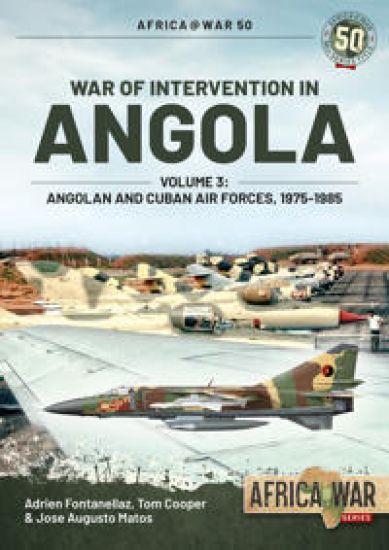
War of Intervention in Angola, Volume 3 covers the air warfare during the II Angolan War – fought 1975-1992 – through narrating the emergence and operational history of the Angolan Air Force and Air Defence Force (FAPA/DAA) as told by Angolan and Cuban sources. Most accounts of this conflict – better known in the West as the ‘Border War’ or the ‘Bush War’, as named by its South African participants – tend to find the operations by the FAPA/DAA barely worth mentioning. A handful of published histories mention two of its MiG-21s claimed as shot down by Dassault Mirage F.1 interceptors of the South African Air Force (SAAF) in 1981 and 1982, and at least something about the activities of its MiG-23 interceptors during the battles of the 1987-1988 period. On the contrary, the story told by Angolan and Cuban sources not only reveals an entirely different image of the air war over Angola of the 1980s: indeed, it reveals to what degree this conflict was dictated by the availability – or the lack of – air power and shows that precisely this issue dictated the way that the commanders of the Cuban contingents deployed to the country – whether as advisors or as combat troops – planned and conducted their operations. It is thus little surprising that the first contingent of Cuban troops deployed to Angola during Operation Carlota, in late 1975, included a sizeable group of pilots and ground personnel who subsequently helped build-up the FAPA/DAA from virtually nothing. They continued that work over the following 14 years - sometimes in cooperation of Soviet advisors and others from East European countries – eventually establishing an air force that by 1988 maintained what South African military intelligence and the media subsequently described as the ‘most advanced air defence system in Africa’. Not only the air defence system in question, but also the aircraft serving as its extended arms, ultimately managed a unique feat in contemporary military history: they enabled an air force equipped with Soviet-made aircraft and trained along the Soviet doctrine to establish at least a semblance of aerial superiority over an air force equipped with Western-made aircraft and operating under a Western doctrine. Based on extensive research with help of Angolan and Cuban sources, the ‘War of Intervention in Angola, Volume 3’, traces the military build-up of the FAPA/DAA in the period 1975-1992, its capabilities and its intentions. Moreover, it provides a unique, blow-by-blow account of its combat operations and experiences. The volume is illustrated with 100 rare photographs, half a dozen maps and 15 colour profiles, thus providing a unique source of reference on this topic.
Wings of Iraq Volume 1

Wings of Iraq Volume 1

Tom Cooper; Milos Sipos

Helion Company
2020
nidottu
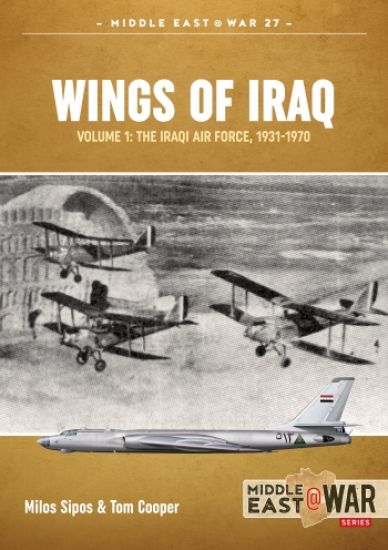
Officially established on 22 April 1931, around a core of 5 pilots and 32 aircraft mechanics, the Royal Iraqi Air Force was the first military flying service in any Arab country. Coming into being with the task of supporting the Iraqi armed forces and the British against revolts by local tribes, it saw extensive combat and gradually grew into a potent force. During the Anglo-Iraqi War of 1941, it became involved in its first conventional campaign in support of an anti-British coup but was destroyed as a fighting force. It was still recovering when deployed in combat again, this time against Israel in the course of the Palestine War of 1948-1949. During the 1950s, the Royal Iraqi Force experienced a phase of unprecedented growth: after acquiring several batches of Hawker Fury piston-engined fighter-bombers, Bristol Freighter transports and its first helicopters, it entered the jet-age through the acquisition of de Havilland Vampires and Venoms, and Hawker Hunters in quick succession. The 14 Tammuz Revolution of 1958 toppled the British-imposed monarchy and cut the ties to London. For the next five years, the Iraqi Air Force (IrAF) maintained close links to the Union of Soviet Socialist Republics and became the first Arab air force to operate types like the MiG-19 and MiG-21, and also the first equipped with Tupolev Tu-16 medium jet bombers. Through the 1960s, the IrAF played a dominant role in Iraq’s inner politics, determining the fate of the nation to an unprecedented degree. It not only became involved in combat against Kurdish insurgents in the north of the country: its officers staged multiple coups d’état in 1963, 1965 and 1966, served as Ministers of Defence and Prime Ministers of the Iraqi government, became involved in the June 1967 War with Israel, and were instrumental in the putsch of 1968 that brought the Ba’ath Party to power. Although subjected to the tight control of the Ba’ath and the Army, the IrAF continued growing through the 1970s and reached its zenith during the Iran-Iraq War of 1980-1988, when it flew some of the most advanced combat aircraft available world-wide, became the air force with most combat- and flying experience on the MiG-25 and the first true multi-role combat aircraft ever – the Mirage F.1 - and played the crucial role in forcing Tehran to accept a cease-fire. In 1990, the IrAF took part in the invasion of Kuwait. Decimated during the 1991 Gulf War against the US-led coalition, it became involved in the suppression of the uprisings in northern and southern Iraq, and subsequently continued fighting a decade-long no-fly zone maintained by the USA and Great Britain. Although virtually ‘born in battle’, collecting precious combat experience and playing an important role in so many internal and external conflicts, the Iraqi Air Force remains one of the least known and most misinterpreted military services in the Middle East. Richly illustrated, ‘Wings over Iraq’ provides a uniquely compact yet comprehensive guide to its operational history, its crucial officers and aircraft, and its major operations.
Florida Man

Florida Man

Tom Cooper

Random House
2020
sidottu
"A riotous journey into the heart of insanity also known as the State of Florida. Bravo "--Gary Shteyngart, author of Lake Success Florida, circa 1980. Reed Crowe, the eponymous Florida Man, is a middle-aged beach bum, beleaguered and disenfranchised, living on ill-gotten gains deep in the jungly heart of Florida. When sinkholes start opening on Emerald Island, not only are Reed Crowe's seedy businesses--a moribund motel and a shabby amusement park--endangered, but so are his secrets. Crowe, amateur spelunker, begins uncovering artifacts that change his understanding of the island's history, as well as his understanding of his family's birthright as pioneering homesteaders. Meanwhile, there are other Florida men with whom Crowe must contend. Hector "Catface" Morales, a Cuban refugee, trained assassin, and crack-addicted Marielito, is seeking revenge on Reed for stealing his stash of drugs and leaving him for dead (unbeknownst to Reed) in the wreckage of a plane crash in the Everglades decades ago. Loner and misanthrope Henry Yahchilane, a Seminole native, has something to hide on the island. So does irascible and pervy Wayne Wade, Reed Crowe's childhood friend turned bad penny. Then there are the Florida women, including Heidi Karavas, Reed Crowe's ex-wife, now a globe-trekking art curator, and Nina Arango, a Cuban refugee and fiercely protective woman with whom Reed Crowe falls in love. There are curses. There are sea monsters. There are biblical storms. There's something called the Jupiter Effect. Ultimately, Florida Man is a generation-spanning story about how a man decides to live his life, and how despite staying landlocked and stubbornly in one place, the world nevertheless comes to him.
The Iran-Iraq War

The Iran-Iraq War

E.R. Hooton; Tom Cooper; Farzin Nadimi

Helion Company
2019
nidottu
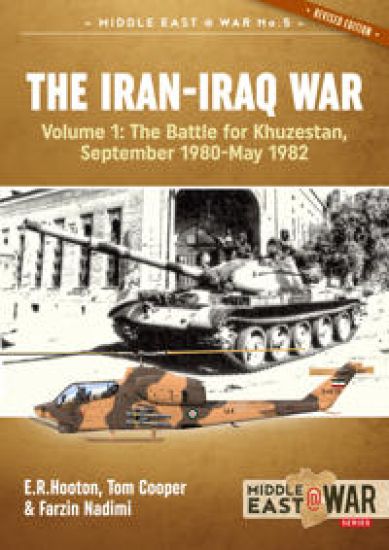
The Iran-Iraq War was one of the bloodiest conflicts of the 20th Century and accidentally created the current nightmare of Islamic fundamentalist terrorism. There have been many books on the conflict but this is the first detailed military history using materials from both sides, as well as materials obtained from US Intelligence circles and British Governmental archives. It provides a unique insight into a war which began through miscalculation and rapidly escalated into the longest conventional conflict in the post Second World War era. The first volume looks at the background and describes in detail how Saddam Hussein decided to invade but hamstrung the Iraqi Army to restrict its greatest success to a narrow strip of territory in Iran’s southern province of Khuzestan. This left the Iraqis unable either to advance or withdraw and exposed them to ever greater and more successful Iranian counter-strokes which drove them out in May 1982 in the ferocious Battle of Khorramshahr.
The Iran-Iraq War

The Iran-Iraq War

E.R. Hooton; Tom Cooper; Farzin Nadimi

Helion Company
2019
nidottu
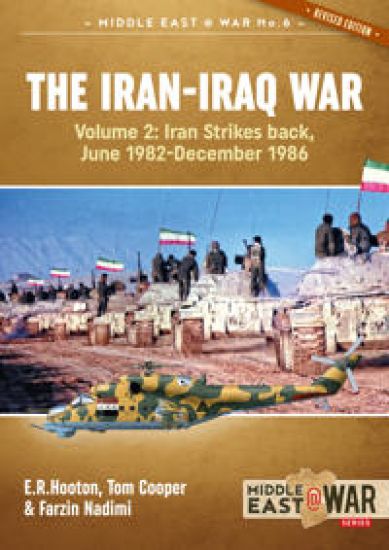
Volume 2 takes up the account after Iraq withdrew from Khuzestan and is based upon material from both sides, from US Intelligence data, British Government documents and secret Iraqi files. Iraq’s withdrawal exposed the great southern city of Basra to Iranian attack but it was shielded by fortifications based upon a huge anti-tank ditch, the so-called Fish Lake, which the Iranians tried to storm in the summer of 1982. This bloody failure left Tehran in a position where prestige prevented a withdrawal into Iran but the armed forces lacked the resources to bring the conflict to a favourable conclusion. During the next four years the Iranians tried to outflank the Fish Lake defences initially through the marshes in the north and finally through an attack on the Fao Peninsula which increased national prestige but was a strategic failure and paved the way for Iraq’s massive victories in 1988. This followed a series of successful defensive battles in which the Iranians were driven back with great loss. This account describes the battles in greater detail than before and, by examining them, provides unique insights and ends many of the myths which are repeated in many other accounts of this conflict.
Showdown in the Western Sahara Volume 2

Showdown in the Western Sahara Volume 2

Tom Cooper; Albert Grandolini; Adrien Fontanellaz

Helion Company
2019
nidottu
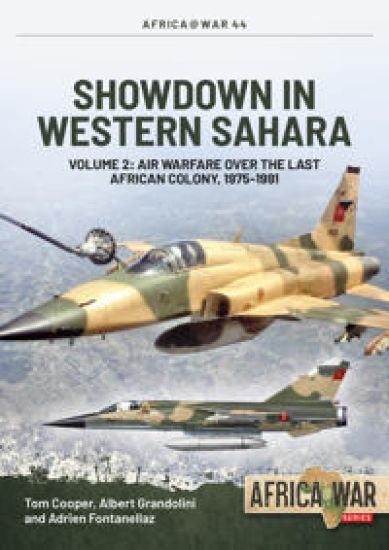
The former colony of Spanish Sahara saw frequent outbursts of tribal and ethnic rebellions while ruled by the colonial authorities in the late 19th and through the early 20th Century. Its vastness and distances essentially dictated the application of air power in response. While most of these events attracted next to no attention in English-language media, the large-scale operations of the Spanish colonial authorities of the late 1950s became notable at least for the final combat deployment of the famous Messerschmitt Bf.109. Following the Spanish withdrawal from Spanish Sahara in 1975, a major war erupted as Sahrawi nationalists – organized by the POLISARIO front – engaged in guerrilla warfare against Moroccan armed forces deployed to secure the northern part of the country, and Mauritanian forces deployed in the south. Characteristically for this period, POLISARIO’s insurgency was often misinterpreted in the West as ‘Soviet-influenced’, although the rebels never adapted any related frameworks for their operations and tactics, such as those of Mao Zedong. On the contrary, while Algeria at least tolerated their bases on its soil, it was Libya that provided most of the support for the insurgency, eventually enabling it to defeat the Mauritanian military, slightly over a year later. Combined with POLISARIO’s raids deep into Mauritania this prompted France to launch a limited military intervention in support. While tactically successful, this proved insufficient: Mauritania withdrew in 1979 after signing a peace treaty. Morocco continued fighting a series of bitter campaigns through 1979 and 1980, until rising costs and casualties prompted its government into developing an entirely new strategy. Construction of extensive earthen fortifications eventually slowed the war down to one of low intensity, only sporadically interrupted by insurgent attempts to achieve at least local successes. With both sides realizing that no solution through an armed conflict was possible, a cease-fire agreement was signed in 1991. However, this conflict still remains unresolved: it merely shifted to civilian resistance. Warfare in Western Sahara has in many ways become exemplary for modern-day counter-insurgency efforts in Africa and elsewhere. This conflict has been falsely declared as a part of some larger, external conflict – the Cold War; in regards of the concept of an insurgency applying motorized forces to deliver often spectacular ‘hit-and-run’ attacks; and in regards of a conventional military reacting with a combination of earth berms and air power. Illustrated by over 100 photograph as, a dozen maps and 18 colour profiles, Showdown in Western Sahara offers a fascinating study of the military aspects of this conflict, warfare strategies, tactics and experiences with different weapons systems.
Lebanese Civil War

Lebanese Civil War

Sergio Santana; Tom Cooper

Helion Company
2019
nidottu
Formerly known as the ‘Switzerland of the Middle East’, an island of economic stability and social progress, Lebanon was shattered by a civil war that raged from 1975 until 1990. Pitting the central government against different factions and alliances of Christians, Sunni and Shi’a Moslems, leftists, and Syrian armed forces, this multifaceted conflict experienced a major escalation when Israel launched an invasion with the aim of destroying the Palestine Liberation Organisation (PLO), in 1982. Also known as the First Lebanon War, or Operation Peace for Galilee, the Israeli enterprise was run in cooperation with Christian allies and the self-proclaimed Free Lebanon State. Except for attacking the PLO and surrounding its leadership in West Beirut, it provoked a major showdown with Syrian armed forces deployed inside Lebanon, and resulted in a series of bitter battles. Ever since, fighting on the ground and in the sky of the Beka’a Valley is a synonym for modern-day conventional air-land battle in the age of high-technology warfare. Focusing on military-related developments, and rich in exclusive details and illustrations, ‘Lebanese Civil War: Israeli Invasion, 1982’ is dissecting military forces, their equipment, intention and capabilities, and their combat operations.
Desert Storm Volume 1

Desert Storm Volume 1

E.R. Hooton; Tom Cooper

Helion Company
2019
nidottu
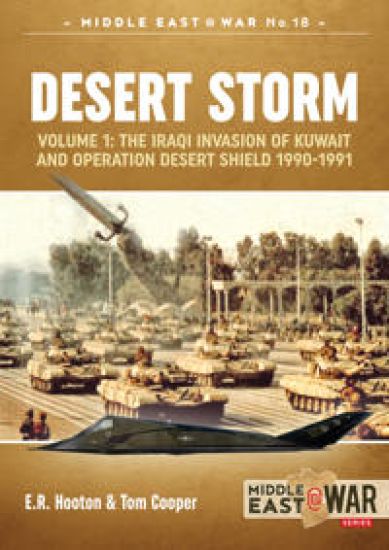
Early in the morning of 2 August 1990, aircraft of the Iraqi Air Force bombed Kuwaiti air bases, and then the Iraqi Republican Guards stormed into the country. Thus began what would be called the ‘Gulf War’ – also the ‘II Gulf War’, and sometimes the ‘II Persian Gulf War’ – fought between January and March 1991. Although encountering some problems, the Iraqi forces occupied Kuwait in a matter of few days. However, when President Saddam Hussein of Iraq unleashed his military upon Kuwait, little did he know what kind of reaction he would provoke from the Western superpowers, and what kind of devastation his country would suffer in return. Concerned about the possibility of Iraq continuing its advance into Saudi Arabia, the USA – in coordination with Great Britain, France, and several local allies – reacted by deploying large contingents of their air-, land- and naval forces to the Middle East. Months of fruitless negotiations and the continuous military build-up – Operation Desert Shield – followed, as tensions continued to increase. Determined to retain Kuwait, and despite multiple warnings from his own generals, Saddam Hussein rejected all demands to withdraw. The USA and its allies, ‘the Coalition’, were as determined to drive out the invader and restore Kuwaiti independence. Gradually, they agreed this would have to be by force. Following an authorisation from the United Nations, the Coalition launched the Operation Desert Storm, on 17 January 1991, opening one of the most intensive air campaigns in history. The last conventional war of the 20th Century saw the large, but essentially traditional, Iraqi Army overwhelmed by forces trained and equipped to exploit the latest technologies. Desert Storm reveals the whole war fought between Iraq and an international coalition, from the start of this campaign to its very end. Largely based on data released from official archives, spiced with numerous interviews, and illustrated with over 100 photographs, 18 colour profiles and maps, it offers a refreshing insight into this unique conflict.
1973: the First Nuclear War

1973: the First Nuclear War

Abdallah Emran; Tom Cooper

Helion Company
2019
nidottu
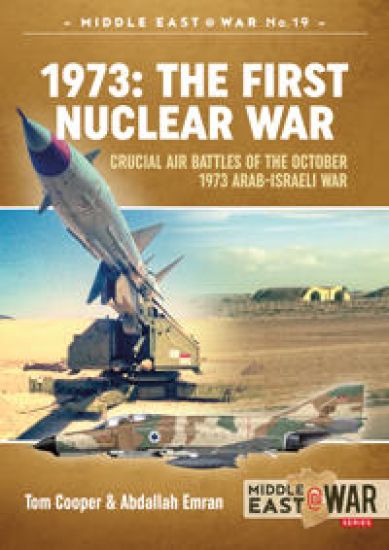
The majority of narratives about the October 1973 Arab-Israeli War stress that air power did not play a dominant role. The deployment of strong, well-integrated air defences by Egypt and Syria, that caused heavy losses to the Israeli air force early during that conflict, not only spoiled Israel’s pre-war planning, but prevented it from providing support for Israeli ground forces too. A cross-examination of interviews with dozens of Egyptian participants in that conflict, contemporary reporting in the media, and also intelligence reports, offers an entirely different picture. Accordingly, for much of that war, the Israelis flew heavy air strikes on Port Said, on the northern entry to the Suez Canal. Furthermore, they repeatedly attacked two major Egyptian air bases in the Nile Delta – el-Mansourah and Tanta – in turn causing some of the biggest air battles of this war. Indeed, in Egypt, the response to these attacks reached the level of legend: the supposed repelling of an Israeli air strike on el-Mansourah, on 14 October 1973, prompted Cairo to declare not only a massive victory, but also that date for the day of its air force. However, the actual reasons for Israeli air strikes on Port Said, el-Mansourah and Tanta remain unclear to this day: there are no Israeli publications offering a sensible explanation, and there are no Egyptian publications explaining the reasoning. Only a cross-examination of additional reporting provides a possible solution: el-Mansourah was also the base of the only Egyptian unit equipped with R-17E ballistic missiles, known as the SS-1 Scud in the West. As of October 1973, these missiles were the only weapon in Egyptian hands capable of reaching central Israel – and that only if fired from the area around Port Said. While apparently unimportant in the overall context, this fact gains immensely in importance considering reports from the US intelligence services about the possible deployment of Soviet nuclear warheads to Egypt in October 1973. Discussing all the available information, strategy, tactics, equipment and related combat operations of both sides, ‘1973: the First Nuclear War’ provides an in-depth insight into the Israeli efforts to prevent the deployment of Egyptian Scud missiles – whether armed with Soviet nuclear warheads or not – in the Port Said area: an effort that dictated a lengthy segment of the application of air power during the October 1973 Arab-Israeli war, and resulted in some of the most spectacular air-to-air and air-to-ground battles of that conflict. Illustrated by over 100 photographs, a dozen maps and 18 colour profiles, this book thus offers an entirely new thesis about crucial, but previously unknown factors that determined the flow of the aerial warfare in October 1973.