Kirjojen hintavertailu. Mukana 12 390 323 kirjaa ja 12 kauppaa.

Kirjailija

Vijay Prashad

Kirjat ja teokset yhdessä paikassa: 43 kirjaa, julkaisuja vuosilta 2001-2025, suosituimpien joukossa Red Star Over the Third World. Vertaile teosten hintoja ja tarkista saatavuus suomalaisista kirjakaupoista.

43 kirjaa

Kirjojen julkaisuhaarukka 2001-2025.

Mutiny

Mutiny

Peter Mertens; Vijay Prashad

UNKNOWN
2024
nidottu
"A lot of people in the North are angry. Their ability to be wealthy-ish in their own community is gone, and they're finding it hard to make sense of that. People in the South are also finding it hard to make sense of why they're paid so little for the coffee, the wheat, and the maize that they grow. Yet somewhere in the middle, somebody is making an awful lot of money. Peter Mertens brings together the two ends in solidarity and points out that the real issue is the profits that have been made by faceless, distant global corporations, that have their headquarters in tax havens. And at the end of it, he does the most important thing. Two very important things, two words: hope and inspiration, as to how we empower ourselves to go forward." Jeremy Corbyn, lifelong activist, London "Mutiny is a rollicking ride through world politics. Peter Mertens is able to clearly and convincingly show how opulence and poverty, domination and exploitation are intertwined on both a large and small scale. The book presents a compelling case for a joint mutiny of people in the North and the South." Sevim Dagdelen, left MP in the Bundestag, Germany "Compelling, pugnacious, and endlessly engaging. The world is turning, and Peter Mertens does a wonderful job of showing which way the wind is blowing. It's a book brimming with vivid anecdotes, topical analysis and fascinating historical detail." Jerome Roos, London School of Economics "Workers in the North and South, from US autoworkers and British nurses to South African metalworkers, need to read Mutiny. It interrupts our navel-gazing and captures the seeds of social change germinating all over the planet. That's where hope lies: if we organise ourselves, locally and internationally, and if we link social movements in the North and South, we can win." Luc Triangle, General Secretary of the International Trade Union Confederation

The Political Marx (Edition1st)

The Political Marx (Edition1st)

Aijaz Ahmad; Vijay Prashad

UNKNOWN
2023
nidottu
For a thinker whose revolutionary ideas have had such a decisive impact on the world, it is ironic that Marx's own political writings remain so neglected. His political writings are often seen as texts written instrumentally to earn money, which he often desperately needed, or they are seen as beautiful texts with little connection to his economic studies and writings. But in fact, Marx's political texts are themselves extraordinary displays of analysis of the class struggle and the mediations needed to understand these struggles. Aijaz Ahmad (1941-2022) guided generations of Marxists around the world in their struggle to understand the world and to change the world. In these conversations with Vijay Prashad, himself a leading Marxist thinker, Aijaz Ahmad examines texts such as The German Ideology, The Communist Manifesto, The 18th Brumaire of Louis Bonaparte, and The Civil War in France, placing them in context, drawing out their interconnections, and shining his bright analytical torch on aspects that make these texts come alive for us today. This book is a little gem, a veritable course on how to read Karl Marx.
Washington's New Cold War

Washington's New Cold War

Vijay Prashad; John Bellamy Foster; John Ross; Deborah Veneziale

MONTHLY REVIEW PRESS,U.S.
2022
pokkari
Argues the forces which originally drove us into the Cold War never went anywhere, and the stakes are higher than ever As the American people delude themselves once more into thinking of the United States as a liberating force for peace in the world, Waging a New Cold War invites us, instead, to think for ourselves. Behind the scenes the plans to wage war have been laid--either by proxy, as in Ukraine, or directly, against the U.S.'s old twentieth-century foes. Waging a New Cold War: A Socialist Perspective makes a strong case that, as the official story is laid out by government propagandists, and as the mainstream media provides cover, the aim of this latest set of American military escapades remains the same as ever: Maintenance of U.S hegemony in the global financial system. Foregrounded with an introduction by Vijay Prashad, this cogent collaboration puts forth three essays that illustrate clearly that, while the Cold War against the Soviet Union ended, the "cold war" against the "enemies" of the United States did not. Furthermore, its authors lay out evidence that the U.S. establishment has been willing to risk nuclear winter--in other words, mutual annihilation--to hold onto economic primacy. And they show that, while Russia and China can each be criticized, justifiably, for their violations of human life and dignity, neither, on its own, threatens the eruption of a Third World War and the end of the human race as we know it. Just in time, we have in our hands an intelligent text that strengthens our struggle against the cynical machinations of the American military behemoth and its propaganda machine.
Washington's New Cold War

Washington's New Cold War

Vijay Prashad; John Bellamy Foster; John Ross; Deborah Veneziale

MONTHLY REVIEW PRESS,U.S.
2022
sidottu
As the American people delude themselves once more into thinking of the United States as a liberating force for peace in the world, Waging a New Cold War invites us, instead, to think for ourselves. Behind the scenes the plans to wage war have been laid--either by proxy, as in Ukraine, or directly, against the U.S.'s old twentieth-century foes. Waging a New Cold War: A Socialist Perspective makes a strong case that, as the official story is laid out by government propagandists, and as the mainstream media provides cover, the aim of this latest set of American military escapades remains the same as ever: Maintenance of U.S hegemony in the global financial system. Foregrounded with an introduction by Vijay Prashad, this cogent collaboration puts forth three essays that illustrate clearly that, while the Cold War against the Soviet Union ended, the "cold war" against the "enemies" of the United States did not. Furthermore, its authors lay out evidence that the U.S. establishment has been willing to risk nuclear winter--in other words, mutual annihilation--to hold onto economic primacy. And they show that, while Russia and China can each be criticized, justifiably, for their violations of human life and dignity, neither, on its own, threatens the eruption of a Third World War and the end of the human race as we know it. Just in time, we have in our hands an intelligent text that strengthens our struggle against the cynical machinations of the American military behemoth and its propaganda machine.
The Withdrawal

The Withdrawal

Noam Chomsky; Vijay Prashad; Angela Y. Davis

THE NEW PRESS
2022
sidottu
Two of our most celebrated intellectuals grapple with the uncertain aftermath of the American collapse in Afghanistan “Through the structure of a deeply engaging conversation between two of our most important contemporary public intellectuals, we are urged to defy the inattention of the media to the disastrous damage inflicted in Afghanistan on life, land, and resources in the aftermath of the U.S. withdrawal and the connections to the equally avoidable and unnecessary wars on Iraq and Libya.”—from the foreword by Angela Y. Davis Not since the last American troops left Vietnam have we faced such a sudden vacuum in our foreign policy—not only of authority, but also of explanations of what happened, and what the future holds. Few analysts are better poised to address this moment than Noam Chomsky and Vijay Prashad, intellectuals and critics whose work spans generations and continents. Called “the most widely read voice on foreign policy on the planet” by the New York Times Book Review, Noam Chomsky is the guiding light of dissidents around the world. In The Withdrawal, Chomsky joins with noted scholar Vijay Prashad—who “helps to uncover the shining worlds hidden under official history and dominant media” (Eduardo Galeano)—to get at the roots of this unprecedented time of peril and change. Chomsky and Prashad interrogate key inflection points in America’s downward spiral: from the disastrous Iraq War to the failed Libyan intervention to the descent into chaos in Afghanistan. As the final moments of American power in Afghanistan fade from view, this crucial book argues that we must not take our eyes off the wreckage—and that we need, above all, an unsentimental view of the new world we must build together.
Struggle Is What Makes Us Human

Struggle Is What Makes Us Human

Vijay Prashad; Frank Barat

Haymarket Books
2022
sidottu
An incisive and inspiring call to look beyond capitalism to chart a road map for a planet ravaged by pandemics, climate crisis, and wars.Prompted by trenchant questions by international solidarity organizer Frank Barat, renowned author and activist Vijay Prashad shows that the path toward hope and liberation lies in looking closely at myriad, under covered struggles being waged all across the world by workers in countries such as India, Kenya, Peru, Tunisia, and Argentina. A marvelously global but grassroots perspective.Prashad also examines pressing topics such as debt cancellation, a wealth tax, austerity, the pandemic, the arms industry, the climate crisis, socialism, working-class social movements and much more.
Struggle Is What Makes Us Human

Struggle Is What Makes Us Human

Vijay Prashad; Frank Barat

Haymarket Books
2022
pokkari
An incisive and inspiring call to look beyond capitalism to chart a road map for a planet ravaged by pandemics, climate crisis, and wars.Prompted by trenchant questions by international solidarity organizer Frank Barat, renowned author and activist Vijay Prashad shows that the path toward hope and liberation lies in looking closely at myriad, under covered struggles being waged all across the world by workers in countries such as India, Kenya, Peru, Tunisia, and Argentina. A marvelously global but grassroots perspective.Prashad also examines pressing topics such as debt cancellation, a wealth tax, austerity, the pandemic, the arms industry, the climate crisis, socialism, working-class social movements and much more.
Washington Bullets

Washington Bullets

Vijay Prashad; Evo Morales; Richard Pithouse

Inkani Books
2022
pokkari
Washington Bullets is written in the best traditions of Marxist journalism and history-writing. It is a book of fluent and readable stories, full of detail about US imperialism, but never letting the minutiae obscure the larger political point. It is a book that could easily have been a song of despair - a lament of lost causes; it is, after all, a roll call of butchers and assassins; of plots against people's movements and governments; of the assassinations of socialists, Marxists, communists all over the Third World by the country where liberty is a statue.Despite all this, Washington Bullets is a book about possibilities, about hope, about genuine heroes. One such is Thomas Sankara of Burkina Faso - also assassinated - who said: 'You cannot carry out fundamental change without a certain amount of madness. In this case, it comes from nonconformity, the courage to turn your back on the old formulas, the courage to invent the future. It took the madmen of yesterday for us to be able to act with extreme clarity today. I want to be one of those madmen. We must dare to invent the future.'Washington Bullets is a book infused with this madness, the madness that dares to invent the future.
The Cancer of Colonialism

The Cancer of Colonialism

Tony Pecinovsky; Alphaeus Hunton; Vijay Prashad

INTERNATIONAL PUBLISHERS CO INC.,U.S.
2021
pokkari
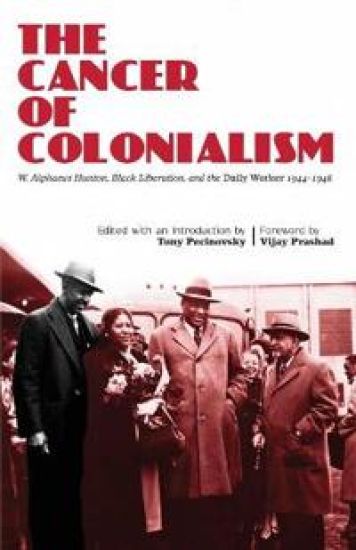
From July 1944 to January 1946, Alphaeus Hunton wrote regularly for the Communist Party, USA's newspaper, the Daily Worker. Collected here for the first time are Hunton's Daily Worker columns. They provide a glimpse into Hunton's Marxist worldview and are important resources for scholars and general readers interested in the evolution of 20th century resistance to Jim Crow and colonial subjugation. Included in this volume is a Foreword by Vijay Prashad and an Introduction by Tony Pecinovsky, as well as a short biography of Hunton enabling readers to better grasp his contributions as an early intellectual and organizational architect of the long struggle for equality and liberation.
The Cancer of Colonialism

The Cancer of Colonialism

Tony Pecinovsky; Alphaeus Hunton; Vijay Prashad

International Publishers
2021
sidottu
From July 1944 to January 1946, Alphaeus Hunton wrote regularly for the Communist Party, USA's newspaper, the Daily Worker. Collected here for the first time are Hunton's Daily Worker columns. They provide a glimpse into Hunton's Marxist worldview and are important resources for scholars and general readers interested in the evolution of 20th century resistance to Jim Crow and colonial subjugation. Included in this volume is a Foreword by Vijay Prashad and an Introduction by Tony Pecinovsky, as well as a short biography of Hunton enabling readers to better grasp his contributions as an early intellectual and organizational architect of the long struggle for equality and liberation.
Will the Flower Slip Through the Asphalt?

Will the Flower Slip Through the Asphalt?

Vijay Prashad

Leftword Books
2020
pokkari
Naomi Klein, delivering the Edward Said lecture, links the question of climate with the question of occupation (with Palestine as the focus). Klein points out that those who are 'othered' will be the first victims of the climate catastrophe. This volume collects Naomi Klein's superb essay, along with reactions from important writers who live across the globe. John Bellamy Foster and Ghassan Hage offer direct reflections on Klein's lecture, while other writers are spurred by Klein's insights. Rafia Zakaria takes us to the shoreline of Karachi, Masturah Alatas wonders about 'the hijab' and airconditioning in Malaysia, Shalini Singh meanders through the climate wars in India, and susan abulhawa writes from the 'fossil fuel sacrifice zone' at Standing Rock (North Dakota, USA). The book closes with Amitav Ghosh's meditation on nutmeg and cloves, leading to important insights into globalization, interconnectedness and transformation.//Contributors: NAOMI KLEIN - CARLOS DRUMMOND DE ANDRADE - JOHN BELLAMY FOSTER - GHASSAN HAGE - RAFIA ZAKARIA -MASTURAH ALATAS - SHALINI SINGH - SUSAN ABULHAWA - AMITAV GHOSH
Red October

Red October

Vijay Prashad

Leftword Books
2020
nidottu
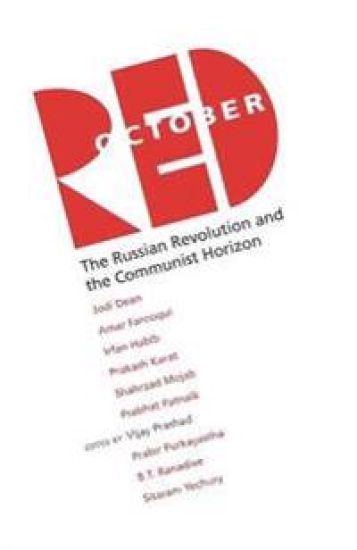
The first socialist state in history lasted only seventy years. This is a very small period of time in the scope of world history. Its achievements have been pilloried - its demise being the greatest argument against its achievements. But merely because it disappeared does not mean that it was without merit. It provides us with the assurance that a workers and peasants' state can exist, that it can create policies to benefit the vast masses of the people rather than merely the rich, that it can heal and educate rather than merely starve and kill. Red October is an invitation to rediscover the importance of the Russian Revolution, to explore how it faltered and to nudge us to consider the ghosts of that revolution in our own movements today.
Marx200

Marx200

John McDonnell; Vijay Prashad

Praxis Press
2019
pokkari
Marx200 examines the significance of Marxism for today's world. Leading scholars and activists from different countries - including Cuba, India and the UK - show that Marx's ideas continue to provide us with the analysis we need to understand our world today in order to change it. The relevance of Marx's contribution to political economy is discussed, as is Marxism and the ongoing battle of ideas. John McDonnell MP, Shadow Chancellor, writes about Marxism as a force for change in the 21st century. The leader of the Indian Communist Party, Sitaram Yechury, focuses on Marx's legacy 200 years on. Other wide-ranging topics demonstrating the relevance of Marxist ideas and approaches in the current climate include: 'neoliberalism, austerity and Marx', 'capitalism and new technology', 'Marxism and the environment', 'Marxism & Women', 'Marxism and culture' as well as 'the role of the state', 'Marxism and the present as history' and 'Populist nationalism'. The book is based on a major international conference organised by the Marx Memorial Library to coincide with the 200th anniversary of the birth of Karl Marx on 5 May 2018. Contents include: INTRODUCTIONMARY DAVISMarx200 - The Significance of Marxism in the 21st CenturyJOHN McDONNELLMarx as a Force for Change Today BEN FINEMarx and Value: The Enigma Code for Contemporary Capitalism DENISE CHRISTIEPublic before Profit VIJAY PRASHADEvery Form of Working-Class Activity MARY DAVISWomen, Class and Gender: A Marxist-Feminist PerspectiveJOHN FOSTERHistory and Marx's MethodISABEL MONALThe Battle of Ideas and the Formation of Consciousness DAVID McLELLANMarx's Materialist Conception of History: New Perspectives FRANCISCO DOMINGUEZMarxism and the Peculiarities of Indo-American Socialism ALAN F BLACKWELLArtificial Intelligence and the Abstraction of Cognitive LabourURSULA HUWSThe Onward March of CommodificationCHRISTINE LINDEYBeing a Marxist Artist Under Capitalism DAVID MARGOLIESLiterature and political judgmentTED BENTONThe Ecological Marx? JOHN O'NEILLFrom Socialist Calculation to Political Ecology SITARAM YECHURYMarxism as a force for change today
Strongmen

Strongmen

Eve Ensler; Danish Husain; Lara Vapnyar; Burhan S?nmez; Ninotchka Rosca; Vijay Prashad

OR Books
2018
sidottu
Five noted writers and thinkers profile five of the world's leaders. For some of us, these leaders are heroes; for others, villains; for all of us--strongmen. We're edging towards a new kind of global fascism driven by aggression and strident nationalism. In this energetic, focused book, a group of five accomplished writers confronts five would-be dictators. American playwright Eve Ensler (The Vagina Monologues) burrows beneath the skin of Donald Trump. Danish Husain, Indian storyteller and actor, finds himself recounting the story not only of Indian Prime Minister Narendra Modi, but also of the ascension of the extremism of the Sangh Parivar. Burhan S nmez, Turkish novelist, ferrets about amidst the bewildering career of the Turkish President Recep Tayyip Erdoğan. Lara Vapnyar, Russian-American novelist and journalist, ponders the Stalinist origins of the Supreme Leader of All the Russias. Ninotchka Rosca, Filipina feminist novelist, unravels the macho world of Rodrigo Duterte. These essays do not presume to be neutral. They are by partisan thinkers, magical writers, people who see not only the monsters but also a future beyond the ghouls. A future that is necessary. The present is too painful.
The Russian Revolution

The Russian Revolution

Walter Rodney; Vijay Prashad

Verso Books
2018
nidottu
Preface by Jesse Benjamin and the Walter Rodney FoundationIntroduction by Robin D.G. KelleyAfterword by Vijay PrashadIn his short life, the Guyanese intellectual Walter Rodney emerged as one of the leading revolutionary thinkers of the Black Sixties. He became a leading force of dissent throughout the Caribbean and a lightning rod of controversy. The 1968 Rodney Riots erupted in Jamaica when he was prevented from returning to his teaching post at the University of the West Indies. In 1980, Rodney was assassinated in Guyana, reportedly at the behest of the government. In the mid-'70s, Rodney taught a course on the Russian Revolution at the University of Dar es Salaam in Tanzania. A Pan-Africanist and Marxist, Rodney sought to make sense of the reverberations of the October Revolution in a decolonising world marked by Third World revolutionary movements. He intended to publish a book based on his research and teaching. Now historians Jesse Benjamin, Robin D. G. Kelley, and Vijay Prashad have edited Rodney's polished chapters and unfinished lecture notes, presenting the book that Rodney had hoped to publish in his lifetime.1917 is a signal event in radical publishing, and will inaugurate Verso's standard edition of Walter Rodney's works.
Arab Spring, Libyan Winter

Arab Spring, Libyan Winter

Vijay Prashad

AK Press
2012
nidottu
The Arab Spring captivated the planet. Mass action overthrew Tunisia's Ben Ali and Egypt's Hosni Mubarak. The revolutionary wave spread to the far corners of the Arab world, from Morocco to Bahrain. It seemed as if all the authoritarian states would finally be freed, even those of the Arabian Peninsula. People's power had produced this wave, and continued to ride it out.In Libya, though, the new world order had different ideas. Social forces opposed to Muammar Qaddafi had begun to rebel, but they were weak. In came the French and the United States, with promises of glory. A deal followed with the Saudis, who then sent in their own forces to cut down the Bahraini revolution, and NATO began its assault, ushering in a Libyan Winter that cast its shadow over the Arab Spring.This brief, timely analysis situates the assault on Libya in the context of the winds of revolt that swept through the Middle East in the Spring of 2011. Vijay Prashad explores the recent history of the Qaddafi regime, the social forces who opposed him, and the role of the United Nations, NATO, and the rest of the world's superpowers in the bloody civil war that ensued.Vijay Prashad is the George and Martha Kellner Chair of South Asian History, and professor and director of international studies at Trinity College in Hartford, Connecticut. He is the author or editor of over a dozen books, including "Karma of Brown Folk" and, most recently, "The Darker Nations: A People's History of the Third World."