Kirjojen hintavertailu. Mukana 12 390 323 kirjaa ja 12 kauppaa.

Kirjailija

Vijay Prashad

Kirjat ja teokset yhdessä paikassa: 43 kirjaa, julkaisuja vuosilta 2001-2025, suosituimpien joukossa Red Star Over the Third World. Vertaile teosten hintoja ja tarkista saatavuus suomalaisista kirjakaupoista.

43 kirjaa

Kirjojen julkaisuhaarukka 2001-2025.

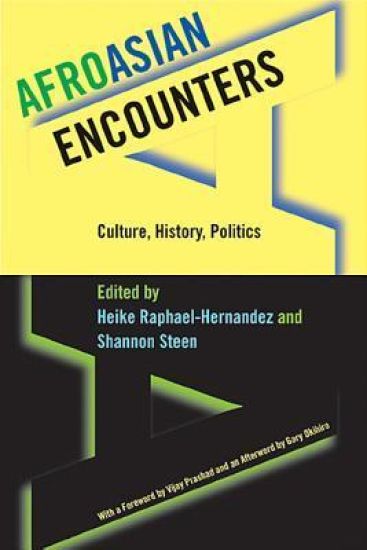
AfroAsian Encounters

AfroAsian Encounters

Vijay Prashad; Gary Okihiro

New York University Press
2006
pokkari
With a Foreword by Vijay Prashad and an Afterword by Gary Okihiro How might we understand yellowface performances by African Americans in 1930s swing adaptations of Gilbert and Sullivan's The Mikado, Paul Robeson's support of Asian and Asian American struggles, or the absorption of hip hop by Asian American youth culture? AfroAsian Encounters is the first anthology to look at the mutual influence of and relationships between members of the African and Asian diasporas. While these two groups have often been thought of as occupying incommensurate, if not opposing, cultural and political positions, scholars from history, literature, media, and the visual arts here trace their interconnections and interactions, as well as the tensions between the two groups that sometimes arise. AfroAsian Encounters probes beyond popular culture to trace the historical lineage of these coalitions from the late nineteenth century to the present. A foreword by Vijay Prashad sets the volume in the context of the Bandung conference half a century ago, and an afterword by Gary Okihiro charts the contours of a "Black Pacific." From the history of Japanese jazz composers to the current popularity of black/Asian "buddy films" like Rush Hour, AfroAsian Encounters is a groundbreaking intervention into studies of race and ethnicity and a crucial look at the shifting meaning of race in the twenty-first century.
AfroAsian Encounters

AfroAsian Encounters

Vijay Prashad; Gary Okihiro

New York University Press
2006
sidottu
With a Foreword by Vijay Prashad and an Afterword by Gary Okihiro How might we understand yellowface performances by African Americans in 1930s swing adaptations of Gilbert and Sullivan's The Mikado, Paul Robeson's support of Asian and Asian American struggles, or the absorption of hip hop by Asian American youth culture? AfroAsian Encounters is the first anthology to look at the mutual influence of and relationships between members of the African and Asian diasporas. While these two groups have often been thought of as occupying incommensurate, if not opposing, cultural and political positions, scholars from history, literature, media, and the visual arts here trace their interconnections and interactions, as well as the tensions between the two groups that sometimes arise. AfroAsian Encounters probes beyond popular culture to trace the historical lineage of these coalitions from the late nineteenth century to the present. A foreword by Vijay Prashad sets the volume in the context of the Bandung conference half a century ago, and an afterword by Gary Okihiro charts the contours of a "Black Pacific." From the history of Japanese jazz composers to the current popularity of black/Asian "buddy films" like Rush Hour, AfroAsian Encounters is a groundbreaking intervention into studies of race and ethnicity and a crucial look at the shifting meaning of race in the twenty-first century.
Karma Of Brown Folk

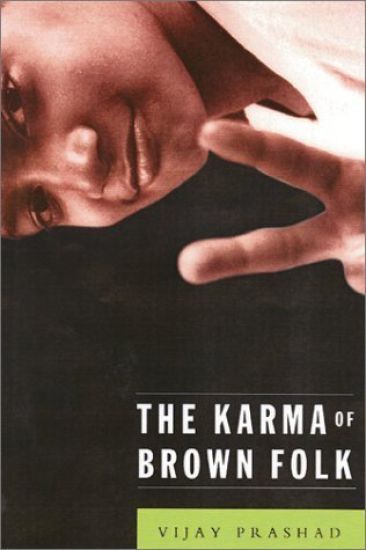
Karma Of Brown Folk

Vijay Prashad

University of Minnesota Press
2001
nidottu
Village Voice Favorite Books of 2000 The popular book challenging the idea of a model minority, now in paperback!“How does it feel to be a problem?” asked W. E. B. Du Bois of black Americans in his classic The Souls of Black Folk. A hundred years later, Vijay Prashad asks South Asians “How does it feel to be a solution?” In this kaleidoscopic critique, Prashad looks into the complexities faced by the members of a “model minority”-one, he claims, that is consistently deployed as "a weapon in the war against black America."On a vast canvas, The Karma of Brown Folk attacks the two pillars of the “model minority” image, that South Asians are both inherently successful and pliant, and analyzes the ways in which U.S. immigration policy and American Orientalism have perpetuated these stereotypes. Prashad uses irony, humor, razor-sharp criticism, personal reflections, and historical research to challenge the arguments made by Dinesh D’Souza, who heralds South Asian success in the U.S., and to question the quiet accommodation to racism made by many South Asians. A look at Deepak Chopra and others whom Prashad terms “Godmen” shows us how some South Asians exploit the stereotype of inherent spirituality, much to the chagrin of other South Asians. Following the long engagement of American culture with South Asia, Prashad traces India’s effect on thinkers like Cotton Mather and Henry David Thoreau, Ravi Shankar’s influence on John Coltrane, and such essential issues as race versus caste and the connection between antiracism activism and anticolonial resistance.The Karma of Brown Folk locates the birth of the “model minority” myth, placing it firmly in the context of reaction to the struggle for Black Liberation. Prashad reclaims the long history of black and South Asian solidarity, discussing joint struggles in the U.S., the Caribbean, South Africa, and elsewhere, and exposes how these powerful moments of alliance faded from historical memory and were replaced by Indian support for antiblack racism. Ultimately, Prashad writes not just about South Asians in America but about America itself, in the tradition of Tocqueville, Du Bois, Richard Wright, and others. He explores the place of collective struggle and multiracial alliances in the transformation of self and community-in short, how Americans define themselves.