Kirjojen hintavertailu. Mukana 12 390 323 kirjaa ja 12 kauppaa.

Kirjailija

Wendell Berry

Kirjat ja teokset yhdessä paikassa: 95 kirjaa, julkaisuja vuosilta 1980-2026, suosituimpien joukossa Bread and Wine. Vertaile teosten hintoja ja tarkista saatavuus suomalaisista kirjakaupoista.

95 kirjaa

Kirjojen julkaisuhaarukka 1980-2026.

A Small Porch

A Small Porch

Wendell Berry

Basic Civitas Books
2017
nidottu
More than thirty-five years ago, Wendell Berry began spending his sabbaths outdoors, when the weather allowed, walking and wandering around familiar territory, seeking a deep intimacy only time could provide. These walks sometimes yielded poems. Each year since, he has completed a series of these poems dated by the year of its composition. This new sequence provides a virtual syllabus for all of Berry's cultural and agricultural work in concentrated form. Many of these poems, including a sequence at mid-year of 2014, were written on a small porch in the woods, a place of stillness and reflection, a vantage point "of the one / life of the forest composed / of uncountable lives in countless / years, each life coherent itself within / the coherence, the great composure, of all." Recently Berry has been reflecting on more than a half century of reading, to discover and to delight in the poetical, spiritual, and cultural roots of his work. In The Presence of Nature in the Natural World, Berry's survey begins with Alan of Lille's twelfth-century work, The Plaint of Nature. The from the Bible through Chaucer, from Milton to Pope, from Wordsworth to the moderns, Berry's close reading is exhilarating. Moving from the canon of poetry to the sayings and texts found in agricultutre and science, closely presented, we gain new appreciation for the complexity of the issues faced in the twenty-first century by the struggling community of humans on earth. With this long essay appended to these new Sabbath Poems, the result is an unusual book of depth and engagement. A new collection of Wendall Berry poems is always an occasion for celebration, and this eccentric gatheirng is especially so.
Roots To The Earth

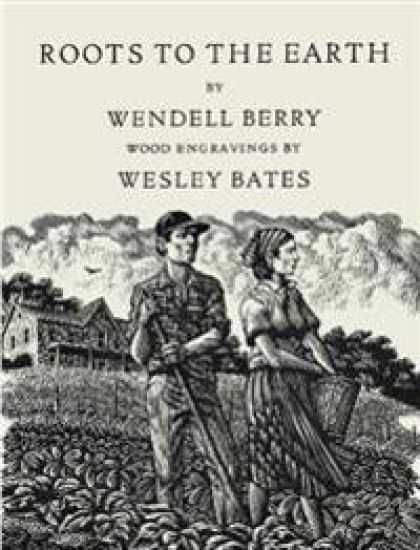
Roots To The Earth

Wendell Berry; Wesley Bates

Counterpoint
2016
sidottu
In 1995, Wendell Berry's Roots to the Earth was published in portfolio form by West Meadow Press. The wood etchings of celebrated artist and wood engraver, Wesley Bates, were printed from the original wood blocks on handmade Japanese paper. In 2014, this work was reprinted at Larkspur Press, along with additional poems. It is now with great pleasure that Counterpoint reproduces this collaborative work for trade publication, as well as expanding it with the inclusion of a short story, "The Branch Way of Doing," and additional engravings by Bates. In his introduction to the 2014 collection, Bates wrote: "As our society moves toward urbanization, the majority of the population views agriculture from an increasingly detached position. . . In his poetry Berry] reveals tenderness and love as well as anger and uncertainty. . . The wood engravings in this collection are intended to be companion pieces to. . . the way he expresses what it is to be a farmer."
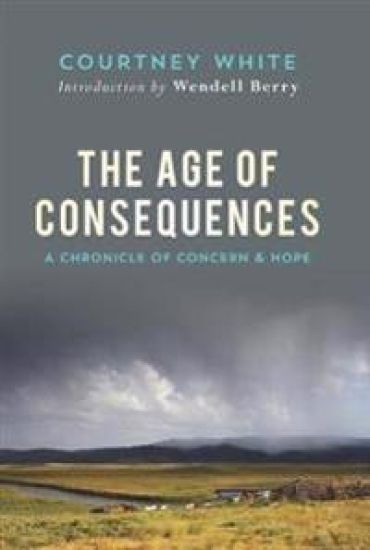
The Age Of Consequences

The Age Of Consequences

Courtney White; Wendell Berry

Counterpoint
2016
nidottu
Our planet is approaching a critical environmental juncture. Across the globe we continue to deplete the five pools of carbon  soil, wood, coal, oil, and natural gas  at an unsustainable rate. We've burned up half the planet's known reserves of oil  one trillion barrels  in less than a century. When these sources of energy-rich carbon go into severe decline, as they surely will, society will follow.Former archeologist and Sierra Club activist Courtney White calls this moment the Age of Consequences a time when the worrying consequences of our environmental actions or inaction  have begun to raise unavoidable and difficult questions. How should we respond? What are effective (and realistic) solutions?In exploring these questions, White draws on his formidable experience as an environmentalist and activist as well as his experience as a father to two children living through this vital moment in time. As a result, The Age of Consequences is a book of ideas and action, but it is also a chronicle of personal experience. Readers follow White as he travels the country --- from Kansas to Los Angeles, New York City, Italy, France, Yellowstone, and New England. Along the way he recounts stories of Amish farmers in Ohio, cattle ranchers in the Southwest, creek restorationists in New Mexico, local food entrepreneurs in Arizona, and carbon pioneers in Australia. Their stories inform and entertain, but they also reveal encouraging and hopeful answers to anguished questions about our collective future, including issues of sustainability, climate change mitigation, resilience, land health, collaborative conservation, ecological restoration, and regenerative agriculture.The Age of Consequences is an engaging and informative look at our current environmental predicament, as well as an important contribution to the growing body of environmental literature by writers such as Wallace Stegner, Wendell Berry, Barbara Kingsolver, Bill McKibben and E.O. Wilson, and Michael Pollan. For fans of Paul Hawken's Blessed Unrest and Elizabeth Kolbert's Field Notes of a Catastrophe.
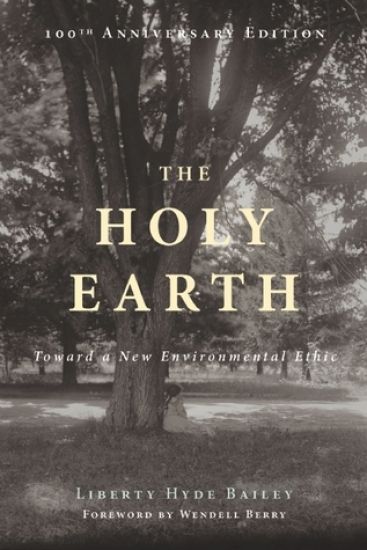
The Holy Earth

The Holy Earth

Liberty Hyde Bailey; Wendell Berry; John Linstrom

Counterpoint
2015
nidottu
The agrarian tradition runs as an undercurrent through the entire history of literature, carrying the age-old wisdom that the necessary access of independent farmers to their own land both requires the responsibility of good stewardship and provides the foundation for a thriving civilization. At the turn of the last century, when farming first began to face the most rapid and extensive series of changes that industrialization would bring, the most compelling and humane voice representing the agrarian tradition came from the botanist, farmer, philosopher, and public intellectual Liberty Hyde Bailey. In 1915, Bailey's environmental manifesto, The Holy Earth, addressed the industrialization of society by utilizing the full range of human vocabulary to assert that the earth's processes and products, because they form the governing conditions of human life, should therefore be understood not first as economic, but as divine. To grasp the extent of human responsibility for the earth, Bailey called for  a new hold" that society must take to develop a  morals of land management," which would later inspire Aldo Leopold's  land ethic" and several generations of agrarian voices. This message of responsible land stewardship has never been as timely as now.
Our Only World

Our Only World

Wendell Berry

Counterpoint
2015
nidottu
Since the Second World War ended, America has performed like a gyroscope losing its balance, wobbling this way and that, unable to settle into itself and its own great promise. Wendell Berry has been a voice for that promise, a voice for reason and hope and urgent concern.As the United States prepares to leave its long war in Afghanistan, it now must contemplate the necessity of sending troops back to Iraq, recalling General Colin Powell's advice to President Bush: Â If you break it, you own it," asthe world's hot spots threaten to spread over the globe with the ferocity of a war of holy terror and desperation.The planet's environmental problems respect no national boundaries. From soil erosion and population displacement to climate change and failed energy policies, American governing classes are paid by corporations to pretend that debate is the only democratic necessity and that solutions are capable of withstanding endless delay. Late Capitalism goes about its business of finishing off the planet. And we citizens are left with a shell of what was once proudly described as The American Dream.In this new collection of eleven essays, Berry confronts head-on the necessity of clear thinking and direct action. Never one to ignore the present challenge, he understands that only clearly stated questions support the understanding their answers require. For more than fifty years we've had no better spokesman and no more eloquent advocate for the planet, for our families, and for the future of our children and ourselves.
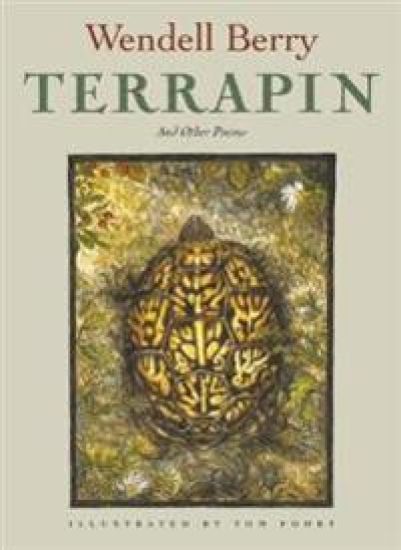
Terrapin

Terrapin

Wendell Berry; Tom Pohrt

Counterpoint
2015
nidottu
Tom Pohrt spent years gathering those poems of Wendell Berry's he imagined children might read and appreciate, making sketches to accompany his selection. Over the past several years a dialogue has evolved in which the poet has come to advise the illustrator on the natural history of the animals and plants seen so intimately in the poems. Then came the august book designer Dave Bullen, who has been designing the books of Wendell Berry for more than thirty years.The resulting volume of 21 poems includes dozens of the sketches, drawings and watercolors in what amounts to a visual meditation on the poem they work to illustrate and is simply staggering in both its beauty and its meaning to those of us who remain lovers of the book as physical object.In the full-color Terrapin we have not only a volume of staggering beauty but a consummate example of the collaborative effort that is fine bookmaking, the perfect gift for children, grandchildren or anyone who remains a lover of the book as physical object.
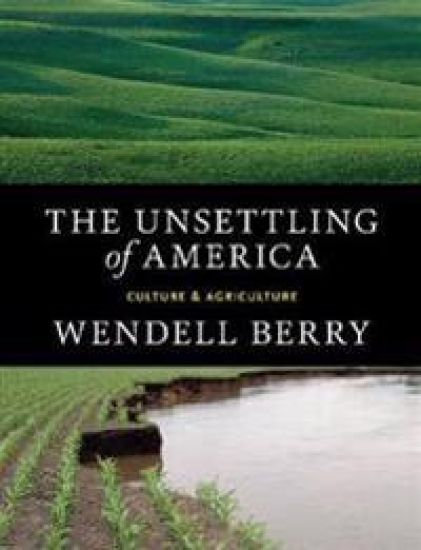
The Unsettling Of America

The Unsettling Of America

Wendell Berry

Counterpoint
2015
nidottu
Since its publication by Sierra Club Books in 1977, The Unsettling of America has been recognized as a classic of American letters. In it, Wendell Berry argues that good farming is a cultural development and spiritual discipline. Today's agribusiness, however, takes farming out of its cultural context and away from families. As a result, we as a nation are more estranged from the land from the intimate knowledge, love, and care of it.Sadly, his arguments and observations are more relevant than ever. We continue to suffer loss of community, the devaluation of human work, and the destruction of nature under an economic system dedicated to the mechanistic pursuit of products and profits. Although  this book has not had the happy fate of being proved wrong," Berry writes, there are good people working  to make something comely and enduring of our life on this earth." Wendell Berry is one of those people, writing and working, as ever, with passion, eloquence, and conviction.
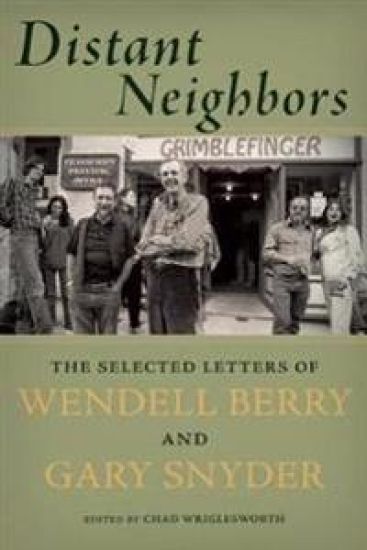
Distant Neighbors

Distant Neighbors

Gary Snyder; Wendell Berry

Counterpoint
2015
nidottu
In 1969 Gary Snyder returned from a long residence in Japan to northern California, to a homestead in the Sierra foothills where he intended to build a house and settle on the land with his wife and young sons. He had just published his first book of essays, Earth House Hold. A few years before, after a long absence, Wendell Berry left New York City to return to land near his grandfather's farm in Port Royal, Kentucky, where he built a small studio and lived there with his wife as they restored an old house on their newly acquired homestead. In 1969 Berry had just published Long-Legged House. These two founding members of the counterculture and of the new environmental movement had yet to meet, but they knew each other's work, and soon they began a correspondence. Neither man could have imagined the impact their work would have on American political and literary culture, nor could they have appreciated the impact they would have on one another.Snyder had thrown over all vestiges of Christianity in favor of becoming a devoted Buddhist and Zen practitioner, and had lived in Japan for a prolonged period to develop this practice. Berry's discomfort with the Christianity of his native land caused him to become something of a renegade Christian, troubled by the church and organized religion, but grounded in its vocabulary and its narrative. Religion and spirituality seemed like a natural topic for the two men to discuss, and discuss they did.They exchanged more than 240 letters from 1973 to 2013, remarkable letters of insight and argument. The two bring out the best in each other, as they grapple with issues of faith and reason, discuss ideas of home and family, worry over the disintegration of community and commonwealth, and share the details of the lives they've chosen to live with their wives and children. Contemporary American culture is the landscape they reside on. Environmentalism, sustainability, global politics and American involvement, literature, poetry and progressive ideals, these two public intellectuals address issues as broad as are found in any exchange in literature.No one can be unaffected by the complexity of their relationship, the subtlety of their arguments, and the grace of their friendship. This is a book for the ages.
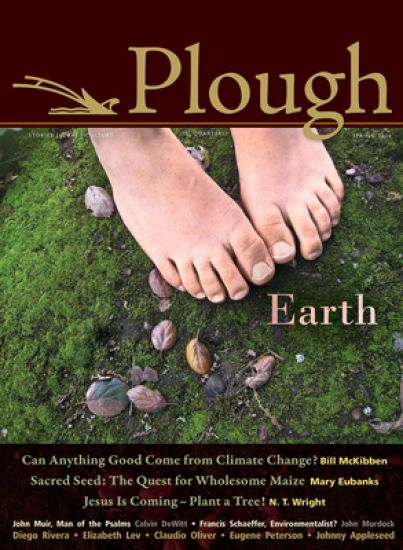
Plough Quarterly No. 4

Plough Quarterly No. 4

Bill McKibben; Eugene H. Peterson; N. T. Wright; Elizabeth Lev; Calvin DeWitt; Jane Tyson Clement; Wendell Berry; Barbara Kingsolver; John Muir; Flannery O'Connor; John Paul; Peter Mommsen

Plough Publishing House
2015
pokkari
This issue of Plough Quarterly explores our relationship with the natural world. Hear from leading scientists, farmers, writers, activists, theologians, and artists who have set their hearts and minds and hands to caring for the earth for generations to come. Bold, hope-filled, and down-to-earth, Plough Quarterly features thought-provoking articles, commentary, interviews, short fiction, book reviews, poetry and artwork to inspire everyday faith and action. Each issue brings together essential voices from many traditions to give you fresh insights on a core theme such as peacemaking, biblical justice, children and family, building community, man and woman, nature and the environment, nonviolence, or simple living. Starting from the conviction that the teachings and example of Jesus can transform and renew our world, it aims to apply them to all aspects of life, seeking common ground with all people of goodwill regardless of creed.
The Age Of Consequences

The Age Of Consequences

Courtney White; Wendell Berry

Counterpoint
2015
sidottu
Our planet is approaching a critical environmental juncture. Across the globe we continue to deplete the five pools of carbon  soil, wood, coal, oil, and natural gas  at an unsustainable rate. We've burned up half the planet's known reserves of oil  one trillion barrels  in less than a century. When these sources of energy-rich carbon go into severe decline, as they surely will, society will follow.Former archeologist and Sierra Club activist Courtney White calls this moment the Age of Consequences a time when the worrying consequences of our environmental actions or inaction  have begun to raise unavoidable and difficult questions. How should we respond? What are effective (and realistic) solutions?In exploring these questions, White draws on his formidable experience as an environmentalist and activist as well as his experience as a father to two children living through this vital moment in time. As a result, The Age of Consequences is a book of ideas and action, but it is also a chronicle of personal experience. Readers follow White as he travels the country --- from Kansas to Los Angeles, New York City, Italy, France, Yellowstone, and New England.
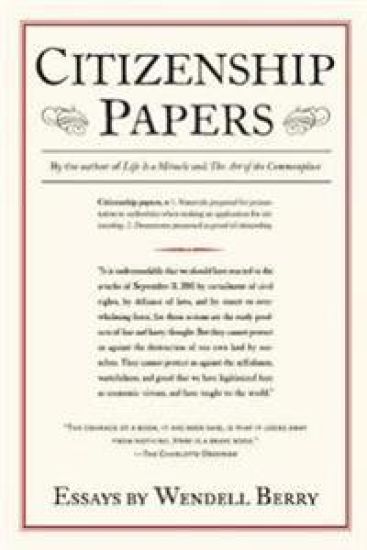
Citizenship Papers

Citizenship Papers

Wendell Berry

Counterpoint
2014
nidottu
Discerning the political import of complex current events requires great urgency, clarity, and care. Nothing less than the future of our nation is at stake. Wendell Berry's Citizenship Papers, collecting nineteen essays, is a ringing alarm, a call for resistance and responsibility, and a reminder of how fragile our commonwealth has become at the dawn of the twenty-first century. We are encouraged to believe that the governments and corporations of the affluent parts of the world are run by people using rational processes to make rational decisions. The dominant faith of the world in our time is rationality. That in an age of reason, the human race, or the most wealthy and powerful parts of it, should be behaving with colossal irrationality ought to make us wonder if reason alone can lead us to do what is right." from  Two Minds"
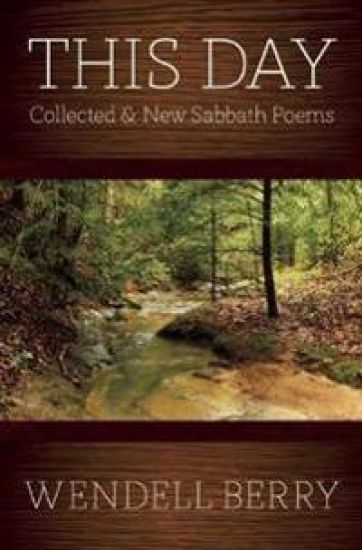
This Day

This Day

Wendell Berry

Counterpoint
2014
nidottu
For nearly thirty-five years, Wendell Berry has been at work on a series of poems occasioned by his solitary Sunday walks around his farm in Kentucky. From riverfront and meadows, to grass fields and woodlots, every inch of this hillside farm lives in these poems, as do the poet's constant companions of memory and occasion, family and animals, who have with Berry created his Home Place with love and gratitude.These are poems of spiritual longing and political extremity, memorials and celebrations, elegies and lyrics, alongside the occasional rants of the Mad Farmer, pushed to the edge yet again by his compatriots and elected officials.With the publication of this new complete edition, it has become increasingly clear that The Sabbath Poems have become the very heart of Berry's entire work. And these magnificent poems, taken as a whole, have become one of the greatest contributions ever made to American poetry.
The Mad Farmer Poems

The Mad Farmer Poems

Wendell Berry; Abigail Rorer

Counterpoint
2014
nidottu
During the otherwise quiet course of his life as a poet, Wendell Berry has become  mad" at what contemporary society has made of its land, its communities, and its past. This anger reaches its peak in the poems of the Mad Farmer, an open-ended sequence he's found himself impelled to continue against his better instincts. These poems can take the shape of manifestos, meditations, insults, Whitmanic fits and ravings-these are often funny in spite of themselves. The Mad Farmer is a character as necessary, perhaps, as he is regrettable.We have here gathered the individual poems from Berry's various collections to offer the teachings and bitcheries of this amazing American voice. After the great success of the lovely Window Poems, Bob Baris of the Press on Scroll Road, returns to design and produce an edition illustrated with etchings by Abigail Rover. His hand-press pages will be off-set for our trade edition.Ed McClanahan offers an introduction wherein he clears up the inspiration behind the Mad Farmer himself. McClanahan also manages to take more credit than he is clearly due. Then Berry weighs in with an apology-and characteristic exaggeration. James Baker Hall and William Kloefkorn offer poems here that also show how the Mad Farmer has escaped into the work of others.The whole is a wonderful testimony to the power of anger and humor to bring even the most terrible consequences into a focus otherwise impossible to obtain.
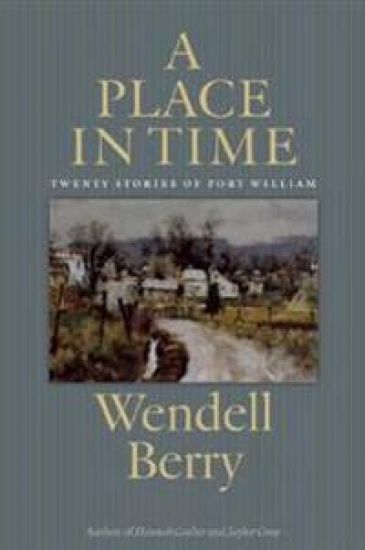
A Place In Time

A Place In Time

Wendell Berry

Counterpoint
2013
nidottu
For more than fifty years, Wendell Berry has been telling us stories about Port William, a mythical town on the banks of the Kentucky River, populated over the years by a cast of unforgettable characters living in a single place over a long time. In this new collection, the author's first piece of new fiction since the publication of Andy Catlett in 2006, the stories date's range from 1864, when Rebecca Dawe finds herself in her own reflection at the end of the Civil War, to one from 1991 when Grover Gibbs' widow, Beulah, attends the auction as her home place is offered for sale.It feels as if the entire membership, all the Catletts, Burley Coulter, Elton Penn, the Rowanberrys, Laura Milby, the preacher's wife, Kate Helen Branch, Andy's dog, Mike, nearly everyone returns with a story or two, to fill in the gaps in this long tale. Those just now joining the Membership will be charmed. Those who've attended before will be enriched.The story of the community of Port William is one of the great works in American literature. Published in the author's 78th year, this collection, the tenth volume in the series, is the perfect occasion to celebrate his huge achievement.
New Collected Poems

New Collected Poems

Wendell Berry

Counterpoint
2013
nidottu
In New Collected Poems, the poet revisits for the first time his immensely popular Collected Poems, which The New York Times Book Review described as  a straightforward search for a life connected to the soil, for marriage as a sacrament and family life" that  affirms a style that is resonant with the authentic," and  [returns] American poetry to a Wordsworthian clarity of purpose."In New Collected Poems, Berry reprints the nearly two hundred pieces in Collected Poems, along with the poems from his most recent collections Entries, Given, and Leavings to create an expanded collection, showcasing the work of a man heralded by The Baltimore Sun as  a sophisticated, philosophical poet in the line descending from Emerson and Thoreau . . . a major poet of our time."Wendell Berry is the author of over fifty works of poetry, fiction, and nonfiction, and has been awarded numerous literary prizes, including the T. S. Eliot Award, a National Institute of Arts and Letters award for writing, the American Academy of Arts and Letters Jean Stein Award, and a Guggenheim Foundation Fellowship. While he began publishing work in the 1960s, Booklist has written that  Berry has become ever more prophetic," clearly standing up to the test of time.
The Poetry Of William Carlos Williams Of Rutherford
Acclaimed essayist and poet Wendell Berry was born and has always lived in a "provincial" part of the country without an established literary culture. In an effort to adapt his poetry to his place of Henry County, Kentucky, Berry discovered an enduringly useful example in the work of William Carlos Williams. In Williams' commitment to his place of Rutherford, New Jersey, Berry found an inspiration that inevitably influenced the direction of his own writing.Both men would go on to establish themselves as respected American poets, and here Berry sets forth his understanding of that evolution for Williams, who in the course of his local membership and service, became a poet indispensable to us all.
A Country Of Marriage

A Country Of Marriage

Wendell Berry

Counterpoint
2013
nidottu
First published in 1971, The Country of Marriage is Wendell Berry's fifth volume of poetry. What he calls "an expansive metaphor" is "a farmer's relationship to his land as the basic and central relation of humanity to creation." "Similarly, marriage is the basic and central community tie; it begins and stands for the relation we have to family and to the larger circles of human association. And these relationships are in turn basic to, and may stand for, our relationship to God and to the sustaining mysteries and powers of creation." Each of the thirty-five poems in this collection is concerned with this metaphor. The long sequence that is itself entitled "The Country of Marriage," perhaps the finest single work in the book, is a grave, moving, and beautifully wrought love poem. But the shorter lyrics have an equal grace and beauty writing that contains the exhilarating lucidity of mountain spring water. And there are most notably, several more poems about the "Mad Farmer," who advises us here to 'every day do something that won't compute.' Berry has here perfected a work that is immediately accessible but that becomes, as we read it again, always more satisfying, reverberant with manifold meanings.
It All Turns On Affection

It All Turns On Affection

Wendell Berry

Counterpoint
2012
nidottu
When he accepted the invitation to deliver The Jefferson Lecture--our nation's highest honor for distinguished intellectual achievement--Wendell Berry decided to take on the obligation of thinking again about the problems that have engaged him throughout his long career. He wanted a fresh start, not only in looking at the groundwork of the problems facing our nation and the earth itself, but in gaining hope from some examples of repair and healing even in these times of Late Capitalism and its destructive contagions. As a poet and writer he understood already that much can be gleaned from looking at the vocabulary of these problems themselves and how we describe them. And he settled on "affection" as a method of engagement and solution. The result is the greatest speech he has delivered in his six decades of public life. It All Turns on Affection will take its place alongside The Unsettling of America and The Gift of Good Land as major testaments to the power and clarity of his contribution to American thought. We have taken this opportunity to include a small handful of other recent essays and a wonderful conversation between Mr.Berry, his wife Tanya Berry, and the head of the National Endowment of the Humanities Jim Leech, which took place just after the award was announced. The result offers a wonderful continuation of the long conversation Berry has had with his readers over many years and as well as a fine introduction to his life and work.
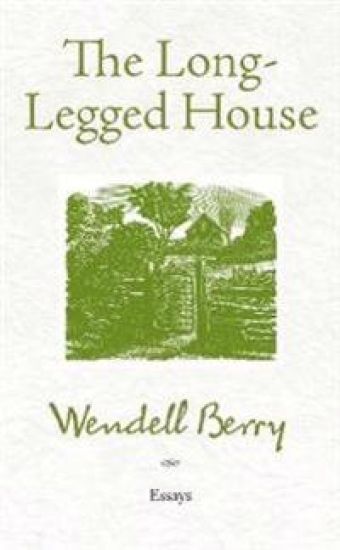
The Long-legged House

The Long-legged House

Wendell Berry

Counterpoint
2012
nidottu
First published in 1969 and out of print for more than twenty-five years, The Long-Legged House was Wendell Berry's first collection of essays, the inaugural work introducing many of the central issues that have occupied him over the course of his career. Three essays at the heart of this volume- The Rise,"  The Long-Legged House," and  A Native Hill" -are essays of homecoming and memoir, as the writer finds his home place, his native ground, his place on earth. As he later wrote,  What I stand for is what I stand on," and here we see him beginning the acts of rediscovery and resettling.