Kirjojen hintavertailu. Mukana 12 390 323 kirjaa ja 12 kauppaa.

Kirjailija

Wilhelm Dilthey

Kirjat ja teokset yhdessä paikassa: 63 kirjaa, julkaisuja vuosilta 1870-2025, suosituimpien joukossa Introduction to the Human Sciences. Vertaile teosten hintoja ja tarkista saatavuus suomalaisista kirjakaupoista.

63 kirjaa

Kirjojen julkaisuhaarukka 1870-2025.

Introduction to the Human Sciences

Introduction to the Human Sciences

Wilhelm Dilthey; Ramon J. Betanzos

Wayne State University Press
1988
nidottu
For some two centuries, scholars have wrestled with questions regarding the nature and logic of history as a discipline and, more broadly, with the entire complex of the "human sciences, " with include theology, philosophy, history, literature, the fine arts, and languages. The fundamental issue is whether the human sciences are a special class of studies with a specifically distinct object and method or whether they must be subsumed under the natural sciences.German philosopher Wilhelm Dilthey dedicated the bulk of his long career to there and related questions. His Introduction to the Human Sciences is a pioneering effort to elaborate a general theory of the human sciences, especially history, and to distinguish these sciences radically from the field of natural sciences. Though the Introduction was never completed, it remains one of the major statements of the topic. Together with other works by Dilthey, it has had a substantial influence on the recognition and human sciences as a fundamental division of human knowledge and on their separation from the natural sciences in origin, nature, and method.As a contribution to the issue of the methodologies of the humanities and social sciences, the Introduction rightly claims a place. This is the first time the entire work is available in English.In his introductory essay, translator Ramon J. Betanzos surveys Dilthey's life and thought and hails his efforts to create a foundational science for the particular human sciences, and at the same time, takes serious issue with Dilthey's historical/critical evaluation of metaphysics.

Weltanschauung und Analyse des Menschen seit Renaissance und Reformation
Der bedeutende Philosoph Wilhelm Dilthey (1833 - 1911) wollte mit seinen Arbeiten zum Thema Weltanschauung "ein Verst ndnis ber Denkungsart und Motive gewinnen, die zu den philosophiegeschichtlichen Entwicklungen gef hrt haben. Dilthey entwickelte dieses Verst ndnis jedoch nicht aus abstrakten Gesetzen des Denkens oder metaphysischen Annahmen, sondern durch den hermeneutischen Zugriff auf die Geschichte. Die verschiedenen religi sen, metaphysischen und auch wissenschaftlichen Systeme lassen sich dann als Weltanschauungen verstehen, die ihren gemeinsamen Ursprung im Lebenszusammenhang des Menschen haben." (Wikipedia) Das hier vorliegende, 1921 als zweiter Band seiner "Gesammelten Schriften" erschienene Werk legt hiervon beredtes Zeugnis ab in folgenden Kapiteln: "Auffassung und Analyse des Menschen im 15. und 16. Jahrhundert", "Das nat rliche System der Geisteswissenschaften", Die Autonomie des Denkens", "Giordano Bruno", "Der entwicklungsgeschichtliche Pantheismus", "Aus der Zeit der Spinozastudien Goethes" und "Die Funktion der Anthropologie in der Kultur des 16. und 17. Jahrhunderts. Nachdruck der Originalausgabe
Die Jugendgeschichte Hegels und andere Abhandlungen zur Geschichte des deutschen Idealismus
Der bedeutende Philosoph Wilhelm Dilthey (1833 - 1911) verfolgte mit der hier vorliegenden Arbeit folgendes Ziel: "Die Entwicklungsgeschichte des Hegelschen Systems soll ... dargestellt und historisch verst ndlich gemacht werden. Hierbei soll insbesondere ber cksichtigt werden die Ausbildung seines Pantheismus, seiner dialektischen Methode, der An-ordnung der Kategorien in seiner Logik und seines Verfahrens, die Gestalten des geschichtlichen Lebens in einen philosophischen Zu-sammenhang zu bringen." (Vorwort) Diese Studie wird noch erg nzt durch Abhgandlungen zu den Themen "Der Streit Kants mit der Zensur", " ber das Recht freier Religionsforschung", "Die drei Grundformen des System in der ersten H lfte des 19. Jahrhunderts", "Friedrich Daniel Schleiermacher" und noch einige weitere Kapitel. Nachdruck der 1921 als vierter Band der "Gesammelten Schriften" erschienenen Originalausgabe.
The Essence of Philosophy

The Essence of Philosophy

Wilhelm Dilthey

The University of North Carolina Press
2020
pokkari
Wilhelm Dilthey (1833-1911), the great German humanist, remained a towering figure in Europe long into the twentieth century. Published in 1954, this translation by Stephen A. Emery and William T. Emery was the first English translation of Dilthey's Das Wesen der Philosophie (1907) as well as his first work to be translated completely into English, making Dilthey accessible to scholars of the English-speaking world.
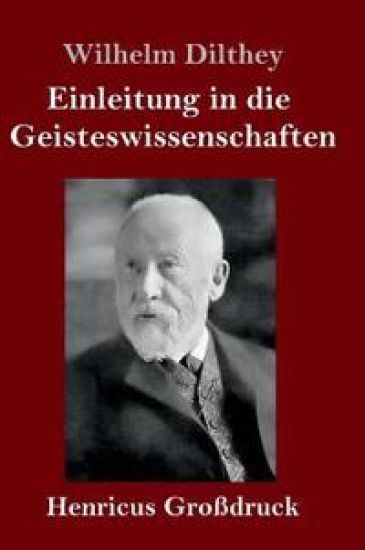
Einleitung in die Geisteswissenschaften (Großdruck)

Einleitung in die Geisteswissenschaften (Großdruck)

Wilhelm Dilthey

Henricus - Edition Deutsche Klassik GmbH, Berlin
2020
pokkari
Wilhelm Dilthey: Einleitung in die Geisteswissenschaften. Versuch einer Grundlegung f r das Studium der Gesellschaft und ihrer Geschichte Lesefreundlicher Gro druck in 16-pt-Schrift Gro format, 210 x 297 mm Berliner Ausgabe, 2020 Durchgesehener Neusatz bearbeitet und eingerichtet von Theodor Borken Erstdruck: Leipzig (Duncker & Humblot) 1883. Textgrundlage ist die Ausgabe: Wilhelm Dilthey: Gesammelte Schriften. Herausgegeben von Bernhard Groethuysen u. a., Leipzig u. a.: B. G. Teubner u. a., 1914 ff. Umschlaggestaltung von Thomas Schultz-Overhage. Gesetzt aus der Minion Pro, 16 pt. Henricus Edition Deutsche Klassik UG (haftungsbeschr nkt)
Wilhelm Dilthey: Selected Works, Volume VI

Wilhelm Dilthey: Selected Works, Volume VI

Wilhelm Dilthey

PRINCETON UNIVERSITY PRESS
2019
sidottu
This book completes a landmark six-volume translation of the major writings of Wilhelm Dilthey (1833–1911), a philosopher and historian of culture who continues to have a significant influence on philosophy, hermeneutics, and the theory of the human sciences. These volumes make available to English readers texts that represent the full range of Dilthey's work.The works in this volume present Dilthey's most deeply held views about philosophy and how it can guide human practices. System of Ethics (1890) argues that Humean sympathy motivates us only externally and must be replaced with the internally motivated fellow-feeling of solidarity that respects others as ends in themselves. The Essence of Philosophy (1907) demonstrates how philosophy has developed from its traditional metaphysical role to the epistemological and encyclopedic functions that ground and order the natural and human sciences. The work also discloses an orientational function of philosophy that is explored further in "The Types of World-View and Their Development" (1911). Philosophical world-views are important in that they address the existential needs and riddles that grow out of life experience and are not solved by any of the sciences.In addition, the book features three other significant essays. "Present Day Culture and Philosophy" (1898) concerns the challenges to philosophy posed by contemporary culture. "Dream" (1903) is about the thinkers portrayed in Raphael's School of Athens and Dilthey's worries about them breaking up into three divergent groups. Finally, "The Problem of Religion" (1911) considers how religiosity can still inform lived experience in secular times.