Kirjojen hintavertailu. Mukana 12 390 323 kirjaa ja 12 kauppaa.

Kirjailija

Willi Freeden

Kirjat ja teokset yhdessä paikassa: 22 kirjaa, julkaisuja vuosilta 2004-2024, suosituimpien joukossa Spherical Functions of Mathematical Geosciences. Vertaile teosten hintoja ja tarkista saatavuus suomalaisista kirjakaupoista.

22 kirjaa

Kirjojen julkaisuhaarukka 2004-2024.

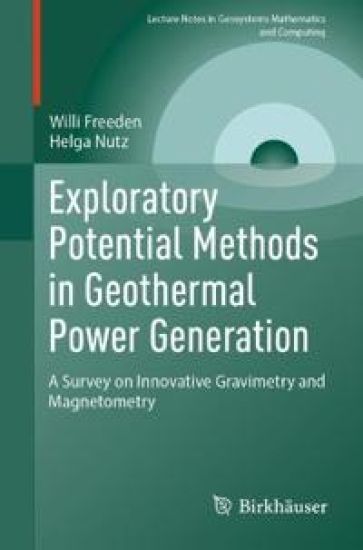
Exploratory Potential Methods in Geothermal Power Generation

Exploratory Potential Methods in Geothermal Power Generation

Willi Freeden; Helga Nutz

BIRKHAUSER VERLAG AG
2024
nidottu
The book provides the geoscientific context, that arises in gravimetric/magnetometric exploration. It essentially uses mathematics as a key technology for modeling issues on the basis of analysis and interpretation according to dense and precise gravitational/magnetic measurements. It is dedicated to surface and deep geology with potential data primarily of terrestrial origin. The book spans the interdisciplinary arc from geoengineering, especially geodesy, via geophysics to geomathematics and geology, and back again. It presents the recently published pioneering and groundbreaking multiscale mollifier methodologies realizing the bridging transfer from gravitational/magnetic measurements to approximative/numerical mollifier wavelet decorrelations with novel geologic prospects and layer-structure determination as outcome. Using the specific example of the German Saarland region, new important fields of application, especially for areas with mining-related cavities, will be opened up and subjected to an in-depth geologic detection.
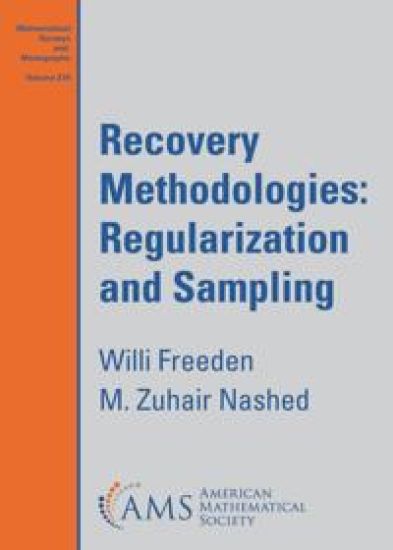
Recovery Methodologies: Regularization and Sampling

Recovery Methodologies: Regularization and Sampling

Willi Freeden; M. Zuhair Nashed

AMERICAN MATHEMATICAL SOCIETY
2023
nidottu
The goal of this book is to introduce the reader to methodologies in recovery problems for objects, such as functions and signals, from partial or indirect information. The recovery of objects from a set of data demands key solvers of inverse and sampling problems. Until recently, connections between the mathematical areas of inverse problems and sampling were rather tenuous. However, advances in several areas of mathematical research have revealed deep common threads between them, which proves that there is a serious need for a unifying description of the underlying mathematical ideas and concepts. Freeden and Nashed present an integrated approach to resolution methodologies from the perspective of both these areas.Researchers in sampling theory will benefit from learning about inverse problems and regularization methods, while specialists in inverse problems will gain a better understanding of the point of view of sampling concepts. This book requires some basic knowledge of functional analysis, Fourier theory, geometric number theory, constructive approximation, and special function theory. By avoiding extreme technicalities and elaborate proof techniques, it is an accessible resource for students and researchers not only from applied mathematics, but also from all branches of engineering and science.
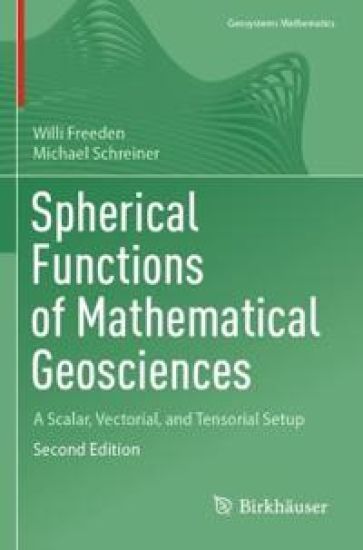
Spherical Functions of Mathematical Geosciences

Spherical Functions of Mathematical Geosciences

Willi Freeden; Michael Schreiner

Springer-Verlag Berlin and Heidelberg GmbH Co. KG
2023
nidottu
This book is an enlarged second edition of a monograph published in the Springer AGEM2-Series, 2009. It presents, in a consistent and unified overview, a setup of the theory of spherical functions of mathematical (geo-)sciences. The content shows a twofold transition: First, the natural transition from scalar to vectorial and tensorial theory of spherical harmonics is given in a coordinate-free context, based on variants of the addition theorem, Funk-Hecke formulas, and Helmholtz as well as Hardy-Hodge decompositions. Second, the canonical transition from spherical harmonics via zonal (kernel) functions to the Dirac kernel is given in close orientation to an uncertainty principle classifying the space/frequency (momentum) behavior of the functions for purposes of data analysis and (geo-)application. The whole palette of spherical functions is collected in a well-structured form for modeling and simulating the phenomena and processes occurring in the Earth's system. The result is a work which, while reflecting the present state of knowledge in a time-related manner, claims to be of largely timeless significance in (geo-)mathematical research and teaching.
Spherical Functions of Mathematical Geosciences

Spherical Functions of Mathematical Geosciences

Willi Freeden; Michael Schreiner

Springer-Verlag Berlin and Heidelberg GmbH Co. KG
2022
sidottu
This book is an enlarged second edition of a monograph published in the Springer AGEM2-Series, 2009. It presents, in a consistent and unified overview, a setup of the theory of spherical functions of mathematical (geo-)sciences. The content shows a twofold transition: First, the natural transition from scalar to vectorial and tensorial theory of spherical harmonics is given in a coordinate-free context, based on variants of the addition theorem, Funk-Hecke formulas, and Helmholtz as well as Hardy-Hodge decompositions. Second, the canonical transition from spherical harmonics via zonal (kernel) functions to the Dirac kernel is given in close orientation to an uncertainty principle classifying the space/frequency (momentum) behavior of the functions for purposes of data analysis and (geo-)application. The whole palette of spherical functions is collected in a well-structured form for modeling and simulating the phenomena and processes occurring in the Earth's system. The result is a work which, while reflecting the present state of knowledge in a time-related manner, claims to be of largely timeless significance in (geo-)mathematical research and teaching.
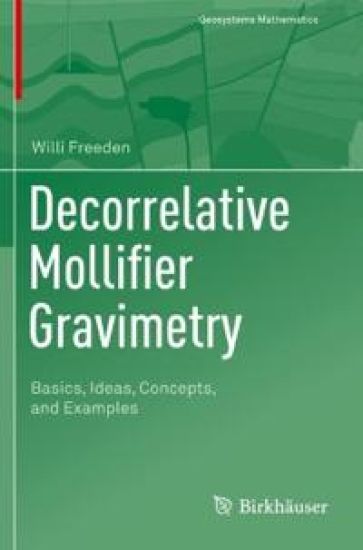
Decorrelative Mollifier Gravimetry

Decorrelative Mollifier Gravimetry

Willi Freeden

Springer Nature Switzerland AG
2022
nidottu
This monograph presents the geoscientific context arising in decorrelative gravitational exploration to determine the mass density distribution inside the Earth. First, an insight into the current state of research is given by reducing gravimetry to mathematically accessible, and thus calculable, decorrelated models. In this way, the various unresolved questions and problems of gravimetry are made available to a broad scientific audience and the exploration industry. New theoretical developments will be given, and innovative ways of modeling geologic layers and faults by mollifier regularization techniques are shown.This book is dedicated to surface as well as volume geology with potential data primarily of terrestrial origin. For deep geology, the geomathematical decorrelation methods are to be designed in such a way that depth information (e.g., in boreholes) may be canonically entered. Bridging several different geo-disciplines, this book leads in a cycle from the potential measurements made by geoengineers, to the cleansing of data by geophysicists and geoengineers, to the subsequent theory and model formation, computer-based implementation, and numerical calculation and simulations made by geomathematicians, to interpretation by geologists, and, if necessary, back. It therefore spans the spectrum from geoengineering, especially geodesy, via geophysics to geomathematics and geology, and back.Using the German Saarland area for methodological tests, important new fields of application are opened, particularly for regions with mining-related cavities or dense development in today's geo-exploration.
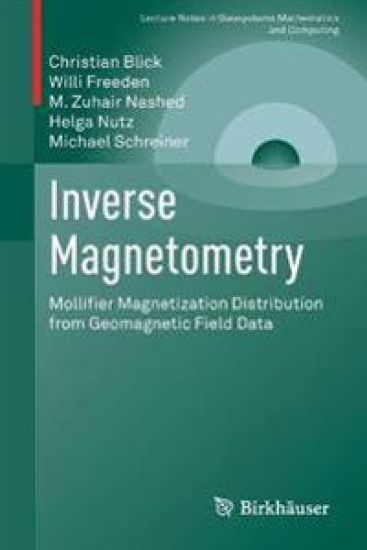
Inverse Magnetometry

Inverse Magnetometry

Christian Blick; Willi Freeden; M. Zuhair Nashed; Helga Nutz; Michael Schreiner

Springer Nature Switzerland AG
2021
nidottu
This monograph presents the geoscientific context arising in decorrelative geomagnetic exploration. First, an insight into the current state of research is given by reducing magnetometry to mathematically accessible, and thus calculable, decorrelated models. In this way, various questions and problems of magnetometry are made available to a broad scientific audience and the exploration industry. New stimuli are given, and innovative ways of modeling geologic strata by mollifier magnetometric techniques are shown.Potential data sets primarily of terrestrial origin constitute the main data basis in the book. For deep geology, the geomathematical decorrelation methods are designed in such a way that depth information (e.g., in boreholes) may be canonically entered. Overall, this book provides pioneering and ground-breaking innovative mathematical knowledge as a transfer methodology from the “reality space” of magnetometric measurements into the “virtual space” of mathematical-numerical modeling structures and mollifier solutions with novel geological application areas. It pursues a double goal: On the one hand, it represents a geoscientific set of rules for today's geoengineering, interested in the application of innovative modelling and simulation techniques to promising data sets and structures occurring in geomagnetics. On the other hand, the book serves as a collection of current material in Applied Mathematics to offer alternative methodologies in the theory of inverse problems.
Decorrelative Mollifier Gravimetry

Decorrelative Mollifier Gravimetry

Willi Freeden

Springer Nature Switzerland AG
2021
sidottu
This monograph presents the geoscientific context arising in decorrelative gravitational exploration to determine the mass density distribution inside the Earth. First, an insight into the current state of research is given by reducing gravimetry to mathematically accessible, and thus calculable, decorrelated models. In this way, the various unresolved questions and problems of gravimetry are made available to a broad scientific audience and the exploration industry. New theoretical developments will be given, and innovative ways of modeling geologic layers and faults by mollifier regularization techniques are shown.This book is dedicated to surface as well as volume geology with potential data primarily of terrestrial origin. For deep geology, the geomathematical decorrelation methods are to be designed in such a way that depth information (e.g., in boreholes) may be canonically entered. Bridging several different geo-disciplines, this book leads in a cycle from the potential measurements made by geoengineers, to the cleansing of data by geophysicists and geoengineers, to the subsequent theory and model formation, computer-based implementation, and numerical calculation and simulations made by geomathematicians, to interpretation by geologists, and, if necessary, back. It therefore spans the spectrum from geoengineering, especially geodesy, via geophysics to geomathematics and geology, and back.Using the German Saarland area for methodological tests, important new fields of application are opened, particularly for regions with mining-related cavities or dense development in today's geo-exploration.
Dekorrelative Gravimetrie

Dekorrelative Gravimetrie

Willi Freeden; Mathias Bauer

Springer-Verlag Berlin and Heidelberg GmbH Co. K
2020
sidottu
Die Entwicklung immer leistungsfähigerer absoluter wie auch relativer Gravimeter mit deutlich verbesserter Messgenauigkeit ermöglicht es, dass sich künftig nicht nur prägnante Schwereanomalien (wie z. B. die eines Salzstocks), sondern auch schwächere Signaturen erfassen und modellieren lassen. Mehr noch, die rasante Entwicklung der Computer führt zu neuartigen Methoden der Datendekomposition, wie z. B. Waveletdekorrelation. Dekorrelative Gravimetrie ist somit eine neue Explorationstechnik, die als kanonische Innovation aus der Verbindung neuartiger Mess- und Modellierungstechniken resultiert.Dekorrelative Gravimetrie dient der Reduzierung des Fündigkeitsrisikos von Aquiferen sowie von Gas- und Öllagerstätten, auch durch Vergleich und Zusammenschau alternativer, aber strukturell ähnlich gelagerter, dekorrelativer Verfahren wie etwa Magnetometrie und Seismik. Hier setzt dieses Buch mit einem exemplarischen Überblick über die neuartige Dekorrelationsmethoden der heutigenGeomathematik mit Hauptgewicht für den Fall der Gravimetrie an. Wesentliches mathematisches Hilfsmittel ist die Regularisierung des Newtonschen Volumenintegrals durch taylorisierte Mollifier-Varianten des Newton-Kerns.Ziel des vorliegenden Buches ist somit die Vermittlung des Grundverständnisses, dass Zooming-In Mollifier-Potentialmethoden wie etwa dekorrelative Gravimetrie neue wichtige Anwendungsfelder in der heutigen Geoexploration eröffnen, insbesondere für Gebiete mit bergbaubedingten Hohlräumen oder sehr dichter Bebauung wie etwa das Saarland oder Sachsen, die den Einsatz von reflexionsseismischen Messungen erschweren oder sogar unmöglich machen.Zusammenfassend lässt sich für dieses Buchprojekt festhalten, dass es einen Einblick in den aktuellen Stand gravimetrischer Multiskalenforschung vermittelt. Als wesentliches Resultat ergibt sich, dass die Schlüsseltechnologie Geomathematik in der Tat in der Lage ist, die Gravimetrie auf einfache, für Explorationszwecke zugängliche und somit rechenbare Dekorrelationsmodelle zu reduzieren. Mehr noch, das Buch macht auf diese Weise ein breites Publikum mit den vielfältigen Fragen und Problemen der heutigen Gravimetrie vertraut und setzt Denkanstöße für eine erfolgreiche Weiterentwicklung und eine adäquate praxisrelevante Anwendbarkeit von Potentialmethoden in der Exploration in Gang.
Lattice Point Identities and Shannon-Type Sampling

Lattice Point Identities and Shannon-Type Sampling

Willi Freeden; M. Zuhair Nashed

CRC Press
2019
sidottu
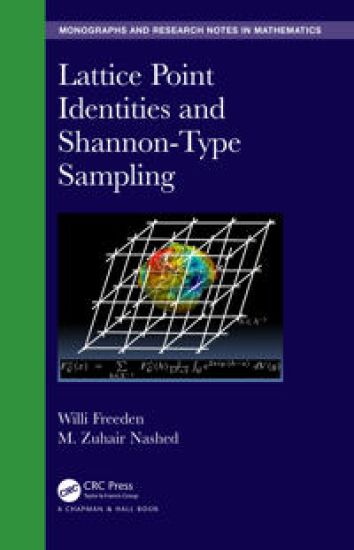
Lattice Point Identities and Shannon-Type Sampling demonstrates that significant roots of many recent facets of Shannon's sampling theorem for multivariate signals rest on basic number-theoretic results. This book leads the reader through a research excursion, beginning from the Gaussian circle problem of the early nineteenth century, via the classical Hardy-Landau lattice point identity and the Hardy conjecture of the first half of the twentieth century, and the Shannon sampling theorem (its variants, generalizations and the fascinating stories about the cardinal series) of the second half of the twentieth century. The authors demonstrate how all these facets have resulted in new multivariate extensions of lattice point identities and Shannon-type sampling procedures of high practical applicability, thereby also providing a general reproducing kernel Hilbert space structure of an associated Paley-Wiener theory over (potato-like) bounded regions (cf. the cover illustration of the geoid), as well as the whole Euclidean space. All in all, the context of this book represents the fruits of cross-fertilization of various subjects, namely elliptic partial differential equations, Fourier inversion theory, constructive approximation involving Euler and Poisson summation formulas, inverse problems reflecting the multivariate antenna problem, and aspects of analytic and geometric number theory. Features: New convergence criteria for alternating series in multi-dimensional analysis Self-contained development of lattice point identities of analytic number theory Innovative lattice point approach to Shannon sampling theory Useful for students of multivariate constructive approximation, and indeed anyone interested in the applicability of signal processing to inverse problems.
An Invitation to Geomathematics

An Invitation to Geomathematics

Willi Freeden; Clemens Heine; M. Zuhair Nashed

Springer Nature Switzerland AG
2019
nidottu
The authors introduce geomathematics as an active research area to a wider audience. Chapter 1 presents an introduction to the Earth as a system to apply scientific methods. Emphasis is laid on transfers from virtual models to reality and vice versa. In the second chapter geomathematics is introduced as a new scientific area which nevertheless has its roots in antiquity. The modern conception of geomathematics is outlined from different points of view and its challenging nature is described as well as its interdisciplinarity. Geomathematics is shown as the bridge between the real world and the virtual world. The complex mathematical tools are shown from a variety of fields necessary to tackle geoscientific problems in the mathematical language. Chapter 3 contains some exemplary applications as novel exploration methods. Particular importance is laid on the change of language when it comes to translate measurements to mathematical models. New solution methods like the multiscale mollifier technique are presented. Further applications discussed are aspects of reflection seismics. Chapter 4 is devoted to the short description of recent activities in geomathematics. The Appendix (Chapter 5) is devoted to the GEM – International Journal on Geomathematics founded ten years ago. Besides a detailed structural analysis of the editorial goals an index of all papers published in former issues is given.
Spherical Sampling

Spherical Sampling

Willi Freeden; M. Zuhair Nashed; Michael Schreiner

Springer Nature Switzerland AG
2019
nidottu
This book presents, in a consistent and unified overview, results and developments in the field of today´s spherical sampling, particularly arising in mathematical geosciences. Although the book often refers to original contributions, the authors made them accessible to (graduate) students and scientists not only from mathematics but also from geosciences and geoengineering. Building a library of topics in spherical sampling theory it shows how advances in this theory lead to new discoveries in mathematical, geodetic, geophysical as well as other scientific branches like neuro-medicine. A must-to-read for everybody working in the area of spherical sampling.
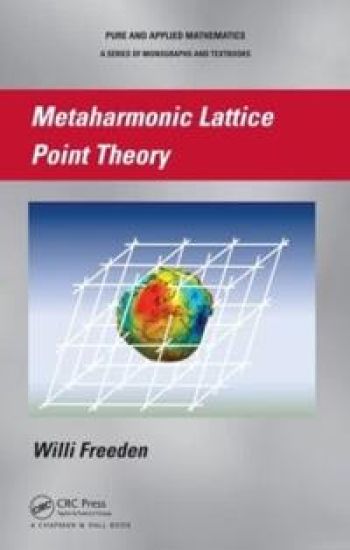
Metaharmonic Lattice Point Theory

Metaharmonic Lattice Point Theory

Willi Freeden

CRC Press
2018
nidottu
Metaharmonic Lattice Point Theory covers interrelated methods and tools of spherically oriented geomathematics and periodically reflected analytic number theory. The book establishes multi-dimensional Euler and Poisson summation formulas corresponding to elliptic operators for the adaptive determination and calculation of formulas and identities of weighted lattice point numbers, in particular the non-uniform distribution of lattice points.The author explains how to obtain multi-dimensional generalizations of the Euler summation formula by interpreting classical Bernoulli polynomials as Green’s functions and linking them to Zeta and Theta functions. To generate multi-dimensional Euler summation formulas on arbitrary lattices, the Helmholtz wave equation must be converted into an associated integral equation using Green’s functions as bridging tools. After doing this, the weighted sums of functional values for a prescribed system of lattice points can be compared with the corresponding integral over the function.Exploring special function systems of Laplace and Helmholtz equations, this book focuses on the analytic theory of numbers in Euclidean spaces based on methods and procedures of mathematical physics. It shows how these fundamental techniques are used in geomathematical research areas, including gravitation, magnetics, and geothermal.
Spherical Sampling

Spherical Sampling

Willi Freeden; M. Zuhair Nashed; Michael Schreiner

Birkhauser Verlag AG
2018
sidottu
This book presents, in a consistent and unified overview, results and developments in the field of today´s spherical sampling, particularly arising in mathematical geosciences. Although the book often refers to original contributions, the authors made them accessible to (graduate) students and scientists not only from mathematics but also from geosciences and geoengineering. Building a library of topics in spherical sampling theory it shows how advances in this theory lead to new discoveries in mathematical, geodetic, geophysical as well as other scientific branches like neuro-medicine. A must-to-read for everybody working in the area of spherical sampling.
Integration and Cubature Methods

Integration and Cubature Methods

Willi Freeden; Martin Gutting

CRC Press
2017
sidottu
In industry and economics, the most common solutions of partial differential equations involving multivariate numerical integration over cuboids include techniques of iterated one-dimensional approximate integration. In geosciences, however, the integrals are extended over potato-like volumes (such as the ball, ellipsoid, geoid, or the Earth) and their boundary surfaces which require specific multi-variate approximate integration methods. Integration and Cubature Methods: A Geomathematically Oriented Course provides a basic foundation for students, researchers, and practitioners interested in precisely these areas, as well as breaking new ground in integration and cubature in geomathematics.
Special Functions of Mathematical (Geo-)Physics

Special Functions of Mathematical (Geo-)Physics

Willi Freeden; Martin Gutting

Birkhauser Verlag AG
2015
nidottu
Special functions enable us to formulate a scientific problem by reduction such that a new, more concrete problem can be attacked within a well-structured framework, usually in the context of differential equations. A good understanding of special functions provides the capacity to recognize the causality between the abstractness of the mathematical concept and both the impact on and cross-sectional importance to the scientific reality. The special functions to be discussed in this monograph vary greatly, depending on the measurement parameters examined (gravitation, electric and magnetic fields, deformation, climate observables, fluid flow, etc.) and on the respective field characteristic (potential field, diffusion field, wave field). The differential equation under consideration determines the type of special functions that are needed in the desired reduction process. Each chapter closes with exercises that reflect significant topics, mostly in computational applications. As a result, readers are not only directly confronted with the specific contents of each chapter, but also with additional knowledge on mathematical fields of research, where special functions are essential to application. All in all, the book is an equally valuable resource for education in geomathematics and the study of applied and harmonic analysis. Students who wish to continue with further studies should consult the literature given as supplements for each topic covered in the exercises.
Energiewirtschaft 2014

Energiewirtschaft 2014

Mathias Bauer; Willi Freeden; Hans Jacobi; Thomas Neu

Springer Spektrum
2014
nidottu
?Die durch das Reaktorunglück in Fukushima forcierte Energiewende hin zu einer Stromversorgung mit primär erneuerbaren Energien konzentriert sich in der aktuellen Wahrnehmung nur auf den Ausbau von Solar und Windkraftenergie. Dabei wird vergessen, dass aufgrund fehlender Stromspeichertechnologien und Überlandstromtrassen eine erneuerbare Energie benötigt wird, die konstant Strom liefern und so Erzeugungsschwankungen bei Solar- und Windkraftenergie ausgleichen kann. Tiefe Geothermie, also Energie, die aus der Erde kommt, kann diese Aufgabe leisten, da sie die einzige erneuerbare Energie ist, die nicht klimatischen oder wetterbedingten Schwankungen unterliegt. Mit einem durch Wissenschaftlern und Praktikern erstellten Normenkatalog für tiefengeothermische Bohrungen, würde hier ein höchstmöglichen Sicherheitsstandard erreicht, und die wirtschaftlichen wie geologischen Risiken jedes Projektes minimiert werden.
Special Functions of Mathematical (Geo-)Physics

Special Functions of Mathematical (Geo-)Physics

Willi Freeden; Martin Gutting

Springer Basel
2013
sidottu
Special functions enable us to formulate a scientific problem by reduction such that a new, more concrete problem can be attacked within a well-structured framework, usually in the context of differential equations. A good understanding of special functions provides the capacity to recognize the causality between the abstractness of the mathematical concept and both the impact on and cross-sectional importance to the scientific reality. The special functions to be discussed in this monograph vary greatly, depending on the measurement parameters examined (gravitation, electric and magnetic fields, deformation, climate observables, fluid flow, etc.) and on the respective field characteristic (potential field, diffusion field, wave field). The differential equation under consideration determines the type of special functions that are needed in the desired reduction process. Each chapter closes with exercises that reflect significant topics, mostly in computational applications. As a result, readers are not only directly confronted with the specific contents of each chapter, but also with additional knowledge on mathematical fields of research, where special functions are essential to application. All in all, the book is an equally valuable resource for education in geomathematics and the study of applied and harmonic analysis. Students who wish to continue with further studies should consult the literature given as supplements for each topic covered in the exercises.
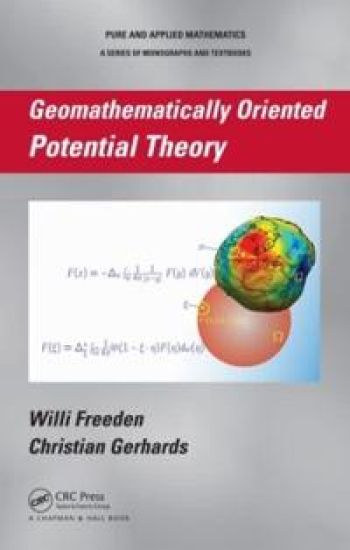
Geomathematically Oriented Potential Theory

Geomathematically Oriented Potential Theory

Willi Freeden; Christian Gerhards

Taylor Francis Inc
2012
sidottu
As the Earth`s surface deviates from its spherical shape by less than 0.4 percent of its radius and today’s satellite missions collect their gravitational and magnetic data on nearly spherical orbits, sphere-oriented mathematical methods and tools play important roles in studying the Earth’s gravitational and magnetic field. Geomathematically Oriented Potential Theory presents the principles of space and surface potential theory involving Euclidean and spherical concepts. The authors offer new insight on how to mathematically handle gravitation and geomagnetism for the relevant observables and how to solve the resulting potential problems in a systematic, mathematically rigorous framework.The book begins with notational material and the necessary mathematical background. The authors then build the foundation of potential theory in three-dimensional Euclidean space and its application to gravitation and geomagnetism. They also discuss surface potential theory on the unit sphere along with corresponding applications.Focusing on the state of the art, this book breaks new geomathematical grounds in gravitation and geomagnetism. It explores modern sphere-oriented potential theoretic methods as well as classical space potential theory.
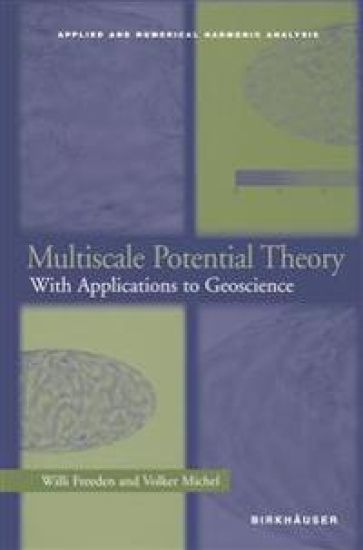
Multiscale Potential Theory

Multiscale Potential Theory

Willi Freeden; Volker Michel

Springer-Verlag New York Inc.
2011
nidottu
During the last few decades, the subject of potential theory has not been overly popular in the mathematics community. Neglected in favor of more abstract theories, it has been taught primarily where instructors have ac­ tively engaged in research in this field. This situation has resulted in a scarcity of English language books of standard shape, size, and quality covering potential theory. The current book attempts to fill that gap in the literature. Since the rapid development of high-speed computers, the remarkable progress in highly advanced electronic measurement concepts, and, most of all, the significant impact of satellite technology, the flame of interest in potential theory has burned much brighter. The realization that more and more details of potential functions are adequately visualized by "zooming­ in" procedures of modern approximation theory has added powerful fuel to the flame. It seems as if, all of a sudden, harmonic kernel functions such as splines and/or wavelets provide the impetus to offer appropriate means of assimilating and assessing the readily increasing flow of potential data, reducing it to comprehensible form, and providing an objective basis for scientific interpretation, classification, testing of concepts, and solutions of problems involving the Laplace operator.
Metaharmonic Lattice Point Theory

Metaharmonic Lattice Point Theory

Willi Freeden

Taylor Francis Inc
2011
sidottu
Metaharmonic Lattice Point Theory covers interrelated methods and tools of spherically oriented geomathematics and periodically reflected analytic number theory. The book establishes multi-dimensional Euler and Poisson summation formulas corresponding to elliptic operators for the adaptive determination and calculation of formulas and identities of weighted lattice point numbers, in particular the non-uniform distribution of lattice points.The author explains how to obtain multi-dimensional generalizations of the Euler summation formula by interpreting classical Bernoulli polynomials as Green’s functions and linking them to Zeta and Theta functions. To generate multi-dimensional Euler summation formulas on arbitrary lattices, the Helmholtz wave equation must be converted into an associated integral equation using Green’s functions as bridging tools. After doing this, the weighted sums of functional values for a prescribed system of lattice points can be compared with the corresponding integral over the function.Exploring special function systems of Laplace and Helmholtz equations, this book focuses on the analytic theory of numbers in Euclidean spaces based on methods and procedures of mathematical physics. It shows how these fundamental techniques are used in geomathematical research areas, including gravitation, magnetics, and geothermal.