Kirjojen hintavertailu. Mukana 12 229 862 kirjaa ja 12 kauppaa.

Kirjailija

William Cronon

Kirjat ja teokset yhdessä paikassa: 92 kirjaa, julkaisuja vuosilta 1992-2017, suosituimpien joukossa Car Country. Vertaile teosten hintoja ja tarkista saatavuus suomalaisista kirjakaupoista.

92 kirjaa

Kirjojen julkaisuhaarukka 1992-2017.

Changes in the Land: Indians, Colonists, and the Ecology of New England
The book that launched environmental history, William Cronon's Changes in the Land, now revised and updated. Winner of the Francis Parkman Prize In this landmark work of environmental history, William Cronon offers an original and profound explanation of the effects European colonists' sense of property and their pursuit of capitalism had upon the ecosystems of New England. Reissued here with an updated afterword by the author and a new preface by the distinguished colonialist John Demos, Changes in the Land, provides a brilliant inter-disciplinary interpretation of how land and people influence one another. With its chilling closing line, "The people of plenty were a people of waste," Cronon's enduring and thought-provoking book is ethno-ecological history at its best.
The Nature of Gold

The Nature of Gold

Kathryn Morse; William Cronon

University of Washington Press
2003
sidottu
In 1896, a small group of prospectors discovered a stunningly rich pocket of gold at the confluence of the Klondike and Yukon rivers, and in the following two years thousands of individuals traveled to the area, hoping to find wealth in a rugged and challenging setting. Ever since that time, the Klondike Gold Rush - especially as portrayed in photographs of long lines of gold seekers marching up Chilkoot Pass - has had a hold on the popular imagination.In this first environmental history of the gold rush, Kathryn Morse describes how the miners got to the Klondike, the mining technologies they employed, and the complex networks by which they obtained food, clothing, and tools. She looks at the political and economic debates surrounding the valuation of gold and the emerging industrial economy that exploited its extraction in Alaska, and explores the ways in which a web of connections among America's transportation, supply, and marketing industries linked miners to other industrial and agricultural laborers across the country. The profound economic and cultural transformations that supported the Alaska-Yukon gold rush ultimately reverberate to modern times.The story Morse tells is often narrated through the diaries and letters of the miners themselves. The daunting challenges of traveling, working, and surviving in the raw wilderness are illustrated not only by the miners' compelling accounts but by newspaper reports and advertisements. Seattle played a key role as "gateway to the Klondike." A public relations campaign lured potential miners to the West and local businesses seized the opportunity to make large profits while thousands of gold seekers streamed through Seattle.The drama of the miners' journeys north, their trials along the gold creeks, and their encounters with an extreme climate will appeal not only to scholars of the western environment and of late-19th-century industrialism, but to readers interested in reliving the vivid adventure of the West's last great gold rush.
Man and Nature

Man and Nature

George Perkins Marsh; William Cronon

University of Washington Press
2003
pokkari
In Man and Nature, first published in 1864, polymath scholar and diplomat George Perkins Marsh challenged the general belief that human impact on nature was generally benign or negligible and charged that ancient civilizations of the Mediterranean had brought about their own collapse by their abuse of the environment. By deforesting their hillsides and eroding their soils, they had destroyed the natural fertility that sustained their well-being. Marsh offered his compatriots in the United States a stern warning that the young American republic might repeat these errors of the ancient world if it failed to end its own destructive waste of natural resources. Marsh's ominous warnings inspired conservation and reform. In linking culture with nature, science with history, Man and Nature was the most influential text of its time next to Darwin's On the Origin of Species, published just five years earlier.In his Introduction to this new edition, David Lowenthal places Man and Nature in the context of recent scholarship and evaluates its significance for the environmental movement that has emerged since the latter part of the twentieth century. He also paints a vivid portrait of the book's brilliant, passionate, wide-ranging, and sometimes choleric author.Although what we know and what we fear about the environment have vastly amplified since Marsh's day, his appraisal of forest cover and erosion remains largely valid, his cautions about watershed control still cognent, and his call for stewardship ever more pertinent. Man and Nature is worth reading not only for having taught lessons crucial in its day, but for teaching them still so well.
George Perkins Marsh

George Perkins Marsh

David Lowenthal; William Cronon

University of Washington Press
2003
pokkari
George Perkins Marsh (1801–1882) was the first to reveal the menace of environmental misuse, to explain its causes, and to prescribe reforms. David Lowenthal here offers fresh insights, from new sources, into Marsh's career and shows his relevance today, in a book which has its roots in but wholly supersedes Lowenthal's earlier biography George Perkins Marsh: Versatile Vermonter (1958). Marsh's devotion to the repair of nature, to the concerns of working people, to women's rights, and to historical stewardship resonate more than ever. His Vermont birthplace is now a national park chronicling American conservation, and the crusade he launched is now global.Marsh's seminal book Man and Nature is famed for its ecological acumen. The clue to its inception lies in Marsh's many-sided engagement in the life of his time. The broadest scholar of his day, he was an acclaimed linguist, lawyer, congressman, and renowned diplomat who served 25 years as U.S. envoy to Turkey and to Italy. He helped found and guide the Smithsonian Institution, shaped the Washington Monument, penned potent tracts on fisheries and on irrigation, spearheaded public science, art, and architecture. He wrote on camels and corporate corruption, Icelandic grammar and Alpine glaciers. His pungent and provocative letters illuminate life on both sides of the Atlantic.Like Darwin's Origin of Species, Marsh's Man and Nature marked the inception of a truly modern way of looking at the world, of taking care lest we irreversibly degrade the fabric of humanized nature we are bound to manage. Marsh's ominous warnings inspired reforestation, watershed management, soil conservation, and nature protection in his day and ours.George Perkins Marsh: Prophet of Conservation was awarded the Association for American Geographers' 2000 J. B. Jackson Prize. The book was also on the shortlist for the first British Academy Book Prize, awarded in December 2001.
Irrigated Eden

Irrigated Eden

Mark Fiege; William Cronon

University of Washington Press
2000
pokkari
Irrigation came to the arid West in a wave of optimism about the power of water to make the desert bloom. Mark Fiege's fascinating and innovative study of irrigation in southern Idaho's Snake River valley describes a complex interplay of human and natural systems. Using vast quantities of labor, irrigators built dams, excavated canals, laid out farms, and brought millions of acres into cultivation. But at each step, nature rebounded and compromised the intended agricultural order. The result was a new and richly textured landscape made of layer upon layer of technology and intractable natural forces—one that engineers and farmers did not control with the precision they had anticipated. Irrigated Eden vividly portrays how human actions inadvertently helped to create a strange and sometimes baffling ecology.Winner of the Idaho Library Association Book Award, 1999Winner of the Charles A. Weyerhaeuser Award, Forest History Society, 1999-2000
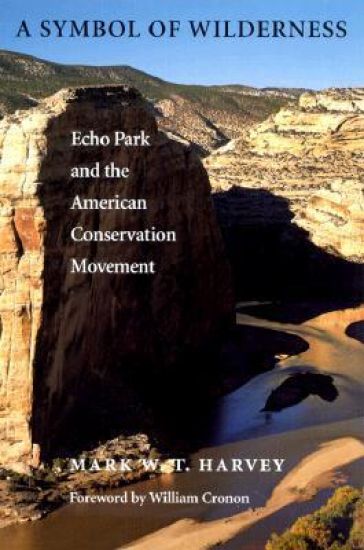
A Symbol of Wilderness

A Symbol of Wilderness

Mark W. T. Harvey; William Cronon

University of Washington Press
2000
pokkari
Harvey details the first major clash between conservationists and developers after World War II, the successful fight to prevent the building of Echo Park Dam. The dam on the Green River was intended to create a recreational lake in northwest Colorado and generate hydroelectric power, but would have flooded picturesque Echo Park Valley and threatened Dinosaur National Monument, straddling the Utah-Colorado border near Wyoming.
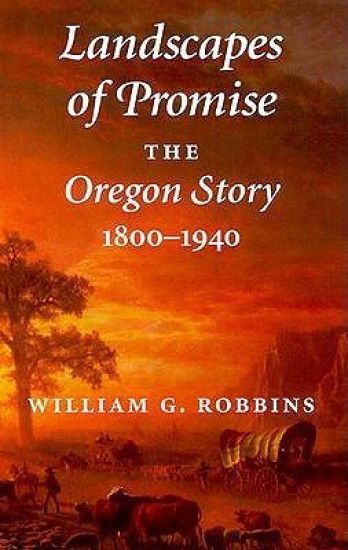
Landscapes of Promise

Landscapes of Promise

William G. Robbins; William Cronon

University of Washington Press
1999
pokkari
Landscapes of Promise is the first comprehensive environmental history of the early years of a state that has long been associated with environmental protection. Covering the period from early human habitation to the end of World War II, William Robbins shows that the reality of Oregon's environmental history involves far more than a discussion of timber cutting and land-use planning.Robbins demonstrates that ecological change is not only a creation of modern industrial society. Native Americans altered their environment in a number of ways, including the planned annual burning of grasslands and light-burning of understory forest debris. Early Euro-American settlers who thought they were taming a virgin wilderness were merely imposing a new set of alterations on an already modified landscape.Beginning with the first 18th-century traders on the Pacific Coast, alterations to Oregon's landscape were closely linked to the interests of global market forces. Robbins uses period speeches and publications to document the increasing commodification of the landscape and its products. "Environment melts before the man who is in earnest," wrote one Oregon booster in 1905, reflecting prevailing ways of thinking.In an impressive synthesis of primary sources and historical analysis, Robbins traces the transformation of the Oregon landscape and the evolution of our attitudes toward the natural world.
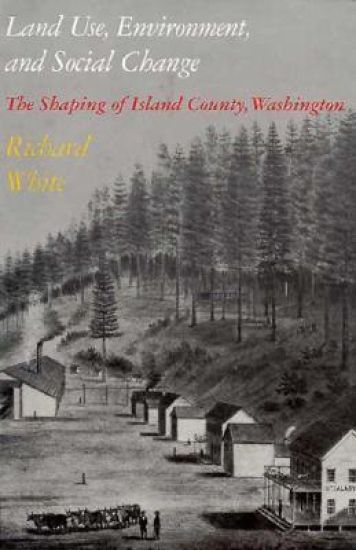
Land Use, Environment, and Social Change

Land Use, Environment, and Social Change

Richard White; William Cronon

University of Washington Press
1999
pokkari
Whidbey and Camano, two of the largest of the numerous beautiful islands dotting Puget Sound, together form the major part of Island Country. Taking this county as a case study and following its history from Indian times to the present, Richard White explores the complex relationship between human induced environmental change and social change. This new edition of his classic study includes a new preface by the author and a foreword by William Cronon.
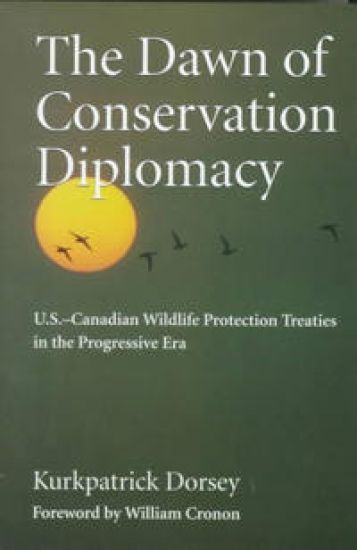
The Dawn of Conservation Diplomacy

The Dawn of Conservation Diplomacy

Kurkpatrick Dorsey; William Cronon

University of Washington Press
1998
sidottu
In the first decades of the twentieth century, fish in the Great Lakes and Puget Sound, seals in the North Pacific, and birds across North America faced a common threat: over harvesting that threatened extinction for many species. Progressive era conservationists saw a need for government intervention to protect threatened animals. And because so many species migrated across international political boundaries, their protectors saw the necessity of international conservation agreements. In The Dawn of Conservation Diplomacy, Kurkpatrick Dorsey examines the first three comprehensive wildlife conservation treaties in history, all between the United States and Canada: the Inland Fisheries Treaty of 1908, the North Pacific Fur Seal Convention of 1911, and the Migratory Bird Treaty of 1916.In his highly readable text, Dorsey argues that successful conservation treaties came only after conservationists learned to marshal scientific evidence, public sentiment, and economic incentives in their campaigns for protective legislation. The first treaty, intended to rescue the overfished boundary waters, failed to gain the necessary support and never became law. Despite scientific evidence of the need for conservation, politicians, and the general public were unable to counter the vocal opposition of fishermen across the continent. A few years later, conservationists successfully rallied popular sympathy for fur seals threatened with slaughter and the North Pacific Fur Seal Convention was adopted. By the time of the Migratory Bird Treaty of 1916, the importance of aesthetic appeal was clear: North American citizens were joining chapters of the Audubon Society in efforts to protect beautiful songbirds. Conservationists also presented economic evidence to support their efforts as they argued that threatened bird species provided invaluable service to farmers.Dorsey recounts the story of each of these early treaties, examining the scientific research that provided the basis for each effort, acknowledging the complexity of the issues, and presenting the personalities behind the politics. He argues that these decades-old treaties both directly affect us today and offer lessons for future conservation efforts.
Mountain Gloom and Mountain Glory

Mountain Gloom and Mountain Glory

Marjorie Hope Nicolson; William Cronon

University of Washington Press
1997
pokkari
To English poets and writers of the seventeenth century, as to their predecessors, mountains were ugly protuberances which disfigured nature and threatened the symmetry of earth; they were symbols God's wrath. Yet, less than two centuries later the romantic poets sang in praise of mountain splendor, of glorious heights that stirred their souls to divine ecstasy. In this very readable and fascinating study, Marjorie Hope Nicolson considers the intellectual renaissance at the close of the seventeenth century that caused the shift from mountain gloom to mountain glory. She examines various writers from the seventeenth, eighteenth, and nineteenth centuries and traces both the causes and the process of this drastic change in perception.
Nature's Metropolis

Nature's Metropolis

William Cronon

WW Norton Co
1992
nidottu
In this groundbreaking work, William Cronon gives us an environmental perspective on the history of nineteenth-century America. By exploring the ecological and economic changes that made Chicago America's most dynamic city and the Great West its hinterland, Mr. Cronon opens a new window onto our national past. This is the story of city and country becoming ever more tightly bound in a system so powerful that it reshaped the American landscape and transformed American culture. The world that emerged is our own. Winner of the Chicago Tribune Heartland Prize