Kirjojen hintavertailu. Mukana 12 595 353 kirjaa ja 12 kauppaa.

Kirjailija

William James

Kirjat ja teokset yhdessä paikassa: 590 kirjaa, julkaisuja vuosilta 1896-2026, suosituimpien joukossa Pragmatism a New Name for Some Old Ways of Thinking. Vertaile teosten hintoja ja tarkista saatavuus suomalaisista kirjakaupoista.

590 kirjaa

Kirjojen julkaisuhaarukka 1896-2026.

The Correspondence of William James v. 10; July 1902-March 1905
Consisting of some 572 letters, with another 460 calendared, this tenth volume in a projected series of twelve offers a complete accounting of William James's known correspondence-with family, friends, and colleagues-from the beginning of 1902 through March 1905. For James these were hopeful years of recovery. The end of the depressing cure at Nauheim, the successful conclusion of the arduous Gifford Lectures in Edinburgh, the reaching maturity and independence of his two eldest children, and the gradual withdrawal from teaching responsibilities at Harvard allowed him to hope that he would at long last present his philosophical message to the world in the shape of a treatise on metaphysics. Philosophy was in a state of unrest, with old alliances breaking up and new ones forming, and was ripe for a more fruitful reformulation of its traditional questions. Intellectualism, philosophical and scientific, was waning, making room for the emergence of an empiricism congenial to humane values. As reflected in the letters of this period, James comes to recognize that Dewey and the Chicago school were his allies and that the Frenchman Henri Bergson was moving in the same direction. Consequently, Bergson is the major new correspondent of the present volume, and, because he emerges during this period as James's leading supporter, Ferdinand Schiller is another dominant correspondent. Often boisterous and irreverent, Schiller saw himself as a general about to overwhelm an aged and sleepy, but still dangerous, enemy. James, in the meantime, had to call upon all of his diplomatic skills to keep on good terms with the people Schiller irritated, while remaining Schiller's friend and defender. Scholars will find much material in this volume that will help them judge whether the common view of pragmatism as a capricious subjectivism largely reflected a widespread lack of respect for Schiller. While continuing his involvement with anti-imperialism, James takes a more critical stance toward existing social conditions during this period, proclaiming his admiration for the small and insisting on the connection between great size and social evil. In 1904 he tours the American South. There are hints that he was acting as a scout for his brother Henry, which perhaps caused William James to see more of the meanness and shabbiness of the region than he would have otherwise. Along with Bergson and Schiller, prominent intellectuals represented in this volume include Theodore Flournoy, Wincenty Lutoslawski, Carl Stumpf, Hugo Munsterberg, Josiah Royce, Charles Sanders Peirce, Oliver Lodge, John Dewey, George Herbert Palmer, Charles William Eliot, James Mark Baldwin, and Edwin Godkin.
Pragmatism and Other Writings

Pragmatism and Other Writings

William James

Penguin Classics
2000
pokkari
The writings of William James represent one of America's most original contributions to the history of ideas. Ranging from philosophy and psychology to religion and politics, James composed the most engaging formulation of American pragmatism. 'Pragmatism' grew out of a set of lectures and the full text is included here along with 'The Meaning of Truth', 'Psychology', 'The Will to Believe', and 'Talks to Teachers on Psychology'.
The Principles of Psychology, Vol. 1

The Principles of Psychology, Vol. 1

William James

Dover Publications Inc.
2000
nidottu
Volume 1 of the famous long course, complete and unabridged. Stream of thought, time perception, memory, experimental methods — these are only some of the concerns of a work that was years ahead of its time and is still valid, interesting and useful. Total in set: 94 figures.
The Principles of Psychology, Vol. 2

The Principles of Psychology, Vol. 2

William James

Dover Publications Inc.
2000
nidottu
This is the first inexpensive edition of the complete Long Course in Principles of Psychology, one of the great classics of modern Western literature and science and the source of the ripest thoughts of America’s most important philosopher. As such, it should not be confused with the many abridgements that omit key sections. The book presents lucid descriptions of human mental activity, with detailed considerations of the stream of thought, consciousness, time perception, memory, imagination, emotions, reason, abnormal phenomena, and similar topics. In its course it takes into account the work of Berkeley, Binet, Bradley, Darwin, Descartes, Fechner, Galton, Green, Helmholtz, Herbart, Hume, Janet, Kant, Lange, Lotze, Locke, Mill, Royce, Schopenhauer, Spinoza, Wundt, and scores of others. It examines contrasting interpretations of mental phenomena, treating introspective analysis, philosophical interpretations, and experimental research. Although the book originally appeared nearly 75 years ago, it remains unsurpassed today as a brilliantly written survey of William James’ timeless view of psychology.
The Varieties of Religious Experience

The Varieties of Religious Experience

William James

Modern Library Inc
1999
pokkari
Hailed as "one of the greatest philosophical minds of all time" by English philosopher Alfred North Whitehead, William James is widely recognized as one of the most influential figures in twentieth-century Western philosophy and as the founder of the psychology of religion. An immediate bestseller upon its publication in June 1902, The Varieties of Religious Experience weaves together acute observations with simple anecdotes to argue that individual religious experiences, rather than the tenets of organized religion, are what form the backbone of religious life. The book explores all sides of religous life, from repentance and conversion to mysticism and the value of saintliness. Written with James' characteristic humor and skill, The Varieties of Religious Experience sounds the depths of what he termed "Man's Religious Appetites. The old clich that Henry James wrote novels as though they were philosophical treatises whereas William James wrote philosophic treatises as though they were novels, while unfair to Henry, describes . . . the William James of The Varieties of Religious Experience, very well. Believers and unbelievers (and semibelievers) will continue to find in it both a resource and a challenge," wrote religion scholar Jaroslav Pelikan.
The Correspondence of William James v. 5; 1878-84

The Correspondence of William James v. 5; 1878-84

William James

University of Virginia Press
1997
sidottu
This fifth volume of letters chronicles James's emergence into professional and personal maturity. The correspondence is dominated by letters to his wife, Alice, and they reflect difficult events of the period such as the death of his parents and the responsibility he took for heading the family.
The Meaning of Truth

The Meaning of Truth

William James

Prometheus Books
1997
pokkari
Preeminent American philosopher and educator John Dewey (1859-1952) rejected Hegelian idealism for the pragmatism of William James. In this collection of informal, highly readable essays, originally published between 1897 and 1909, Dewey articulates his now classic philosophical concepts of knowledge and truth and the nature of reality. Here Dewey introduces his scientific method and uses critical intelligence to reject the traditional ways of viewing philosophical discourse. Knowledge cannot be divorced from experience; it is gradually acquired through interaction with nature. Philosophy, therefore, has to be regarded as itself a method of knowledge and not as a repository of disembodied, pre-existing absolute truths.
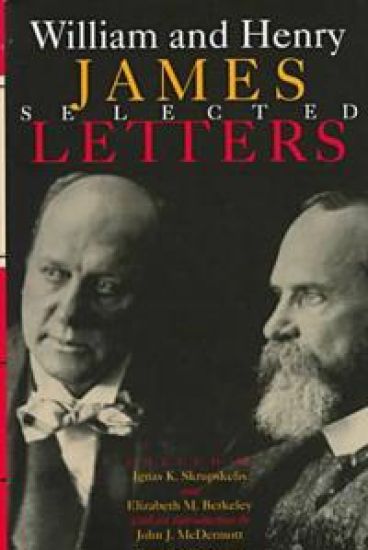
William and Henry James

William and Henry James

William James; Henry James

University of Virginia Press
1997
sidottu
This collection of 216 letters offers an accessible, single-volume distillation of the exchange spanning 50 years between celebrated brothers William and Henry James. Their correspondence demonstrates the persons, places, and events that effected the Euro-American world from 1861-1910.
Some Problems of Philosophy

Some Problems of Philosophy

William James

University of Nebraska Press
1996
pokkari
With the clarity that James deemed obligatory, Some Problems of Philosophy outlines his theory of perception. The early chapters expose the defects of intellectualism and monism and the advantages of empiricism and pluralism. The novelty that enters into concrete perceptual experience, and that is disallowed by the rationalizing intellect, suggests exciting possibilities. Denied any absolute truth in an ever-changing world, privy to only a piece of the truth at any given moment, the individual can, with faith and good will, help create order out of chaos. Some Problems in Philosophy, published posthumously, represents an important advance in William James's thought.
Essays in Radical Empiricism

Essays in Radical Empiricism

William James

University of Nebraska Press
1996
pokkari
Essays in Radical Empiricism shows William James concerned with ultimate reality and moving toward a metaphysical system. The twelve essays originally appeared in journals between 1904 and 1906. James himself collected them to illustrate what he called "radical empiricism," but this volume was not published until 1912, two years after his death. Included are such seminal essays as "Does Consciousness Exist?" and "A World of Pure Experience." The distinguished scholar and biographer Ralph Barton Perry, who edited this volume, called the essays essential to an understanding of James's writings. Radical empiricism takes us into a "world of pure experience." In the essays, as introducer Ellen Kappy Suckiel notes, "James inquires into the metaphysically basic reality underlying the common-sense objects of our world. It is here that he defends his view that 'experience' is the sole and ultimate reality." The essays deal with the applications of this "pure" or "neutral" experience: the general problem of relations, the role of feeling in experience, the nature of truth. Horace M. Kallen observed: "The fundamental point of these essays is that the relations between things, holding them together or separating them, are at least as real as the things themselves . . . and that no hidden substrata are necessary to account for the clashes and coherences of the world."
The Correspondence of William James, Volume 3

The Correspondence of William James, Volume 3

William James

University of Virginia Press
1994
sidottu
This volume presents the correspondence between William James, known for his contributions to psychology and philosophy, and his brother Henry. It covers their most productive years, when William was writing The Varieties of Religious Experience and Henry was writing his late masterpieces.
The Correspondence of William James v. 2; William and Henry, 1885-96
William James, known for his contributions to psychology and philosophy, occupies a secure place in American intellectual history. The 12 volumes of ""The Correspondence of William James"" present his vast and entertaining correspondence with his brother Henry, with other members of his family, with friends and colleagues, as well as with enthusiasts and detractors among readers of his work. The publication of James's private letters complements the 17 titles of ""The Works of William James"". During the years covered in this second of 3 volumes devoted to the letters of William and Henry, each of the brothers underwent a period of trial or testing as a writer. Henry's attempts at fame as a playwright failed, and his 1880s novels did not receive the popular reception he had hoped for. William struggled for years to complete ""The Principles of Psychology"", while burdened by many responsibilities, intermittent depression and eye troubles, finally to have it published in 1890, 12 years after the contract date. These letters offer glimpses of the diverse academic, literary, and social worlds in which the brothers circulated, of Henry's friendship with Robert Louis Stevenson, William Dean Howells, Rudyard Kipling, and the American writer Constance Fenimore Woolson, who may have been in love with him. In William's letters he expresses pleasure and progress in his work, comments on Henry's writing, describes his meetings with and reactions to Paul Bourget and other continental writers, and even reports an attack of crab lice and an experiment with peyote. After the death of both parents in 1882 and of brother Garth Wilkinson in 1883, the famous family had dwindled to William, Henry, the unstable and alcoholic Robertson and the invalid Alice. The anxieties of William and Henry over the troubles of Robertson and Alice are a recurrent theme of these letters, particularly up to the time of Alice's death from breast cancer in 1892. William's letter show his continuous concern for and frustration with the philandering, alcholic Robertson. But it is Alice who elicits the most extensive and moving commentary. After her move to England in 1884, Henry writes at great length and poignancy of her difficulties. She emerges as an example of how American civilization laid crippling constraints on the development of young women. The correspondence in this volume also covers the birth of William's daughter, Margaret Mary (Peggy), and his fourth son, Francis Tweedy, later renamed Alexander Robertson, and the poignant death of 18-month-old Herman. It details William's purchase of a large farmhouse in New Hampshire and his building of a home in Cambridge, the two residences that afforded him some solitude for his periods of moodiness, melancholia and insomnia. Henry's letters, though occasionally hinting at some regret over his life as a confirmed bachelor, reveal how he cherished his solitude, because it suited him and was conducive to his literary art. Altogether, this volume is a window into the lives of two brothers who stood out as accomplished and influential figures in their generation.