Kirjojen hintavertailu. Mukana 12 657 676 kirjaa ja 12 kauppaa.

Kirjailija

William Walker

Kirjat ja teokset yhdessä paikassa: 89 kirjaa, julkaisuja vuosilta 1985-2025, suosituimpien joukossa Betrayal at Little Gibraltar. Vertaile teosten hintoja ja tarkista saatavuus suomalaisista kirjakaupoista.

89 kirjaa

Kirjojen julkaisuhaarukka 1985-2025.

The Bards of Bon-Accord 1375-1860

The Bards of Bon-Accord 1375-1860

William Walker

Hansebooks
2017
pokkari
The Bards of Bon-Accord 1375-1860 is an unchanged, high-quality reprint of the original edition of 1887. Hansebooks is editor of the literature on different topic areas such as research and science, travel and expeditions, cooking and nutrition, medicine, and other genres. As a publisher we focus on the preservation of historical literature. Many works of historical writers and scientists are available today as antiques only. Hansebooks newly publishes these books and contributes to the preservation of literature which has become rare and historical knowledge for the future.
Weapons of Mass Destruction and International Order
First Published in 2005. How should the 'problem of order' associated with weapons of mass destrcution be understood and addressed today? Have the problem and its solution been misconceived and misrepresented, as manifested by the problematic aftermath of Iraq War? Has 9/11 rendered redundant past international ordering strategies, or these still discarded at our own peril? These are questions explored in this Adelphi Paper.
Memoirs of the Distinguished Men of Science of Great Britain
Memoirs of the Distinguished Men of Science of Great Britain - Living in the years 1807-8 - an appendix is an unchanged, high-quality reprint of the original edition of 1864. Hansebooks is editor of the literature on different topic areas such as research and science, travel and expeditions, cooking and nutrition, medicine, and other genres. As a publisher we focus on the preservation of historical literature. Many works of historical writers and scientists are available today as antiques only. Hansebooks newly publishes these books and contributes to the preservation of literature which has become rare and historical knowledge for the future.
Betrayal at Little Gibraltar

Betrayal at Little Gibraltar

William Walker

Scribner
2017
Nidottu
A vivid, thrilling, and impeccably researched account of Americas bloodiest battle everWorld War Is Meuse-Argonne Offensiveand the shocking American cover-up at its heart. The year is 1918. German engineers have fortified Montfaucon, an elevated fortress in northern France, with bunkers, tunnels, and a top-secret observatory capable of directing artillery shells across the battlefield. Following a number of unsuccessful attacks, the French have deemed Montfaucon impregnable. Capturing it is the key to success for General John J. Pershings 1.2 million troops and his plan to end the war. But a betrayal of Americans by Americans results in a bloody debacle. In his masterful Betrayal at Little Gibraltar, William Walker tells the full story for the first time. After a delay in the assault on Montfaucon, thousands of Americans lost their lives while the Germans defended their position without mercy. Years of archival research show the actual cause of the delay was a senior American officer, Major General Robert E. Lee Bullard, who disobeyed orders to assist in the direct assault on Montfaucon. The result was the unnecessary slaughter of American doughboys during the assault. Although several officers learned of the circumstances, Pershing protected Bullardan old friend and fellow West Point graduateby covering up the story. The true and full account of the battle that cost 122,000 American casualties was almost lost to time. A "military history for all libraries" (Library Journal), Betrayal at Little Gibraltar tells of the soldiers who fought to capture the giant fortress and push the American advance. Using unpublished first-person accountsand featuring photographs, documents, and mapsWalker describes the horrors of combat, the sacrifices of the doughboys, and the determined efforts of two participants to solve the mystery of Montfaucon. This is compelling history, important to be told, an "as valuable account as Barbara Tuchman's The Guns of August" (Virginian-Pilot).
Antiformalist, Unrevolutionary, Illiberal Milton
On the basis of a close reading of Milton's major published political prose works from 1644 through to the Restoration, William Walker presents the anti-formalist, unrevolutionary, illiberal Milton. Walker shows that Milton placed his faith not so much in particular forms of government as in statesmen he deemed to be virtuous. He reveals Milton's profound aversion to socio-political revolution and his deep commitments to what he took to be orthodox religion. He emphasises that Milton consistently presents himself as a champion not of heterodox religion, but of 'reformation'. He observes how Milton's belief that all men are not equal grounds his support for regimes that had little popular support and that did not provide the same civil liberties to all. And he observes how Milton's powerful commitment to a single religion explains his endorsement of various English regimes that persecuted on grounds of religion. This reading of Milton's political prose thus challenges the current consensus that Milton is an early modern exponent of republicanism, revolution, radicalism, and liberalism. It also provides a fresh account of how the great poet and prose polemicist is related to modern republics that think they have separated church and state.
War in Nicaragua

War in Nicaragua

William Walker

Windham Press
2013
nidottu
War in Nicaragua By General William Walker No history is so hard to write as that of our own times. Few, if any, can free themselves from the fashions of thought and opinion which control the daily life of their neighbors, and every one inhales to some extent the vapors and miasms floating in the air he hourly breathes. The task is even more difficult if a man attempts to narrate events in which he has taken. As the soldier, warmed by the heat of battle, dimly sees through the dust and smoke of a well-fought field, the large movements which decide the issue of the conflict, so he who has mingled in the struggles of parties or the contests of nations, may not be as well fitted as others to speak of facts molded partially by his own will and hand. But if the memoir writer be fair and discreet, he may contribute materials for future use, and his very errors may instruct after ages. The author of the following narrative does not expect to attain perfect truth in all things; he merely asks the reader to give him credit for the desire to state facts accurately, and to reason justly about the circumstances attending the presence of the Americans in Nicaragua... ------------------------------------------------------------------------------------------------------------------------------------------ Windham Press is committed to bringing the lost cultural heritage of ages past into the 21st century through high-quality reproductions of original, classic printed works at affordable prices. This book has been carefully crafted to utilize the original images of antique books rather than error-prone OCR text. This also preserves the work of the original typesetters of these classics, unknown craftsmen who laid out the text, often by hand, of each and every page you will read. Their subtle art involving judgment and interaction with the text is in many ways superior and more human than the mechanical methods utilized today, and gave each book a unique, hand-crafted feel in its text that connected the reader organically to the art of bindery and book-making. We think these benefits are worth the occasional imperfection resulting from the age of these books at the time of scanning, and their vintage feel provides a connection to the past that goes beyond the mere words of the text.
A Perpetual Menace

A Perpetual Menace

William Walker

Routledge
2011
sidottu
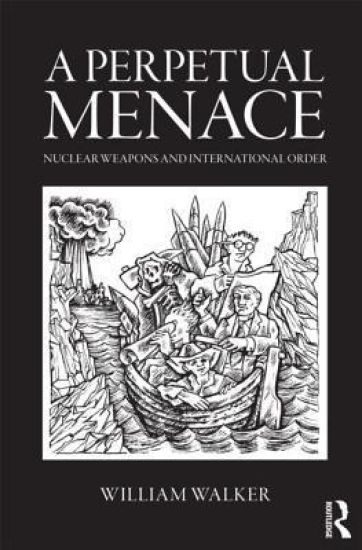
Written by a leading scholar in the field of nuclear weapons and international relations, this book examines ‘the problem of order’ arising from the existence of weapons of mass destruction.This central problem of international order has its origins in the nineteenth century, when industrialization and the emergence of new sciences, technologies and administrative capabilities greatly expanded states’ abilities to inflict injury, ushering in the era of total war. It became acute in the mid-twentieth century, with the invention of the atomic bomb and the pre-eminent role ascribed to nuclear weapons during the Cold War. It became more complex after the end of the Cold War, as power structures shifted, new insecurities emerged, prior ordering strategies were called into question, and as technologies relevant to weapons of mass destruction became more accessible to non-state actors as well as states.William Walker explores how this problem is conceived by influential actors, how they have tried to fashion solutions in the face of many predicaments, and why those solutions have been deemed effective and ineffective, legitimate and illegitimate, in various times and contexts.
A Perpetual Menace

A Perpetual Menace

William Walker

Routledge
2011
nidottu
Written by a leading scholar in the field of nuclear weapons and international relations, this book examines ‘the problem of order’ arising from the existence of weapons of mass destruction.This central problem of international order has its origins in the nineteenth century, when industrialization and the emergence of new sciences, technologies and administrative capabilities greatly expanded states’ abilities to inflict injury, ushering in the era of total war. It became acute in the mid-twentieth century, with the invention of the atomic bomb and the pre-eminent role ascribed to nuclear weapons during the Cold War. It became more complex after the end of the Cold War, as power structures shifted, new insecurities emerged, prior ordering strategies were called into question, and as technologies relevant to weapons of mass destruction became more accessible to non-state actors as well as states.William Walker explores how this problem is conceived by influential actors, how they have tried to fashion solutions in the face of many predicaments, and why those solutions have been deemed effective and ineffective, legitimate and illegitimate, in various times and contexts.