Kirjojen hintavertailu. Mukana 12 374 466 kirjaa ja 12 kauppaa.

Kirjailija

Alain Badiou

Kirjat ja teokset yhdessä paikassa: 155 kirjaa, julkaisuja vuosilta 1999-2026, suosituimpien joukossa Ahmed the Philosopher. Vertaile teosten hintoja ja tarkista saatavuus suomalaisista kirjakaupoista.

155 kirjaa

Kirjojen julkaisuhaarukka 1999-2026.

For a Politics of the Common Good

For a Politics of the Common Good

Alain Badiou; Peter Engelmann

Polity Press
2019
nidottu
This volume of conversations between Alain Badiou and Peter Engelmann focuses on the concrete political situation in the world of today. Here the validity and applicability of Badiou’s ideas are tested in relation to the great social and political problems of our time, including terrorism, migration, the surge in support for nationalist and populist parties and the growing gap between rich and poor. Badiou argues that in the age of today’s globalized capitalism, with its division of labour on a global scale and the worldwide interconnection of information through the Internet, there are no longer any national solutions. Because nations and states lose meaning in favour of transnational corporations in globalized capitalism, resistance to capitalism must by definition be global too. Only a politics that defines itself as a politics for all and does not act in the interests of one particular group – whether a nation, religion or community of shared values – can lead the world out of the current crisis of globalized capitalism.
For a Politics of the Common Good

For a Politics of the Common Good

Alain Badiou; Peter Engelmann

Polity Press
2019
sidottu
This volume of conversations between Alain Badiou and Peter Engelmann focuses on the concrete political situation in the world of today. Here the validity and applicability of Badiou’s ideas are tested in relation to the great social and political problems of our time, including terrorism, migration, the surge in support for nationalist and populist parties and the growing gap between rich and poor. Badiou argues that in the age of today’s globalized capitalism, with its division of labour on a global scale and the worldwide interconnection of information through the Internet, there are no longer any national solutions. Because nations and states lose meaning in favour of transnational corporations in globalized capitalism, resistance to capitalism must by definition be global too. Only a politics that defines itself as a politics for all and does not act in the interests of one particular group – whether a nation, religion or community of shared values – can lead the world out of the current crisis of globalized capitalism.
Matter and Form, Self-Evidence and Surprise

Matter and Form, Self-Evidence and Surprise

Alain Badiou; Miguel Abreu

Sequence Press
2019
sidottu
The eminent French philosopher "dialecticizes" five of the artist Jean-Luc Moulene's objects with five conceptual formations from the history of Western philosophy.In this unique essay, first delivered as a lecture during a panel discussion with the artist and philosopher Reza Negarestani, Alain Badiou identifies and "dialecticizes" five of the artist Jean-Luc Moulene's objects with five conceptual formations from the history of Western philosophy. Aristotle's complex of matter and form is called to mind to describe the inner logic of a hard foam sculpture. A bronze statue with holes activates Plato's notion of participation of the concrete world in the "injured Idea of the Beautiful." A small metallic and incomplete "angel" engages Leibniz's affirmation that "everything that exists is composed of an infinity of things." Badiou's musings go on to pair a broken and repaired plastic chair with Victor Hugo; a terrible hand made of concrete with the Freudian unconscious; and a large-scale "red and blue monster" with rudimentary mechanisms of the Cartesian cogito, the famous "I think, therefore I am," with unexpected inversions and variations.Badiou refrains, of course, from claiming that Moulene thinks about any of these philosophers when making his specific works. What he points to, however, in this richly illustrated bilingual volume, is that the artist and his art are "on the side of philosophy."
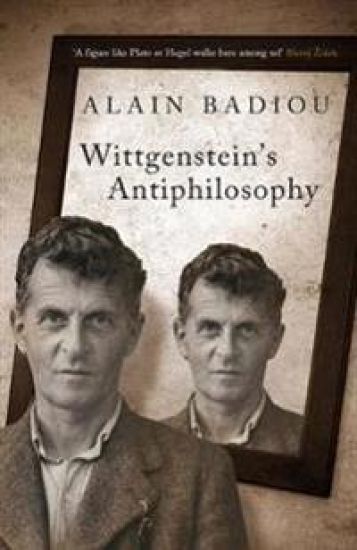
Wittgenstein's Antiphilosophy

Wittgenstein's Antiphilosophy

Alain Badiou

Verso Books
2019
nidottu
Alain Badiou takes on the standard bearer of the "linguistic turn" in modern philosophy and anatomizes the "antiphilosophy" of Ludwig Wittgenstein. In the course of his interrogation of Wittgenstein's thinking, Badiou refines his own definitions of the universal truths that govern his work. Bruno Bosteels's introduction argues that a continuing dialogue with Wittgenstein is inescapable for contemporary philosophy.
The End

The End

Alain Badiou; Giovanbattista Tusa

Polity Press
2019
sidottu
The notion of ‘the end’ has long occupied philosophical thought. In light of the horrors of the twentieth century, some writers have gone so far as to declare the end of philosophy itself, emphasizing the impossibility of thinking after Auschwitz. In this book the distinguished philosopher Alain Badiou, in dialogue with Giovanbattista Tusa, argues that we must renounce ‘the pathos of completion’ and continue to think philosophically. To accept the atrocities of the twentieth century as marking the end of philosophy is intolerable precisely because it buys into the totalizing doctrines of the perpetrators. Badiou contends that philosophical thinking is needed now more than ever to counter the totalizing effects of globalized capitalism, which prescribes no objective for human life other than integration into its system, giving rise to a widespread sense of hopelessness and nihilism. This book will appeal to the many followers of Badiou’s work and to anyone interested in contemporary philosophy and radical political theory.
The End

The End

Alain Badiou; Giovanbattista Tusa

Polity Press
2019
nidottu
The notion of ‘the end’ has long occupied philosophical thought. In light of the horrors of the twentieth century, some writers have gone so far as to declare the end of philosophy itself, emphasizing the impossibility of thinking after Auschwitz. In this book the distinguished philosopher Alain Badiou, in dialogue with Giovanbattista Tusa, argues that we must renounce ‘the pathos of completion’ and continue to think philosophically. To accept the atrocities of the twentieth century as marking the end of philosophy is intolerable precisely because it buys into the totalizing doctrines of the perpetrators. Badiou contends that philosophical thinking is needed now more than ever to counter the totalizing effects of globalized capitalism, which prescribes no objective for human life other than integration into its system, giving rise to a widespread sense of hopelessness and nihilism. This book will appeal to the many followers of Badiou’s work and to anyone interested in contemporary philosophy and radical political theory.
Malebranche

Malebranche

Alain Badiou

Columbia University Press
2019
sidottu
Alain Badiou is perhaps the world’s most significant living philosopher. In his annual seminars on major topics and pivotal figures, Badiou developed vital aspects of his thinking on a range of subjects that he would go on to explore in his influential works. In this seminar, Badiou offers a tour de force encounter with a lesser-known seventeenth-century philosopher and theologian, Nicolas Malebranche, a contemporary and peer of Spinoza and Leibniz.The seminar is at once a record of Badiou’s thought at a key moment in the years before the publication of his most important work, Being and Event, and a lively interrogation of Malebranche’s key text, the Treatise on Nature and Grace. Badiou develops a rigorous yet novel analysis of Malebranche’s theory of grace, retracing his claims regarding the nature of creation and the relation between God and world and between God and Jesus. Through Malebranche, Badiou develops a radical concept of truth and the subject. This book renders a seemingly obscure post-Cartesian philosopher fascinating and alive, restoring him to the philosophical canon. It occupies a pivotal place in Badiou’s reflections on the nature of being that demonstrates the crucial role of theology in his thinking.
Trump

Trump

Alain Badiou

Polity Press
2019
nidottu
The election of Donald Trump as president of the United States sent shockwaves across the globe. How was such an outcome even possible? In two lectures given at American universities in the immediate aftermath of the election, the leading French philosopher Alain Badiou helps us to make sense of this extraordinary occurrence. He argues that Trump's victory was the symptom of a global crisis made up of four characteristics: the triumph of a brutal form of global capitalism, the decomposition of the established political elite, the growing frustration and disorientation that many people feel today, and the absence of a compelling alternative vision. It was in this context that Trump could emerge as a new kind of political figure that was both inside and outside the political order, a member of the Republican Party who, at the same time, represents something outside the system. The progressive political challenge now is to create something new that offers people a real choice, a radical alternative based on principles of universality and equality. This concise account of the meaning of Trump should be read by everyone who wants to understand what is happening in our world today.
Trump

Trump

Alain Badiou

Polity Press
2019
sidottu
The election of Donald Trump as president of the United States sent shockwaves across the globe. How was such an outcome even possible? In two lectures given at American universities in the immediate aftermath of the election, the leading French philosopher Alain Badiou helps us to make sense of this extraordinary occurrence. He argues that Trump's victory was the symptom of a global crisis made up of four characteristics: the triumph of a brutal form of global capitalism, the decomposition of the established political elite, the growing frustration and disorientation that many people feel today, and the absence of a compelling alternative vision. It was in this context that Trump could emerge as a new kind of political figure that was both inside and outside the political order, a member of the Republican Party who, at the same time, represents something outside the system. The progressive political challenge now is to create something new that offers people a real choice, a radical alternative based on principles of universality and equality. This concise account of the meaning of Trump should be read by everyone who wants to understand what is happening in our world today.
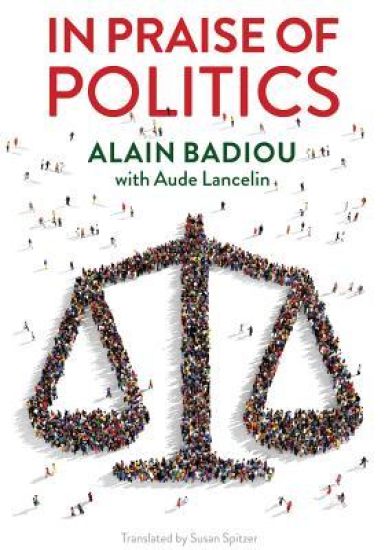
In Praise of Politics

In Praise of Politics

Alain Badiou; Aude Lancelin

Polity Press
2019
sidottu
Against the backdrop of an alarming rise in authoritarianism and the crisis of liberal democracy, few would consider extoling the virtues of politics today. Yet in this lively dialogue with journalist Aude Lancelin, leading French thinker Alain Badiou argues that it is precisely through politics that humanity can still achieve its most ambitious aims. As power becomes ever more concentrated in the hands of the state and global corporations, the role of the citizen is reduced to little more than ritual. But Badiou emphasizes that politics is concerned not just with power and the state, but also with justice. So the central question of politics is “What is a just power?”, and the debate over politics is fundamentally about the norms to which power is subject and its relationship to a community – a community that is able to take control of its own destiny and provide its own direction, based on a shared standard of justice. This engaging dialogue, in which Badiou articulates his view of politics with exceptional clarity, will be of great value to anyone interested in radical politics today.
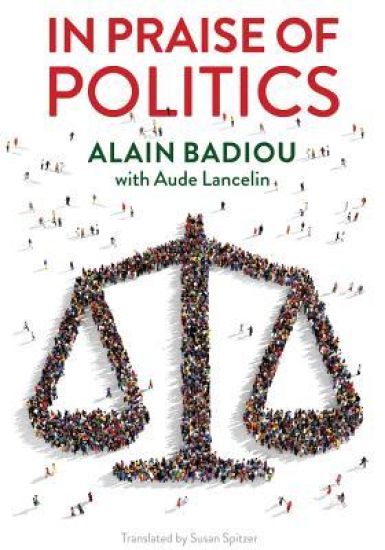
In Praise of Politics

In Praise of Politics

Alain Badiou; Aude Lancelin

Polity Press
2019
nidottu
Against the backdrop of an alarming rise in authoritarianism and the crisis of liberal democracy, few would consider extoling the virtues of politics today. Yet in this lively dialogue with journalist Aude Lancelin, leading French thinker Alain Badiou argues that it is precisely through politics that humanity can still achieve its most ambitious aims. As power becomes ever more concentrated in the hands of the state and global corporations, the role of the citizen is reduced to little more than ritual. But Badiou emphasizes that politics is concerned not just with power and the state, but also with justice. So the central question of politics is “What is a just power?”, and the debate over politics is fundamentally about the norms to which power is subject and its relationship to a community – a community that is able to take control of its own destiny and provide its own direction, based on a shared standard of justice. This engaging dialogue, in which Badiou articulates his view of politics with exceptional clarity, will be of great value to anyone interested in radical politics today.
Happiness

Happiness

Alain Badiou

Bloomsbury Academic
2019
nidottu
‘All philosophy is a metaphysics of happiness…or it’s not worth an hour of trouble’ claims Alain Badiou in this lively intervention into one of the most persistent themes in philosophy: what is happiness? And what do I need to do to be happy? The desire to be happy is one of our most universal goals and yet there doesn’t seem to be any easy answers or formulas for achieving happiness. And the concept has become so commodified and corrupted to be almost unrecognizable as something worth pursuing. In light of this, should we just give up the aspiration to be happy altogether? Alain Badiou thinks not. While eschewing futile procedures for magically becoming ‘happy’, Badiou does passionately maintain that in order to be truly happy we need philosophy. And, bolder still, that a life lived philosophically is the happiest life of all!
Happiness

Happiness

Alain Badiou

Bloomsbury Academic
2019
sidottu
‘All philosophy is a metaphysics of happiness…or it’s not worth an hour of trouble’ claims Alain Badiou in this lively intervention into one of the most persistent themes in philosophy: what is happiness? And what do I need to do to be happy? The desire to be happy is one of our most universal goals and yet there doesn’t seem to be any easy answers or formulas for achieving happiness. And the concept has become so commodified and corrupted to be almost unrecognizable as something worth pursuing. In light of this, should we just give up the aspiration to be happy altogether? Alain Badiou thinks not. While eschewing futile procedures for magically becoming ‘happy’, Badiou does passionately maintain that in order to be truly happy we need philosophy. And, bolder still, that a life lived philosophically is the happiest life of all!
Logics of Worlds

Logics of Worlds

Alain Badiou

Bloomsbury Academic
2019
nidottu
Logics of Worlds is the sequel to Alain Badiou's masterpiece, Being and Event. Tackling the questions that had been left open by Being and Event, and answering many of his critics in the process, Badiou supplements his pioneering treatment of multiple being with a daring and complex theory of the worlds in which truths and subjects make their mark - what he calls a materialist dialectic. Drawing on his most ambitious philosophical predecessors - Leibniz, Kant, Hegel, Kierkegaard, Lacan, Deleuze – Badiou ends this important later work with an impassioned call to 'live for an Idea'.
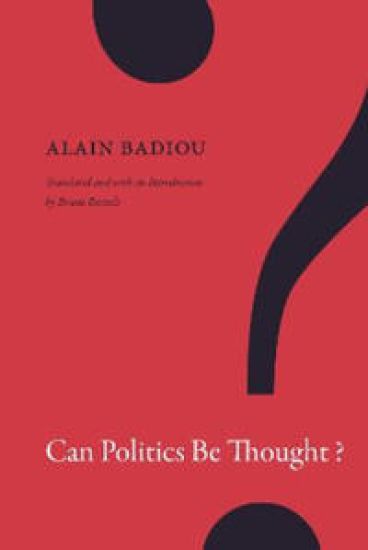
Can Politics Be Thought?

Can Politics Be Thought?

Alain Badiou

Duke University Press
2019
pokkari
In Can Politics Be Thought?-published in French in 1985 and appearing here in English for the first time-Alain Badiou offers his most forceful and systematic analysis of the crisis of Marxism. Distinguishing politics as an active mode of thinking from the political as a domain of the State, Badiou argues for the continuation of Marxist politics. In so doing, he shows why we need to recapture the emancipatory hypothesis of Marx's original gesture in order to actualize its radical potential. This volume also includes Badiou's “Of an Obscure Disaster: On the End of the Truth of the State,” in which he rebuts claims of Communism's death after the fall of the Soviet Union.
Can Politics Be Thought?

Can Politics Be Thought?

Alain Badiou

Duke University Press
2019
sidottu
In Can Politics Be Thought?-published in French in 1985 and appearing here in English for the first time-Alain Badiou offers his most forceful and systematic analysis of the crisis of Marxism. Distinguishing politics as an active mode of thinking from the political as a domain of the State, Badiou argues for the continuation of Marxist politics. In so doing, he shows why we need to recapture the emancipatory hypothesis of Marx's original gesture in order to actualize its radical potential. This volume also includes Badiou's “Of an Obscure Disaster: On the End of the Truth of the State,” in which he rebuts claims of Communism's death after the fall of the Soviet Union.
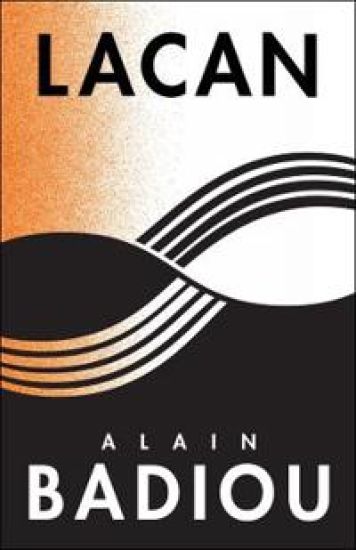
Lacan

Lacan

Alain Badiou

Columbia University Press
2018
sidottu
Alain Badiou is arguably the most significant philosopher in Europe today. Badiou’s seminars, given annually on major conceptual and historical topics, constitute an enormously important part of his work. They served as laboratories for his thought and public illuminations of his complex ideas yet remain little known. This book, the transcript of Badiou’s year-long seminar on the psychoanalytic theory of Jacques Lacan, is the first volume of his seminars to be published in English, opening up a new and vital aspect of his thinking.In a highly original and compelling account of Lacan’s theory and therapeutic practice, Badiou considers the challenge that Lacan poses to fundamental philosophical topics such as being, the subject, and truth. Badiou argues that Lacan is a singular figure of the “anti-philosopher,” a series of thinkers stretching back to Saint Paul and including Kierkegaard and Nietzsche, with Lacan as the last great anti-philosopher of modernity. The book offers a forceful reading of an enigmatic yet foundational thinker and sheds light on the crucial role that Lacan plays in Badiou’s own thought. This seminar, more accessible than some of Badiou’s more difficult works, will be profoundly valuable for the many readers across academic disciplines, art and literature, and political activism who find his thought essential.
I Know There Are So Many of You

I Know There Are So Many of You

Alain Badiou

Polity Press
2018
nidottu
The history of humanity has only just begun. The Neolithic Revolution may have endowed us with unparalleled means of communication, subsistence, and knowledge acquisition. However, it is clear in today’s world that inequality, power hierarchies, and violence persist on a greater scale than ever before. In these two lectures, delivered to the large number of young people who gathered in the Lycée Henri-IV and the École nationale des Beaux-Arts in Paris to hear him speak, Alain Badiou argues that we are still firmly rooted in the Neolithic era, subjugated by the structures of political power – property, family, and state. He calls for a second revolution to restore to each person their freedom and agency. Through an analysis of recent attempts at political organisation, including the Arab Spring, Occupy, and Nuit debout, Badiou shows that progress toward this goal will only be achieved through an emphasis on sameness, not difference. This rallying cry to the young from one of France’s most renowned radical thinkers will appeal to the many who read and follow his work, and to the millions of young people around the world who are passionate about redressing the deeply entrenched inequalities and divisions in our societies today.
I Know There Are So Many of You

I Know There Are So Many of You

Alain Badiou

Polity Press
2018
sidottu
The history of humanity has only just begun. The Neolithic Revolution may have endowed us with unparalleled means of communication, subsistence, and knowledge acquisition. However, it is clear in today’s world that inequality, power hierarchies, and violence persist on a greater scale than ever before. In these two lectures, delivered to the large number of young people who gathered in the Lycée Henri-IV and the École nationale des Beaux-Arts in Paris to hear him speak, Alain Badiou argues that we are still firmly rooted in the Neolithic era, subjugated by the structures of political power – property, family, and state. He calls for a second revolution to restore to each person their freedom and agency. Through an analysis of recent attempts at political organisation, including the Arab Spring, Occupy, and Nuit debout, Badiou shows that progress toward this goal will only be achieved through an emphasis on sameness, not difference. This rallying cry to the young from one of France’s most renowned radical thinkers will appeal to the many who read and follow his work, and to the millions of young people around the world who are passionate about redressing the deeply entrenched inequalities and divisions in our societies today.
German Philosophy

German Philosophy

Alain Badiou; Jean-Luc Nancy

MIT Press
2018
pokkari
Two eminent French philosophers discuss German philosophy-including the legacy of Kant, Hegel, Nietzsche, Adorno, Fichte, Marx, and Heidegger-from a French perspective.In this book, Alain Badiou and Jean-Luc Nancy, the two most important living philosophers in France, discuss German philosophy from a French perspective. Written in the form of a dialogue, and revised and expanded from a 2016 conversation between the two philosophers at the Universitat der Kunste Berlin, the book offers not only Badiou's and Nancy's reinterpretations of German philosophers and philosophical concepts, but also an accessible introduction to the greatest thinkers of German philosophy. Badiou and Nancy discuss and debate such topics as the legacies of Kant, Hegel, and Marx, as well as Nietzsche, Adorno, Fichte, Schelling, and the unavoidable problem of Heidegger and Nazism. The dialogue is contentious, friendly, and often quotable, with strong-at times passionate-positions taken by both Badiou and Nancy, who find themselves disagreeing over Kant, for example, and in unexpected agreement on Marx, for another.What does it mean, then, to conduct a dialogue on German philosophy from a French perspective? As volume editor Jan Voelker observes, "German philosophy" and "French philosophy" describe complex constellations that, despite the reference to nation-states and languages, above all encompass shared concepts and problems-although these take a range of forms. Perhaps they can reveal their essential import only in translation.