Kirjailija
Alain Badiou
Kirjat ja teokset yhdessä paikassa: 155 kirjaa, julkaisuja vuosilta 1999-2026, suosituimpien joukossa Ahmed the Philosopher. Vertaile teosten hintoja ja tarkista saatavuus suomalaisista kirjakaupoista.
155 kirjaa
Kirjojen julkaisuhaarukka 1999-2026.
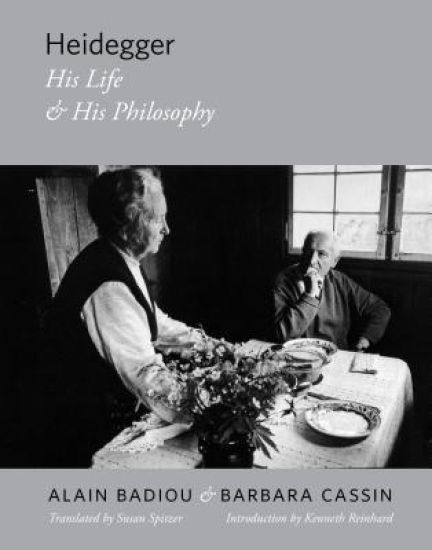
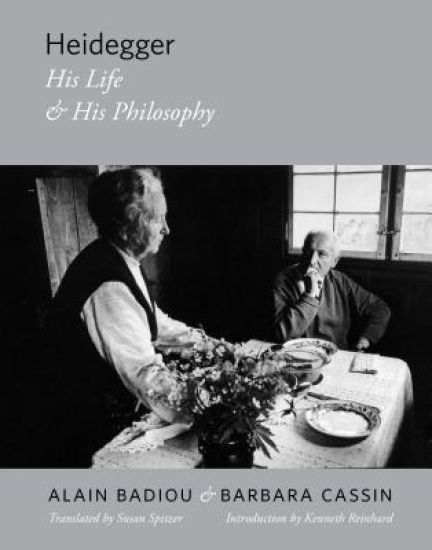
Martin Heidegger was an ordinary Nazi and a loyal member of the provincial petty bourgeoisie. He was also a seminal thinker of the Continental tradition and one of the twentieth century's most important philosophers. How are we to make sense of this dual life? Should we factor Heidegger's domestic and political associations into our understanding of his thought, or should we treat his intellectual work independently of his abhorrent politics? How does any thinker reconcile the mundane with the ideal or the pursuit of philosophical inquiry with the demands of civic engagement? In Heidegger, Alain Badiou and Barbara Cassin immerse themselves in the philosopher's correspondence with his wife Elfride to answer these questions as they relate to Heidegger and all thinkers vulnerable to the politics of their times. They focus on Heidegger's tormented relationship with his wife, with Hannah Arendt, and with numerous other women, bringing an unusual level of intimacy to his personal and intellectual worlds.
What Is a People?
Alain Badiou; Judith Butler; Georges Didi-Huberman; Sadri Khiari; Jacques Rancière; Pierre Bourdieu; Kevin Olson
Columbia University Press
2016
sidottu
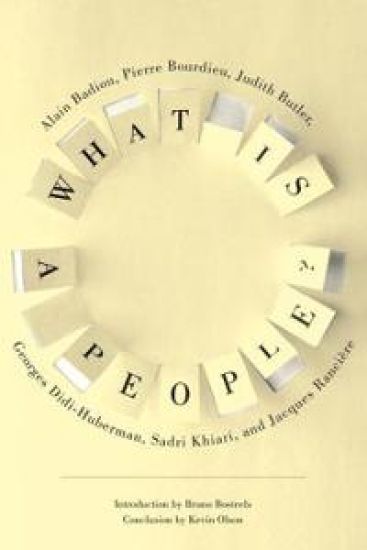
What Is a People? seeks to reclaim "people" as an effective political concept by revisiting its uses and abuses over time. Alain Badiou surveys the idea of a people as a productive force of solidarity and emancipation and as a negative tool of categorization and suppression. Pierre Bourdieu follows with a sociolinguistic analysis of "popular" and its transformation of democracy, beliefs, songs, and even soups into phenomena with outsized importance. Judith Butler calls out those who use freedom of assembly to create an exclusionary "we," while Georges Didi-Huberman addresses the problem of summing up a people with totalizing narratives. Sadri Khiari applies an activist's perspective to the racial hierarchies inherent in ethnic and national categories, and Jacques Ranciere comments on the futility of isolating theories of populism when, as these thinkers have shown, the idea of a "people" is too diffuse to support them. By engaging this topic linguistically, ethnically, culturally, and ontologically, the voices in this volume help separate "people" from its fraught associations to pursue more vital formulations. Together with Democracy in What State?, in which Giorgio Agamben, Alain Badiou, Daniel Bensaid, Wendy Brown, Jean-Luc Nancy, Jacques Ranciere, Kristin Ross, and Slavoj Zizek discuss the nature and purpose of democracy today, What Is a People? expands an essential exploration of political action and being in our time.
The fall of the Berlin wall was seen by many as the final triumph of liberal democracy over communism. But now, in the wake of the great financial crisis of 2008 and its aftermath, things look a little different. New questions are arising about capitalism and democracy, new social movements are challenging established institutions and new political possibilities are emerging. Is democracy an inevitable hostage of capitalism, or can it reinvent itself to meet the challenge of globalization? In an exclusive, previously unpublished dialogue, Alain Badiou, a key figure of the radical left and a leading advocate of the communist idea, and Marcel Gauchet, a major exponent of anti-totalitarianism and a champion of liberal democracy, confront one another. Together, they take stock of history, interrogate one another?s views and defend their respective projects: on the one side, the revival of ?the communist hypothesis,? and on the other, the radical reform of a contested democratic model.
Alain Badiou is arguably the most original and influential philosopher working in France today. Working against the tide of postmodern orthodoxy, Badiou revitalizes philosophy's perennial attempt to provide a systematic theory of truth. Theoretical Writings presents, in Badiou’s own words, ‘the theoretical core of [his] Philosophy’. Beginning with the controversial assertion that ontology is mathematics, the chapters step the reader through his key concepts of being, subject and truth via startling re-readings of canonical figures including Spinoza, Kant and Hegel and engagements with poetry, psychoanalysis and radical politics. Theoretical Writings is an indispensable introduction to one of the great thinkers of our time.
In Praise of Theatre is Alain Badiou’s latest work on the ‘most complete of the arts,’ the theatrical stage. This book, certain to be of great interest to scholars and theatre practitioners alike, elaborates the theory of the theatre developed by Badiou in works such as Rhapsody for the Theatre and the ‘Theses on Theatre’ and enquires into the status of a theatre that would be adequate to our 'contemporary, market-oriented chaos.' In a departure from his usual emphasis upon canonical figures of the stage such as Bertolt Brecht and Samuel Beckett, Badiou devotes In Praise of Theatre largely to a consideration of contemporary practitioners, including Jan Fabre, Brigitte Jacques and Romeo Castellucci. In addition, the book features an incisive analysis of the precarious status of the theatre today, in which Badiou describes not only the current threats to the theatre from the right, but the far more insidious threat from the left.
"We know that communism is the right hypothesis. All those who abandon this hypothesis immediately resign themselves to the market economy, to parliamentary democracy - the form of state suited to capitalism - and to the inevitable and "natural" character of the most monstrous inequalities." Alain Badiou Alain Badiou's 'communist hypothesis', first stated in 2008, cut through the cant and compromises of the past twenty years to reconceptualize the Left. The hypothesis is a fresh demand for universal emancipation and a galvanizing call to arms. Anyone concerned with the future of the planet needs to reckon with the ideas outlined within this book.
An urgent and provocative account of the modern 'militant', a transformative figure at the front line of emancipatory politics. Around the world, recent events have seen the creation of a radical phalanx comprising students, the young, workers and immigrants. It is Badiou's contention that the politics of such militants should condition the tasks of philosophy, even as philosophy clarifies the truth of our political condition. To resolve the conflicts between politics, philosophy and democracy, Badiou argues for a resurgent communism - returning to the original call for universal emancipation and organizing for militant struggle.
Plato's Republic: A Dialogue in Sixteen Chapters
Alain Badiou
Columbia University Press
2015
nidottu
Plato's Republic is one of the best-known and most widely-discussed texts in the history of philosophy. But how might we get to the heart of this work today, 2,500 years after its original composition? Alain Badiou breathes life into Plato's landmark text and revives its universality. Rather than producing yet another critical commentary, he has instead worked closely on the original Greek and, through spectacular changes, adapted it to our times. In this innovative reimagining of Plato's work, Badiou has removed all references specific to ancient Greek society--from lengthy exchanges about moral courage in archaic poetry to political considerations mainly of interest to the aristocratic elite--and has expanded the range of cultural references. Here, philosophy is firing on all cylinders: Socrates and his companions are joined by Beckett, Pessoa, Freud, and Hegel, among others. Together these thinkers demonstrate that true philosophy endures, ready to absorb new horizons without changing its essence. Moreover, Badiou--who is also a dramatist--has transformed the Socratic dialogue into a genuine oratorial contest. In his version of the Republic, the interlocutors do much more than simply agree with Socrates. They argue, stand up to him, put him on the spot, and show thought in motion. In this work of dramatic scholarship and philosophy, we encounter a modern version of Plato's text that is alive, stimulating, and directly relevant to our own world.
Plato's Republic is one of the most well-known and widely discussed texts in the history of philosophy, but how might we get to the heart of this work today, 2500 years after it was originally composed? Alain Badiou invents a new genre in order to breathe fresh life into Plato's text and restore its universality. Rather than producing yet another critical commentary, he has retranslated the work from the original Greek and, by making various changes, adapted it for our times. In this innovative reimagining of a classic text, Badiou has removed all references specific to ancient Greek society, from the endless exchanges about the moral courage of poets to those political considerations that were only of interest to the aristocratic elite. On the other hand, Badiou has expanded the range of cultural references: here philosophy is firing on all cylinders, and Socrates and his companions are joined by Beckett, Pessoa, Freud and Hegel. They demonstrate the enduring nature of true philosophy, always ready to move with the times. Moreover, Badiou the dramatist has made the Socratic dialogue a true oratorial contest: in his version of the Republic, the interlocutors have more in mind than merely agreeing with the Master. They stand up to him, put him on the spot and thereby show thought in motion. Through this work of writing, scholarship and philosophy, we are able, for the first time, to read a version of Plato's text which is alive, stimulating and directly relevant to our world today.
In a well-known text called ‘The Communist Hypothesis’, first published in 2007, the renowned philosopher Alain Badiou breathed fresh life into the idea of communism as an intellectual representation that provides a critical perspective on existing politics and offers a systemic alternative to capitalism. Now, in the course of this wide-ranging conversation with Peter Engelmann, Alain Badiou explains why he continues to value the idea of communism against the background of current social crises and despite negative historical experiences. From the anticipation of a communism without a state to the problem of the concept of democracy and an analysis of capitalism as a system, the two thinkers discuss the key political issues of our time. Whilst explaining his political philosophy, Badiou also reflects on current socio-political developments such as the turmoil in the Middle East and the situation in China. This compelling dialogue is both a highly topical contribution to the question of how we might organize our societies differently and an accessible introduction to Badiou's philosophical thinking.
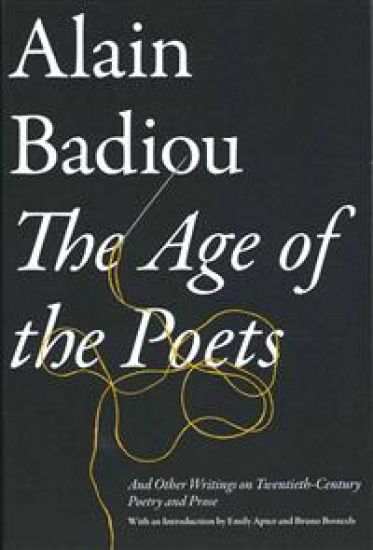
The Age of the Poets revisits the age-old problem of the relation between literature and philosophy, arguing against both Plato and Heidegger's famous arguments. Philosophy neither has to ban the poets from the republic nor abdicate its own powers to the sole benefit of poetry or art. Instead, it must declare the end of what Badiou names the "age of the poets," which stretches from Hölderlin to Celan. Drawing on ideas from his first publication on the subject, "The Autonomy of the Aesthetic Process," Badiou offers an illuminating set of readings of contemporary French prose writers, giving us fascinating insights into the theory of the novel while also accounting for the specific position of literature between science and ideology.
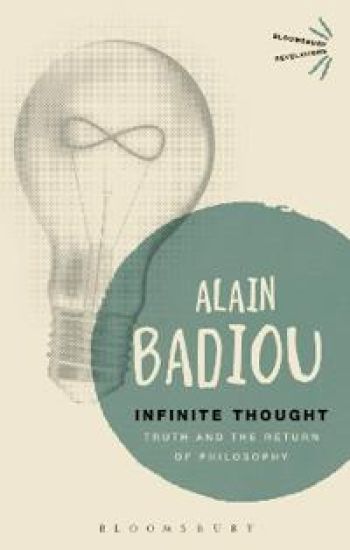
Alain Badiou (1937- ) is one of the most high profile and controversial philosophers writing in France today. A leading light in the generation of thinkers who come of intellectual age in 1968, his work deftly draws on a wide range of intellectual traditions and thinkers from Plato and Lucretius, through Heidegger to Lacan and Deleuze.Now available in the Bloomsbury Revelations series, Infinite Thought is a vivid demonstration of that range. Here Badiou introduces his own thought on the full gamut of intellectual concerns, from politics, psychoanalysis and art to truth, desire and the definition of philosophy itself. As well as Badiou’s reflections on the fall of communism and the ‘War on Terror’, the book also includes an interview with the author.Translated and edited by Oliver Feltham and Justin Clemens.
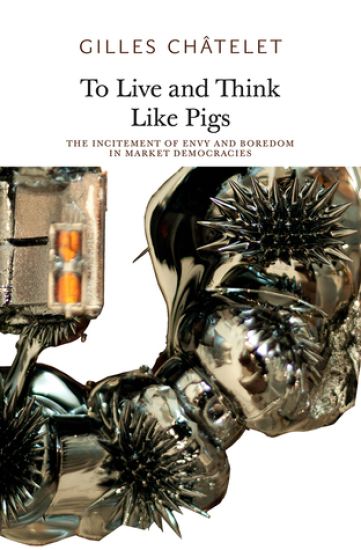
A startlingly prescient treatise on the cybernetic automation of society and a burlesque satire of its middle-class celebrants.An uproarious portrait of the evils of the market and a technical manual for its innermost ideological workings, this is the story of how the perverted legacy of liberalism sought to knead Marx's "free peasant" into a statistical "average man"-pliant raw material for the sausage-machine of postmodernity.Combining the incandescent wrath of the betrayed comrade with the acute discrimination of the mathematician-physicist, Chatelet scrutinizes the pseudoscientific alibis employed to naturalize "market democracy" and the "triple alliance" between politics, economics, and cybernetics.A bestseller in France on its publication in 1998, this book remains crucial reading for any future politics that wants to replace individualism with individuation and libertarianism with liberation, this new translation constitutes a major contribution to contemporary debate on neoliberalism, economics, and capitalist subjectivation.
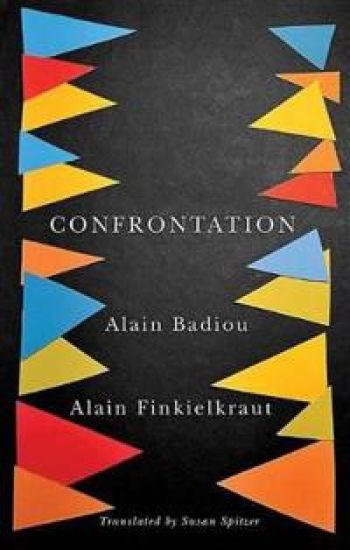
Everything in their respective positions divides them: Alain Badiou is the thinker of a revitalized communism and Alain Finkielkraut the mournful observer of the loss of values. The two opponents, gathered here for their first-ever debate, have irreconcilable visions. Yet neither is a stranger to controversy, and in this debate they make explicit the grounds of their personal dispute as well as addressing, in a frank and open exchange, their ideas and theories. Guided by Aude Lancelin, the two philosophers discuss subjects as diverse as national identity, Israel and Judaism, May 1968, and renewed popularity of the idea of communism. Their passionate debate is more than just the sum total of their disagreements, however, for neither of them is satisfied with the state of our society or the direction in which its political representatives persist in taking it. They agree that there needs to be change and their confrontation in this volume shows the importance of asking difficult questions, not only of each other, but also of our political systems.