

Kirjailija
Alain Badiou
Kirjat ja teokset yhdessä paikassa: 155 kirjaa, julkaisuja vuosilta 1999-2026, suosituimpien joukossa Ahmed the Philosopher. Vertaile teosten hintoja ja tarkista saatavuus suomalaisista kirjakaupoista.
155 kirjaa
Kirjojen julkaisuhaarukka 1999-2026.
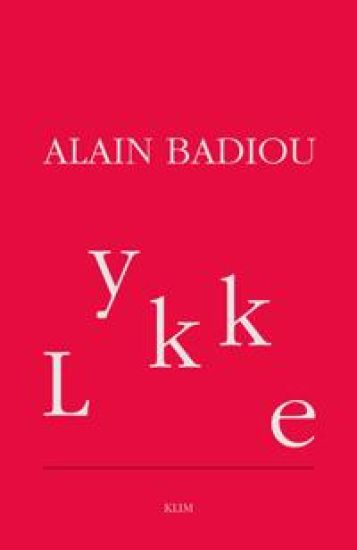
”Lykke er en risiko, som vi er nødt til at tage.”Den franske filosof Alain Badiou angriber i denne lille bog den forestilling, at lykke er et spørgsmål om at skabe overensstemmelse mellem sine personlige behov og det, som verden tilbyder os og kategoriserer som ”det gode liv”. Han opponerer mod den positive psykologi og “lykkeindustrien”, der fortæller os, at det gælder det om at planlægge livet efter forskrifterne for, hvad der giver den største sikkerhed for at opnå lykke. Men ifølge Badiou er lykke præcis det modsatte af sikkerhed og planlægning. Lykke involverer altid en risiko, som fx når vi i kærlighedsmødet vælger at overgive os til dets uforudsigelighed. For at det, Badiou kalder ”reel lykke”, kan blive mulig, kræves også et opgør med den (forbruger-)tilfredshed, der ifølge Badiou præsenteres som lykke i dag. Opgaven med at skabe lykke finder dermed sted både på det individuelle og på det kollektive, politiske plan. Og den går ud på at blive noget, vi ikke troede, vi var i stand til at blive og at skabe en fælles verden, som vi ikke troede var mulig.
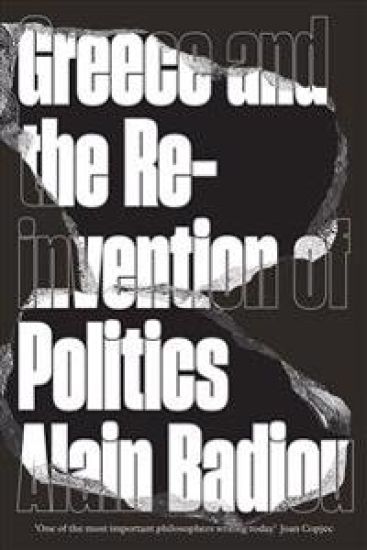
One of the world's leading radical philosophers analyses the failure of the Syriza experience in Greece Over the last six years, Greece has provided the world with "an open-air political lesson." The country's deep economic and social crisis has exposed the fundamental contradictions of the European Union, and indeed the capitalist world as a whole. It has been a test case for movements seeking to put an end to the authoritarian anarchy of neoliberal capitalism. The Greek resistance to EU institutions and financial-market hegemony offered a beacon of hope. Yet the "movementist" politics of 2011 could not build anything lasting, and Syriza's efforts as a party of government soon led to impasse. For Alain Badiou, it is not enough to mourn this defeat - we must understand why such a vigorous opposition could fail. Greece and the Reinvention of Politics argues that an opposition of real consequence must revive the "communist hypothesis," the vision of an alternative state structure. The "orienting maxims" that this hypothesis provides light the way for effective political action. Written in the storm of the crisis, the interventions collected in this book offer a path out of our contemporary powerlessness.
In a series of seven trenchant interventions Alain Badou analyses the decisive developments in Greece since 2011. Badiou considers this Mediterranean country "a sort of open-air political lesson", with much to tell us about the wider situation. Greece is exemplary of "our fundamental contradictions in Europe, which are also ultimately the fundamental contradictions of the world such as it is-the world served up to the authoritarian anarchy of capitalism."Notwithstanding the Greeks' heartening opposition to the financial markets' hegemony, Badiou considers it also important to address the reasons why this opposition failed. "Movementist" politics may arouse widespread sympathy, but for the French philosopher they have "absolutely no effect other than to temporarily trap the movement in the negative weakness of its affects." Badiou argues that a consequential opposition inspired by the emancipatory politics of the past-or by what he calls "the communist hypothesis"-should set its compass by the "orienting maxims" proposed in this book, defining a direction for political action.

This is a unique collection presenting work by Alain Badiou and commentaries on his philosophical theories. It includes three lectures by Badiou, on contemporary politics, the infinite, cinema and theatre and two extensive interviews with Badiou – one concerning the state of the contemporary situation and one wide ranging interview on all facets of his work and engagements. It also includes six interventions on aspects of Badiou’s work by established scholars in the field, addressing his concept of history, Lacan, Cinema, poetry, and feminism; and four original essays by young and established scholars in Australia and New Zealand addressing the key concerns of Badiou’s 2015 visit to the Antipodal region and the work he presented there.With new material by Badiou previously unpublished in English this volume is a valuable overview of his recent thinking. Critical responses by distinguished and gifted Badiou scholars writing outside of the European context make this text essential reading for anyone interested in the development and contemporary reception of Badiou’s thought.
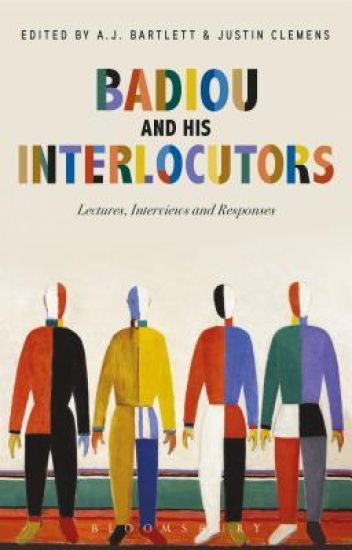
This is a unique collection presenting work by Alain Badiou and commentaries on his philosophical theories. It includes three lectures by Badiou, on contemporary politics, the infinite, cinema and theatre and two extensive interviews with Badiou – one concerning the state of the contemporary situation and one wide ranging interview on all facets of his work and engagements. It also includes six interventions on aspects of Badiou’s work by established scholars in the field, addressing his concept of history, Lacan, Cinema, poetry, and feminism; and four original essays by young and established scholars in Australia and New Zealand addressing the key concerns of Badiou’s 2015 visit to the Antipodal region and the work he presented there.With new material by Badiou previously unpublished in English this volume is a valuable overview of his recent thinking. Critical responses by distinguished and gifted Badiou scholars writing outside of the European context make this text essential reading for anyone interested in the development and contemporary reception of Badiou’s thought.
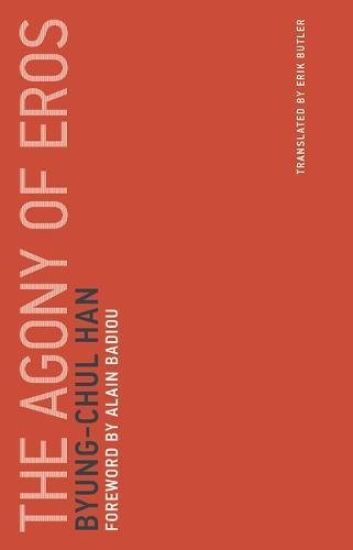
An argument that love requires the courage to accept self-negation for the sake of discovering the Other.Byung-Chul Han is one of the most widely read philosophers in Europe today, a member of the new generation of German thinkers that includes Markus Gabriel and Armen Avanessian. In The Agony of Eros, a bestseller in Germany, Han considers the threat to love and desire in today's society. For Han, love requires the courage to accept self-negation for the sake of discovering the Other. In a world of fetishized individualism and technologically mediated social interaction, it is the Other that is eradicated, not the self. In today's increasingly narcissistic society, we have come to look for love and desire within the “inferno of the same.” Han offers a survey of the threats to Eros, drawing on a wide range of sources—Lars von Trier's film Melancholia, Wagner's Tristan und Isolde,Fifty Shades of Grey, Michel Foucault (providing a scathing critique of Foucault's valorization of power), Martin Buber, Hegel, Baudrillard, Flaubert, Barthes, Plato, and others. Han considers the “pornographication” of society, and shows how pornography profanes eros; addresses capitalism's leveling of essential differences; and discusses the politics of eros in today's “burnout society.” To be dead to love, Han argues, is to be dead to thought itself. Concise in its expression but unsparing in its insight, The Agony of Eros is an important and provocative entry in Han's ongoing analysis of contemporary society.This remarkable essay, an intellectual experience of the first order, affords one of the best ways to gain full awareness of and join in one of the most pressing struggles of the day: the defense, that is to say—as Rimbaud desired it—the “reinvention” of love.—from the foreword by Alain Badiou
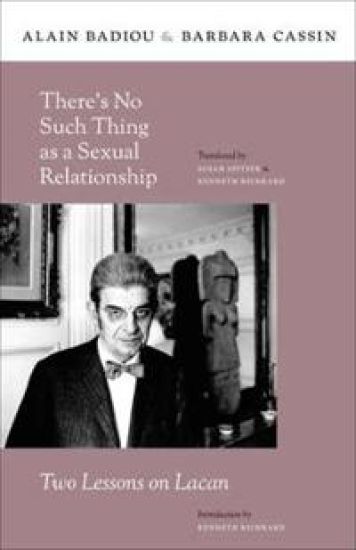
There’s No Such Thing as a Sexual Relationship
Alain Badiou; Barbara Cassin
Columbia University Press
2017
sidottu
Published in 1973, "L'Etourdit" was one of the French philosopher Jacques Lacan's most important works. The book posed questions that traversed the entire body of Lacan's psychoanalytical explorations, including his famous idea that "there is no such thing as a sexual relationship," which seeks to undermine our certainties about intimacy and reality. In There's No Such Thing as a Sexual Relationship, Alain Badiou and Barbara Cassin take possession of Lacan's short text, thinking "with" Lacan about his propositions and what kinds of questions they raise in relation to knowledge. Cassin considers the relationship of the real to language through a Sophist lens, while the Platonist Badiou unpacks philosophical claims about truth. Each of their contributions echoes back to one another, offering new ways of thinking about Lacan, his seminal ideas, and his role in advancing philosophical thought.
There’s No Such Thing as a Sexual Relationship
Alain Badiou; Barbara Cassin
Columbia University Press
2017
pokkari
Published in 1973, "L'Etourdit" was one of the French philosopher Jacques Lacan's most important works. The book posed questions that traversed the entire body of Lacan's psychoanalytical explorations, including his famous idea that "there is no such thing as a sexual relationship," which seeks to undermine our certainties about intimacy and reality. In There's No Such Thing as a Sexual Relationship, Alain Badiou and Barbara Cassin take possession of Lacan's short text, thinking "with" Lacan about his propositions and what kinds of questions they raise in relation to knowledge. Cassin considers the relationship of the real to language through a Sophist lens, while the Platonist Badiou unpacks philosophical claims about truth. Each of their contributions echoes back to one another, offering new ways of thinking about Lacan, his seminal ideas, and his role in advancing philosophical thought.
In Mathematics of the Transcendental, Alain Badiou painstakingly works through the pertinent aspects of category theory, demonstrating their internal logic and veracity, their derivation and distinction from set theory, and the 'thinking of being'. In doing so he sets out the basic onto-logical requirements of his greater and transcendental logics as articulated in his magnum opus, Logics of Worlds. Now available in paperback, Mathematics of the Transcendental provides Badiou's readers with a much-needed complete elaboration of his understanding and use of category theory. The book is vital to understanding the mathematical and logical basis of his theory of appearing, as elaborated in Logics of Worlds and other works, and is essential reading for his many followers.
Beginning with a sustained critique of the so-called 'end of philosophy', Badiou goes on to propose a new definition of philosophy, one that is tested with respect to both its origin, in Plato, and its contemporary state. The essays that follow are ordered according to what Badiou sees as the four great conditions of philosophy: philosophy and poetry, philosophy and mathematics, philosophy and politics, and philosophy and love. Now available in paperback, Conditions provides an illuminating reworking of all the major theories in Being and Event. In so doing, Badiou not only develops the complexity of the concepts central to Being and Event but also adds new ones to his already formidable arsenal. The essays in Conditions reveal the extraordinary and systematic nature of Badiou's philosophical enterprise.
'I'm 79 years old. So why on earth should I concern myself with speaking about youth?' This is the question with which renowned French philosopher Alain Badiou begins his passionate plea to the young. Today young people, at least in the West, are on the brink of a new world. With the decline of old traditions, they now face more choices than ever before. Yet powerful forces are pushing them in dangerous directions, into the vortex of consumerism or into reactive forms of traditionalism. This is a time when young people must be particularly attentive to the signs of the new and have the courage to venture forth and find out what they're capable of, without being constrained by the old prejudices and hierarchical ideas of the past. And if the aim of philosophy is to corrupt youth, as Socrates was accused of doing, this can mean only one thing: to help young people see that they don't have to go down the paths already mapped out for them, that they are not just condemned to obey social customs, that they can create something new and propose a different direction as regards the true life.
'I'm 79 years old. So why on earth should I concern myself with speaking about youth?' This is the question with which renowned French philosopher Alain Badiou begins his passionate plea to the young. Today young people, at least in the West, are on the brink of a new world. With the decline of old traditions, they now face more choices than ever before. Yet powerful forces are pushing them in dangerous directions, into the vortex of consumerism or into reactive forms of traditionalism. This is a time when young people must be particularly attentive to the signs of the new and have the courage to venture forth and find out what they're capable of, without being constrained by the old prejudices and hierarchical ideas of the past. And if the aim of philosophy is to corrupt youth, as Socrates was accused of doing, this can mean only one thing: to help young people see that they don't have to go down the paths already mapped out for them, that they are not just condemned to obey social customs, that they can create something new and propose a different direction as regards the true life.

Who hasn't had the frightening experience of stumbling around in the pitch dark? Alain Badiou experienced that primitive terror when he, with his young friends, made up a game called "The Stroke of Midnight." The furtive discovery of the dark continent of sex in banned magazines, the beauty of black ink on paper, but also the mysteries of space and the grief of mourning: these are some of the things we encounter as the philosopher takes us on a trip through the private theater of his mind, at the whim of his memories. Music, painting, politics, sex, and metaphysics: all contribute to making black more luminous than it has ever been.
Who hasn't had the frightening experience of stumbling around in the pitch dark? Alain Badiou experienced that primitive terror when he, with his young friends, made up a game called "The Stroke of Midnight." The furtive discovery of the dark continent of sex in banned magazines, the beauty of black ink on paper, but also the mysteries of space and the grief of mourning: these are some of the things we encounter as the philosopher takes us on a trip through the private theater of his mind, at the whim of his memories. Music, painting, politics, sex, and metaphysics: all contribute to making black more luminous than it has ever been.

On 13 November 2015, Paris suffered the second wave of brutal terrorist attacks in a year, leaving 130 dead and many more seriously injured. How are we to make sense of these violent acts and what do they tell us about the forces shaping our world today?In this short book the influential philosopher Alain Badiou argues that while these violent events are commonly portrayed as acts of Islamic terrorism, in fact they attest to a much deeper malaise that is connected to the triumph of global capitalism and to new forms of imperialism that involve the weakening of states, such that whole regions of the world have been turned into ungovernable zones run by armed gangs in which ordinary people are forced to live the most precarious lives. These zones have become the breeding ground for a new kind of nihilism that seeks revenge for the domination of the West. And it is this new nihilism, on to which Islam has been grafted, that exerts a particular appeal to the young men and women on the margins who carried out the atrocities in Paris. The tragedy of 13 November might appear at first sight to be rooted in immigration and Islam but our wound is not so recent: it is rooted in a deeper set of transformations that have reshaped our world, creating small islands of privilege amidst large masses of the destitute and depriving us of a politics that would offer a serious alternative to the present.
Why bother to praise mathematics when you claim, as Alain Badiou does, that philosophy is first and foremost a metaphysics of happiness, or else it’s not worth an hour of trouble? What possible relationship can there be between mathematics and happiness? That is precisely the issue at stake in this dialogue, which serves as a very accessible introduction to what mathematics is and an exploration of the crucial influence it has always exerted on the greatest philosophers. Far from the thankless, pointless exercises they are often thought to be, mathematics and logic are indispensable guides to ridding ourselves of dominant opinions and making possible an access to truths, or to a human experience of the utmost value. That is why mathematics may well be the shortest path to the true life, which, when it exists, is characterized by an incomparable happiness.
Why bother to praise mathematics when you claim, as Alain Badiou does, that philosophy is first and foremost a metaphysics of happiness, or else it’s not worth an hour of trouble? What possible relationship can there be between mathematics and happiness? That is precisely the issue at stake in this dialogue, which serves as a very accessible introduction to what mathematics is and an exploration of the crucial influence it has always exerted on the greatest philosophers. Far from the thankless, pointless exercises they are often thought to be, mathematics and logic are indispensable guides to ridding ourselves of dominant opinions and making possible an access to truths, or to a human experience of the utmost value. That is why mathematics may well be the shortest path to the true life, which, when it exists, is characterized by an incomparable happiness.
Pocket Pantheon is an invitation to engage with the greats of postwar Western thought, such as Lacan, Sartre and Foucault, in the company of one of today's leading political and philosophical minds. Alain Badiou draws on his encounters with this pantheon-his teachers, opponents and allies-to offer unique insights into both the authors and their work. These studies form an accessible, authoritative distillation of continental theory and a capsule history of a period in Western thought.