Kirjojen hintavertailu. Mukana 12 595 353 kirjaa ja 12 kauppaa.

Kirjailija

Albert Einstein

Kirjat ja teokset yhdessä paikassa: 241 kirjaa, julkaisuja vuosilta 1916-2026, suosituimpien joukossa New Evidence of the Militarization of America. Vertaile teosten hintoja ja tarkista saatavuus suomalaisista kirjakaupoista.

241 kirjaa

Kirjojen julkaisuhaarukka 1916-2026.

Einstein sagt

Einstein sagt

Albert Einstein

PIPER VERLAG GMBH
2007
pokkari
Mit Einstein ist es wie mit Goethe: Wer ihn zitiert, liegt richtig. Dieses Buch bietet Albert Einstein im Originalton - und eine Fülle von >>geflügelten Worten
The World As I See It

The World As I See It

Albert Einstein

Book Tree
2007
sidottu
The most advanced and celebrated mind of the 20th Century, without a doubt, is attributed to Albert Einstein. Instead of his hard science and advanced mathematical theories, which often go far beyond the minds of average people, this book allows us to meet him as a person. This interesting book allows us to explore his beliefs, philosophical ideas, and opinions on many subjects so we can walk away afterwards knowing and understanding one of the world's greatest intellectual giants. Subjects include politics, religion, education, the meaning of life, Jewish issues, the world economy, peace and pacifism. One does not need an advanced degree in math or physics to appreciate the genius of Einstein, shared so clearly by the man himself in this book.
The Collected Papers of Albert Einstein, Volume 10 (English)

The Collected Papers of Albert Einstein, Volume 10 (English)

Albert Einstein

Princeton University Press
2006
pokkari
Since this supplementary paperback includes only select portions of Volume 10, it is not recommended for purchase without the main volume http://www.pupress.princeton.edu/titles/8331.html. The first half of this volume presents a substantial amount of heretofore unavailable correspondence. From among family letters closed for twenty years after the death of Margot Einstein, who donated them to the Albert Einstein Archives in Jerusalem, the volume presents, for the first time, letters written by Einstein's sons, the adolescent Hans Albert and little Eduard, and numerous letters written by Einstein to his cousin and future second wife Elsa Einstein. Combined with newly available correspondence with his close friend Heinrich Zangger, this supplementary correspondence provides vivid and intimate details of Einstein's private life. It documents the emotional bonds to his family and friends; the severe deprivations caused by the war to family members in Berlin and Zurich; the fragile health of Mileva Einstein-Maric during these years of separation and divorce; the worries and joys of caring for the sons; and Einstein's views on German and international politics during this turbulent period. The second half finds Einstein full of optimism about Germany's new democracy. He vigorously promotes general relativity and the endeavors of other scientists toward its further confirmation. He responds to the rising interest in his work among philosophers, as attested by correspondence with M. Schlick, H. Reichenbach, R. Carnap, E. Cassirer, and H. Vaihinger. And yet he is embroiled in vociferous, politically tinged, public attacks on his theory of relativity. He considers leaving Berlin, which would have deprived the Weimar Republic of its most famous scientist. In many letters, colleagues, friends, and unknown admirers offer support. Einstein travels to Leyden, where he is appointed a visiting professor and where, in the circle of friends such as P. Ehrenfest, H. A. Lorentz, and H. Kamerlingh Onnes, he is involved in lively debates on issues related to quantum physics. He visits Oslo and Copenhagen, where he meets with N. Bohr, and receives invitations to the United States, anticipating his first visit to the New World in 1921.
The Collected Papers of Albert Einstein, Volume 10

The Collected Papers of Albert Einstein, Volume 10

Albert Einstein

Princeton University Press
2006
sidottu
The first half of this volume presents a substantial amount of heretofore unavailable correspondence. From among family letters closed for twenty years after the death of Margot Einstein, who donated them to the Albert Einstein Archives in Jerusalem, the volume presents, for the first time, letters written by Einstein's sons, the adolescent Hans Albert and little Eduard, and numerous letters written by Einstein to his cousin and future second wife Elsa Einstein. Combined with newly available correspondence with his close friend Heinrich Zangger, this supplementary correspondence provides vivid and intimate details of Einstein's private life. It documents the emotional bonds to his family and friends; the severe deprivations caused by the war to family members in Berlin and Zurich; the fragile health of Mileva Einstein-Maric during these years of separation and divorce; the worries and joys of caring for the sons; and Einstein's views on German and international politics during this turbulent period. The second half finds Einstein full of optimism about Germany's new democracy. He vigorously promotes general relativity and the endeavors of other scientists toward its further confirmation. He responds to the rising interest in his work among philosophers, as attested by correspondence with M. Schlick, H. Reichenbach, R. Carnap, E. Cassirer, and H. Vaihinger. And yet he is embroiled in vociferous, politically tinged, public attacks on his theory of relativity. He considers leaving Berlin, which would have deprived the Weimar Republic of its most famous scientist. In many letters, colleagues, friends, and unknown admirers offer support. Einstein travels to Leyden, where he is appointed a visiting professor and where, in the circle of friends such as P. Ehrenfest, H. A. Lorentz, and H. Kamerlingh Onnes, he is involved in lively debates on issues related to quantum physics. He visits Oslo and Copenhagen, where he meets with N. Bohr, and receives invitations to the United States, anticipating his first visit to the New World in 1921. ENGLISH TRANSLATION: A translation of selected non-English texts included in Volume 10 is available in paperback, http://www.pupress.princeton.edu/titles/8332.html. Since this supplementary paperback includes only select portions of Volume 10, it is not recommended for purchase without the main volume.
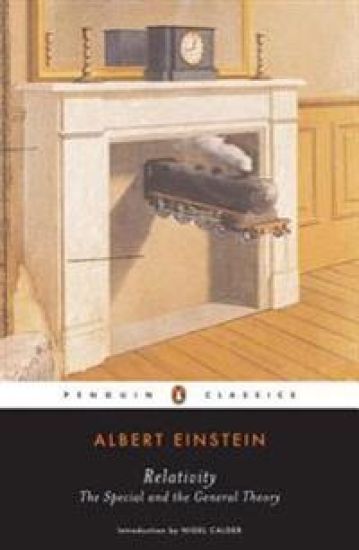
Relativity: The Special and the General Theory

Relativity: The Special and the General Theory

Albert Einstein

PENGUIN CLASSICS
2006
nidottu
An accesible version of Einstein's masterpiece of theory, written by the genius himself According to Einstein himself, this book is intended "to give an exact insight into the theory of Relativity to those readers who, from a general scientific and philosophical point of view, are interested in the theory, but who are not conversant with the mathematical apparatus of theoretical physics." When he wrote the book in 1916, Einstein's name was scarcely known outside the physics institutes. Having just completed his masterpiece, The General Theory of Relativity--which provided a brand-new theory of gravity and promised a new perspective on the cosmos as a whole--he set out at once to share his excitement with as wide a public as possible in this popular and accessible book. Here published for the first time as a Penguin Classic, this edition of Relativity features a new introduction by bestselling science author Nigel Calder. For more than seventy years, Penguin has been the leading publisher of classic literature in the English-speaking world. With more than 1,700 titles, Penguin Classics represents a global bookshelf of the best works throughout history and across genres and disciplines. Readers trust the series to provide authoritative texts enhanced by introductions and notes by distinguished scholars and contemporary authors, as well as up-to-date translations by award-winning translators.
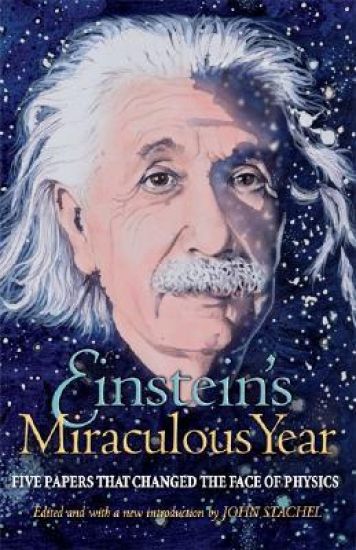
Einstein's Miraculous Year

Einstein's Miraculous Year

Albert Einstein; Roger Penrose

Princeton University Press
2005
pokkari
After 1905, Einstein's miraculous year, physics would never be the same again. In those twelve months, Einstein shattered many cherished scientific beliefs with five extraordinary papers that would establish him as the world's leading physicist. This book brings those papers together in an accessible format. The best-known papers are the two that founded special relativity: On the Electrodynamics of Moving Bodies and Does the Inertia of a Body Depend on Its Energy Content? In the former, Einstein showed that absolute time had to be replaced by a new absolute: the speed of light. In the second, he asserted the equivalence of mass and energy, which would lead to the famous formula E = mc2 . The book also includes On a Heuristic Point of View Concerning the Production and Transformation of Light, in which Einstein challenged the wave theory of light, suggesting that light could also be regarded as a collection of particles. This helped to open the door to a whole new world--that of quantum physics. For ideas in this paper, he won the Nobel Prize in 1921. The fourth paper also led to a Nobel Prize, although for another scientist, Jean Perrin. On the Movement of Small Particles Suspended in Stationary Liquids Required by the Molecular-Kinetic Theory of Heat concerns the Brownian motion of such particles. With profound insight, Einstein blended ideas from kinetic theory and classical hydrodynamics to derive an equation for the mean free path of such particles as a function of the time, which Perrin confirmed experimentally. The fifth paper, A New Determination of Molecular Dimensions, was Einstein's doctoral dissertation, and remains among his most cited articles. It shows how to calculate Avogadro's number and the size of molecules. These papers, presented in a modern English translation, are essential reading for any physicist, mathematician, or astrophysicist. Far more than just a collection of scientific articles, this book presents work that is among the high points of human achievement and marks a watershed in the history of science. Coinciding with the 100th anniversary of the miraculous year, this new paperback edition includes an introduction by John Stachel, which focuses on the personal aspects of Einstein's youth that facilitated and led up to the miraculous year.
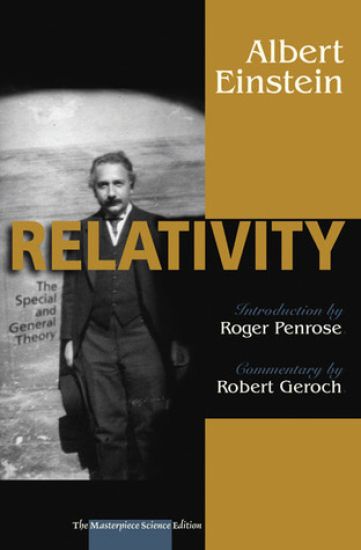
Relativity

Relativity

Albert Einstein; Penrose Roger; Geroch Robert; David C. Cassidy

Pi Press
2005
sidottu
Robert Geroch builds on Einstein's work with commentary that addresses the ideas at the heart of the theory, bringing a modern understanding of relativity to the text. He elucidates how special relativity is a reconciliation of the contradictions between the nature of light and the principle of relativity; he expands on Einstein's treatment of the geometry of space-time and the fundamental notion of an "event"; he explains in detail, but without technical language, the equivalence of inertial and gravitational mass, a cornerstone of general relativity.
Warum Krieg?

Warum Krieg?

Albert Einstein; Sigmund Freud

DIOGENES VERLAG AG
2005
pokkari
"Die Welt ist zu klein für jenen Patriotismus, der zu Kriegen führt. Patriotismus ist nicht einmal mehr in Friedenszeiten nützlich. Die Probleme unserer Welt sind planetarisch. Keine Nation ist ihnen allein gewachsen."
The Collected Papers of Albert Einstein, Volume 9. (English)

The Collected Papers of Albert Einstein, Volume 9. (English)

Albert Einstein

Princeton University Press
2004
pokkari
The present volume, set in the turbulent post-World War I period, finds Einstein awaiting news of the 1919 British eclipse expedition to test the general relativistic prediction of the deflection of starlight by the sun. With the expedition's success, he becomes the first science celebrity of our age. Deeply interested in the other, stellar redshift test of his theory, Einstein supports astronomers engaged in experimental work on the issue. Piqued by early suggestions of a unified field theory, he ponders how to unify gravitation and electromagnetic field theory and also works to resolve contradictions between the new quantum physics and relativity. His open-minded exchanges with colleagues may challenge his later image as the stubborn critic of quantum mechanics. We see Einstein deeply engaged in discussing social and political issues, participating in humanitarian efforts, and intervening on behalf of intellectuals condemned to death after the fall of the Bavarian Soviet republic. He faced anti-Semitic outbursts, reflected increasingly on his own identity as a Jew and assisted in efforts toward the establishment of the Hebrew University. As an internationalist opponent of war, and a German-speaking Swiss citizen whose renown was sealed by the Englishman Eddington's confirmation of relativity, Einstein mitigated postwar hostility toward German scholars. Correspondence with family and friends documents his divorce, remarriage to his cousin, and his closeness to his two sons. Notwithstanding evidence in newly uncovered material concerning efforts to lure Einstein back to Switzerland, and also to the Netherlands, Einstein, entertaining high hopes for the young Weimar Republic, remained in Berlin. This volume reveals new facets of Einstein as he constructively participated in German and European scientific, academic, and cultural life. Since this translation includes only select portions of Volume 9, it is not recommended for purchase without the main volume.
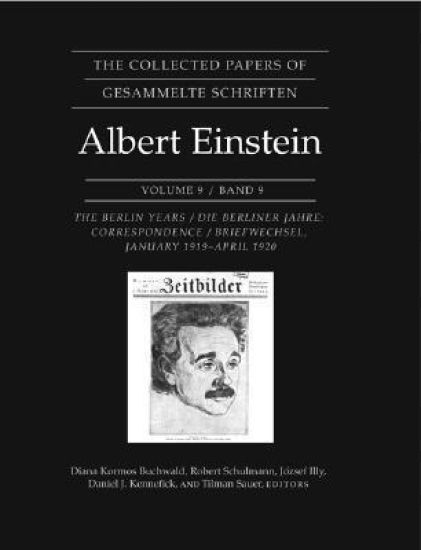
The Collected Papers of Albert Einstein, Volume 9

The Collected Papers of Albert Einstein, Volume 9

Albert Einstein

Princeton University Press
2004
sidottu
The present volume, set in the turbulent post-World War I period, finds Einstein awaiting news of the 1919 British eclipse expedition to test the general relativistic prediction of the deflection of starlight by the sun. With the expedition's success, he becomes the first science celebrity of our age. Deeply interested in the other, stellar redshift test of his theory, Einstein supports astronomers engaged in experimental work on the issue. Piqued by early suggestions of a unified field theory, he ponders how to unify gravitation and electromagnetic field theory and also works to resolve contradictions between the new quantum physics and relativity. His open-minded exchanges with colleagues may challenge his later image as the stubborn critic of quantum mechanics. We see Einstein deeply engaged in discussing social and political issues, participating in humanitarian efforts, and intervening on behalf of intellectuals condemned to death after the fall of the Bavarian Soviet republic. He faced anti-Semitic outbursts, reflected increasingly on his own identity as a Jew and assisted in efforts toward the establishment of the Hebrew University. As an internationalist opponent of war, and a German-speaking Swiss citizen whose renown was sealed by the Englishman Eddington's confirmation of relativity, Einstein mitigated postwar hostility toward German scholars. Correspondence with family and friends documents his divorce, remarriage to his cousin, and his closeness to his two sons. Notwithstanding evidence in newly uncovered material concerning efforts to lure Einstein back to Switzerland, and also to the Netherlands, Einstein, entertaining high hopes for the young Weimar Republic, remained in Berlin. This volume reveals new facets of Einstein as he constructively participated in German and European scientific, academic, and cultural life.
Relativity (Barnes & Noble Library of Essential Reading)
Albert Einstein's "Relativity: The Special and the General Theory" (1920) is a cornerstone of modern physics. Einstein intended this book for 'those readers who, from a general scientific and philosophical point of view, are interested in the theory, but who are not conversant with the mathematical apparatus'. Indeed, within the vast literature on the philosophy of space and time, Einstein's "Relativity" shall remain an illuminable and intelligible exposition, highly quotable as one of the most lucid presentations of the subject matter and a launching pad for any further inquiry on the fascinating features of our universe.