Kirjailija
Albert Einstein
Kirjat ja teokset yhdessä paikassa: 241 kirjaa, julkaisuja vuosilta 1916-2026, suosituimpien joukossa New Evidence of the Militarization of America. Vertaile teosten hintoja ja tarkista saatavuus suomalaisista kirjakaupoista.
241 kirjaa
Kirjojen julkaisuhaarukka 1916-2026.
The Contents of the book are as followsPART IThe Special Theory of RelativityI. Physical Meaning of Geometrical PropositionsII. The System of Co-ordinates III. Space and Time in Classical Mechanics IV. The Galileian System of Co-ordinates V. The Principle of Relativity (In the Restricted Sense) VI. The Theorem of the Addition of Velocities employed in Classical MechanicsVII. The Apparent Incompatibility of the Law of Propagation of Light with the Principle of Relativity VIII. On the Idea of Time in Physics IX. The Relativity of Simultaneity X. On the Relativity of the Conception of Distance XI. The Lorentz Transformation XII. The Behaviour of Measuring-Rods and Clocks in Motion XIII. Theorem of the Addition of Velocities. The Experiment of FizeauXIV. The Heuristic Value of the Theory of Relativity XV. General Results of the Theory XVI. Experience and the Special Theory of Relativity XVII. Minkowski's Four-dimensional Space PART IIThe General Theory of RelativityXVIII. Special and General Principle of RelativityXIX. The Gravitational Field XX. The Equality of Inertial and Gravitational Mass as an Argument for the General Postulate of Relativity XXI. In what Respects are the Foundations of Classical Mechanics and of the Special Theory of Relativity unsatisfactory? XXII. A Few Inferences from the General Principle of Relativity XXIII. Behaviour of Clocks and Measuring-Rods on a Rotating Body of ReferenceXXIV. Euclidean and Non-Euclidean ContinuumXXV. Gaussian Co-ordinatesXXVI. The Space-Time Continuum of the Special Theory of Relativity considered as a Euclidean ContinuumXXVII. The Space-Time Continuum of the General Theory of Relativity is not a Euclidean ContinuumXXVIII. Exact Formulation of the General Principle of Relativity XXIX. The Solution of the Problem of Gravitation on the Basis of the General Principle of Relativity PART IIIConsiderations on the Universe as a WholeXXX. Cosmological Difficulties of Newton's Theory XXXI. The Possibility of a "Finite" and yet "Unbounded" UniverseXXXII. The Structure of Space according to the General Theory of RelativityAPPENDICESI. Simple Derivation of the Lorentz Transformation Supplementary to Section XI] II. Minkowski's Four-dimensional Space ("World") Supplementary to Section XVII]III. The Experimental Confirmation of the General Theory ofRelativity (a) Motion of the Perihelion of Mercury (b) Deflection of Light by a Gravitational Field(c) Displacement of Spectral Lines towards the Red Bibliography Index
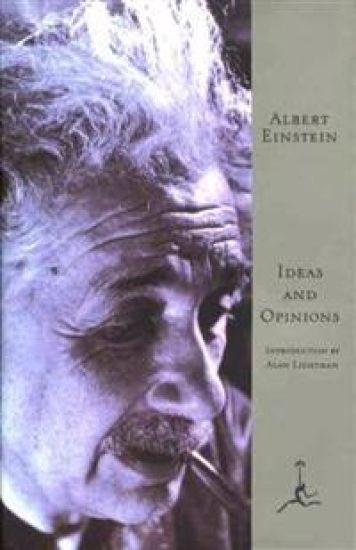
A new edition of the most definitive collection of Albert Einstein's popular writings, gathered under the supervision of Einstein himself. The selections range from his earliest days as a theoretical physicist to his death in 1955; from such subjects as relativity, nuclear war or peace, and religion and science, to human rights, economics, and government.
The Collected Papers of Albert Einstein, Volume 3 (English)
Albert Einstein
Princeton University Press
1994
pokkari
This volume of The Collected Papers of Albert Einstein presents Einstein's writings for the two-year period starting in October 1909. The initial date marks Einstein's departure from the Swiss Patent Office at Bern, which had been his professional home for seven years, and the beginning of his first academic appointment, at the University of Zurich. The volume concludes with the masterful report that Einstein, by then a full professor at the German-language university in Prague, gave to the original Solvay Congress, the first international meeting devoted to the problems of radiation and the quantum theory. Most of Einstein's efforts during these years went into his struggle with these ever more perplexing problems of quanta, on which he made discouragingly little progress. Einstein's new academic career naturally required him to teach, and almost half of this volume consists of the previously unpublished notes he wrote in preparation for his lectures on mechanics, on electricity and magnetism, and on kinetic theory and statistical mechanics. The last of these are particularly interesting in reflecting some of his research interests. Several papers here are concerned with aspects of the special theory of relativity, but it is Einstein's article of June 1911 that is a harbinger of things to come: it contains his calculation of the bending of light in a gravitational field on the basis of his equivalence principle. Martin J. Klein is Bass Professor of the History of Science and Professor of Physics at Yale University and Senior Editor of The Collected Papers of Albert Einstein. A. J. Kox teaches history of science at the University of Amsterdam, Jurgen Renn is Assistant Professor of Philosophy and Physics at Boston University, and Robert Schulmann is Assistant Professor of History at Boston University.
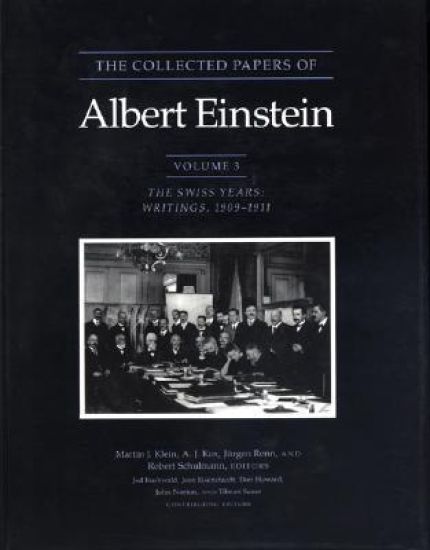
The Collected Papers of Albert Einstein, Volume 3
Albert Einstein
Princeton University Press
1994
sidottu
This volume of The Collected Papers of Albert Einstein presents Einstein's writings for the two-year period starting in October 1909. The initial date marks Einstein's departure from the Swiss Patent Office at Bern, which had been his professional home for seven years, and the beginning of his first academic appointment, at the University of Zurich. The volume concludes with the masterful report that Einstein, by then a full professor at the German-language university in Prague, gave to the original Solvay Congress, the first international meeting devoted to the problems of radiation and the quantum theory. Most of Einstein's efforts during these years went into his struggle with these ever more perplexing problems of quanta, on which he made discouragingly little progress. Einstein's new academic career naturally required him to teach, and almost half of this volume consists of the previously unpublished notes he wrote in preparation for his lectures on mechanics, on electricity and magnetism, and on kinetic theory and statistical mechanics. The last of these is particularly interesting in reflecting some of his research interests. Several papers here are concerned with aspects of the special theory of relativity, but it is Einstein's article of June 1911 that is a harbinger of things to come: it contains his calculation of the bending of light in a gravitational field on the basis of his equivalence principle. Martin J. Klein is Bass Professor of the History of Science and Professor of Physics at Yale University and Senior Editor of The Collected Papers of Albert Einstein. A. J. Kox teaches history of science at the University of Amsterdam, Jurgen Renn is Assistant Professor of Philosophy and Physics at Boston University, and Robert Schulmann is Assistant Professor of History at Boston University.
The Collected Papers of Albert Einstein, Volume 5
Albert Einstein
Princeton University Press
1993
sidottu
This volume, the first in the series to be devoted to Einstein's correspondence, begins in June 1902, when he went to work at the Swiss Patent Office. It closes in March 1914, as Einstein left Switzerland to take up his appointment as a member of the Prussian Academy of Sciences in Berlin. The great majority of the more than 500 letters from and to Einstein presented here have not been published before, and some of them will be new even to most Einstein scholars. They give us a much richer picture of Einstein in his twenties and early thirties than we have ever had. We see him through his correspondence with his mother, his wife Mileva, and, from 1912 on, his cousin Elsa, who would later become his second wife. He maintains close ties with old friends, but his circle widens, particularly after 1906, to include a number of his contemporaries in physics such as Max Laue and Paul Ehrenfest. He also develops important relationships with older theorists--Max Planck, Arnold Sommerfeld, and especially H. A. Lorentz. The letters in this volume clarify the development of his academic career once he leaves the Patent Office in 1909, and bring out the important parts played by such staunch supporters of Einstein as Alfred Kleiner, Fritz Haber, and, above all, Walther Nernst. Most significant, however, is the way the letters document crucial aspects of Einstein's scientific activity: his concentration for years on the unfathomable problems of quanta and radiation, his extensive knowledge of experimental physics, his many fruitful interactions with experimentalists, and finally his long struggle to generalize the 1905 theory of relativity to include gravitation and accelerated frames of reference.
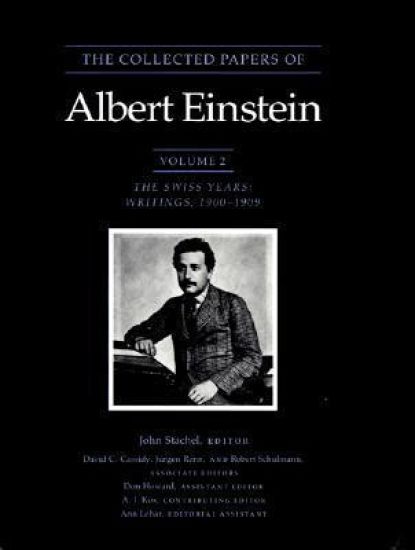
The Collected Papers of Albert Einstein, Volume 2
Albert Einstein
Princeton University Press
1990
sidottu
This volume of The Collected Papers of Albert Einstein contains the scientific work Einstein published during the first decade of his career, and includes some of the most significant achievements of twentieth-century physics. The first paper was written in 1900 by the twenty-one-year-old Einstein, newly graduated from the Swiss Federal Polytechnical School, or ETH, in Zurich and still searching in vain for a job. The last paper in this volume is the text of an invited lecture given in 1909 to a major scientific meeting by Einstein after he was appointed to his first academic post at the University of Zurich. He had already been recognized as an important theoretical physicist on the basis of the work reprinted here, particularly the three masterpieces that appeared in quick succession during 1905, Einstein's year of miracles. In one of these papers Einstein showed how one could finally confirm the ancient view that matter is composed of discrete atoms, and even measure the numbers and masses of these atoms. In a second paper, which even he referred to as "very revolutionary," he argued that the observed properties of thermal radiation suggest that it consists not of waves, but rather of localized particles of energy which he called energy quanta. The third and most famous paper set forth the special theory of relativity, solving some long-standing difficulties, but requiring a significant change in our understanding of those basic concepts, space and time.
Albert Einsteins Relativitätstheorie
Albert Einstein; Karl ?von? Meyenn
Vieweg+Teubner Verlag
1990
nidottu
Albert Einsteins grundlegende Arbeiten zur Relativitatstheorie Karl von Meyenn Unter der ungewohnlich groBen Anzahl hervorragender Gelehrter und Naturwissenschaftler, die das 20. Jahrhundert in seinem Verlaufe hervor- gebracht hat, nimmt Albert Einstein weiterhin eine einzigartige Sonder- stellung ein. Seine drei beriihmten Abhandlungen aus dem Jahre 1905, von denen eine die Relativitatstheorie begriindete, hatten ihn innerhalb von wenigen Jahren sprungartig von seiner Berner AuBenseiterstellung in den Mittelpunkt des allgemeinen wissenschaftlichen Lebens der damali- gen Zeit versetzt. Internationalen Ruhm erlangte er aber erst durch die Bestatigung seiner aufgrund der allgemeinen Relativitatstheorie vorherge- sagten Lichtablenkung im Gravitationsfeld der Sonne, die wahrend einer total en Sonnenfinsternis im Mai 1919 beobachtet werden konnte. Aber schon im September 1906, wahrend der Naturforscherversamm- lung in Stuttgart, hatte der angesehenste Physiker des Deutschen Reiches Max Planck Partei fUr die "Lorentz-Einsteinsche Theorie" des deformier- baren Elektrons ergriffen. Obwohl die bei dieser Gelegenheit diskutierten Kaufmannschen Ablenkbarkeitsmessungen von Elektronen eher zUgun- sten der konkurrierenden Kugel-Theorie des starren Elektrons von Max Abraham (1903) ausgelegt werden konnten, war Planck (1906a) "wegen der groBartigen Vereinfachung aller Probleme der Elektrodynamik" von der Richtigkeit des Einsteinschen Gedankens uberzeugt. Die "experimen- telle Bestatigung der Lorentz-Ensteinschen Theorie" wurde dann tatsach- lich zwei Jahre spater durch Alfred Bucherer (1908) erbracht.
The Collected Papers of Albert Einstein, Volume 2 (English)
Albert Einstein
Princeton University Press
1989
pokkari
Every document in The Collected Papers of Albert Einstein appears in the language in which it was written, and this supplementary paperback volume presents the English translations of all non-English materials. This translation does not include notes or annotation of the documentary volume and is not intended for use without the original language documentary edition which provides the extensive editorial commentary necessary for a full historical and scientific understanding of the documents.
"Relativitetsteorin uttrycks matematiskt, och jag förmodar man måste vara matematiker för att förstå den fullt ut. Ändå tror jag att Einsteins bok gör den begriplig. Hans framställning är inte oöverstiglig för någon. En god regel om man vill förstå ett ämne är att gå till källorna, varje omskrivning är en tolkning - och ofta misstolkning. Nu är det möjligt att läsa Einsteins egen text." /Björn Rosdahl, Helsingborgs Dagblad "Det har skrivits många böcker om relativitetsteorin, men få kommer i närheten av denna framställning av Einstein själv från 1917." /Peter Ekström, Bibliotekstjänst
The Collected Papers of Albert Einstein, Volume 1
Albert Einstein
Princeton University Press
1987
sidottu
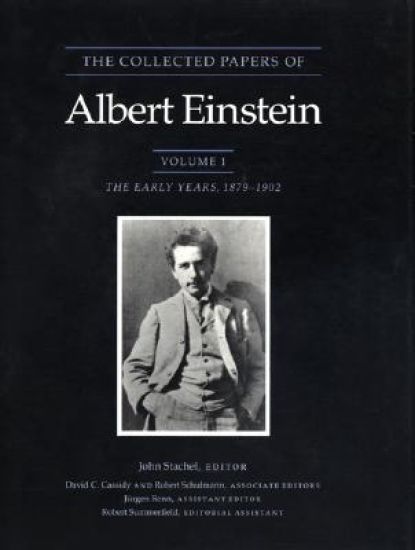
Volume 1 presents important new material on the young Einstein. Over half the documents made available here were discovered by the editors, including a significant group of over fifty letters that Einstein exchanged with Mileva Maric, his fellow student and future wife. These letters, together with other previously unpublished documents, provide an entirely new view of Einstein's youth. The documents in the volume also foreshadow the emergence of his extraordinary creative power. In them is manifested his intense commitment to scientific work and his interest in certain themes that proved to be central to his thinking during the next decade. We can follow, for example, the beginnings of his preoccupation with the electrodynamics of moving bodies that was to lead to the development of this special theory of relativity. For the first time it can be seen how closely he followed such contemporary developments in physics as Planck's work on radiation theory and Drude's work on the electron theory of metals. In addition to all of Einstein's known correspondence and other writings from this period, the volume includes the relevant portions of all third-party letters and other contemporary documents that provide additional information about his secondary schooling at the Aargau Cantonal School; his four years at the Swiss Federal Plytechnical School, or the ETH; and his search for a job after graduation. Included in the volume are those sections of an unpublished biography by Einstein's sister, Maja Winteler-Einstein, which deal with his early years; his extensive notes on a physics course he took at the ETH; and previously unpublished photographs of the young Einstein and his teachers and friends. Documents in Volume 1 portray Einstein's experiences during the two stressful years after his graduation from the ETH in Zurich. Denied a position as an Assistant at the ETH, he lived a hand-to-mouth existence while he looked for a post at other universities; then he attempted to find a secondary-school post, and finally sought a nonacademic job. Tension with his parents over his plans to marry Mileva Maric is evident throughout this period. With the help of a friend, he finally found work at the Swiss Patent Office, the haven where he would spend the next seven years. Freed from his financial worries, he entered on one of the most productive periods of his life, as the next volume, Writings (1901-1910), will document.
The Collected Papers of Albert Einstein, Volume 1 (English)
Albert Einstein
Princeton University Press
1987
pokkari
Volume 1 presents important new material on the young Einstein. Over half the documents made available here were discovered by the editors, including a significant group of over fifty letters that Einstein exchanged with Mileva Maric, his fellow student and future wife. These letters, together with other previously unpublished documents, provide an entirely new view of Einstein's youth. The documents in the volume also foreshadow the emergence of his extraordinary creative power. In them is manifested his intense commitment to scientific work and his interest in certain themes that proved to be central to his thinking during the next decade. We can follow, for example, the beginnings of his preoccupation with the electrodynamics of moving bodies that was to lead to the development of this special theory of relativity. For the first time it can be seen how closely he followed such contemporary developments in physics as Planck's work on radiation theory and Drude's work on the electron theory of metals. In addition to all of Einstein's known correspondence and other writings from this period, the volume includes the relevant portions of all third-party letters and other contemporary documents that provide additional information about his secondary schooling at the Aargau Cantonal School; his four years at the Swiss Federal Plytechnical School, or the ETH; and his search for a job after graduation. Included in the volume are those sections of an unpublished biography by Einstein's sister, Maja Winteler-Einstein, which deal with his early years; his extensive notes on a physics course he took at the ETH; and previously unpublished photographs of the young Einstein and his teachers and friends. Documents in Volume 1 portray Einstein's experiences during the two stressful years after his graduation from the ETH in Zurich. Denied a position as an Assistant at the ETH, he lived a hand-to-mouth existence while he looked for a post at other universities; then he attempted to find a secondary-school post, and finally sought a nonacademic job. Tension with his parents over his plans to marry Mileva Maric is evident throughout this period. With the help of a friend, he finally found work at the Swiss Patent Office, the haven where he would spend the next seven years. Freed from his financial worries, he entered on one of the most productive periods of his life, as the next volume, Writings (1901-1910), will document.
Über die Spezielle und Allgemeine Relativitätstheorie
Albert Einstein
Vieweg+teubner Verlag
1963
nidottu
Das vorliegende Biichlein solI sol chen eine moglichst exakte Ein sicht in die Relativitatstheorie vermitteln, die sich yom alIgemein wissenschaftlichen, philosophischen Standpunkt fiir die Theorie in teressieren, ohne den mathematischen Apparat 1) der theoretischen Physik zu beherrschen. Die Lektiire setzt etwa Maturitatsbildung und - trotz der Kiirze des Biichleins - ziemlich viel Geduld und Willenskraft beim Leser voraus. Der Verfasser hat sich die groGte Miihe gegeben, die Hauptgedanken moglichst deutlich und einfach vorzubringen, im ganzen in solcher Reihenfolge und in solchem Zu sammenhange, wie sie tatsachlich entstanden sind. 1m Interesse der Deutlichkeit erschien es mir unvermeidlich, mich oft zu wiederholen, ohne auf die Eleganz der Darstellung die geringste Riicksicht zu nehmen; ich hielt mich gewissenhaft an die Vorschrift des genialen Theoretikers L. Boltzmann, man solle die Eleganz Sache der Schneider und Schuster sein lassen. Schwierigkeiten, die in der Sache begriindet liegen, glaube ich dem Leser nicht vorenthalten zu haben. Dagegen habe ich die empirischen physikalischen Unterlage. 1 der 1) Die mathematischen Grundlagen der speziellen Relativitatstheorie findet man in den bei B. G. Teubner in der Monographiensammlung "Fort schritte der mathematischen Wissenschaften" unter dem Titel "Das Rela tivitatsprinzip" erschienenen Originalabhandlungen von H. A. Lorentz, A. Einstein, H. Minkowski, sowie in M. Laues ausfiihrlichem Buche "Das Relativitatsprinzip" (Verlag von Friedr. Vieweg & Sohn, Braunschweig). Die allgemeine Relativitatstheorie nebst den zugehOrigen mathematischen Hilfsmitteln der Invariantentheorie ist in der Broschiire des Verfassers, "Die Grundlagen der allgemeinen Relativitatstheorie" (Joh. Ambr. Barth, 1916) behandelt; diese Broschiire setzt einige Vertrautheit mit der spezi ellen Relativitatstheorie voraus."
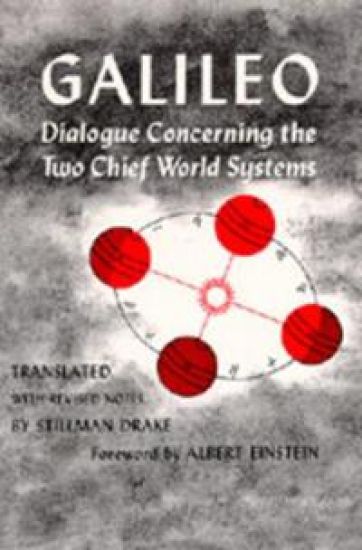
Dialogue Concerning the Two Chief World Systems, Ptolemaic and Copernican, Second Revised edition
Galileo Galilei; Albert Einstein
University of California Press
1962
pokkari
This 1967 edition of the "Dialogue Concerning the Two Chief World Systems" is a revision of a 1953 edition. It includes a foreword by Albert Einstein, which is presented in en face German and English versions. The translation itself is based on the definitive National Edition prepared under the direction of Antonio Favaro and published at Florence in 1897. The material specifically added to the text by Galileo himself after publication of the first edition (1632) has been included as well. In addition, the margins of the book include translations of Galileo's own postils (running notes), placed as nearly as possible beside their textual references.
The Evolution of Physics: Advances in Quantum Mechanics, Relativity, Magnetism and Field, Explained Plainly
Albert Einstein; Leopold Infeld
Pantianos Classics
1938
nidottu
Albert Einstein and Leopold Infeld explain the dramatic changes which the science of physics underwent between the time of Isaac Newton and the 20th century.With some 80 illustrations, the authors embark on a lively and plain-spoken account of scientific principles, pledging in the preface to embark on a simple conversation with the reader. The struggle of the human mind in understanding and explaining the various physical phenomena of the world and universe resulted in a succession of theories as centuries passed. Successive improvements of equipment for experimentation and advent of the scientific method led to better measurements of physical phenomena.Since this book seeks to explain physics for the general population, it contains no advanced mathematics. Instead, the authors rely on numerous drawings and several photographs of relevant phenomena. Explanations are accomplished with examples of real world objects; cars on the roads, or rollercoasters in the theme park, being relied upon to explain aspects of velocity and motion. More complex aspects of the science, such as quantum mechanics and the attributes of heat, are described in simpler terms and with use of analogy.
Das Relativitätsprinzip
Hendrik Antoon Lorentz; Albert Einstein; Hermann Minkowski
VS Verlag fur Sozialwissenschaften
1923
nidottu
Dieser Buchtitel ist Teil des Digitalisierungsprojekts Springer Book Archives mit Publikationen, die seit den Anfängen des Verlags von 1842 erschienen sind. Der Verlag stellt mit diesem Archiv Quellen für die historische wie auch die disziplingeschichtliche Forschung zur Verfügung, die jeweils im historischen Kontext betrachtet werden müssen. Dieser Titel erschien in der Zeit vor 1945 und wird daher in seiner zeittypischen politisch-ideologischen Ausrichtung vom Verlag nicht beworben.
Über die spezielle und die allgemeine Relativitätstheorie (Gemeinverständlich)
Albert Einstein
Vieweg+teubner Verlag
1921
nidottu
Dieser Buchtitel ist Teil des Digitalisierungsprojekts Springer Book Archives mit Publikationen, die seit den Anfängen des Verlags von 1842 erschienen sind. Der Verlag stellt mit diesem Archiv Quellen für die historische wie auch die disziplingeschichtliche Forschung zur Verfügung, die jeweils im historischen Kontext betrachtet werden müssen. Dieser Titel erschien in der Zeit vor 1945 und wird daher in seiner zeittypischen politisch-ideologischen Ausrichtung vom Verlag nicht beworben.
Über die spezielle und die allgemeine Relativitätstheorie
Albert Einstein
Vieweg+teubner Verlag
1920
nidottu
Dieser Buchtitel ist Teil des Digitalisierungsprojekts Springer Book Archives mit Publikationen, die seit den Anfängen des Verlags von 1842 erschienen sind. Der Verlag stellt mit diesem Archiv Quellen für die historische wie auch die disziplingeschichtliche Forschung zur Verfügung, die jeweils im historischen Kontext betrachtet werden müssen. Dieser Titel erschien in der Zeit vor 1945 und wird daher in seiner zeittypischen politisch-ideologischen Ausrichtung vom Verlag nicht beworben.
Meine Herren Kuratoren, Professoren, Doktoren und Studenten dieser Universit t Sie alle ferner, meine Damen und Herren, welche diese Feier durch Ihre Anwesenheit ehren .
Die Grundlagen der Einsteinschen Gravitationstheorie
Erwin Freundlich; Albert Einstein
Springer-Verlag Berlin and Heidelberg GmbH Co. K
1920
nidottu
Dieser Buchtitel ist Teil des Digitalisierungsprojekts Springer Book Archives mit Publikationen, die seit den Anfängen des Verlags von 1842 erschienen sind. Der Verlag stellt mit diesem Archiv Quellen für die historische wie auch die disziplingeschichtliche Forschung zur Verfügung, die jeweils im historischen Kontext betrachtet werden müssen. Dieser Titel erschien in der Zeit vor 1945 und wird daher in seiner zeittypischen politisch-ideologischen Ausrichtung vom Verlag nicht beworben.