Kirjojen hintavertailu. Mukana 12 390 323 kirjaa ja 12 kauppaa.

Kirjailija

Antonio Negri

Kirjat ja teokset yhdessä paikassa: 68 kirjaa, julkaisuja vuosilta 1992-2026, suosituimpien joukossa Spinoza for Our Time. Vertaile teosten hintoja ja tarkista saatavuus suomalaisista kirjakaupoista.

68 kirjaa

Kirjojen julkaisuhaarukka 1992-2026.

The Politics of Subversion

The Politics of Subversion

Antonio Negri

Polity Press
2005
nidottu
In this important book, Antonio Negri develops the key ideas that were to form the basis for the highly influential analyses of new forms of power and social struggle presented in Empire and Multitude. He shows how new technology and the break-up of the traditional factory have created new social subjects whose value is no longer tied to their skill. The spread of communication networks and the globalization of production mean that capitalism has become totalized – but not, Negri stresses, monolithic. On the contrary, the possibilities for subversion have correspondingly increased. Going beyond classical Marxism, he shows how old solidarities must be reformulated and new alliances created. The struggles which marked the political end of the twentieth century are now being repeated in a new historical conjuncture, giving rise to new forms of transnational solidarity that can challenge dominant global powers. This new paperback edition, which includes a new Preface by the author, is an excellent introduction to the work of one of the most influential political thinkers writing today and will be essential reading for anyone who wishes to understand the new forms of conflict and struggle that will shape the world in the twenty-first century.
Time for Revolution

Time for Revolution

Antonio Negri

Continuum International Publishing Group Ltd.
2004
nidottu
Written in prison two decades apart, these two essays reflect Antonio Negris abiding interest in the philosophy of time and resistance. The first essay traces the fracture lines that force capitalist society into perpetual crisis. The second, written immediately after the global bestseller, Empire, develops the two key concepts of empire and multitude. Time for Revolution explores the burning issue of our times: is there still a place for resistance in a society utterly subsumed by capitalism?
Negri on Negri

Negri on Negri

Antonio Negri

Routledge
2003
sidottu
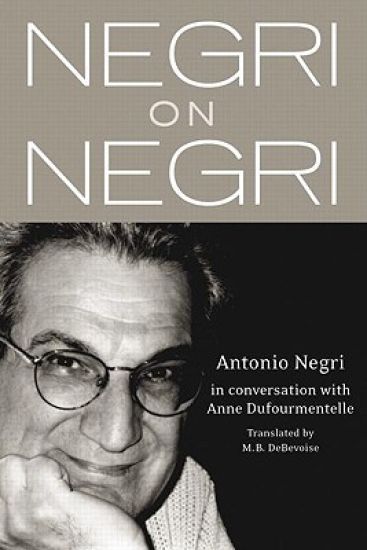
Political philosopher, convicted activist, leftist intellectual and coauthor of the bestselling Empire, Antonio Negri is one of the most controversial thinkers at work today. In this booklength conversation with Anne Dufourmentelle, Negri offers thoughtful responses to twenty-six terms, alphabetically arranged, that have had special significance for his life and work. Negri speaks openly here of his involvement with political movements, his exile, his return to Italy and years there in prison, and his life since. But beyond the biographical there is much here to explain Negri's ideas on globalization, the future of social change, and the history of political thought. The book's subjects - fascism, Heidegger, the Red Brigades, Wittgenstein, empire, Kant, the unconscious, and many others - are often thresholds from which Negri shares his views on still larger topics. Negri on Negri provides a fascinating glimpse into his mind and life. Perhaps nowhere else can one engage so readily the ideas of this major contemporary thinker.
Negri on Negri

Negri on Negri

Antonio Negri

Routledge
2003
nidottu
Political philosopher, convicted activist, leftist intellectual and coauthor of the bestselling Empire, Antonio Negri is one of the most controversial thinkers at work today. In this booklength conversation with Anne Dufourmentelle, Negri offers thoughtful responses to twenty-six terms, alphabetically arranged, that have had special significance for his life and work. Negri speaks openly here of his involvement with political movements, his exile, his return to Italy and years there in prison, and his life since. But beyond the biographical there is much here to explain Negri's ideas on globalization, the future of social change, and the history of political thought. The book's subjects - fascism, Heidegger, the Red Brigades, Wittgenstein, empire, Kant, the unconscious, and many others - are often thresholds from which Negri shares his views on still larger topics. Negri on Negri provides a fascinating glimpse into his mind and life. Perhaps nowhere else can one engage so readily the ideas of this major contemporary thinker.
Empire

Empire

Michael Hardt; Antonio Negri

Harvard University Press
2001
nidottu
Imperialism as we knew it may be no more, but Empire is alive and well. It is, as Michael Hardt and Antonio Negri demonstrate in this bold work, the new political order of globalization. It is easy to recognize the contemporary economic, cultural, and legal transformations taking place across the globe but difficult to understand them. Hardt and Negri contend that they should be seen in line with our historical understanding of Empire as a universal order that accepts no boundaries or limits. Their book shows how this emerging Empire is fundamentally different from the imperialism of European dominance and capitalist expansion in previous eras. Rather, today’s Empire draws on elements of U.S. constitutionalism, with its tradition of hybrid identities and expanding frontiers.Empire identifies a radical shift in concepts that form the philosophical basis of modern politics, concepts such as sovereignty, nation, and people. Hardt and Negri link this philosophical transformation to cultural and economic changes in postmodern society—to new forms of racism, new conceptions of identity and difference, new networks of communication and control, and new paths of migration. They also show how the power of transnational corporations and the increasing predominance of postindustrial forms of labor and production help to define the new imperial global order.More than analysis, Empire is also an unabashedly utopian work of political philosophy, a new Communist Manifesto. Looking beyond the regimes of exploitation and control that characterize today’s world order, it seeks an alternative political paradigm—the basis for a truly democratic global society.
Savage Anomaly

Savage Anomaly

Antonio Negri

University of Minnesota Press
1999
nidottu
A fresh take on this critical philosopher. In this essential rereading of Spinoza’s (1632-1677) philosophical and political writings, Negri positions this thinker within the historical context of the development of the modern state and its attendant political economy. Through a close examination of Spinoza, Negri reveals him as unique among his contemporaries for his nondialectical approach to social organization in a bourgeois age.
Marx Beyond Marx

Marx Beyond Marx

Antonio Negri

Pluto Press
1992
sidottu
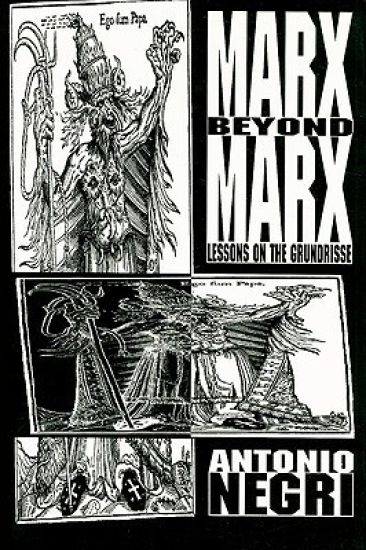
In 1978, at the invitation of Louis Althusser, Negri presented a series of seminars on Marx's Grundrisse in Paris. This is the book of those seminars. Negri, a leading figure of the Italian Autonomia, was in France as a consequence of charges relating to revolutionary action brought against him by the Italian state...Marx Beyond Marx aims towards a reconstruction of Marxist theory, a reconstruction that goes beyond Marx by going back to Marx, an angry Marxism summoned by the real possibility of communism...In setting the agenda for such reconstruction, and in clarifying its priorities, Marx Beyond Marx is a pathbreaking and indispensible work.
Marx Beyond Marx

Marx Beyond Marx

Antonio Negri

Pluto Press
1992
pokkari
A reconstruction of Marxist theory that goes beyond Marx by going back to Marx, an angry Marxism summoned by the real possibility of communism. In setting the agenda for such a reconstruction, and in clarifying its priorities.