

Kirjailija
Augustine
Kirjat ja teokset yhdessä paikassa: 160 kirjaa, julkaisuja vuosilta 1930-2026, suosituimpien joukossa Confessions. Vertaile teosten hintoja ja tarkista saatavuus suomalaisista kirjakaupoista.
160 kirjaa
Kirjojen julkaisuhaarukka 1930-2026.



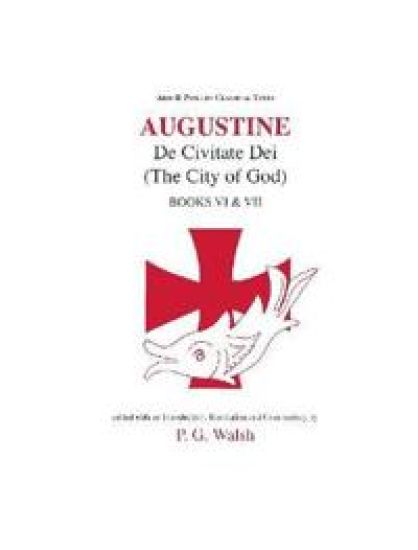
This edition of St Augustine's The City of God (De Civitate Dei) is the only one in English to provide a text and translation as well as a detailed commentary of this most influential document in the history of western Christianity. In these books, written in the aftermath of the sack of Rome in AD 410 by the Goths, Augustine replies to the pagans, who attributed the fall of Rome to the Christian religion and its prohibition of the worship of the pagan gods. Books VI and VII focus on the figure of Terentius Varro, a man revered by Augustine’s pagan contemporaries. By exploiting Varro’s learned researches on Roman religion, Augustine condemns Roman religious practices and beliefs in order to refute pagan claims that the Roman deities had guaranteed a blessed life in the hereafter for their devotees. These books are therefore not only an invaluable source for the study of early Christianity but also for any student of Classical Rome, who is provided here with a detailed account of one of the most learned figures of Roman antiquity, whose own works have not survived in the same state. Latin text with facing-page English translation, introduction and commentary.

This edition of St Augustine's The City of God (De Civitate Dei) is the only one in English to provide a text and translation as well as a detailed commentary of this most influential document in the history of western Christianity. In these books, written in the aftermath of the sack of Rome in AD 410 by the Goths, Augustine replies to the pagans, who attributed the fall of Rome to the Christian religion and its prohibition of the worship of the pagan gods. Books VI and VII focus on the figure of Terentius Varro, a man revered by Augustine’s pagan contemporaries. By exploiting Varro’s learned researches on Roman religion, Augustine condemns Roman religious practices and beliefs in order to refute pagan claims that the Roman deities had guaranteed a blessed life in the hereafter for their devotees. These books are therefore not only an invaluable source for the study of early Christianity but also for any student of Classical Rome, who is provided here with a detailed account of one of the most learned figures of Roman antiquity, whose own works have not survived in the same state. Latin text with facing-page English translation, introduction and commentary.
The Letters Of St. Augustine (1919)
William John Sparrow-Simpson; Augustine
KESSINGER PUBLISHING, LLC
2009
nidottu
S. Aureli Augustini Confessionum Libri Tredecim (1898)
Augustine; Pius Knoll
KESSINGER PUBLISHING, LLC
2009
nidottu
This edition of St Augustine's The City of God (De Civitate Dei) is the only one in English to provide a text and translation as well as a detailed commentary of this most influential document in the history of western Christianity. In Book V Augustine searches out and presents an answer to the question which lies behind the earlier books. In spite of the moral bankruptcy of the Roman state, and in spite of the disasters and injustices which have marked her history since the foundation, Rome has extended her imperial sway throughout Europe and the Near East. If the pagan gods have not guided her to this terrestrial eminence, how has this success been achieved? Augustine divides his response into four main sections: addressing the pagan notion of fate; arguing that God aided the Romans to imperial glory because a minority of them were virtuous even though they did not worship him; stating explicitly that the Roman Empire was set in place by God and is governed by his providence; and devoting the final section to the advent of Christian Emperors. Latin text with facing-page English translation, introduction and commentary.
This edition of St Augustine's The City of God (De Civitate Dei) is the only one in English to provide a text and translation as well as a detailed commentary of this most influential document in the history of western Christianity. In Book V Augustine searches out and presents an answer to the question which lies behind the earlier books. In spite of the moral bankruptcy of the Roman state, and in spite of the disasters and injustices which have marked her history since the foundation, Rome has extended her imperial sway throughout Europe and the Near East. If the pagan gods have not guided her to this terrestrial eminence, how has this success been achieved? Augustine divides his response into four main sections: addressing the pagan notion of fate; arguing that God aided the Romans to imperial glory because a minority of them were virtuous even though they did not worship him; stating explicitly that the Roman Empire was set in place by God and is governed by his providence; and devoting the final section to the advent of Christian Emperors. Latin text with facing-page English translation, introduction and commentary.



The Catholic and Manichaean Ways of Life
Augustine
The Catholic University of America Press
2008
nidottu
The Catholic and Manichaean Ways of Life is, like the Contra academicos (386) and the works of St. Augustine's later life against the Donatists and other heretics, the refutation of a redoubtable adversary whom he is determined to overthrow for the protection of his fellow Christians. Even a rapid glance at its contents is sufficient to show its character as a polemical work in which he contrasts one religious view of God, man and the world with another. In the first book, we are provided with a treatise on Christian morality, written, we must always bear in mind, by one received into the Church not two years before. It establishes that God is the Supreme Good. It shows the meaning of unions with him in charity. It explains the four cardinal virtues in terms of love, and particularly in terms of the love of God. Finally, it holds up for our admiration and emulation the Christian virtues of the religious, clergy, and laity. The way of life of the Catholic Church thus portrayed by Augustine embodies in his view a lofty ideal, but one that is livable by individuals in all states of life and in various stages of progress in virtue. The second book describes and refutes the teaching of the Manichaeans on the nature and origin of evil, their false ascetical practices, and their doctrines concerning the three symbols of the mouth, the hands, and the breast. In conclusion, Augustine denounces, on the basis of personal knowledge of first-hand reports, the scandalous conduct of the members of the Manichaean elect. Throughout this book, he is concerned, nor merely to expose the errors and excesses of the sect, including the shameful behavior and hypocrisy of certain of its leaders, but the absurdities and even depravity to which men are led by a way of life that is essentially unlivable. Whatever may be claimed for the austerities of the more sincere and ascetic members of the Manichaean sect, a religion that corrodes human nature and castigates its natural functioning as evil, cannot be good. Such is St. Augustine's ultimate judgment upon Manichaeanism, and he expresses it with eloquence and invective.

Renowned for his homiletic virtuosity, Augustine has been credited with hundreds of sermons. This collection of eighty-two sermons on the holy days and seasons of the Christian calendar includes specimens of Augustine's preaching on Christmas, New Year, Epiphany, Lent, the Easter Vigil, Easter Sunday, the Easter season, and Ascension, as well as exhortations to Christians who were newly baptized (at the Easter Vigil). His conversational tone and his penchant for images and symbolism are outstanding features of this collection.

This volume contains the translation of the six concluding books of The City of God. Book 17 briefly reviews significant events in the history of the chosen people down to the birth of Christ and calls attention to the prophecies that are fulfilled in Christ In summarizing the contents of the first 17 books Augustine shows in book 18 that there is a unifying theme running through the voluminous work: a comparison in the origin, development and progress of the earthly city and the city of God. A synchronizing of events in Jewish history with those in secular history brings this book to a close. Book 19 begins with a discussion of philosophical questions, e.g., the definition of the supreme good and the conditions for a just war, and concludes with an explanation of the differences between the earthly city and God's city and refutation of Porphyry's attacks on Christianity. Augustine himself says that he plans to discuss in book 20 the day of final judgment and to defend its reality against those who deliberately disbelieve in it. This purpose involves a consideration of Antichrist, the coming of Elias before the great and dreadful day of the Lord, the millennium mentioned in the book of Revelations, the new heaven and the new earth. The second last book discusses in some detail the kind of punishment that the Devil and those belonging to the earthly city are to endure. Reflections on hell, the nature of eternal torments and the unquenchable fire where the worm does not die bring this book to a close. The last book, book 22, treats the eternal blessedness of the city of God