Kirjojen hintavertailu. Mukana 12 237 025 kirjaa ja 12 kauppaa.

Kirjailija

Boethius

Kirjat ja teokset yhdessä paikassa: 73 kirjaa, julkaisuja vuosilta 1973-2025, suosituimpien joukossa Boece Console Par La Philosophie. Vertaile teosten hintoja ja tarkista saatavuus suomalaisista kirjakaupoista.

Mukana myös kirjoitusasut: Boëthius

73 kirjaa

Kirjojen julkaisuhaarukka 1973-2025.

The Consolation of Philosophy: A Classical Philosophical Work

The Consolation of Philosophy: A Classical Philosophical Work

Boethius

Createspace Independent Publishing Platform
2018
nidottu
The Consolation of Philosophy by Boethius. Translated into English Prose and Verse by H. R. James. The Consolation of Philosophy is a philosophical work by Boethius, written around the year 524. It has been described as the single most important and influential work in the West on Medieval and early Renaissance Christianity, as well as the last great Western work of the Classical Period. The Consolation of Philosophy was written in AD 523 during a one-year imprisonment Boethius served while awaiting trial - and eventual execution - for the alleged crime of treason under the Ostrogothic King Theodoric the Great. Boethius was at the very heights of power in Rome and was brought down by treachery. This experience inspired the text, which reflects on how evil can exist in a world governed by God (the problem of theodicy), and how happiness is still attainable amidst fickle fortune, while also considering the nature of happiness and God. It has been described as "by far the most interesting example of prison literature the world has ever seen."
Anicius Manlius Torquatus Severinus Boetius his Consolation of Philosophy, in Five Books Translated Into English
The 18th century was a wealth of knowledge, exploration and rapidly growing technology and expanding record-keeping made possible by advances in the printing press. In its determination to preserve the century of revolution, Gale initiated a revolution of its own: digitization of epic proportions to preserve these invaluable works in the largest archive of its kind. Now for the first time these high-quality digital copies of original 18th century manuscripts are available in print, making them highly accessible to libraries, undergraduate students, and independent scholars.The Age of Enlightenment profoundly enriched religious and philosophical understanding and continues to influence present-day thinking. Works collected here include masterpieces by David Hume, Immanuel Kant, and Jean-Jacques Rousseau, as well as religious sermons and moral debates on the issues of the day, such as the slave trade. The Age of Reason saw conflict between Protestantism and Catholicism transformed into one between faith and logic -- a debate that continues in the twenty-first century.++++The below data was compiled from various identification fields in the bibliographic record of this title. This data is provided as an additional tool in helping to insure edition identification: ++++Trinity College Library Watkinson CollectionT143750Titlepage in red and black. With a list of subscribers. Pp. xv-xvi omitted from the pagination; text is continuous. Translated by William Causton.London: printed for the author, 1730. 8], xxxv i.e. xxxiii], 1],161, 1]p.; 8
Anicii Manlii Severini Boetii consolationis philosophiae libri quinque.
The 18th century was a wealth of knowledge, exploration and rapidly growing technology and expanding record-keeping made possible by advances in the printing press. In its determination to preserve the century of revolution, Gale initiated a revolution of its own: digitization of epic proportions to preserve these invaluable works in the largest archive of its kind. Now for the first time these high-quality digital copies of original 18th century manuscripts are available in print, making them highly accessible to libraries, undergraduate students, and independent scholars.The Age of Enlightenment profoundly enriched religious and philosophical understanding and continues to influence present-day thinking. Works collected here include masterpieces by David Hume, Immanuel Kant, and Jean-Jacques Rousseau, as well as religious sermons and moral debates on the issues of the day, such as the slave trade. The Age of Reason saw conflict between Protestantism and Catholicism transformed into one between faith and logic -- a debate that continues in the twenty-first century.++++The below data was compiled from various identification fields in the bibliographic record of this title. This data is provided as an additional tool in helping to insure edition identification: ++++John Rylands University Library of ManchesterT149298With a final advertisement leaf. Also issued in octavo.Glasguae: in aedibus academicis excudebant Robertus et Andreas Foulis, 1751. 4],157, 3]p.; 4
The Metres of Boethius, on the Consolation of Philosophy
The 18th century was a wealth of knowledge, exploration and rapidly growing technology and expanding record-keeping made possible by advances in the printing press. In its determination to preserve the century of revolution, Gale initiated a revolution of its own: digitization of epic proportions to preserve these invaluable works in the largest archive of its kind. Now for the first time these high-quality digital copies of original 18th century manuscripts are available in print, making them highly accessible to libraries, undergraduate students, and independent scholars.The Age of Enlightenment profoundly enriched religious and philosophical understanding and continues to influence present-day thinking. Works collected here include masterpieces by David Hume, Immanuel Kant, and Jean-Jacques Rousseau, as well as religious sermons and moral debates on the issues of the day, such as the slave trade. The Age of Reason saw conflict between Protestantism and Catholicism transformed into one between faith and logic -- a debate that continues in the twenty-first century.++++The below data was compiled from various identification fields in the bibliographic record of this title. This data is provided as an additional tool in helping to insure edition identification: ++++British LibraryT105558With a half-title. Parallel Latin and English text. With the preface of Peter Berty in Latin and English. P.i occurs on the verso. The text appears complete despite the pagination.London: printed for the author, by J. Crowder, and sold by G. G. J. and J. Robinson, 1792. 9], cix, 3],6-108p., plate: port.; 8
Boethius's Consolation of Philosophy. Translated From the Latin, With Notes and Illustrations, by the Rev. Mr. Philip Ridpath,
The 18th century was a wealth of knowledge, exploration and rapidly growing technology and expanding record-keeping made possible by advances in the printing press. In its determination to preserve the century of revolution, Gale initiated a revolution of its own: digitization of epic proportions to preserve these invaluable works in the largest archive of its kind. Now for the first time these high-quality digital copies of original 18th century manuscripts are available in print, making them highly accessible to libraries, undergraduate students, and independent scholars.The Age of Enlightenment profoundly enriched religious and philosophical understanding and continues to influence present-day thinking. Works collected here include masterpieces by David Hume, Immanuel Kant, and Jean-Jacques Rousseau, as well as religious sermons and moral debates on the issues of the day, such as the slave trade. The Age of Reason saw conflict between Protestantism and Catholicism transformed into one between faith and logic -- a debate that continues in the twenty-first century.++++The below data was compiled from various identification fields in the bibliographic record of this title. This data is provided as an additional tool in helping to insure edition identification: ++++British LibraryT143757With a half-title.London: printed for C. Dilly, 1785. 4], xxxi, 1],224p.; 8
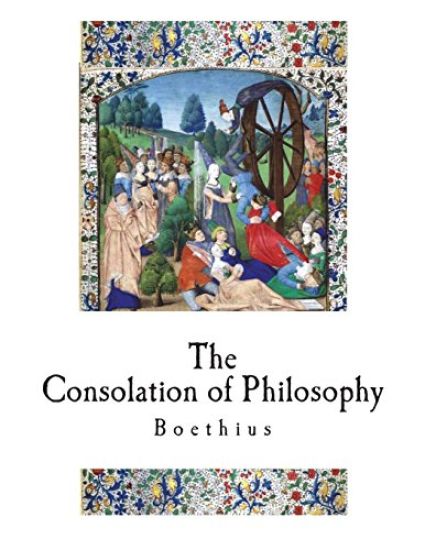
The Consolation of Philosophy

The Consolation of Philosophy

Boethius

Createspace Independent Publishing Platform
2018
nidottu
The Consolation of Philosophy was, throughout the Middle Ages and down to the beginnings of the modern epoch in the sixteenth century, the scholar's familiar companion. Few books have exercised a wider influence in their time. It has been translated into every European tongue, and into English nearly a dozen times. The great work of Boethius, with its alternate prose and verse, skilfully fitted together like dialog and chorus in a Greek play, is unique in literature and ought not to be forgotten.
The Consolation of Philosophy

The Consolation of Philosophy

Boethius

Createspace Independent Publishing Platform
2017
nidottu
Boethius was an eminent public figure under the Gothic emperor Theodoric, and an exceptional Greek scholar. When he became involved in a conspiracy and was imprisoned in Pavia, it was to the Greek philosophers that he turned. THE CONSOLATION was written in the period leading up to his brutal execution. is a short work of literature, written in the form of a prosimetrical apocalyptic dialogue (i.e. a dialogue with a mythical, imaginary, or allegorical figure). It contains five Books, which are written in a combination of prose and verse. Her instruction on the nature of fortune and happiness, good and evil, fate and free will, restore his health and bring him to enlightenment. THE CONSOLATION was extremely popular throughout medieval Europe and his ideas were influential on the thought of Chaucer and Dante.
King Alfred's Anglo-Saxon version of Boethius De consolatione philosophiae
The Old English Boethius is an Old English translation / adaptation of the sixth-century Consolation of Philosophy by Boethius, dating from between c. 880 and 950. Boethius's work is prosimetrical, alternating between prose and verse, and one of the two surviving manuscripts of the Old English translation renders the poems as Old English alliterative verse: these verse translations are known as the Metres of Boethius. NOTE: While Introduction and notes are in modern English, and a glossary is also included, the book does not contain a translation into modern English of the text of Consolation of Philosophy.
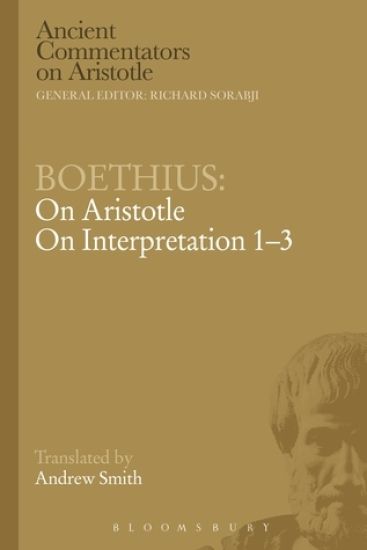
Boethius: On Aristotle On Interpretation 1-3
Boethius (c.480-c.525) wrote his highly influential second commentary on Aristotle's On Interpretation in Latin, but using the style of the Greek commentaries on Aristotle. It was part of his project to bring knowledge of Plato and Aristotle to the Latin-speaking world of his fellow Christians. The project was cruelly interrupted by his execution at the age of about 45, leaving the Latin world under-informed about Greek Philosophy for 700 years. Boethius reveals to us how On Interpretation was understood not only by himself, but also by some of the best Greek interpreters, especially Alexander and Porphyry. Alexander had insisted that its subject was composite thoughts, not composite sentences nor composite things - it is thoughts that are primarily true or false. Although Aristotle's first six chapters define name, verb, sentence, statement, affirmation and negation, Porphyry had claimed that Aristotelians believe in three types of name and verb, written, spoken and mental, in other words a language of the mind.Boethius discusses individuality and ascribes to Aristotle a view that each individual is distinguished by having a composite quality that is not merely unshared, but unshareable. Boethius also discusses why we can still say that the dead Homer is a poet, despite having forbidden us to say that the dead Socrates is either sick or well. But Boethius' most famous contribution is his interpretation of Aristotle's discussion of the threat of that tomorrow's events, for example a sea battle, will have been irrevocable 10,000 years ago, if it was true 10,000 years ago that there would be a sea battle on that day. In Boethius' later Consolation of Philosophy, written in prison awaiting execution, he offered a seminal conception of eternity to solve the related problem of future events being irrevocable because of God's foreknowledge of them.Boethius' influential commentary was part of his ideal of bringing Plato and Aristotle to the Latin-speaking world. Throughout the Latin Middle Ages, it remained the standard introduction to On Interpretation.This volume contains the first English translation of Boethius' commentary, as well as a detailed introduction, notes and bibliography.