Kirjojen hintavertailu. Mukana 12 199 750 kirjaa ja 12 kauppaa.

Kirjailija

Boethius

Kirjat ja teokset yhdessä paikassa: 73 kirjaa, julkaisuja vuosilta 1973-2025, suosituimpien joukossa Boece Console Par La Philosophie. Vertaile teosten hintoja ja tarkista saatavuus suomalaisista kirjakaupoista.

Mukana myös kirjoitusasut: Boëthius

73 kirjaa

Kirjojen julkaisuhaarukka 1973-2025.

The Consolation of Philosophy

The Consolation of Philosophy

Boethius

Oxford University Press
2008
nidottu
Boethius composed the De Consolatione Philosophiae in the sixth century AD whilst awaiting death under torture, condemned on a charge of treason which he protested was manifestly unjust. Though a convinced Christian, in detailing the true end of life which is the soul's knowledge of God, he consoled himself not with Christian precepts but with the tenets of Greek philosophy. This work dominated the intellectual world of the Middle Ages; writers as diverse as Thomas Aquinas, Jean de Meun, and Dante were inspired by it. In England it was rendered in to Old English by Alfred the Great, into Middle English by Geoffrey Chaucer, and later Queen Elizabeth I made her own translation. The circumstances of composition, the heroic demeanour of the author, and the 'Menippean' texture of part prose, part verse have combined to exercise a fascination over students of philosophy and literature ever since. ABOUT THE SERIES: For over 100 years Oxford World's Classics has made available the widest range of literature from around the globe. Each affordable volume reflects Oxford's commitment to scholarship, providing the most accurate text plus a wealth of other valuable features, including expert introductions by leading authorities, helpful notes to clarify the text, up-to-date bibliographies for further study, and much more.
Boethius's "De Topicis Differentiis"

Boethius's "De Topicis Differentiis"

Boethius

Cornell University Press
2004
pokkari
In Ciceronis Topica and De topicis differentiis are Boethius's two treatises on Topics (loci). Together these two works present Boethius's theory of the art of discovering arguments, a theory that was highly influential in the history of medieval logic.
Boethius's "in Ciceronis Topica"

Boethius's "in Ciceronis Topica"

Boethius

Cornell University Press
2004
pokkari
In Ciceronis Topica and De topicis differentiis are Boethius's two treatises on Topics (loci). Together these two works present Boethius's theory of the art of discovering arguments, a theory that was highly influential in the history of medieval logic. Eleonore Stump here presents the first English language translation of In Ciceronis Topica, Boethius's extended commentary on Cicero's Topica. To supplement her translation, Professor Stump has provided an introduction that supplies essential information about In Ciceronis Topica, Boethius's life, and the tradition of dialectic; her detailed notes explore the many philosophical problems in Boethius's text. A significant contribution to the history of Western intellectual life in its own right, Boethius's ''In Ciceronis Topica" makes an excellent companion to Professor Stump's earlier work, Boethius's "De topicis differentiis" (also available from Cornell).
Consolation of Philosophy

Consolation of Philosophy

Boethius

Hackett Publishing Co, Inc
2001
pokkari
Entirely faithful to Boethius' Latin; Relihan's translation makes the philosophy of the Consolation intelligible to readers; it gives equal weight to the poetry--in fact, Relihan's metrical translation of Boethius' metro are themselves contributions of the first moment to Boethian studies. Boethius finally has a translator equal to his prodigious talents and his manifold vision. --Joseph Pucci, Brown University
The Consolation of Philosophy

The Consolation of Philosophy

Boethius

Clarendon Press
1999
sidottu
Boethius composed the Consolatio Philosophiae in the sixth century AD whilst awaiting death under torture. He had been condemned on a charge of treason which he protested was manifestly unjust. Though a convinced Christian, in detailing the true end of life which is the soul's knowledge of God, he consoled himself not with Christian precepts but with the tenets of Greek philosophy. This work dominated the intellectual world of the Middle Ages; writers as diverse as Thomas Aquinas, Jean de Meun, and Dante were inspired by it. In England it was rendered into Old English by Alfred the Great, into Middle English by Geoffrey Chaucer, and later Queen Elizabeth I made her own translation. The circumstances of composition, the heroic demeanour of the author, and the `Menippean' texture (part prose, part verse; Boethius was a considerable poet) have combined to exercise a fascination over students of philosophy and of literature ever since. Professor Walsh has included an introduction and explanatory notes which combined with his new translation make the text accessible to general readers and scholars alike.
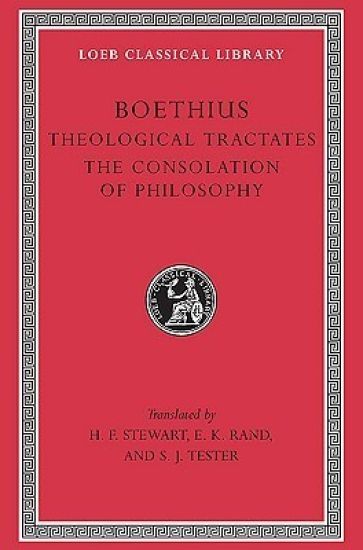
Theological Tractates. The Consolation of Philosophy
A Christian polymath embraces reason against misfortune in poetry and prose.Boethius (Boetius)—Anicius Manlius Severinus—Roman statesman and philosopher (ca. AD 480–524), was son of Flavius Manlius Boetius, after whose death he was looked after by several men, especially Memmius Symmachus. He married Symmachus’ daughter, Rusticiana, by whom he had two sons. All three men rose to high honors under Theodoric the Ostrogoth, but Boethius fell from favor, was tried for treason, wrongly condemned, and imprisoned at Ticinum (Pavia), where he wrote his renowned Consolation of Philosophy. He was put to death in 524, to the great remorse of Theodoric. Boethius was revered as if he were a saint and his bones were removed in 996 to the Church of S. Pietro in Ciel d’Oro, and later to the Cathedral. The tower in Pavia where he was imprisoned is still venerated.Boethius was author of Latin translations of Aristotle, commentaries on various philosophical works, original works on logic, five books on music, and other works. His Consolation of Philosophy is the last example of purely literary Latin of ancient times—a mingling of alternate dialogue and poems. His Theological Tractates are also included in this volume.