Kirjojen hintavertailu. Mukana 12 595 353 kirjaa ja 12 kauppaa.

Kirjailija

Boethius

Kirjat ja teokset yhdessä paikassa: 73 kirjaa, julkaisuja vuosilta 1973-2025, suosituimpien joukossa Boece Console Par La Philosophie. Vertaile teosten hintoja ja tarkista saatavuus suomalaisista kirjakaupoista.

Mukana myös kirjoitusasut: Boëthius

73 kirjaa

Kirjojen julkaisuhaarukka 1973-2025.
De diuisione

De diuisione

Boethius

Createspace Independent Publishing Platform
2014
nidottu
"De diuisione" from Boethius. Anicius Manlius Severinus Bo thius, commonly called Boethius (480-525), was a philosopher of the early 6th century.
Boethius' Consolation Of Philosophy

Boethius' Consolation Of Philosophy

Boethius

Literary Licensing, LLC
2014
sidottu
Boethius' Consolation of Philosophy is a philosophical and literary masterpiece written by the Roman philosopher and statesman, Boethius, in the early 6th century. The book is written in the form of a dialogue between Boethius and Lady Philosophy, who appears to him in his prison cell where he is awaiting execution. Boethius is despondent and despairing, having been unjustly accused of treason and sentenced to death. Lady Philosophy appears to him to provide comfort and wisdom, and to guide him towards a deeper understanding of the nature of happiness, fortune, and the human condition.Throughout the book, Lady Philosophy engages Boethius in a series of discussions on a range of topics, including the nature of good and evil, the relationship between happiness and virtue, the role of fortune in human affairs, and the nature of God and the universe. She argues that true happiness can only be found through a life of virtue and that the pursuit of wealth, power, and fame is ultimately futile and leads to misery. She also argues that God is the ultimate source of all good and that human suffering can be understood as a means of spiritual growth and purification.Boethius' Consolation of Philosophy is a work of profound philosophical and literary significance. It has been widely read and studied throughout the centuries and has influenced many great thinkers, including Dante, Chaucer, and Shakespeare. The book is a testament to the enduring power of philosophy and the human capacity for wisdom and understanding, even in the face of adversity and suffering.This Is A New Release Of The Original 1897 Edition.This scarce antiquarian book is a facsimile reprint of the old original and may contain some imperfections such as library marks and notations. Because we believe this work is culturally important, we have made it available as part of our commitment for protecting, preserving, and promoting the world's literature in affordable, high quality, modern editions, that are true to their original work.
Trost der Philosophie / Consolatio philosophiae
Von Theoderich zun chst gef rdert, dann wegen Hochverrats zum Tode verurteilt, verfasste Boethius seine Schrift im Gef ngnis vor seiner Hinrichtung (524 n. Chr.). Sein Werk ist eines der wirkungsm chtigsten der Sp tantike und z hlt zu den beliebtesten B chern des Abendlandes berhaupt. Zweifellos war der Autor Christ, doch suchte er Trost und Hoffnung nicht beim Christentum, sondern in der philosophischen Tradition.
Boethius: On Aristotle on Interpretation 4-6

Boethius: On Aristotle on Interpretation 4-6

Boethius

Bristol Classical Press
2011
sidottu
Boethius (c. 480-c. 525) was a Christian philosopher and author of many translations and works of philosophy, most famously the Consolations of Philosophy which were probably written when he was under house arrest, having been accused of treason by King Theoderic the Great. He was subsequently executed. On Interpretation is the second part of the Organon, as Aristotle's collected works on logic are known; it deals comprehensively and systematically with the relationship between logic and language. In his first six chapters, Aristotle defines name, verb, sentence, statement, affirmation and negation. Boethius preserves lost interpretations by two of the greatest earlier interpreters, Alexander and Porphyry, and the defence of the work's authenticity against criticism. He records the idea of Porphyry that Aristotelians believe in three types of name and verb, written, spoken and mental, in other words a language of the mind. Boethius' commentary formed part of his project to bring knowledge of Plato and Aristotle to the Latin-speaking world. It had great influence, remaining the standard introduction to On Interpretation throughout the Latin Middle Ages.
The Consolation of Philosophy

The Consolation of Philosophy

Boethius

Harvard University Press
2010
nidottu
In this highly praised new translation of Boethius’s The Consolation of Philosophy, David R. Slavitt presents a graceful, accessible, and modern version for both longtime admirers of one of the great masterpieces of philosophical literature and those encountering it for the first time. Slavitt preserves the distinction between the alternating verse and prose sections in the Latin original, allowing us to appreciate the Menippian parallels between the discourses of literary and logical inquiry. His prose translations are lively and colloquial, conveying the argumentative, occasionally bantering tone of the original, while his verse translations restore the beauty and power of Boethius’s poetry. The result is a major contribution to the art of translation. Those less familiar with Consolation may remember it was written under a death sentence. Boethius (c. 480–524), an Imperial official under Theodoric, Ostrogoth ruler of Rome, found himself, in a time of political paranoia, denounced, arrested, and then executed two years later without a trial. Composed while its author was imprisoned, cut off from family and friends, it remains one of Western literature’s most eloquent meditations on the transitory nature of earthly belongings, and the superiority of things of the mind. In an artful combination of verse and prose, Slavitt captures the energy and passion of the original. And in an introduction intended for the general reader, Seth Lerer places Boethius’s life and achievement in context.
Boethius: On Aristotle On Interpretation 1-3

Boethius: On Aristotle On Interpretation 1-3

Boethius

Bristol Classical Press
2010
sidottu
Boethius (c. 480-c. 525) wrote his highly influential second commentary on Aristotle's On Interpretationin Latin, but using the style of the Greek commentaries on Aristotle. It was part of his project to bring knowledge of Plato and Aristotle to the Latin-speaking world of his fellow Christians. The project was cruelly interrupted by his execution at the age of about 45, leaving the Latin world under-informed about Greek Philosophy for 700 years. Boethius reveals to us how On Interpretation was understood not only by himself, but also by some of the best Greek interpreters, especially Alexander and Porphyry. Alexander had insisted that its subject was composite thoughts, not composite sentences nor composite things - it is thoughts that are primarily true or false. Although Aristotle's first six chapters define name, verb, sentence, statement, affirmation and negation, Porphyry had claimed that Aristotelians believe in three types of name and verb, written, spoken and mental, in other words a language of the mind. Boethius discusses individuality and ascribes to Aristotle a view that each individual is distinguished by having a composite quality that is not merely unshared, but unshareable. Boethius also discusses why we can still say that the dead Homer is a poet, despite having forbidden us to say that the dead Socrates is either sick or well. But Boethius' most famous contribution is his interpretation of Aristotle's discussion of the threat of that tomorrow's events, for example a sea battle, will have been irrevocable 10,000 years ago, if it was true 10,000 years ago that there would be a sea battle on that day. In Boethius' later "Consolation of Philosophy", written in prison awaiting execution, he offered a seminal conception of eternity to solve the related problem of future events being irrevocable because of God's foreknowledge of them.
The Consolation of Philosophy

The Consolation of Philosophy

Boethius

WW Norton Co
2009
nidottu
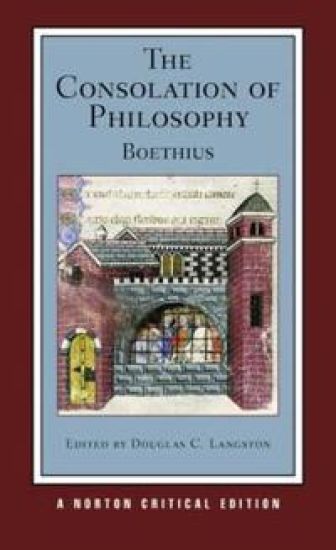
The Consolation of Philosophy occupies a central place in the history of Western thought. Its author, Anicius Manlius Severinus Boethius (ca. 476–526 c.e.), was a Roman philosopher, scholar, and statesman who wrote The Consolation of Philosophy while in a remote prison awaiting his execution on dubious political charges. The text of this Norton Critical Edition is based on the translation by Richard H. Green. It is accompanied by the editor’s preface and full-scale introduction to the work, the translator’s preface, and explanatory annotations. “Contexts” reprints selections from the texts that Boethius drew upon for his own work. These include excerpts from two of Plato’s Dialogues (Gorgias and Timaeus), from Aristotle’s Nicomachean Ethics, and from Augustine’s On Free Choice of the Will. “Criticism” collects five wide-ranging essays by major scholars of Boethius. Henry Chadwick presents a general introduction to Boethius’s life and works. Nelson Pike presents a clear and insightful interpretation of what Boethius means by writing that God is eternal (timeless). The final three essays—by William Bark, Edmund Reiss, and John Marenbon—all depart from traditional readings of The Consolation of Philosophy in significant ways and are sure to stimulate classroom discussion. A Chronology of Boethius’s life and work and a Selected Bibliography are also included.