Kirjojen hintavertailu. Mukana 12 390 323 kirjaa ja 12 kauppaa.

Kirjailija

David Owen

Kirjat ja teokset yhdessä paikassa: 85 kirjaa, julkaisuja vuosilta 1964-2025, suosituimpien joukossa A Handbook for Authentic Learning in Higher Education. Vertaile teosten hintoja ja tarkista saatavuus suomalaisista kirjakaupoista.

85 kirjaa

Kirjojen julkaisuhaarukka 1964-2025.

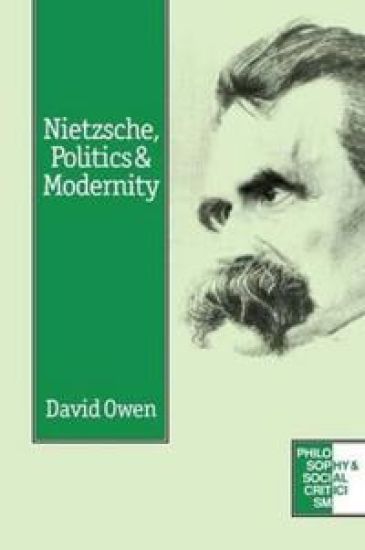
Nietzsche, Politics and Modernity

Nietzsche, Politics and Modernity

David Owen

SAGE Publications Ltd
1995
sidottu
Written in a clear and engaging style, this text demonstrates Nietzsche's significance as a philosopher and as a political theorist by highlighting his critique of liberalism (in both its philosophical and political forms) and by elaborating the form of ethical and political understanding which his philosophy discloses. In describing Nietzsche's diagnosis of the modern condition, this book explains the central aspects of his thought including the will to power, the Overman and amor fati. David Owen traces the relevance of Nietzsche's philosophy to current debates in political theory and engages with key figures such as MacIntyre, Taylor, Rorty and Rawls. Owen argues that the liberalism of the latter two can be seen as the contemporary expression of Nietzsche's dystopian vision of the Last Man and develops Nietzsche's political agonism as articulating a cogent alternative to liberal political theory.
Nietzsche, Politics and Modernity

Nietzsche, Politics and Modernity

David Owen

SAGE Publications Ltd
1995
nidottu
Written in a clear and engaging style, this text demonstrates Nietzsche's significance as a philosopher and as a political theorist by highlighting his critique of liberalism (in both its philosophical and political forms) and by elaborating the form of ethical and political understanding which his philosophy discloses. In describing Nietzsche's diagnosis of the modern condition, this book explains the central aspects of his thought including the will to power, the Overman and amor fati. David Owen traces the relevance of Nietzsche's philosophy to current debates in political theory and engages with key figures such as MacIntyre, Taylor, Rorty and Rawls. Owen argues that the liberalism of the latter two can be seen as the contemporary expression of Nietzsche's dystopian vision of the Last Man and develops Nietzsche's political agonism as articulating a cogent alternative to liberal political theory.
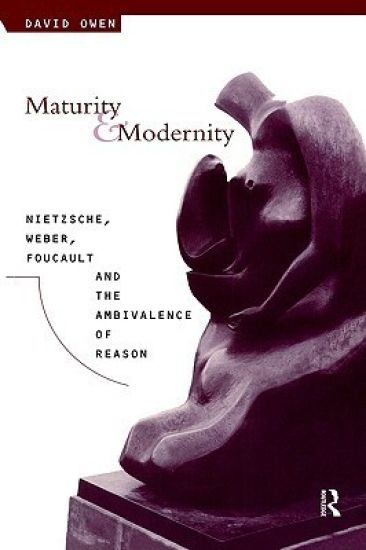
Maturity and Modernity

Maturity and Modernity

David Owen

Routledge
1994
sidottu
Maturity and Modernity is the first book to analyze Nietzsche, Weber and Foucault as a tradition of theorising and to chart the development of genealogy as a mode of critique. It provides clear accounts of the main ideas of Nietzsche, Weber and Foucault (as well as a useful Glossary) and illustrates the relations between these thinkers at methodological, substantive and politcal levels.
The Government of Victorian London, 1855-1889

The Government of Victorian London, 1855-1889

David Owen

Harvard University Press
1982
sidottu
Of all the major cities of Britain, London, the world metropolis, was the last to acquire a modern municipal government. Its antiquated administrative system led to repeated crises as the population doubled within a few decades and reached more than two million in the 1840s. Essential services such as sanitation, water supply, street paving and lighting, relief of the poor, and maintenance of the peace were managed by the vestries of ninety-odd parishes or precincts plus divers ad hoc authorities or commissions. In 1855, with the establishment of the Metropolitan Board of Works, the groundwork began to be laid for a rational municipal government. Owen tells in absorbing detail the story of the operations of the Metropolitan Board of Works, its political and other problems, and its limited but significant accomplishments--including the laying down of 83 miles of sewers and the building of the Thames Embankments--before it was replaced in 1889 by the London County Council. His account, based on extensive archival research, is balanced, judicious, lucid, often witty and always urbane.