Kirjailija
Ian Stewart
Kirjat ja teokset yhdessä paikassa: 115 kirjaa, julkaisuja vuosilta 1983-2026, suosituimpien joukossa Torry. Vertaile teosten hintoja ja tarkista saatavuus suomalaisista kirjakaupoista.
115 kirjaa
Kirjojen julkaisuhaarukka 1983-2026.
The seventeen equations that form the basis for life as we know it. Most people are familiar with history's great equations: Newton's Law of Gravity, for instance, or Einstein's theory of relativity. But the way these mathematical breakthroughs have contributed to human progress is seldom appreciated. In In Pursuit of the Unknown, celebrated mathematician Ian Stewart untangles the roots of our most important mathematical statements to show that equations have long been a driving force behind nearly every aspect of our lives. Using seventeen of our most crucial equations -- including the Wave Equation that allowed engineers to measure a building's response to earthquakes, saving countless lives, and the Black-Scholes model, used by bankers to track the price of financial derivatives over time -- Stewart illustrates that many of the advances we now take for granted were made possible by mathematical discoveries. An approachable, lively, and informative guide to the mathematical building blocks of modern life, In Pursuit of the Unknown is a penetrating exploration of how we have also used equations to make sense of, and in turn influence, our world.
From Newton's Law of Gravity to the Black-Scholes model used by bankers to predict the markets, equations, are everywhere -- and they are fundamental to everyday life.Seventeen Equations that Changed the World examines seventeen ground-breaking equations that have altered the course of human history. He explores how Pythagoras's Theorem led to GPS and Satnav; how logarithms are applied in architecture; why imaginary numbers were important in the development of the digital camera, and what is really going on with Schrödinger's cat. Entertaining, surprising and vastly informative, Seventeen Equations that Changed the World is a highly original exploration -- and explanation -- of life on earth.
In the 1800s mathematicians introduced a formal theory of symmetry: group theory. Now a branch of abstract algebra, this subject first arose in the theory of equations. Symmetry is an immensely important concept in mathematics and throughout the sciences, and its applications range across the entire subject. Symmetry governs the structure of crystals, innumerable types of pattern formation, how systems change their state as parameters vary; and fundamental physics is governed by symmetries in the laws of nature. It is highly visual, with applications that include animal markings, locomotion, evolutionary biology, elastic buckling, waves, the shape of the Earth, and the form of galaxies. In this Very Short Introduction, Ian Stewart demonstrates its deep implications, and shows how it plays a major role in the current search to unify relativity and quantum theory. ABOUT THE SERIES: The Very Short Introductions series from Oxford University Press contains hundreds of titles in almost every subject area. These pocket-sized books are the perfect way to get ahead in a new subject quickly. Our expert authors combine facts, analysis, perspective, new ideas, and enthusiasm to make interesting and challenging topics highly readable.
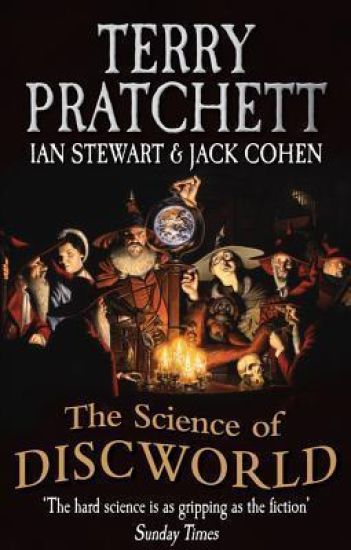
The fantastic first book in the Sunday Times bestselling Science of Discworld seriesWhen a wizardly experiment goes adrift, the wizards of Unseen University find themselves with a pocket universe on their hands: Roundworld, where neither magic nor common sense seems to stand a chance against logic.
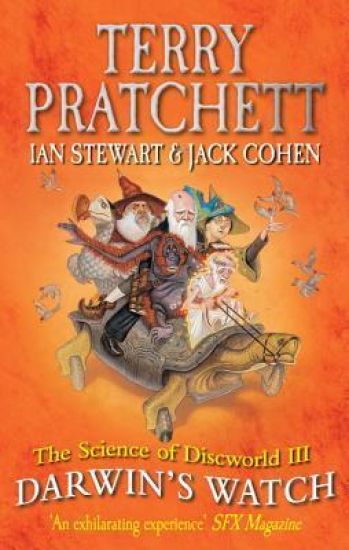
Science of Discworld III: Darwin's Watch
Ian Stewart; Jack Cohen; Terry Pratchett
Random House UK
2013
pokkari
They know the creatures who lived there escaped the impending Big Freeze by inventing the space elevator - they even intervened to rid the planet of a plague of elves, who attempted to divert humanity onto a different time track. Can the God of Evolution come to humanity's aid and ensure Darwin writes a very different book?
Acclaimed The Science of Discworld centred around an original Pratchett story about the wizards of Discworld.
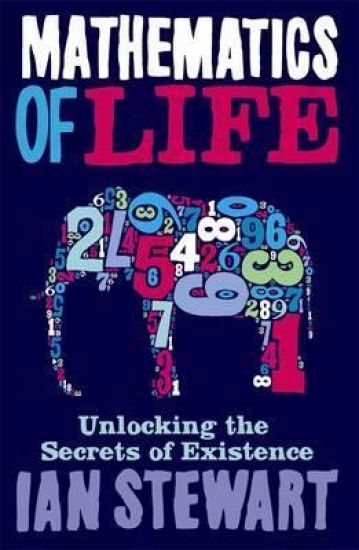
Biologists have long dismissed mathematics as being unable to meaningfully contribute to our understanding of living beings. Within the past ten years, however, mathematicians have proven that they hold the key to unlocking the mysteries of our world -- and ourselves. In The Mathematics of Life, Ian Stewart provides a fascinating overview of the vital but little-recognized role mathematics has played in pulling back the curtain on the hidden complexities of the natural world -- and how its contribution will be even more vital in the years ahead. In his characteristically clear and entertaining fashion, Stewart explains how mathematicians and biologists have come to work together on some of the most difficult scientific problems that the human race has ever tackled, including the nature and origin of life itself.
A new partnership of biologists and mathematicians is picking apart the hidden complexity of animals and plants to throw fresh light on the behaviour of entire organisms, how they interact and how changes in biological diversity affect the planet's ecological balance. Mathematics offers new and sometimes startling perspectives on evolution and how patterns of inheritance and population work out over time-scales ranging from millions to hundreds of years - as well as what's going on to change us right now. Ian Stewart, in characteristically clear and entertaining fashion, explores these and a whole range of pertinent issues, including how far genes control behaviour and the nature of life itself. He shows how far mathematicians and biologists are succeeding in tackling some of the most difficult scientific problems the human race has ever confronted and where their research is currently taking us.
New Horizon Player's Guide 2nd Edition
Michal Lysek; Ian Stewart; Stephen Mayo
Lulu.com
2012
pokkari
Welcome to a world that is not our own. Mankind's new home among the stars is more than they ever imagined when they left Earth. The settlers are surrounded by bizarre alien creatures that are often as deadly as they are amazing. Their lives are filled with the wonders of technology, but are held together by the strength of their resolve. Mankind walks this new world hand in hand with wafans, their sister race of sentient living machines, designed during the darker days of humanity's past. This is the world we live in, this is New Horizon. New Horizon is a roleplaying game that incorporates elements of science fiction, fantasy, utopian and dystopian fiction, and speculative fiction. New Horizon is a setting where advanced technologies and futuristic innovations are interweaved with the primeval roughness of an untamed world. It is a place where technology and nature are often seen struggling against one another, each protecting itself from the spread of the other.
It is only in recent times that infinite-dimensional Lie algebras have been the subject of other than sporadic study, with perhaps two exceptions: Cartan's simple algebras of infinite type, and free algebras. However, the last decade has seen a considerable increase of interest in the subject, along two fronts: the topological and the algebraic. The former, which deals largely with algebras of operators on linear spaces, or on manifolds modelled on linear spaces, has been dealt with elsewhere*). The latter, which is the subject of the present volume, exploits the surprising depth of analogy which exists between infinite-dimen sional Lie algebras and infinite groups. This is not to say that the theory consists of groups dressed in Lie-algebraic clothing. One of the tantalising aspects of the analogy, and one which renders it difficult to formalise, is that it extends to theorems better than to proofs. There are several cases where a true theorem about groups translates into a true theorem about Lie algebras, but where the group-theoretic proof uses methods not available for Lie algebras and the Lie-theoretic proof uses methods not available for groups. The two theories tend to differ in fine detail, and extra variations occur in the Lie algebra case according to the underlying field. Occasionally the analogy breaks down altogether. And of course there are parts of the Lie theory with no group-theoretic counterpart.
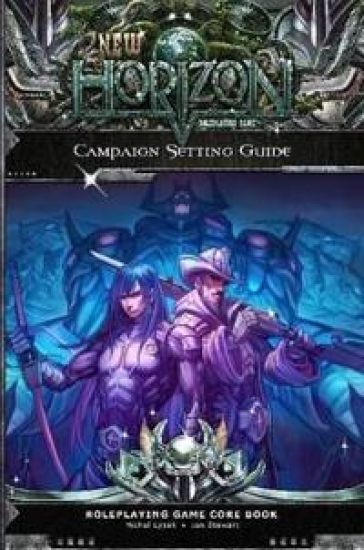
New Horizon Campaign Setting Guide 2nd Edition Paperback
Michal Lysek; Ian Stewart
Lulu.com
2011
pokkari
Welcome to a world that is not our own. Mankind's new home among the stars is more than they ever imagined when they left Earth. The settlers are surrounded by bizarre alien creatures that are often as deadly as they are amazing. Their lives are filled with the wonders of technology, but are held together by the strength of their resolve. Mankind walks this new world hand in hand with wafans, their sister race of sentient living machines, designed during the darker days of humanity's past. This is the world we live in, this is New Horizon. New Horizon is a roleplaying game that incorporates elements of science fiction, fantasy, utopian and dystopian fiction, and speculative fiction. New Horizon is a setting where advanced technologies and futuristic innovations are interweaved with the primeval roughness of an untamed world. It is a place where technology and nature are often seen struggling against one another, each protecting itself from the spread of the other.
Singularities and Groups in Bifurcation Theory
Martin Golubitsky; Ian Stewart; David G. Schaeffer
Springer-Verlag New York Inc.
2011
nidottu
Bifurcation theory studies how the structure of solutions to equations changes as parameters are varied. The nature of these changes depends both on the number of parameters and on the symmetries of the equations. Volume I discusses how singularity-theoretic techniques aid the understanding of transitions in multiparameter systems. This volume focuses on bifurcation problems with symmetry and shows how group-theoretic techniques aid the understanding of transitions in symmetric systems. Four broad topics are covered: group theory and steady-state bifurcation, equicariant singularity theory, Hopf bifurcation with symmetry, and mode interactions. The opening chapter provides an introduction to these subjects and motivates the study of systems with symmetry. Detailed case studies illustrate how group-theoretic methods can be used to analyze specific problems arising in applications.
Ian Stewart, author of the bestselling Professor Stewart's Cabinet of Mathematical Curiosities, presents a new and magical mix of games, puzzles, paradoxes, brainteasers, and riddles. He mingles these with forays into ancient and modern mathematical thought, appallingly hilarious mathematical jokes, and enquiries into the great mathematical challenges of the present and past. Amongst a host of arcane and astonishing facts about every kind of number from irrational or imaginary to complex or cuneiform, we find out: how to organise chaos; how matter balances anti-matter; how to turn a sphere inside out (without creasing it...); why you can't comb a hairy ball; how to calculate pi by observing the stars. And we get some tantalising glimpses of the maths of life and the universe.Mind-stretching, enlightening and endlessly amusing, Professor Stewart's new entertainment will stimulate, delight, and enthral.
School maths is not the interesting part. The real fun is elsewhere. Like a magpie, Ian Stewart has collected the most enlightening, entertaining and vexing 'curiosities' of maths over the years... Now, the private collection is displayed in his cabinet. There are some hidden gems of logic, geometry and probability -- like how to extract a cherry from a cocktail glass (harder than you think), a pop up dodecahedron, the real reason why you can't divide anything by zero and some tips for making money by proving the obvious. Scattered among these are keys to unlocking the mysteries of Fermat's last theorem, the Poincaré Conjecture, chaos theory, and the P/NP problem for which a million dollar prize is on offer. There are beguiling secrets about familiar names like Pythagoras or prime numbers, as well as anecdotes about great mathematicians. Pull out the drawers of the Professor's cabinet and who knows what could happen...
Opening another drawer in his Cabinet of Curiosities, renowned mathematics professor Ian Stewart presents a new medley of games, paradoxes, and riddles in Professor Stewart's Hoard of Mathematical Treasures . With wit and aplomb, Stewart mingles casual puzzles with grander forays into ancient and modern mathematical thought. Amongst a host of arcane and astonishing facts about every kind of number from irrational and imaginary to complex and cuneiform, we learn: - How to organize chaos - How matter balances anti-matter - How to turn a sphere inside out (without creasing it) - How to calculate pi by observing the stars - ...and why you can't comb a hairy ball. Along the way Stewart offers the reader tantalizing glimpses of the mathematics underlying life and the universe. Mind-stretching, enlightening, and endlessly amusing, Professor Stewart's Hoard of Mathematical Treasures will stimulate, delight, and enthrall.
From ancient Babylon to the last great unsolved problems, Ian Stewart brings us his definitive history of mathematics. In his famous straightforward style, Professor Stewart explains each major development - from the first number systems to chaos theory - and considers how each affected society and changed everyday life forever. Maintaining a personal touch, he introduces all of the outstanding mathematicians of history, from the key Babylonians, Greeks and Egyptians, via Newton and Descartes, to Fermat, Babbage and Godel, and demystifies maths' key concepts without recourse to complicated formulae. Written to provide a captivating historic narrative for the non-mathematician, Taming the Infinite: The Story of Mathematics is packed with fascinating nuggets and quirky asides, and contains 100 illustrations and diagrams to illuminate and aid understanding of a subject many dread, but which has made our world what it is today.
Knowing that the most exciting math is not taught in school, Professor Ian Stewart has spent years filling his cabinet with intriguing mathematical games, puzzles, stories, and factoids intended for the adventurous mind. This book reveals the most exhilarating oddities from Professor Stewart's legendary cabinet. Inside, you will find hidden gems of logic, geometry, and probability--like how to extract a cherry from a cocktail glass (harder than you think), a pop-up dodecahedron, and the real reason why you can't divide anything by zero. Scattered among these are keys to Fermat's last theorem, the Poincare conjecture, chaos theory, and the P=NP problem (you'll win a million dollars if you solve it). You never know what enigmas you'll find in the Stewart cabinet, but they're sure to be clever, mind-expanding, and delightfully fun.
A mathematical sightseeing tour of the natural world from the author of THE MAGICAL MAZEWhy do many flowers have five or eight petals, but very few six or seven? Why do snowflakes have sixfold symmetry? Why do tigers have stripes but leopards have spots?Mathematics is to nature as Sherlock Holmes is to evidence. Mathematics can look at a single snowflake and deduce the atomic geometry of its crystals; it can start with a violin string and uncover the existence of radio waves. And mathematics still has the power to open our eyes to new and unsuspected regularities - the secret structure of a cloud or the hidden rhythms of the weather. There are patterns in the world we are now seeing for the first time - patterns at the frontier of science, yet patterns so simple that anybody can see them once they know where to look.