Kirjojen hintavertailu. Mukana 12 290 406 kirjaa ja 12 kauppaa.

Kirjailija

Jacques Derrida

Kirjat ja teokset yhdessä paikassa: 171 kirjaa, julkaisuja vuosilta 1982-2027, suosituimpien joukossa Given Time II. Vertaile teosten hintoja ja tarkista saatavuus suomalaisista kirjakaupoista.

171 kirjaa

Kirjojen julkaisuhaarukka 1982-2027.

Thinking Out of Sight

Thinking Out of Sight

Jacques Derrida

University of Chicago Press
2021
sidottu
Jacques Derrida remains a leading voice of philosophy, his works still resonating today—and for more than three decades, one of the main sites of Derridean deconstruction has been the arts. Collecting nineteen texts spanning from 1979 to 2004, Thinking out of Sight brings to light Derrida’s most inventive ideas about the making of visual artworks. The book is divided into three sections. The first demonstrates Derrida’s preoccupation with visibility, image, and space. The second contains interviews and collaborations with artists on topics ranging from the politics of color to the components of painting. Finally, the book delves into Derrida’s writings on photography, video, cinema, and theater, ending with a text published just before his death about his complex relationship to his own image. With many texts appearing for the first time in English, Thinking out of Sight helps us better understand the critique of representation and visibility throughout Derrida’s work, and, most importantly, to assess the significance of his insights about art and its commentary.
Clang

Clang

Jacques Derrida

University of Minnesota Press
2021
sidottu
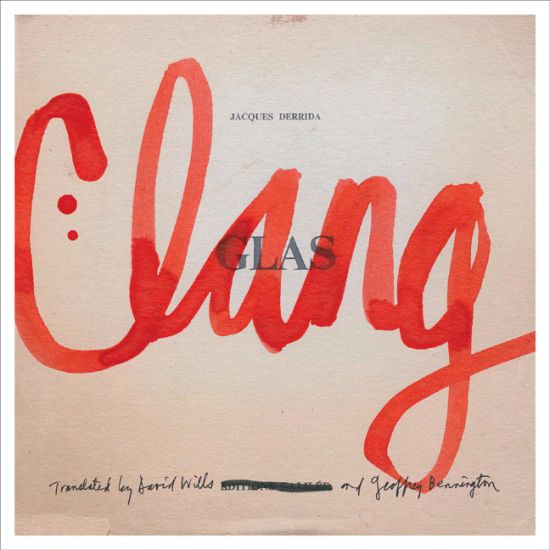
A new translation of Derrida’s groundbreaking juxtaposition of Hegel and Genet, forcing two incompatible discourses into dialogue with each other Jacques Derrida’s famously challenging book Glas puts the practice of philosophy and the very acts of writing and reading to the test. Formatted with parallel texts, its left column discusses G. W. F. Hegel and its right column engages Jean Genet, with numerous notes and interpolations in the margins. The resulting work, published for the first time in French in 1974, is a collage that practices theoretical thinking as a form of grafting. Presented here in an entirely new translation as Clang-its title resonating like the sound of an alarm or death knell-this book brilliantly juxtaposes Hegel’s totalizing, hierarchical system of thought with Genet’s autobiographical, carceral erotics. It innovatively forces two incompatible discourses into dialogue with each other: philosophical and literary, familial and perverse, logical and sensory. In both content and structure, Clang heightens the significance of all encounters across ruptures of thought or experience and vibrates with the impact of discordant languages colliding.
Clang

Clang

Jacques Derrida

University of Minnesota Press
2021
nidottu
A new translation of Derrida’s groundbreaking juxtaposition of Hegel and Genet, forcing two incompatible discourses into dialogue with each other Jacques Derrida’s famously challenging book Glas puts the practice of philosophy and the very acts of writing and reading to the test. Formatted with parallel texts, its left column discusses G. W. F. Hegel and its right column engages Jean Genet, with numerous notes and interpolations in the margins. The resulting work, published for the first time in French in 1974, is a collage that practices theoretical thinking as a form of grafting. Presented here in an entirely new translation as Clang-its title resonating like the sound of an alarm or death knell-this book brilliantly juxtaposes Hegel’s totalizing, hierarchical system of thought with Genet’s autobiographical, carceral erotics. It innovatively forces two incompatible discourses into dialogue with each other: philosophical and literary, familial and perverse, logical and sensory. In both content and structure, Clang heightens the significance of all encounters across ruptures of thought or experience and vibrates with the impact of discordant languages colliding.
Deconstruction in a Nutshell

Deconstruction in a Nutshell

Jacques Derrida

Fordham University Press
2020
pokkari
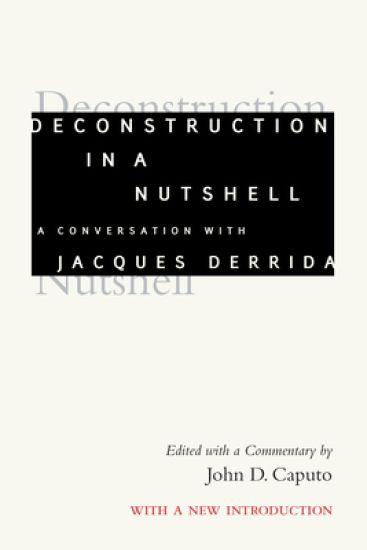
This volume, now with a substantial new Introduction, represents one of the most lucid, compact and reliable introductions to Derrida and deconstruction available in any language. Responding to questions put to him at a roundtable held at Villanova University in 1994, Jacques Derrida leads the reader through an illuminating discussion of the central themes of deconstruction. Speaking in English and extemporaneously, Derrida takes up with unusual clarity and great eloquence such topics as the task of philosophy, the Greeks, justice, responsibility, the gift, community, and the messianic. Derrida refutes the charges of relativism that are often leveled at deconstruction by its critics and sets forth the profoundly affirmative and ethico-political thrust of his work. The roundtable is marked by an unusual clarity that continues into the second part of the book, in which one of Derrida's most influential readers, John D. Caputo, elaborates upon Derrida's comments and supplies material for further discussion. This edition also includes a substantial new Introduction by Caputo that discusses the original context of the book and traces the development of deconstruction since Derrida's death in 2004, from the rise of new materialisms to return to religion. Long one of the most lucid and reliable introductions to Derrida and deconstruction available in any language, and an ideal volume for students, Deconstruction in a Nutshell will also prove illuminating for those already familiar with Derrida's work.
Deconstruction in a Nutshell

Deconstruction in a Nutshell

Jacques Derrida

FORDHAM UNIVERSITY PRESS
2020
sidottu
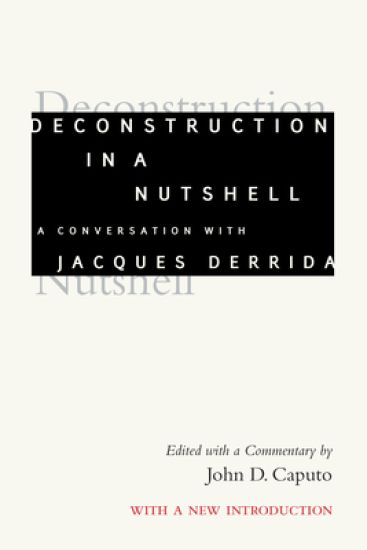
This volume, now with a substantial new Introduction, represents one of the most lucid, compact and reliable introductions to Derrida and deconstruction available in any language. Responding to questions put to him at a roundtable held at Villanova University in 1994, Jacques Derrida leads the reader through an illuminating discussion of the central themes of deconstruction. Speaking in English and extemporaneously, Derrida takes up with unusual clarity and great eloquence such topics as the task of philosophy, the Greeks, justice, responsibility, the gift, community, and the messianic. Derrida refutes the charges of relativism that are often leveled at deconstruction by its critics and sets forth the profoundly affirmative and ethico-political thrust of his work. The roundtable is marked by an unusual clarity that continues into the second part of the book, in which one of Derrida's most influential readers, John D. Caputo, elaborates upon Derrida's comments and supplies material for further discussion. This edition also includes a substantial new Introduction by Caputo that discusses the original context of the book and traces the development of deconstruction since Derrida's death in 2004, from the rise of new materialisms to return to religion. Long one of the most lucid and reliable introductions to Derrida and deconstruction available in any language, and an ideal volume for students, Deconstruction in a Nutshell will also prove illuminating for those already familiar with Derrida's work.
Differance

Differance

Jacques Derrida

Gyldendal
2020
nidottu
“Differancen er det ’frembringende’ moment ved forskellene, de konstituerede forskelles, det konstituerede sprogs, det fuldt færdige sprogsystems ’historie’ … Ja, der er meget gammelt i det, jeg har sagt. Det hele er sikkert gammelt. Det er Heraklit, jeg har refereret til i sidste instans.” Sådan falder ordene i et par af de svar, som Jacques Derrida (f. 1930) giver under debatten i Fransk filosofisk Selskab om hans foredrag Differance i januar 1968. Det er i sig selv et intenst, fortættet forsøg på at endevende den filosofiske tale om væren, det værende, nærværet, så fokus kommer på den differeren, der både adskiller og udsætter – og derved sætter forskelle i spil. Det er metafysikkens gamle værenstænkning med afsæt i en ’ubevæget bevæger’, en sidste (eller første) instans, der her får modspil af en anderledes dekonstruerende forskelstænkning. Det på flere måder skelsættende foredrag ledsages i denne udgave ved Søren Gosvig Olesen, der også giver en grundig introduktion, af den oprindelige diskussion og af den manchet, hvormed Derrida i sin tid indbød sit lærde publikum. Bogen genudgives i Hans Reitzels Forlags serie Klassikere og udkom første gang på dansk i 2002.
The Politics of Friendship

The Politics of Friendship

Jacques Derrida

Verso Books
2020
nidottu
Jacques Derrida was one of most influential philosophers of the 20th century. In The Politics of Friendship he explores the idea of friendship and its political consequences, past and future in order to explore invention of a radically new friendship, of a deeper and more inclusive democracy.
Geschlecht III

Geschlecht III

Jacques Derrida

University of Chicago Press
2020
sidottu
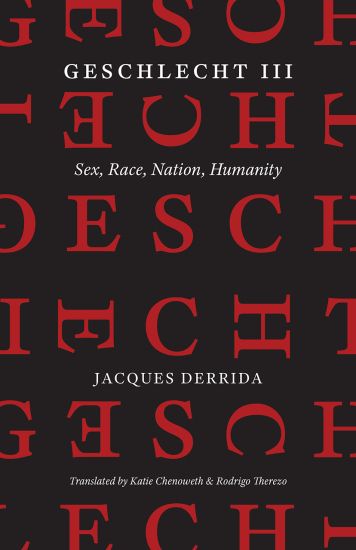
A significant event in Derrida scholarship, this book marks the first publication of his long-lost philosophical text known only as "Geschlecht III." The third, and arguably the most significant, piece in his four-part Geschlecht series, it fills a gap that has perplexed Derrida scholars. The series centers on Martin Heidegger and the enigmatic German word Geschlecht, which has several meanings pointing to race, sex, and lineage. Throughout the series, Derrida engages with Heidegger's controversial oeuvre to tease out topics of sexual difference, nationalism, race, and humanity. In Geschlecht III, he calls attention to Heidegger's problematic nationalism, his work's political and sexual themes, and his promise of salvation through the coming of the "One Geschlecht," a sentiment that Derrida found concerningly close to the racial ideology of the Nazi party. Amid new revelations about Heidegger's anti-Semitism and the contemporary context of nationalist resurgence, this third piece of the Geschlecht series is timelier and more necessary than ever. Meticulously edited and expertly translated, this volume brings Derrida's mysterious and much awaited text to light.
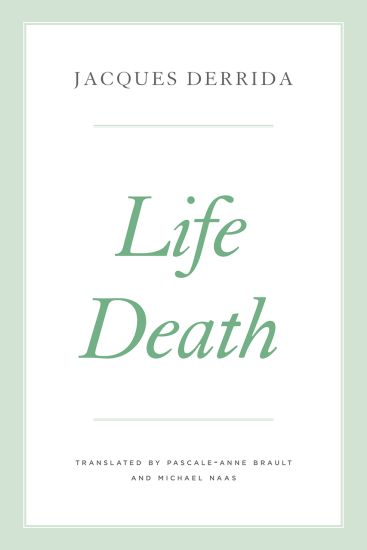
Life Death

Life Death

Jacques Derrida

University of Chicago Press
2020
sidottu
One of Jacques Derrida's richest and most provocative works, Life Death challenges and deconstructs one of the most deeply rooted dichotomies of Western thought: life and death. Here Derrida rethinks the traditional philosophical understanding of the relationship between life and death, undertaking multidisciplinary analyses of a range of topics, including philosophy, linguistics, and the life sciences. In seeking to understand the relationship between life and death, he engages in close readings of Freudian psychoanalysis, the philosophy of Nietzsche and Heidegger, French geneticist Francois Jacob, and epistemologist Georges Canguilhem. Derrida gave his "Life Death" seminar over fourteen sessions between 1975 and 1976 at the Ecole normale superieure in Paris as part of the preparation for students studying for the agregation, a notoriously competitive qualifying exam. The theme for the exam that year was "Life and Death," but Derrida made a critical modification to the title by dropping the coordinating conjunction. The resulting title of Life Death poses a philosophical question about the close relationship between life and death. Derrida argues that death must be considered neither as the opposite of life nor as the truth or fulfillment of it, but rather as that which both limits life and makes it possible. Through these captivating sessions, Derrida thus not only questions traditional understandings of the relationship between life and death, but also ultimately develops a new way of thinking about what he calls "life death."
Antonin Artaud

Antonin Artaud

Paule Thévenin; Jacques Derrida

MIT Press
2019
sidottu
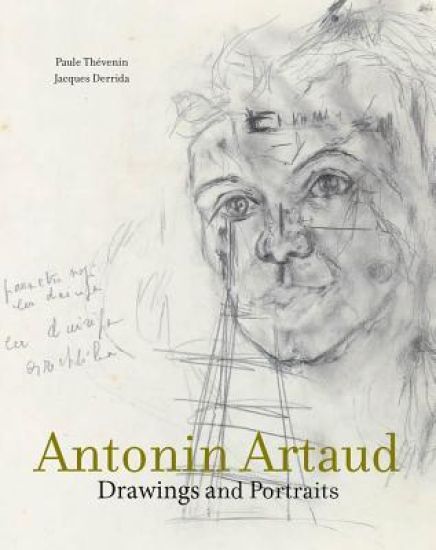
Philosophical and biographical accounts of Antonin Artaud's late visual work, all reproduced in color.Antonin Artaud (1896-1948)-stage and film actor, director, writer, and visual artist-was a man of rage and genius. Expelled from the Surrealist movement for his refusal to renounce the theatre, he founded the Theater of Cruelty and wrote The Theater and Its Double, one of the key twentieth-century texts on the topic. Artaud spent nine years at the end of his life in asylums, undergoing electroshock treatments. Released to the care of his friends in 1946, he began to draw again.This book presents drawings and portraits from this late resurgence, all in color. Accompanying the images are texts by by Artaud's longtime friend and editor Paule Thevenin and the philosopher Jacques Derrida."We won't be describing any paintings," Derrida warns the reader. Derrida struggles with Artaud's peculiar language, punctuating his text with agitated footnotes and asides (asking at one point, "How will they translate this?"). Thevenin offers a more straightforward biographical and historical account. (It was on the walls of her apartment that Derrida first saw Artaud's paintings and drawings.) These two texts were previously published by the MIT Press in The Secret Art of Antonin Artaud without the artwork that is their subject. This book brings together art and text for the first time in English.
Heidegger

Heidegger

Jacques Derrida

University of Chicago Press
2019
pokkari
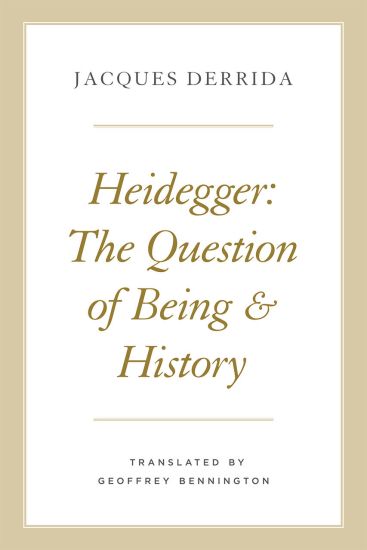
Few philosophers held greater fascination for Jacques Derrida than Martin Heidegger, and in this book we get an extended look at Derrida's first real encounters with him. Delivered over nine sessions in 1964 and 1965 at the cole Normale Sup rieure, these lectures offer a glimpse of the young Derrida first coming to terms with the German philosopher and his magnum opus, Being and Time. They provide not only crucial insight into the gestation of some of Derrida's primary conceptual concerns--indeed, it is here that he first uses, with some hesitation, the word "deconstruction"--but an analysis of Being and Time that is of extraordinary value to readers of Heidegger or anyone interested in modern philosophy. Derrida performs an almost surgical reading of the notoriously difficult text, marrying pedagogical clarity with patient rigor and acting as a lucid guide through the thickets of Heidegger's prose. At this time in intellectual history, Heidegger was still somewhat unfamiliar to French readers, and Being and Time had only been partially translated into French. Here Derrida mostly uses his own translations, giving his own reading of Heidegger that directly challenges the French existential reception initiated earlier by Sartre. He focuses especially on Heidegger's Destruktion (which Derrida would translate both into "solicitation" and "deconstruction") of the history of ontology, and indeed of ontology as such, concentrating on passages that call for a rethinking of the place of history in the question of being, and developing a radical account of the place of metaphoricity in Heidegger's thinking. This is a rare window onto Derrida's formative years, and in it we can already see the philosopher we've come to recognize--one characterized by a bravura of exegesis and an inventiveness of thought that are particularly and singularly his.
Stemmen og fænomenet

Stemmen og fænomenet

Jacques Derrida

Gyldendal
2018
nidottu
I Stemmen og Fænomenet gennemfører Jacques Derrida (1930-2004) en dekonstruktiv læsning af den tyske filosof Edmund Husserl (1859-1938). Bogen udkom oprindeligt på fransk i 1967 og i dansk oversættelse i 1997. Den har en indledning af lektor Adam Diderichsen. Derridas projekt er at vise, at Husserls sprogforståelse på væsentlig vis forudsætter den måde, hvorpå sproget altid er blevet tænkt i den vesterlandske metafysik. På trods af Husserls ønske om at starte forfra i filosofien er han således uhjælpeligt fanget i det spil, som han netop ikke vil spille, nemlig metafysikkens spil.
Theory and Practice

Theory and Practice

Jacques Derrida

University of Chicago Press
2018
sidottu
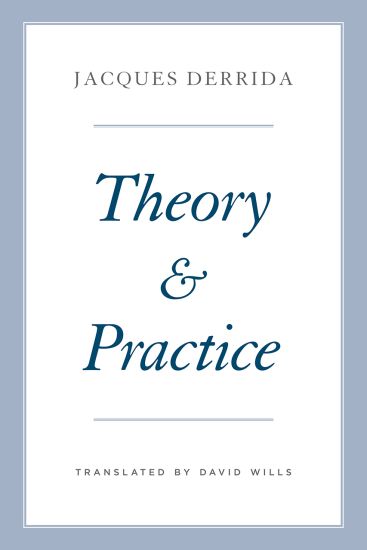
Theory and Practice is a series of nine lectures that Jacques Derrida delivered at the École Normale Supérieure in 1976 and 1977. The topic of “theory and practice” was associated above all with Marxist discourse and particularly the influential interpretation of Marx by Louis Althusser. Derrida’s many questions to Althusser and other thinkers aim at unsettling the distinction between thinking and acting. Derrida’s investigations set out from Marx’s “Theses on Feuerbach,” in particular the eleventh thesis, which has often been taken as a mantra for the “end of philosophy,” to be brought about by Marxist practice. Derrida argues, however, that Althusser has no such end in view and that his discourse remains resolutely philosophical, even as it promotes the theory/practice pair as primary values. This seminar also draws fascinating connections between Marxist thought and Heidegger and features Derrida’s signature reconsideration of the dichotomy between doing and thinking. This text, available for the first time in English, shows that Derrida was doing important work on Marx long before Specters of Marx. As with the other volumes in this series, it gives readers an unparalleled glimpse into Derrida’s thinking at its best—spontaneous, unpredictable, and groundbreaking.
Before the Law

Before the Law

Jacques Derrida

University of Minnesota Press
2018
nidottu
Thinking judgment in relation to the work of Jean-FranÇois Lyotard “How to judge-Jean-FranÇois Lyotard?” It is from this initial question that one of France’s most heralded philosophers of the twentieth century begins his essay on the origin of the law, of judgment, and the work of his colleague Jean-FranÇois Lyotard. If Jacques Derrida begins with the term prÉjugÉs, it is in part because of its impossibility to be rendered properly in other languages and also contain all its meanings: to pre-judge, to judge before judging, to hold prejudices, to know “how to judge,” and more still, to be already prejudged oneself. Striving to contain that which comes before the law, that is in front of the law and also prior to it, how to judge Jean-FranÇois Lyotard then becomes perhaps a beneficial attempt for Derrida to explore humanity’s rapport with judgment, origins, and naming. For how does one come to judge the author of the Differend? How does one abstain from judgment to accept the term prÉjugÉs as suspending judgment and at once as taking into account the impossibility of speaking before the law, prior to naming or judging? If this task indeed seems insurmountable, it is the site where Lyotard’s work itself is played out. Hence this sincere and intriguing essay presented by Jacques Derrida, published here for the first time in English.
Advances

Advances

Jacques Derrida

University of Minnesota Press
2018
nidottu
Originally published in 1995, Advances was first written by Jacques Derrida as a long foreword to a book by one of his most promising former students, the philosopher Serge Margels Le Tombeau du Dieu Artisan (The Tomb of the Craftsman). What Derrida uncovers for us is Margels own unique theory of the promise in relation to an an-archic, pre-chronological temporality, in conjunction with Margels radical rereading of Platos Timaeus. As Derrida states right away, Margels reading is a new one, a new reading of the Demiurge. A new promise. A new advance. In this magisterial late essay by Derrida, what the reader soon discovers is in part a conversation with his former student, as well as an opening for a new reflection on our current ecological and political crises that are all the more urgent today where the possibility of giving ourselves death as a human race and the end of the world is now, within an era of climate change, more real than ever. As part of Univocals Pharmakon series, this essay, itself published in advance, becomes a brief but powerful light pointing toward Univocals forthcoming publication of the translation of Serge Margels Le Tombeau du Dieu Artisan. Once again the Timaeus, of course, but a different Timaeus, a new Demiurge, I promise.
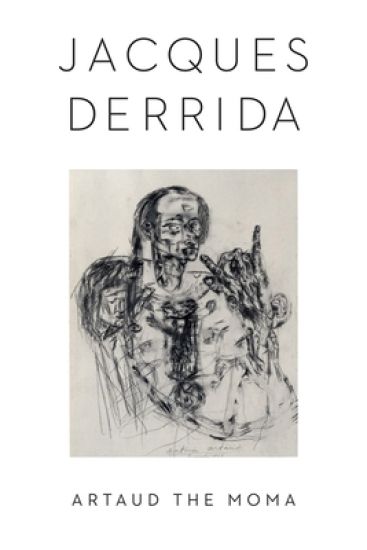
Artaud the Moma

Artaud the Moma

Jacques Derrida; Kaira M. Cabañas

Columbia University Press
2017
sidottu
In 1996 Jacques Derrida gave a lecture at the Museum of Modern Art in New York on the occasion of Antonin Artaud: Works on Paper, one of the first major international exhibitions to present the avant-garde dramatist and poet's paintings and drawings. Derrida's original title, "Artaud the Moma," is a characteristic play on words. It alludes to Artaud's calling himself Momo, Marseilles slang for "fool," upon his return to Paris in 1946 after nine years in various asylums while playing off of the museum's nickname, MoMA. But the title was not deemed "presentable or decent," in Derrida's words, by the very institution that chose to exhibit Artaud's work. Instead, the lecture was advertised as "Jacques Derrida ...will present a lecture about Artaud's drawings." For Derrida, what was at stake was what it meant for the museum to exhibit Artaud's drawings and for him to lecture on Artaud in that institutional context. Thinking over the performative force of Artaud's work and the relation between writing and drawing, Derrida addresses the multiplicity of Artaud's identities to confront the modernist museum's valorizing of originality. He channels Artaud's specter, speech, and struggle against representation to attempt to hold the museum accountable for trying to confine Artaud within its categories. Artaud the Moma, as lecture and text, reveals the challenge that Artaud posed to Derrida-and to art and its institutional history. A powerful interjection into the museum halls, this work is a crucial moment in Derrida's thought and an insightful, unsparing reading of a challenging writer and artist.
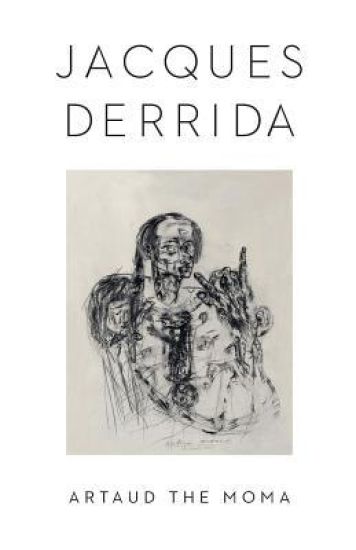
Artaud the Moma

Artaud the Moma

Jacques Derrida; Kaira M. Cabañas

Columbia University Press
2017
pokkari
In 1996 Jacques Derrida gave a lecture at the Museum of Modern Art in New York on the occasion of Antonin Artaud: Works on Paper, one of the first major international exhibitions to present the avant-garde dramatist and poet's paintings and drawings. Derrida's original title, "Artaud the Moma," is a characteristic play on words. It alludes to Artaud's calling himself Momo, Marseilles slang for "fool," upon his return to Paris in 1946 after nine years in various asylums while playing off of the museum's nickname, MoMA. But the title was not deemed "presentable or decent," in Derrida's words, by the very institution that chose to exhibit Artaud's work. Instead, the lecture was advertised as "Jacques Derrida ...will present a lecture about Artaud's drawings." For Derrida, what was at stake was what it meant for the museum to exhibit Artaud's drawings and for him to lecture on Artaud in that institutional context. Thinking over the performative force of Artaud's work and the relation between writing and drawing, Derrida addresses the multiplicity of Artaud's identities to confront the modernist museum's valorizing of originality. He channels Artaud's specter, speech, and struggle against representation to attempt to hold the museum accountable for trying to confine Artaud within its categories. Artaud the Moma, as lecture and text, reveals the challenge that Artaud posed to Derrida-and to art and its institutional history. A powerful interjection into the museum halls, this work is a crucial moment in Derrida's thought and an insightful, unsparing reading of a challenging writer and artist.
The Truth in Painting

The Truth in Painting

Jacques Derrida

University of Chicago Press
2017
nidottu
The four essays in this volume constitute Derrida's most explicit and sustained reflection on the art work as pictorial artifact, a reflection partly by way of philosophical aesthetics (Kant, Heidegger), partly by way of a commentary on art works and art scholarship (Van Gogh, Adami, Titus-Carmel). The illustrations are excellent, and the translators, who clearly see their work as both a rendering and a transformation, add yet another dimension to this richly layered composition. Indispensable to collections emphasizing art criticism and aesthetics. Alexander Gelley, Library Journal
Spurs

Spurs

Jacques Derrida

University of Chicago Press
2017
nidottu
Nietzsche has recently enjoyed much scrutiny from the nouveaux critiques. Jacques Derrida, the leader of that movement, here combines in his strikingly original and incisive fashion questions of sexuality, politics, writing, judgment, procreation, death, and even the weather into a far-reaching analysis of the challenges bequeathed to the modern world by Nietzsche. Spurs, then, is aptly titled, for Derrida's "deconstructions" of Nietzsche's meanings will surely act as spurs to further thought and controversy. This dual-language edition offers the English-speaking reader who has some knowledge of French an opportunity to examine the stylistic virtuosity of Derrida's writing of particular significance for his analysis of "the question of style."