Kirjojen hintavertailu. Mukana 12 152 606 kirjaa ja 12 kauppaa.

Kirjailija

Joel Spring

Kirjat ja teokset yhdessä paikassa: 54 kirjaa, julkaisuja vuosilta 1996-2026, suosituimpien joukossa The American School. Vertaile teosten hintoja ja tarkista saatavuus suomalaisista kirjakaupoista.

54 kirjaa

Kirjojen julkaisuhaarukka 1996-2026.

The American School

The American School

Joel Spring

TAYLOR FRANCIS LTD
2026
nidottu
This comprehensive history of American education is designed to stimulate critical analysis and critical thinking by offering alternative interpretations of each historical period. In his signature straight-forward, concise style, Joel Spring provides a variety of interpretations of American schooling, from conservative to progressive, in order to spark the reader’s own critical thinking about history and schools. This 11th Edition of The American School follows the history of American education from the seventeenth century to the integration into global capitalism of the twenty-first century to the tumultuous, present political landscape. In particular, Spring frames current developments within the historic debate about how morality and religion should be reflected in school instruction, the role of civic and patriotic instruction, gender equality, and civil rights. A brand new Chapter 16 covers the Trump and Biden era from 2017 to Present, exploring meritocracy in education, book bans, the elimination of diversity, equality and inclusion efforts, and the controversy about gender identity, LGBTQ+ rights, and racial justice.

The American School

The American School

Joel Spring

TAYLOR FRANCIS LTD
2026
sidottu
This comprehensive history of American education is designed to stimulate critical analysis and critical thinking by offering alternative interpretations of each historical period. In his signature straight-forward, concise style, Joel Spring provides a variety of interpretations of American schooling, from conservative to progressive, in order to spark the reader’s own critical thinking about history and schools. This 11th Edition of The American School follows the history of American education from the seventeenth century to the integration into global capitalism of the twenty-first century to the tumultuous, present political landscape. In particular, Spring frames current developments within the historic debate about how morality and religion should be reflected in school instruction, the role of civic and patriotic instruction, gender equality, and civil rights. A brand new Chapter 16 covers the Trump and Biden era from 2017 to Present, exploring meritocracy in education, book bans, the elimination of diversity, equality and inclusion efforts, and the controversy about gender identity, LGBTQ+ rights, and racial justice.
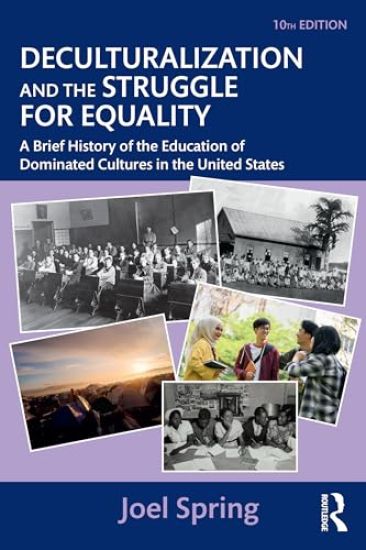
Deculturalization and the Struggle for Equality
Joel Spring’s history of school policies imposed on dominated groups in the United States examines the concept of deculturalization—the use of schools to strip away family languages and cultures and replace them with those of the dominant group. The focus is on the education of dominated groups forced to become citizens in territories conquered by the United States, including Native Americans, African Americans, Asian Americans, Latino Americans, and Hawaiians.In seven concise, thought-provoking chapters, this analysis and documentation of how education is used to change or eliminate linguistic and cultural traditions in the United States looks at the educational, legal, and social construction of race and racism in the United States, emphasizing the various meanings of “equality” that have existed from colonial America to the present. Providing a broader perspective for understanding the denial of cultural and linguistic rights in the United States, issues of language, culture, and deculturalization are placed in a global context.Revised throughout to reflect the national events and shifts in the field since the prior edition, the 10th Edition includes updated discussion around race and its impacts on college campuses, exploration of the refugee crises, new material on Native American, Alaskan, and Hawaiian boarding schools, and expanded discussion of debates over cultural and racial identity.
Deculturalization and the Struggle for Equality
Joel Spring’s history of school policies imposed on dominated groups in the United States examines the concept of deculturalization—the use of schools to strip away family languages and cultures and replace them with those of the dominant group. The focus is on the education of dominated groups forced to become citizens in territories conquered by the United States, including Native Americans, African Americans, Asian Americans, Latino Americans, and Hawaiians.In seven concise, thought-provoking chapters, this analysis and documentation of how education is used to change or eliminate linguistic and cultural traditions in the United States looks at the educational, legal, and social construction of race and racism in the United States, emphasizing the various meanings of “equality” that have existed from colonial America to the present. Providing a broader perspective for understanding the denial of cultural and linguistic rights in the United States, issues of language, culture, and deculturalization are placed in a global context.Revised throughout to reflect the national events and shifts in the field since the prior edition, the 10th Edition includes updated discussion around race and its impacts on college campuses, exploration of the refugee crises, new material on Native American, Alaskan, and Hawaiian boarding schools, and expanded discussion of debates over cultural and racial identity.
American Education

American Education

Joel Spring

TAYLOR FRANCIS LTD
2023
sidottu
Featuring current information and challenging perspectives on the latest issues and forces shaping the American educational system—with scholarship that is often cited as a primary source—Joel Spring introduces readers to the historical, political, social and legal foundations of education and to the profession of teaching in the United States. In his signature straightforward, concise approach to describing complex issues, he illuminates events and topics that are often overlooked or whitewashed, giving students the opportunity to engage in critical thinking about education. Students come away informed on the latest topics, issues and data and with a strong knowledge of the forces shaping the American educational system.Updated throughout, the 21st edition of this clear, authoritative text remains fresh and up-to-date, reflecting the many changes in education that have occurred since the publication of the previous edition. New coverage includes:Discussion of “culture wars” and critical race theoryParental rights versus the goals of common educationLGBTQIA+ students’ rightsDiscussion of the current administration’s educational policies
American Education

American Education

Joel Spring

TAYLOR FRANCIS LTD
2023
nidottu
Featuring current information and challenging perspectives on the latest issues and forces shaping the American educational system—with scholarship that is often cited as a primary source—Joel Spring introduces readers to the historical, political, social and legal foundations of education and to the profession of teaching in the United States. In his signature straightforward, concise approach to describing complex issues, he illuminates events and topics that are often overlooked or whitewashed, giving students the opportunity to engage in critical thinking about education. Students come away informed on the latest topics, issues and data and with a strong knowledge of the forces shaping the American educational system.Updated throughout, the 21st edition of this clear, authoritative text remains fresh and up-to-date, reflecting the many changes in education that have occurred since the publication of the previous edition. New coverage includes:Discussion of “culture wars” and critical race theoryParental rights versus the goals of common educationLGBTQIA+ students’ rightsDiscussion of the current administration’s educational policies
A Primer of Libertarian Education

A Primer of Libertarian Education

Joel Spring

Black Rose Books
2023
sidottu
In this book Joel Spring traces the long tradition of libertarian opposition to established forms of schooling from Rousseau and William Godwin to A.S. Neill and Paulo Freire. He illuminates the central questions that have concerned radical educators: How can teaching encourage independence and self-reliance? Can rigid ideas and ideologies be avoided by radical educators? What is the contradiction between schooling and education? How does truly libertarian child rearing challenge the family structure? How can real learning free people so they can begin to change the world around them? Spring also discusses the ideas of several figures whose relevance to education is just beginning to be appreciated, including Max Stirner, Franciso Ferrer, Wilhelm Reich, and Tolstoy. Spring concludes with suggestions for what directions radical educational change might now take.
Deculturalization and the Struggle for Equality
Joel Spring’s history of school policies imposed on dominated groups in the United States examines the concept of deculturalization—the use of schools to strip away family languages and cultures and replace them with those of the dominant group. The focus is on the education of dominated groups forced to become citizens in territories conquered by the United States, including Native Americans, African Americans, Asian Americans, Latino Americans, and Hawaiians. In seven concise, thought-provoking chapters, this analysis and documentation of how education is used to change or eliminate linguistic and cultural traditions in the United States looks at the educational, legal, and social construction of race and racism in the United States, emphasizing the various meanings of "equality" that have existed from colonial America to the present. Providing a broader perspective for understanding the denial of cultural and linguistic rights in the United States, issues of language, culture, and deculturalization are placed in a global context. Extensively revised throughout to reflect the dramatic national events since the prior edition, the Ninth Edition discusses the rise of the Black Lives Matter movement, increased educational inequality related to the pandemic, concerns about institutional racism and White nationalism, disputes about the interpretation of U.S. history, and debates over cultural and racial identity.
Deculturalization and the Struggle for Equality
Joel Spring’s history of school policies imposed on dominated groups in the United States examines the concept of deculturalization—the use of schools to strip away family languages and cultures and replace them with those of the dominant group. The focus is on the education of dominated groups forced to become citizens in territories conquered by the United States, including Native Americans, African Americans, Asian Americans, Latino Americans, and Hawaiians. In seven concise, thought-provoking chapters, this analysis and documentation of how education is used to change or eliminate linguistic and cultural traditions in the United States looks at the educational, legal, and social construction of race and racism in the United States, emphasizing the various meanings of "equality" that have existed from colonial America to the present. Providing a broader perspective for understanding the denial of cultural and linguistic rights in the United States, issues of language, culture, and deculturalization are placed in a global context. Extensively revised throughout to reflect the dramatic national events since the prior edition, the Ninth Edition discusses the rise of the Black Lives Matter movement, increased educational inequality related to the pandemic, concerns about institutional racism and White nationalism, disputes about the interpretation of U.S. history, and debates over cultural and racial identity.
Today’s Guide to Educational Policy
In his latest book, Joel Spring covers major political, economic and social issues affecting US and global education policy today. Crafted to evoke classroom discussion, this book explores contemporary issues such as the pandemic, institutional racism, religious controversies, nationalism and immigration, increased reliance on online instruction, climate change, economics of education and the deep state in education. Giving students the opportunity to engage in critical thinking and explore the growing sense that US and global education is in distress and in need of fundamental transformation, this book forces readers to examine their own values and how they might apply this thinking to their own education policy and practice.
Today’s Guide to Educational Policy
In his latest book, Joel Spring covers major political, economic and social issues affecting US and global education policy today. Crafted to evoke classroom discussion, this book explores contemporary issues such as the pandemic, institutional racism, religious controversies, nationalism and immigration, increased reliance on online instruction, climate change, economics of education and the deep state in education. Giving students the opportunity to engage in critical thinking and explore the growing sense that US and global education is in distress and in need of fundamental transformation, this book forces readers to examine their own values and how they might apply this thinking to their own education policy and practice.
Alt-Right: The Novel

Alt-Right: The Novel

Joel Spring

Independently Published
2019
nidottu
In this satirical and suspenseful contemporary political novel set in the years immediately before the election of President Donald Trump, Jimmy Brice dreams of restoring true American values. Raised in the 1970s by a militant and depressed working-class father and a sexually oppressed mother who is overly concerned with his bowel movements and masturbation, he tries to overcome his psychological damage through participation in nationalist militia groups and violence. Sally Yates, abused by her corporate-criminal father, becomes a martial arts expert and sharpshooter. After attending Yale and Harvard Law School she pursues a legal career supporting alt-right ideas and founds the Originalist Constitution Fund. Life-long friends and lovers, their complicated love evolves as Jimmy and Sally work together to implement a nationalist alt-right agenda. Through the Originalist Constitution Fund, Jimmy and Sally support gun rights, access to federal lands, segregated militia nations, alt-right economics and the use of violence. Satirical and suspenseful, the story takes startling twists and turns including a takeover of Yellowstone National Park by the Yellowstone Militia Nation, the establishment of the New African Nation in Georgia's Stone Mountain State Park, and Jimmy's journey to Sardinia to help the New Sardinian Armed Movement in its nationalist quest for independence from Italy. Mysterious Russian spies appear throughout. In the end, disgusted with the racism and violence of America, Jimmy and Sally conclude it is impossible to fulfill the ideals of the founding fathers because America was founded on slavery and genocide of Native Americans. Fleeing enemies, the story ends with their radical decision about what to do next.
Global Impacts of the Western School Model
In this timely analysis of the current state of global educational policies, Joel Spring focuses on the spread of the Western school model and its impact on creating an urban-consumer culture, increasing economic inequalities, contributing to environmental destruction and diminishing compassion and empathy essential for energizing social justice movements. In his signature straightforward, concise style, Spring describes and analyzes the school's role in displacing religious with secular values, promoting nationalism, preparing students to work in global corporations, supporting cultural and linguistic homogeneity, and discusses related goals and effects of anti-globalization movements such as the Alt-right, Anti-fascist groups, radical environmentalism and anarchism. An important addition to Spring’s body of work on global educational policies, this provocative book challenges readers to re-examine what they know about education, globalization and their interconnections.
Global Impacts of the Western School Model
In this timely analysis of the current state of global educational policies, Joel Spring focuses on the spread of the Western school model and its impact on creating an urban-consumer culture, increasing economic inequalities, contributing to environmental destruction and diminishing compassion and empathy essential for energizing social justice movements. In his signature straightforward, concise style, Spring describes and analyzes the school's role in displacing religious with secular values, promoting nationalism, preparing students to work in global corporations, supporting cultural and linguistic homogeneity, and discusses related goals and effects of anti-globalization movements such as the Alt-right, Anti-fascist groups, radical environmentalism and anarchism. An important addition to Spring’s body of work on global educational policies, this provocative book challenges readers to re-examine what they know about education, globalization and their interconnections.
The American School

The American School

Joel Spring

Routledge
2018
nidottu
This current, comprehensive history of American education is designed to stimulate critical analysis and critical thinking by offering alternative interpretations of each historical period. In his signature straight-forward, concise style, Joel Spring provides a variety of interpretations of American schooling, from conservative to leftist, in order to spark the reader’s own critical thinking about history and schools. This tenth edition follows the history of American education from the seventeenth century to the integration into global capitalism of the twenty-first century to the tumultuous current political landscape. In particular, the updates focus on tracing the direct religious links between the colonial Puritans and the current-day Trump administration. Chapters 1 and 2 have been rewritten to take a closer look at religious traditions in American schools, leading up to the educational ideas of the current U.S. Secretary of Education Betsy DeVos. An updated Chapter 15 further links traditional religious fundamentalist ideas and the twentieth century free market arguments of the Chicago school of economists to President Trump’s administration and the influence of the Alt-Right.
The American School

The American School

Joel Spring

Routledge
2018
sidottu
This current, comprehensive history of American education is designed to stimulate critical analysis and critical thinking by offering alternative interpretations of each historical period. In his signature straight-forward, concise style, Joel Spring provides a variety of interpretations of American schooling, from conservative to leftist, in order to spark the reader’s own critical thinking about history and schools. This tenth edition follows the history of American education from the seventeenth century to the integration into global capitalism of the twenty-first century to the tumultuous current political landscape. In particular, the updates focus on tracing the direct religious links between the colonial Puritans and the current-day Trump administration. Chapters 1 and 2 have been rewritten to take a closer look at religious traditions in American schools, leading up to the educational ideas of the current U.S. Secretary of Education Betsy DeVos. An updated Chapter 15 further links traditional religious fundamentalist ideas and the twentieth century free market arguments of the Chicago school of economists to President Trump’s administration and the influence of the Alt-Right.
Corporatism, Social Control, and Cultural Domination in Education: From the Radical Right to Globalization
Starting with the 1972 publication of his seminal work, Education and the Rise of the Corporate State, Joel Spring has been documenting and analyzing the politics of knowledge and education. Throughout his work he has explored the attempts to use education to advance the economic and political interests of dominant groups. The general term he uses for the relationship between schools and power is "ideological management." His scholarly work first looked at the influence on American schooling of business and economic doctrines embodied in human capital theories and consumerism. The next step in his exploration of the politics of knowledge was to examine these issues in the context of globalization, leading to a proposed educational rights amendment to national constitutions and a new paradigm for education, both of which might ensure that schools are protected from ideological management by economic and political elites. Spring’s indigenous background has strongly shaped his interest in the political and economic goals of schooling, particularly the attempts of those in power to use schools to destroy indigenous languages and cultures. In this collection, Spring brings together 10 of his key writings, providing an overview not just of his own career but the larger contexts in which it is situated. In the Introduction he reviews the evolution and scope of his work and his earlier arguments and reflects on its central themes, which are reflected in the writings selected for this volume.In the World Library of Educationalists, international scholars themselves compile career-long collections of what they judge to be their finest pieces – extracts from books, key articles, salient research findings, major theoretical and/practical contributions – so the world can read them in a single manageable volume. Readers will be able to follow the themes and strands of their work and see their contribution to the development of a field, as well as the development of the field itself. Contributors to the series include: Michael Apple, James A. Banks, Stephen J. Ball, Elliot Eisner, Howard Gardner, John Gilbert, Ivor F. Goodson, Peter Jarvis.
Political Agendas for Education

Political Agendas for Education

Joel Spring

Routledge
2017
nidottu
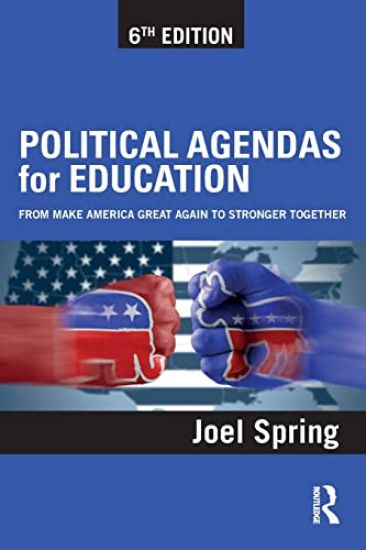
Following the epic, contentious 2016 presidential election, Joel Spring’s ongoing documentation and analysis of political agendas for education reflect the major political issues since 2012. Here he examines the 2016 education planks of the Republican, Democratic, Libertarian, and Green Parties, using their official platforms and other statements, speeches given by each candidate, and media reports and publications. Each party’s position is linked to previous political movements in education. Spring offers an alternative agenda for American schools, including a proposed education amendment to the U.S. Constitution and replacing human capital agendas with goals emphasizing education for a long life and happiness. Taking a fresh look at the social and political forces, educational research, and ideologies shaping their educational agendas and a comparative approach, the book stimulates reflection and discussion.Updates and changes in the Sixth Edition: Betsy DeVos’s education agenda supporting vouchers, free market competition and for-profit schools and its relationship to the education section of the 2016 Republican platform The important role religion and culture played in the evolution of Republican education policies after the school prayer and Bible decisions of the 1960s The influence of human capital economics on Democratic education proposals How No Child Left Behind and Democratic President Barack Obama opened doors to the growth of the for-profit education industry and investment bankers The 2016 Democratic positions on the cost of higher education and student loan debts The Democratic left as represented by the 2016 campaign of Democrat Bernie Sanders and his influence on the presidential candidate Hillary Clinton and the Democratic Party platform The education proposals of the Green and Libertarian parties
Political Agendas for Education

Political Agendas for Education

Joel Spring

Routledge
2017
sidottu
Following the epic, contentious 2016 presidential election, Joel Spring’s ongoing documentation and analysis of political agendas for education reflect the major political issues since 2012. Here he examines the 2016 education planks of the Republican, Democratic, Libertarian, and Green Parties, using their official platforms and other statements, speeches given by each candidate, and media reports and publications. Each party’s position is linked to previous political movements in education. Spring offers an alternative agenda for American schools, including a proposed education amendment to the U.S. Constitution and replacing human capital agendas with goals emphasizing education for a long life and happiness. Taking a fresh look at the social and political forces, educational research, and ideologies shaping their educational agendas and a comparative approach, the book stimulates reflection and discussion.Updates and changes in the Sixth Edition: Betsy DeVos’s education agenda supporting vouchers, free market competition and for-profit schools and its relationship to the education section of the 2016 Republican platform The important role religion and culture played in the evolution of Republican education policies after the school prayer and Bible decisions of the 1960s The influence of human capital economics on Democratic education proposals How No Child Left Behind and Democratic President Barack Obama opened doors to the growth of the for-profit education industry and investment bankers The 2016 Democratic positions on the cost of higher education and student loan debts The Democratic left as represented by the 2016 campaign of Democrat Bernie Sanders and his influence on the presidential candidate Hillary Clinton and the Democratic Party platform The education proposals of the Green and Libertarian parties