Kirjojen hintavertailu. Mukana 12 390 323 kirjaa ja 12 kauppaa.

Kirjailija

John Fraser

Kirjat ja teokset yhdessä paikassa: 126 kirjaa, julkaisuja vuosilta 1982-2026, suosituimpien joukossa Robert Burns. Vertaile teosten hintoja ja tarkista saatavuus suomalaisista kirjakaupoista.

126 kirjaa

Kirjojen julkaisuhaarukka 1982-2026.

Behaving Well

Behaving Well

John Fraser

Aesop Publications
2021
sidottu
Behaving Well consists of three stories on a related theme: When people are forced to leave their home, in the new place they're often told to 'behave themselves' or be sent back, to to somewhere else. In jail or equivalent, they - everyone - may be let go early for 'good behaviour'. Behaving well is a condition for staying somewhere - even somewhere you don't want to be - and 'going back' may pose dilemmas even more problematic than behaving badly. You find yourself in a chain of ill-fortunes and tragedies - a nakba, a catastrophe as one aspect of it has been called. What other rules exist, except our efforts at 'behaving well'? But, you change, through life; you watch injustices you say you cannot remedy. And your behaviour changes, together with its driving principles. If you want history - you can't have good behaviour. Good Behaviour: Alex, undocumented immigrant, is inspired, shadowed, by the adventures of Alexander, the Great. No one says Alexander behaved well - but he acted He transformed. He shaped the classical world, scattered Greeks all over, changed cultures, till his suicidal addictions finished him. Alex starts precarious: is jailed, meets a real hero, Valerio - joins the ex-prisoners and outcasts in a barren place. There, they improvise a polity - growing natural drugs, organising an army. Valerio is their inspiration, their guide. Alex teams up with Anicette, whose inspiration is the book 'On Lying'. He spins out of control but his behaviour is consistent. People close to Alex behave in different ways, but all maintain their principles, Anicette as well. Anicette joins with a young ambitious woman, M lisande. After the death of Alex, we see all who are left have indeed behaved well - at least, consistently. Alex, though, has acted, and imagined: the others, they only react. Anicette concludes, instructing M lisande - the only judge of our behaviour is ourself. Misconduct Does behaving well count for something? It doesn't seem to matter for success and failure, revelation or obscurity. In Misconduct, Matti, a political exile with aspirations of humanistic value, tries to make a life - maintaining principles, but surviving - the betrayal of his partner, unofficial enslavement. He wanders, has adventures - becomes a military strategist, travels to the stepps with a lady jockey - but his life is seeing others ride away, betray, or suffer punishments, promotions - which he's been unabvle to prevent or even understand. Ultimately, his organisation gives him the mission - to assassinate the Chief. To do so means his organisation will be expunged - a mass non-violent movement, non-violent, exposed. But for the otther opposition, assassination means a civil war that they are bound to lose. Matti would betray his principles, his own morality - and probably involve all oppositions in disaster. But - loyalty, behaving well or badly - he has no choice. Many real circumstances involve the exiled militants in just this - perfidious - choice.Catastrophe: The catastrophe is that everything happens comes to an end - without a scrap of meaning, still less justice, truth, equity. Some people behave very poorly: Yannick who has 'saved' Hana and enslaved her, Pavel .... for others, the behaviour is just on the edge of awful - Typhaine .... Dr Hoffman sees and can do nothing except register. Hana has character, but no context where the character can assert itself or, indeed, be good or bad.

Best Friends

Best Friends

John Fraser

Aesop Publications
2020
sidottu
Three novellas by John Fraser with the related theme of friendship: The two cities in Cities on the Plain, on a Hill are the new Jerusalem on the hill, Sodom and Gomorrah on the plain - destinations for Ahmed and Nico, two ex-pats and best friends. Ahmed, an ex-dancer, interested in the law and justice, becomes an amateur judge and Nico, ex-soldier, poetaster, small-time dealer, comes to reside in a city run by drug-cartels.What does it mean, to leave something of oneself? The protagonist of Fame is engaged to follow the past life of an ancient, who hopes to achieve a kind of immortality. The trip involves re-running many adventures of the ancient's women, sentimental, tough. He is fixated with goldsmithing, a re-visiting of the Sarmatians, an archaic steppe people. There is a failed robbery in Ukraine, periods of virtual bondage, prison counselling. The search for a life which is one's own leads to an encounter with survivors of catastrophe, and ultimately to a vital encounter...Seeking a clean start should be easy. But in Cleansing there are mysteries, situations not resolved, friends who lead astray and who you lead astray. Art should be able to present a clean vision, but does not. Street cleaning never starts and never ends. Besides, you witness what you ought not see. Living poor, joining the military - both choices imply different kinds of cleanliness, but ultimately, the prospect seems that of wild horses, tattoed on human skin.
The Ends of the Earth

The Ends of the Earth

John Fraser

Aesop Modern, an imprint of Aesop Publications
2020
pokkari
Three stories about The Ends of the Earth by John FraserMaking the world uninhabitable is a prospect facing us all, each has a strategy to hasten or retard - even avoid - it. Such a project would be the greatest exploit of an evolving species - greater than the creation, quicker than biology and a cock-eyed triumph of the good life and its sciences. Most of us alive won't know if the plan succeeds, so hypothesis is the mode proposed. The people described in these thematically connected tales are precarious, but very human. Extinction would come when the exploration of the planet has barely finished - one thinks of the poet's 'round earth's imagined corners'. If the world indeed is not flat, it still can be conceived of as having ends.In 'Rain', the characters display their comfortably familiar habits - competition, jealousy, distraction. They find they're ill-equipped to wait out their end - which comes (or maybe not) from an unanticipated direction. 'Summer Nights' has its protagonists at the edge of modernity - in the shadow of a monster tower, they seek their space, a 'green', beyond exploitation, beyond the limitations of their work and relationships - and only partly do they succeed.'The Esplanade' sets its scene in an imaginary 'Cambodia', where the past, war and massacres, still looms over the new visitors and long-term occupants. Preservation of the ruins means also preserving the realm of Death. The story ends with a parade where Death and human power are both featured, in a temporary equilibrium.Praise for John Fraser's fiction: 'One of the most extraordinary publishing events of the past few years has been the rapid, indeed insistent, appearance of the novels of John Fraser. There are few parallels in literary history to this almost simultaneous and largely belated appearance of a mature oeuvre, sprung like Athena from Zeus's forehead; and the novels in themselves are extraordinary. I can think of nothing much like them in fiction. Fraser maintains a masterfully ironic distance from the extreme conditions in which his characters find themselves. There are strikingly beautiful descriptions, veiled allusions to rooted traditions, unlikely events half-glimpsed, abrupted narratives, surreal but somehow apposite social customs. 'Fraser's work is conceived on a heroic scale in terms both of its ideas and its situational metaphors. If he were to be filmed, it would need the combined talents of a Bunuel, a Gilliam, a Cameron. Like Thomas Pynchon, whom in some ways he resembles, Fraser is a deep and serious fantasist, wildly inventive. The reader rides as on a switchback or luge of impetuous attention, with effects flashing by at virtuoso speeds. The characters seem to be unwitting agents of chaos, however much wise reflection the author bestows upon them. They move with shrugging self-assurance through circumstances as richly-detailed and as without reliable compass-points as a Chinese scroll.' John Fuller, Whitbread Award winning poet and Booker Prize nominee
Strangers and Refugees

Strangers and Refugees

John Fraser

Aesop Publications
2020
sidottu
John Fraser's latest work of fiction follows the refugee Khalil in two related stories, 'The Refugees' and 'Travels with Strangers'. We are all refugees seeking an entry to soCaucasmewhere when we've left somewhere else. Our knowledge is a raft that's carried us on lumpy seas. We can forget all that when we arrive. It doesn't serve. We don't, of course, stop being refugees, not ever, but we have a lot of living to do while we're forgetting where we were before. It's a commonplace, to say we're strangers to ourselves - not only when we are alone, but especially when we are in company. Khalil comes from a ruined land, chooses the obvious role in his new places - acting. On film, where someone else will edit him. He longs to find the treasure we all want - and isn't his, or ours. He flits through 'Travels with Strangers' too - but people of all spots and stripes are rolling down, shaken from their safe spots - and finish in the Caucasus A place that once was Eden - and they try to plant and harvest there again. It doesn't necessarily work. It's strange, because they're of all human types. Maybe the world wasn't made for people, or maybe it's too far gone for them to find a space to think and talk. And how they talk Seek love and sex and something - nothing - in between. There must be, of course, conclusion. Khalil's a fine dancer - exhibition standard. That's a gift
The Ends of the Earth

The Ends of the Earth

John Fraser

Aesop Publications
2020
sidottu
Three stories about The Ends of the Earth by John Fraser Making the world uninhabitable is a prospect facing us all, each has a strategy to hasten or retard - even avoid - it. Such a project would be the greatest exploit of an evolving species - greater than the creation, quicker than biology and a cock-eyed triumph of the good life and its sciences. Most of us alive won't know if the plan succeeds, so hypothesis is the mode proposed. The people described in these thematically connected tales are precarious, but very human. Extinction would come when the exploration of the planet has barely finished - one thinks of the poet's 'round earth's imagined corners'. If the world indeed is not flat, it still can be conceived of as having ends.In 'Rain', the characters display their comfortably familiar habits - competition, jealousy, distraction. They find they're ill-equipped to wait out their end - which comes (or maybe not) from an unanticipated direction. 'Summer Nights' has its protagonists at the edge of modernity - in the shadow of a monster tower, they seek their space, a 'green', beyond exploitation, beyond the limitations of their work and relationships - and only partly succeed. 'The Esplanade' sets its scene in an imaginary 'Cambodia', where the past, war and massacres, still looms over the new visitors and long-term occupants. Preservation of the ruins means also preserving the realm of Death. The story ends with a parade where Death and human power are both featured, in a temporary equilibrium.
The Future's Coming Everywhere

The Future's Coming Everywhere

John Fraser

Aesop Publications
2020
sidottu
John Fraser's latest work of fiction, The Future's Coming Everywhere, comprises two thematically linked stories. In the first, Candice, echoing both Voltaire's Candide - a disillusioned idealist and world traveller - and Zadig, the last wise, just king of Babylon - Candice sets out to find power and wisdom. Her reason is dwarfed by a huge powerless electronic brain, functioning without purpose or control. She is compelled by office politics to flee, through the natural park she herself created. Managing to evade pursuit, regaining her autonomy and mobility, she finds the people she meets along the reservation's edge have neither power nor wisdom, but they do illuminate. Eventually she finds solace and refuge in a bar, The Truce. In the second tale, Friends, Dani le, after adventures in the catering trade and estrangement from her friends and lovers, realises that it is in Law that wisdom and justice must reside. Wisdom is everywhere, law is precarious, but in the end she finds the latest king of Babylon, in his vast, near-deserted residence. She waits for people to arrive, to benefit from this enlightened rule, but will she wait alone...?
The Future's Coming Everywhere

The Future's Coming Everywhere

John Fraser

Aesop Modern, an imprint of Aesop Publications
2020
pokkari
John Fraser's latest work of fiction, The Future's Coming Everywhere, comprises two thematically linked stories. In the first, Candice, echoingboth Voltaire's Candide - a disillusioned idealist and world traveller - and Zadig, the last wise, just king of Babylon - Candice sets out to find power and wisdom. Her reason is dwarfed by a huge powerless electronic brain, functioning without purpose or control. She is compelled by office politics to flee, through the natural park she herself created. Managing to evade pursuit, regaining her autonomy and mobility, she finds the people she meets along the reservation's edge have neither power nor wisdom, but they do illuminate. Eventually she finds solace and refuge in a bar, The Truce. In the second tale, Friends, Dani le, after adventures in the catering trade and estrangement from her friends and lovers, realises that it is in Law that wisdom and justice must reside. Wisdom is everywhere, law is precarious, but in the end she finds the latest king of Babylon, in his vast, near-deserted residence. She waits for people to arrive, to benefit from this enlightened rule, but will she wait alone...?
Tomorrow the Victory

Tomorrow the Victory

John Fraser

Aesop Modern, an imprint of Aesop Publications
2020
pokkari
What is victory? What would victory actually be in our present world? What would revolution be - and what would happen after? In John Fraser's latest novel, Mack meets an old combatant, a revolutionary, his revolution accomplished: satisfied. He leaves his girlfriend Sophie, but never shakes her off. He tries revealed religion, mysticism, sex. Through his showy friend, Paco, he meets Aurora - a flaky performer, a woman every man would die for her. He tries to define what's on the inside from the outside - specifically, a poor, resource-rich country, between revolt and foreign intervention. He joins a committee deciding between a project for reform: justice: complicity ... or colluding with a persecuted opposition. Complexity gradually comes to prevail... He takes refuge in isolation, a leisure centre-cum retreat, where political plotting carries on, a kind of Mongol wave may be in preparation. He recoils: neither reform nor revolutionary onslaught - both certainty, predictability, that is, and destruction - are to his taste. As his latest girl is seduced by his new best friend, he returns to the beginning: for tomorrow is the victory...
Confessions

Confessions

John Fraser

Aesop Publications
2019
sidottu
John Fraser's latest novel shows how confessions are less about contrition than about seeking accomplices and pardoners - though there is a nod to various 'confessors' - Augustine, Rousseau. Confessions starts with an invocation to addiction, those who take on that burden, and those who will take it on or share it. The story follows the branches of a family tree, rooted in the life of an alcoholic and his accomplice-therapist, and their descendants. Their children are shown being forced to confess what they - probably - haven't done, and to perform a personal sacrifice in recompense, connecting a funicular between the high town and the low. Metaphorically, there is a contrast between addiction in the higher- ups, and that of the lower. Crime too is a sort of addiction, involving pardon, repentance, cures not taken, punishments evaded and selfless accomplices sought. In the end, what is confessed depends on what you think is good and bad. Necessity, among other things, seems to decide. The last protagonist, Cl mence, has to choose, as her last resort, a branch of the tree - piecework in the fashion trade, which may require prostitution too....
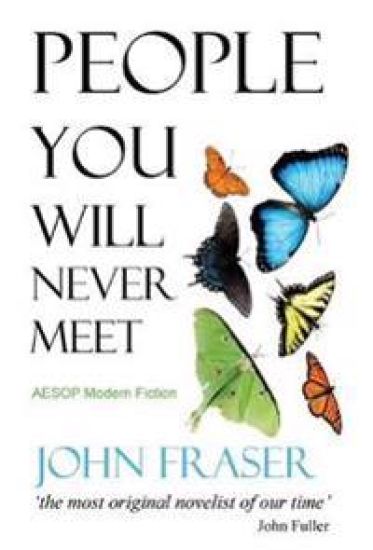
People You Will Never Meet

People You Will Never Meet

John Fraser

Aesop Publications
2019
sidottu
John Fraser's latest work of fiction People You Will Never Meet consists of three thematically-linked trajectories. In the first, two Palestinians escape to humble, even humiliating work in Belgium. They manage to set themselves up as a think-tank above a public dance-hall, and their lives divide between the search for a lofty principle and the drinking and music in the floor below. The link between the levels is provided by a fussy, garrulous first-person narrator, whose own adventures turn out to signify little. There is a party, where the upper and lower worlds mingle, the protagonist dressed as moths and butterflies. The Palestinians move on - one to a ruined Syria, the other to frustration in Europe. The second tale involves a bright country girl, seduced by her teacher with aspirations to a powerful career. She seeks speed, which does not end well for her. In the final tale, the hero aims higher still - a project for the human species. This involves journeying through Eastern Europe, and its underground. Its climax is the burning of a stranger's house, and a long long wait for a slow train...
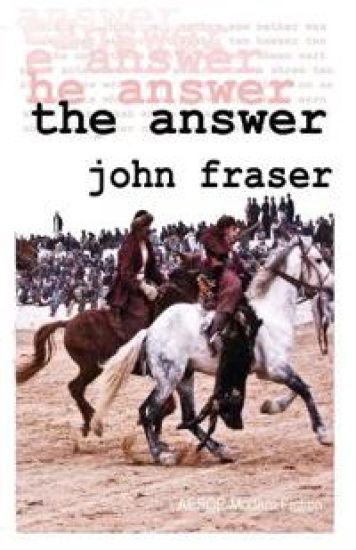
The Answer

The Answer

John Fraser

Aesop Modern, an Imprint of Aesop Publication
2018
nidottu
Where are we? Where are we going? What's in store?In John Fraser's latest novel, the answer to the question 'how might we prepare for catastrophe' comes in the last section of four thematically linked examples.In The Colours of Air many characters live in an apartment, a mocrocosm - intellectuals from Sartre to de Beauvoir, security experts, migr s and refugees, traditionalse from the country, all involved in strategies of survival. In the end, the question becomes to survive, what must be jettisoned, what has irrevocably been lost? Peace and War chronicles couples joining up and spinning off, East Europeans on the margin of a West where music and drink are the context - hiding and burying the dead is a main task - Pavel, the protagonist seems to find permanence in stonework, sculpture, but all wait expectantly for the sound of horses, horsemen and their messages. These characters are on the margin - there seems to be no core, though they are seeking it. In Interlude two displaced intellectuals are being vetted for their status, their security. The theme is 'space without freedom' - waiting, with expectancy, but without knowing what comes next. The answer finally comes in The Answer. It's daring, a risk, a leap into the unknown, with probable disastrous results.Fraser's work is conceived on a heroic scale in terms both of its ideas and its situational metaphors. If he were to be filmed, it would need the combined talents of a Bunuel, a Gilliam, a Cameron. Like Thomas Pynchon, whom in some ways he resembles, Fraser is a deep and serious fantasist, wildly inventive. The reader rides as on a switchback or luge of impetuous attention, with effects flashing by at virtuoso speeds. The characters seem to be unwitting agents of chaos, however much wise reflection the author bestows upon them. They move with shrugging self-assurance through circumstances as richly detailed and as without reliable compass-points as a Chinese scroll. John Fuller, Whitbread Award winner and Booker Prize nominee
A Treatise Containing a Description of Deuteroscopia, Commonly Called the Second Sight. Being the Work of the Reverend Mr. John Fraser,
The 18th century was a wealth of knowledge, exploration and rapidly growing technology and expanding record-keeping made possible by advances in the printing press. In its determination to preserve the century of revolution, Gale initiated a revolution of its own: digitization of epic proportions to preserve these invaluable works in the largest archive of its kind. Now for the first time these high-quality digital copies of original 18th century manuscripts are available in print, making them highly accessible to libraries, undergraduate students, and independent scholars.Medical theory and practice of the 1700s developed rapidly, as is evidenced by the extensive collection, which includes descriptions of diseases, their conditions, and treatments. Books on science and technology, agriculture, military technology, natural philosophy, even cookbooks, are all contained here.++++The below data was compiled from various identification fields in the bibliographic record of this title. This data is provided as an additional tool in helping to insure edition identification: ++++British LibraryT149448Edinburgh: reprinted in the year, 1754. xiv,26p.; 12
'S'

'S'

John Fraser

AESOP PUBLICATIONS
2018
pokkari
'S' is a novel about what makes a person a person - and a 'good' person or 'bad' one - and poses the question: What do we become when we live in cities and improvise for ourselves something for us to do with our lives?Gary, abandoned at birth, seeks his city, the city of 'S'. Once found, it should give direction - an origin, perhaps a destiny. Gary is a joker, a refuser - a music agent who can't stand noise. He seeks clues regarding his origins - camels? Sex? Friendship? He goes to rehab. Maybe punishment brings meaningful reflection and some purging, purity? He's sent to the Dark City - where life is precarious: there's smuggling; crime in the pool hall... He's dependent on Fancy, his crone landlady, but plague and rioting force him out.Gary's first venture has been mythic, religious. The second is history - the city is divided into nationalities, exile quarters - each with a project: the Russians aim to copy the great bell of Kiev, but Gary's own efforts end in violence and defeat. He finds a post as gatekeeper, deciding who enters and who's excluded from the city - but his partner takes a less philosophical type, Puma, and he is set to wandering along the road, looking for the source of purity, the city of his birth which he now believes did not exist, or exists no longer.