Kirjailija
Kenneth W. Thompson
Kirjat ja teokset yhdessä paikassa: 102 kirjaa, julkaisuja vuosilta 1979-2016, suosituimpien joukossa Paul H. Nitze on National Security and Arms Control. Vertaile teosten hintoja ja tarkista saatavuus suomalaisista kirjakaupoista.
102 kirjaa
Kirjojen julkaisuhaarukka 1979-2016.
In volume III, Kenneth W. Thompson centers on two original presentations at the Miller Center by the Pulitzer prize-winning biographer of Jefferson, Dumas Malone. Malone's two contributions are "The Rhetoric of the Founders" and "Jefferson and Madison." Other contributors are Arthur Schlesinger, Jr., Norman Graebner, Lloyd Cutler, Daniel Lang, Hugh Sidey and Kenneth W. Thompson. Among other things, the volume is a festschrift to the late Professor Malone. Co-published with the Miller Center of Public Affairs.
Gerard Piel on Arms Control
Gerard Piel; Kenneth W. Thompson
University Press of America
1987
sidottu
Gerard Piel, one of the nation's foremost writers on science policy, sees the nuclear crisis as the paramount problem of our times. He has been persistent in analyzing its underlying causes and in calling for a greater sense of urgency in ameliorating the perils of conflict. The first original essay addresses the nuclear question. The other essays in this book are reprints of earlier essays written in the 1950s and '60s by Mr. Piel. While he draws on examples of developments in an earlier phase of the arms race, the principles are relevant today, the issues raised a quarter century ago still remain unresolved.
Various public interest groups have been promoting such major constitutional reforms as the single six-year term for the American presidency. Several distinguished public figures and scholars examine this approach to governance and contrast it with the view that the primary purpose of the President and Congress is to preserve the present constitutional system. Contributors include Hedley W. Donovan, Senator Thomas F. Eagleton, Lou Cannon, I. M. Destler, and Kenneth W. Thompson.
Whether partisans of executive leadership or Congressional controls acknowledge it or not, American foreign policy is conducted within the framework of the Constitution, which mandates the separation of powers. Essays illustrating this point are: Foreign Policy and the Separation of Powers, Secretary of State Dean Rusk; Presidential Transitions and Bureaucracy, Louis J. Halle; Staffing the White House for Foreign Policy, I.M. Destler; Roosevelt to Reagan, Hedley W. Donovan; Presidential Transitions: Neglected Problems, Secretary Dean Rusk and Ambassador George McGhee. Co-published with the Miller Center of Public Affairs.
This volume draws on the unique practical experience of five respected leaders in the world of politics and foreign policy who seek to illuminate some aspect or period of presidential transitions. The essays presented here assess the realities and add a new dimension to discussions of the subject. Contributors include Kenneth W. Thompson, Congressman Richard Bolling, General Andrew Goodpaster, Secretary of State Dean Rusk, Ambassador George McGhee and Dr. I.M. Destler.
The twin unifying concepts of the present volume are the President and foreign policy and the President and public philosophy. Table of Contents: Preface, Kenneth W. Thompson; ^IIntroduction, Kenneth W. Thompson; Foreign Policy and the Separation of Powers, former Secretary of State, Dean Rusk; Presidential Transitions and Foreign Policy, General Andrew Goodpaster; Staffing the White House for Foreign Policy, I. M. Destler; European-American Relations and the American Economy, Ambassador Arthur F. Burns; Presidents and Religion, Martin Marty; A Philanthropic Dialogue, Robert Payton; Concluding Observations, Kenneth W. Thompson.
Adds a new dimension of thought on the presidency and public affairs. This volume consists of essays by respected observers of the American political system from abroad. The contributors span the globe, offering perspectives from four continents. They include Hedley Bull, Herbert G. Nicholas, Margarita Mathiopoulos, Oliver Rathkolb, Francisco Cuevas Cancino, Rene Herrera and T.N. Kaul. Co-published with the Center of Public Affairs.
The twin unifying concepts of the present volume are the President and foreign policy and the President and public philosophy. Table of Contents: Preface, Kenneth W. Thompson; ^IIntroduction, Kenneth W. Thompson; Foreign Policy and the Separation of Powers, former Secretary of State, Dean Rusk; Presidential Transitions and Foreign Policy, General Andrew Goodpaster; Staffing the White House for Foreign Policy, I. M. Destler; European-American Relations and the American Economy, Ambassador Arthur F. Burns; Presidents and Religion, Martin Marty; A Philanthropic Dialogue, Robert Payton; Concluding Observations, Kenneth W. Thompson.
Emphasizes the presidency and underlying American values. Table of Contents: Preface Kenneth W. Thompson; ^IIntroduction, Kenneth W. Thompson; Roosevelt to Reagan: A Reporter's Encounter with Nine Presidents, Hedley W. Donovan; Reagan at the Crossroads, Lou Cannon; The President, the Congress and the Internal Revenue Service, The Honorable Mortimer Caplin; The Presidency and Science Advising, Gerard Piel; Secrecy and Democracy, Admiral Stansfield Turner; Concluding Observations, Kenneth W. Thompson.
A neglected field of study, the problems of science advising from the presidency's standpoint form the background for this Miller Center discussion. Practitioners and observers of different areas of competence and concerns were brought together to consider the role of the president's science adviser, who that adviser should be, the requirements for such an official's success, and the adviser's relations to the multiple constituencies served. The group unanimously agreed that science advising is a vital and misunderstood aspect of the American presidency that needs the type of study that this volume provides. Participants included Philip M. Smith, Ted Greenwood, Norman Ramsey and David Billington. Co-published with the Miller Center of Public Affairs.
Literature on the subject of presidential transitions and foreign policy is fragmentary. Since the early 1960's, few books have sketched the history of this aspect of such transitions. Presented here are thoughtful papers by four widely respected public figures: William Bundy, John Macy, Philip W. Bucher and Leslie Gelb. Topics covered include the history of post-war transitions, personnel problems in transitions, unscheduled transitions, and the homogeneity found in some incoming administrations' transition teams. Co-published with the Miller Center of Public Affairs.
A neglected field of study, the problems of science advising from the presidency's standpoint form the background for this Miller Center discussion. Practitioners and observers of different areas of competence and concerns were brought together to consider the role of the president's science adviser, who that adviser should be, the requirements for such an official's success, and the adviser's relations to the multiple constituencies served. The group unanimously agreed that science advising is a vital and misunderstood aspect of the American presidency that needs the type of study that this volume provides. Participants included Philip M. Smith, Ted Greenwood, Norman Ramsey and David Billington. Co-published with the Miller Center of Public Affairs.
The President, the Congress and Foreign Policy
Edmund S. Muskie; Kenneth Rush; Kenneth W. Thompson
University Press of America
1986
sidottu
Studies the formulation of American foreign policy by the executive and legislative branches of the government. This book recommends some reforms which could improve the working relationship between the two governmental branches. These constructive, though not sweeping, recommendations exhibit the volume's successful marriage of theory and practice. Co-published with the Atlantic Council of the United States.
The unifying concept of this volume is the President as leader in the late twentieth century. Table of Contents: Preface, Kenneth W. Thompson; ^IIntroduction, Kenneth W. Thompson; Reflections on the Presidency, Robert Strauss; Putting the Presidency on Automatic Pilot, Aaron Wildavsky; The President and the Congress: The Case of Lyndon B. Johnson, Senator J. William Fulbright; Congress and Foreign Policy, Lee Hamilton; The Presidency and Cabinet Government, Judge Shirley Hufstedler; The President and the Cabinet, Secretary Clifford M. Hardin; Presidents, Communication and the Public: The Kennedy and Nixon Administrations, Clark Mollenhoff; The President and the International Setting: International Private Enterprise, Dwayne Andreas; Foreign Policy in the Eighties: The President and the International Environment, Dean Rusk; Eight Presidents and Their Different Approaches to National Security, Paul H. Nitze; Presidents and the of the Nuclear Crisis, McGeorge Bundy; The President, the Public Philosophy and Nuclear War, Kenneth W. Thompson; Concluding Observations, Kenneth W. Thompson.
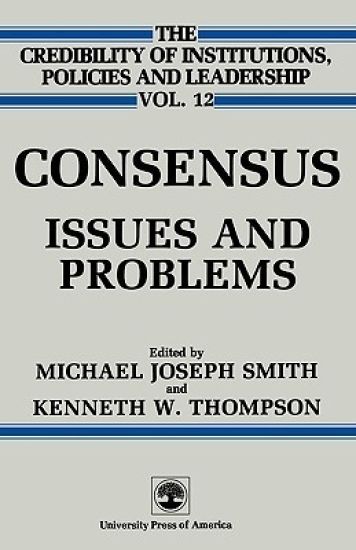
^R This volume examines certain recurrent issues in the fashioning and maintenance of consensus. Contents: Introduction, Kenneth W. Thompson, Preface, Kenneth W. Thompson; Simplification vs. Explanation Michael Joseph Smith; Two Crises, Not One, Major S. Nelson Drew; Nuclear Compliance and Consensus, Lynda M. Rozell; New Law on Old Foundations: Newly Independent States and the Established International Legal System, Betty A. Hempfling; Leadership and Consensus, Nicolai Petro; Concluding Observations, Kenneth W. Thompson; Appendix A: Vietnam Involvement Was a Failure, Not a Folly, John Mueller; Appendix B: United States Foreign Policy: A Theory-Practice-Support Connection, Phillip W. Buchen.
Foreign Policy and Domestic Consensus
Richard A. Melanson; Kenneth W. Thompson
University Press of America
1985
sidottu
^R This volume deals chronologically with the issue of domestic consensus since the Cold War consensus initially crystallized in the late 1940s. Contents: The Cold War Consensus: From Fearful Hostility to Wary Contempt, John Mueller; ^IThe Marshall Plan: A "Non-Presidential" Consensus? David Clinton; Eisenhower, Congress and the Cold War Consensus, Norman A. Graebner; Vietnam and the Breakdown of Consensus, William C. Gibbons; Para-Institutional Elites and Foreign Policy Consensus, Jerry W. Sanders; The Grenada Intervention: Prelude to a New Consensus? Richard A. Melanson.
This volume provides comparative insights into the life and work of five postwar leaders whose actions and thought shaped the world.; Contents: Preface Introduction The Dilemmas and Antimonies of Leadership,^R Kenneth W. Thompson Churchill as Philosopher and Statesman, Michael Fowler Jean Monnet and the Cold War, John B. Bellinger III Konrad Adenauer, Michael Baun Eisenhower and Suez, Todd A. Kushner Adlai E. Stevenson, Don Mitchell Kim Il Sung, Captain Jim Marks, USN Adenauer and his Successors, K. Michael Prince
Focuses on presidential leadership and foreign relations. Table of Contents: Preface, Kenneth W. Thompson; ^IIntroduction, Kenneth W. Thompson; John F. Kennedy: The Man and the Leader, Charles Bartlett; Richard M. Nixon: A Balance Sheet on his Leadership, Maurice Stans; Cabinet Government: An Alternative for Organizing Policymaking, Griffin Bell; The President as Communicator: John F. Kennedy on Civil Rights, Burke Marshall; European-American Relations and the American Presidency: A German Perspective, Cornelius Sommer; Presidential Transitions and the Handling of Foreign Policy Crises: The Iranian Hostage Crisis from Carter to Reagan; Concluding Observations, Kenneth Thompson.