Kirjojen hintavertailu. Mukana 12 427 212 kirjaa ja 12 kauppaa.
Kirjailija
Kenneth W. Thompson
Kirjat ja teokset yhdessä paikassa: 102 kirjaa, julkaisuja vuosilta 1979-2016, suosituimpien joukossa Paul H. Nitze on National Security and Arms Control. Vertaile teosten hintoja ja tarkista saatavuus suomalaisista kirjakaupoista.
Table of Contents: Preface, Kenneth W. Thompson; ^IIntroduction, Kenneth W. Thompson; John F. Kennedy as Political Leader, Arthur Schlesinger, Jr.; The President and National Security, Philip Odeen; Presidents and Civil Rights: Organizing Policymaking, Louis Martin; Latin American Perspectives: The International Setting, Ambassador Francisco Cuevas Cancino; The Eisenhower Presidency and Beyond, Maurice Stans; Concluding Observations, Kenneth Thompson.
Contributors include: General John S.D. Eisenhower; Kenneth W. Thompson; Dr. Milton S. Eisenhower; William B. Ewald; Arthur Larson; General Andrew J. Goodpaster; Karl Harr; Bradley H. Patterson; Bryce N. Harlow; Herbert Brownell; Governor Sherman Adams; Maurice Stans; Arthur S. Fleming.
Table of Contents: Preface, Kenneth W. Thompson; ^IIntroduction, Kenneth W. Thompson; John F. Kennedy as Political Leader, Arthur Schlesinger, Jr.; The President and National Security, Philip Odeen; Presidents and Civil Rights: Organizing Policymaking, Louis Martin; Latin American Perspectives: The International Setting, Ambassador Francisco Cuevas Cancino; The Eisenhower Presidency and Beyond, Maurice Stans; Concluding Observations, Kenneth Thompson.
Contributors include: General John S.D. Eisenhower; Kenneth W. Thompson; Dr. Milton S. Eisenhower; William B. Ewald; Arthur Larson; General Andrew J. Goodpaster; Karl Harr; Bradley H. Patterson; Bryce N. Harlow; Herbert Brownell; Governor Sherman Adams; Maurice Stans; Arthur S. Fleming.
Reflections on the presidency by insiders and outsiders. Table of Contents: Preface, Kenneth W. Thompson; ^IIntroduction, Kenneth W. Thompson; Presidents I Have Known: Reflections on Political Leadership, Senator Harry F. Byrd, Jr.; The President and the Internal Revenue Service, The Honorable Mortimer Caplin; Presidential Advisors, Personnel and the Johnson Presidency, The Honorable John Macy; The American Presidency Viewed from Britain and Australia, Professor Hedley Bull; The Presidency and Foreign Aid, The Honorable Fowler Hamilton; The Public Philosophy of the Kennedy/Johnson Presidencies, The Honorable Orville Freeman; Concluding Observations, Kenneth W. Thompson.
Reflections on the presidency by insiders and outsiders. Table of Contents: Preface, Kenneth W. Thompson; ^IIntroduction, Kenneth W. Thompson; Presidents I Have Known: Reflections on Political Leadership, Senator Harry F. Byrd, Jr.; The President and the Internal Revenue Service, The Honorable Mortimer Caplin; Presidential Advisors, Personnel and the Johnson Presidency, The Honorable John Macy; The American Presidency Viewed from Britain and Australia, Professor Hedley Bull; The Presidency and Foreign Aid, The Honorable Fowler Hamilton; The Public Philosophy of the Kennedy/Johnson Presidencies, The Honorable Orville Freeman; Concluding Observations, Kenneth W. Thompson.
The unifying theme in this volume is the President: political leader, relations with Congress, intelligence user, economist, communicator and guardian of national security. Table of Contents: Preface, Kenneth W. Thompson; ^IIntroduction, Kenneth W. Thompson; Jefferson and the Contemporary World, Hugh Sidey; The President and Congress: The Reagan Administration, Dean Ernest Griffith; The Presidency and the Intelligence System, by Ambassador Richard Helms; Presidential Economics, Herbert Stein; The Kennedy and Johnson Presidency, Charles Roberts; The President and the Senate in Foreign Policy, Senator Gale W. McGee; Concluding Observations, Kenneth W. Thompson.
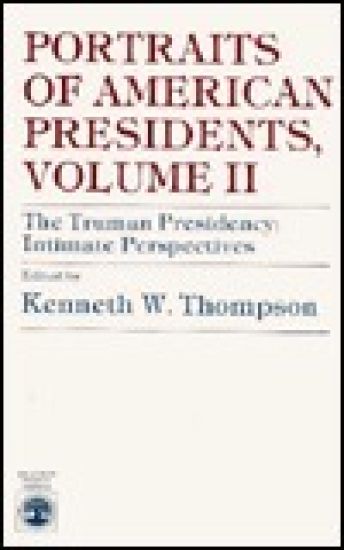
Table of Contents: ^BTruman as Leader: Preserving the Free World; Views of a Fellow Missourian; The Truman White House: The Presidential Assistant; Personnel for the Truman White House; The Truman Budget; Truman's Foreign Policy: The Great Foreign Policy Decisions; The Foreign Policymaking Process; Bipartisanship in Foreign Policy; Truman: An Appraisal: Truman and National Security; The Influence of Harry S. Truman on the Marshall Plan; Truman: An Appraisal.
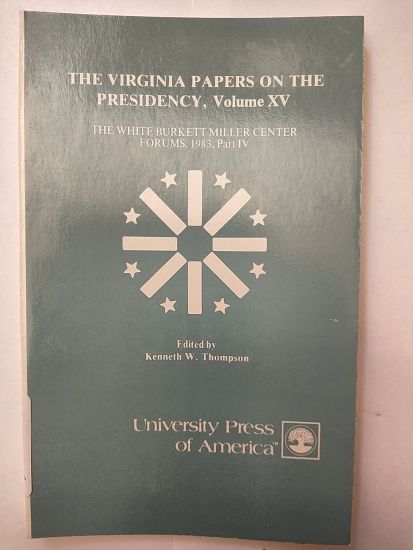
The unifying theme of this volume is the President, American politics, and the World. Table of Contents: Preface, Kenneth W. Thompson; ^IIntroduction, Kenneth W. Thompson; The Nixon Presidency, Elliot L. Richardson; The American Presidency: The Middle East and Israel, Edgar F. Bronfman; The Presidential Nominating Process, Richard M. Scammon; The Presidency and Diplomacy: The Middle East and Central America, Sol M. Linowitz; A Single Six-Year Presidential Term, Charles L. Bartlett; Concluding Observations, Kenneth W. Thompson.
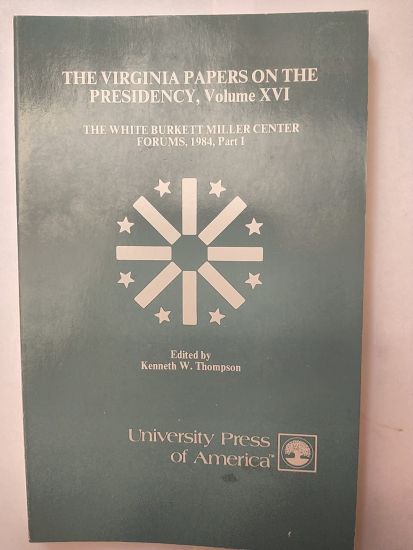
This volume focuses on the President as political leader, economist, communicator, and guardian of national security. Table of Contents: Preface, Kenneth W. Thompson; ^IIntroduction, Kenneth W. Thompson; Presidents I Have Known, Richard L. Strout; The Presidency and the Federal Reserve, George W. Mitchell; The Presidency and the Press, Paul Duke; The President, the Secretary of State, and the National Security Advisor, Sander Vanocur; The Dilemmas and Antinomies of Leadership, Kenneth W. Thompson; Concluding Observations, Kenneth W. Thompson.
This volume is based on a colloquium held at the University of Notre Dame honoring Professor Stephen Kertesz. The basic theme that runs through the chapters on his life and works is his quiet pursuit of responsibility and excellence.
The unifying theme of this volume is the President, American politics, and the World. Table of Contents: Preface, Kenneth W. Thompson; ^IIntroduction, Kenneth W. Thompson; The Nixon Presidency, Elliot L. Richardson; The American Presidency: The Middle East and Israel, Edgar F. Bronfman; The Presidential Nominating Process, Richard M. Scammon; The Presidency and Diplomacy: The Middle East and Central America, Sol M. Linowitz; A Single Six-Year Presidential Term, Charles L. Bartlett; Concluding Observations, Kenneth W. Thompson.
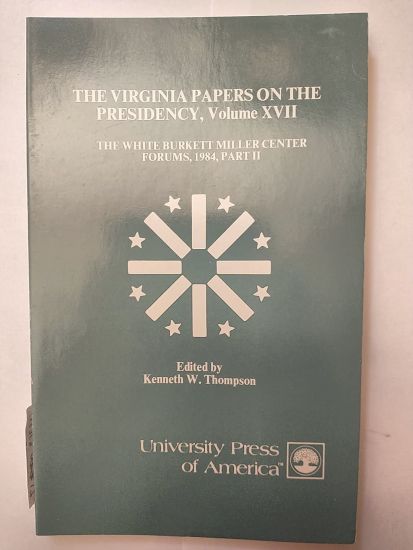
Table of Contents: Preface, Kenneth W. Thompson; ^IIntroduction, Kenneth W. Thompson; Presidents I Have Known: Presidents as Leaders, The Honorable C. Douglas Dillon; Bipartisanship in Foreign Policy: The President and Congress, Senator Hugh Scott; Lyndon Baines Johnson: Politician and Communicator, George Reedy; Eight Presidents I Have Known: The International Setting, Ambassador George McGhee; A Dialogue on the Six Year Term, The Honorable William Simon, The Honorable Griffin Bell, Jack Valenti, Morton J. Frisch, and Matthew Holden; Concluding Observations, Kenneth W. Thompson.
Table of Contents: Preface, Kenneth W. Thompson; ^IIntroduction, Kenneth W. Thompson; Presidents I Have Known: Presidents as Leaders, The Honorable C. Douglas Dillon; Bipartisanship in Foreign Policy: The President and Congress, Senator Hugh Scott; Lyndon Baines Johnson: Politician and Communicator, George Reedy; Eight Presidents I Have Known: The International Setting, Ambassador George McGhee; A Dialogue on the Six Year Term, The Honorable William Simon, The Honorable Griffin Bell, Jack Valenti, Morton J. Frisch, and Matthew Holden; Concluding Observations, Kenneth W. Thompson.
Table of Contents: Preface, Kenneth W. Thompson; ^IIntroduction, Kenneth W. Thompson; The President: Leadership in National Defense, Roswell Gilpatric; The President: Organizing Approaches to the World Economy, Philip Klutznick; Presidents and Civil Rights: Public Philosophy of Pragmatism, Harry Ashmore; The President and Defense: Science and Priorities, Rear Admiral K.S. Masterson, Jr.; The President, the People and a Strategy for National Defense, Admiral Harry D. Train, II; Concluding Observations, Kenneth W. Thompson.
Fills a gap in the literature by throwing the spotlight on the institutions which are the conveyor belts for the transmission of American values. The collected essays in this volume both explain these institutions and illustrate the particular values which they embody, such as health, agriculture, economic and social well-being, American labor, truth, and diplomacy, among others. They in turn provide the substance of values projected abroad.
Table of Contents: Preface, Kenneth W. Thompson; ^IIntroduction, Kenneth W. Thompson; The President: Leadership in National Defense, Roswell Gilpatric; The President: Organizing Approaches to the World Economy, Philip Klutznick; Presidents and Civil Rights: Public Philosophy of Pragmatism, Harry Ashmore; The President and Defense: Science and Priorities, Rear Admiral K.S. Masterson, Jr.; The President, the People and a Strategy for National Defense, Admiral Harry D. Train, II; Concluding Observations, Kenneth W. Thompson.
The complexities of modern politics and international relationships sometimes overwhelm us. Kenneth W. Thompson here offers clarity to replace obscurity, personal warmth and human values to replace abstractions. He states the aim of Masters of International Thought early: to introduce the ideas of eighteen ""men of large and capacious thought"" about twentieth-century international relations.He presents thinkers who assimilate practical ethics and religion (Butterfield, Niebuhr, Murray, Wight); who eschew utopia for the reality of power politics (Carr, Morgenthau, Spykman, Wolfers, Herz, Deutsch); who regard the Cold War as a mirror of the human condition (Lippman, Kennan, Halle, Aron); and who speculate about the possibilities of world order (Wright, Mitrany, de Visscher, and Toynbee). Thompson was guided in his selections by the enduring value of these men's thought. Even those works that are fifty years old are still read by policy makers and scholars, Thompson points out. He also acknowledges his personal approach to these masters, for not only has he known their works, he has known many of the writers. He admits that they are ""intellectual giants, but they are human beings, not gods."" In Masters of International Thought, he clearly fulfills his aim to share the wisdom and knowledge of these twentieth-century thinkers.
Kenneth W. Thompson admits that moral pronouncements and human conduct are often widely separated, particularly in international events. In order to balance harmony and disharmony, world and self-interests, nations observe moral principles less rigidly than do smaller communities. To understand how the separation between pronouncements and conduct widens in matters of foreign policy, Thompson candidly faces such issues as the harsh decisions that countries must make, the need for hypocrisy, and the resulting self-righteousness.Morality and Foreign Policy looks at the assumptions and principles that underlie historic debates about the ethics of foreign policy. Tracing decisions in policy from the 1800s to the present, Thompson views his subject from an American perspective but also concentrates on diverse international contexts in which decisions are made.Thompson cautiously maintains his balance on the fine wire between speaking up for America and embarking on an ideological crusade. He provides such examples from current events as the Bay of Pigs in Cuba and the East-West Cold War to show how easily one can fall on one side or the other. He contrasts the problem of order in America and the Third World and shows how the latter's is weighted by a special urgency, protest, and antithesis to the democratic process. For Kenneth Thompson, American moral reasoning is ""a practical alternative to abstract moralism or hopeless cynicism,"" and he holds up this principle as a challenge, not only to other countries but also to America itself.