Kirjojen hintavertailu. Mukana 12 595 353 kirjaa ja 12 kauppaa.

Kirjailija

Peter Charles Hoffer

Kirjat ja teokset yhdessä paikassa: 48 kirjaa, julkaisuja vuosilta 1998-2025, suosituimpien joukossa Reading and Writing American History Volume 1. Vertaile teosten hintoja ja tarkista saatavuus suomalaisista kirjakaupoista.

48 kirjaa

Kirjojen julkaisuhaarukka 1998-2025.

Reading and Writing American History Volume 1

Reading and Writing American History Volume 1

Peter Charles Hoffer; William W. Stueck; William James H. Hoffer

Pearson Learning Solutions
2011
nidottu
As American colleges and universities strive to prepare twenty-first-century students for an ever-changing world, the importance of studying history within a liberal arts curriculum can be forgotten. Noting that the students of today are very present-minded, the authors of Reading and Writing American History show how learning about history can be seamlessly integrated with up-to-the-minute technology, blending the past, the present, and even the future. Following the philosophy that students should become doers rather than simple consumers, the book aims to teach historical methods and skills while engaging students in a way no ordinary textbook can. The book is thus really a work-text, with opportunities for students to pause and reflect on what they are learning every few pages. Each chapter presents students not only with a period of American history, but also with a specific task to help them become better historians; for example, the chapter on the Civil War encourages students to use the Internet for research but also instructs them on how to tell valid online sources from spurious ones. The chapters include in-depth examinations of previously ignored or marginalized peoples, fulfilling the new multicultural mandates of history departments. By bringing students face to face with the questions that every history teacher and scholar confronts, the authors ensure that history becomes a living and breathing field of study for today's students.
Three Speeches That Saved the Union

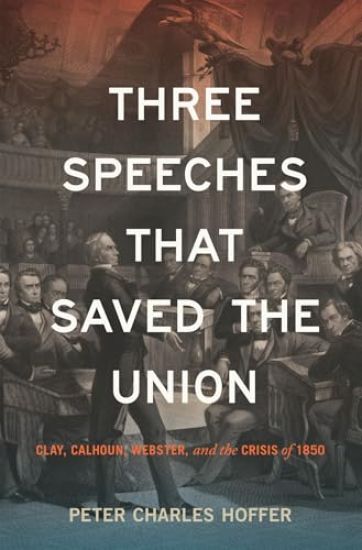
Three Speeches That Saved the Union

Peter Charles Hoffer

NEW YORK UNIVERSITY PRESS
2025
sidottu
How three skilled orators navigated a polarized political landscape For the generation of politicians who inherited the Republic and the Union, the opening months of 1850 were a desperate time filled with increasing animosity between free and slave state leaders over issues of the expansion of slavery. Following the end of the Mexican-American War and the subsequent expansion of American territory came a series of fiery debates over how this new territory would be governed, and whether to allow California's admission to the Union as a "free state." Three Speeches That Saved the Union provides the first ever deep content analysis of the three most eventful speeches delivered in the Us Senate. Historian Peter Charles Hoffer offers a thorough analytical study of the roles of the "great triumvirate" of American political leaders – Henry Clay, John C. Calhoun and Daniel Webster – played in preserving the American Union. All three were lawyers, and for lawyers especially, words mattered. As is the case today, practicing law meant knowing and using "terms of art" correctly, and knowing which words would sway a jury – or a nation. Despite their opposing viewpoints, these skilled orators urged for some kind of compromise that would diffuse the possibility of civil war. Providing all three speeches in their entirety, alongside a running commentary framing the political climate and manner in which each of these speeches were delivered, Hoffer demonstrates how intractable the slavery issue had become, how near a civil war was, and how it was prevented – at least for a time. Three Speeches That Saved the Union is an invaluable study of a nation that three speeches pulled from the brink of dissolution.
Litigation Nation

Litigation Nation

Peter Charles Hoffer

BLOOMSBURY PUBLISHING PLC
2024
nidottu
Americans have long been identified as a people of law and lawyers with an addiction to lawsuits. In Litigation Nation, Peter Charles Hoffer, one of America’s most preeminent legal historians, charts the history of civil litigation from the seventeenth century to the present, using key cases pursued by ordinary people to illustrate how the civil courts have been a battlefront to contest the boundaries of permissible personal conduct in times of social and political change. Using representative case studies from each period—from defamation suits in seventeenth-century America to recent civil rights and gender discrimination lawsuits, Hoffer’s concise and accessible history shows how litigation reflects the lives and values of ordinary Americans.
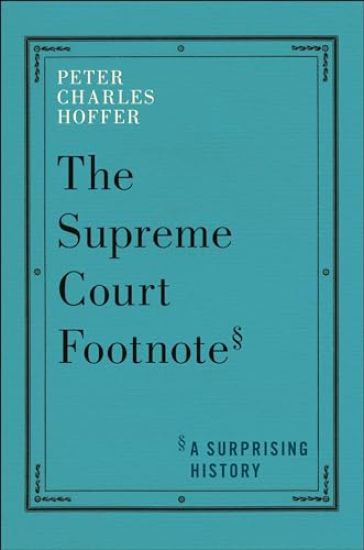
The Supreme Court Footnote

The Supreme Court Footnote

Peter Charles Hoffer

NEW YORK UNIVERSITY PRESS
2024
sidottu
Finalist, 2025 PROSE Awards: Legal Studies and Criminology A history of the humble footnote and its impact on the highest court in the land In May 2022, a seismic legal event occurred as the draft majority opinion in Dobbs v. Jackson Women's Health was leaked. The majority aimed to eliminate constitutional protection for abortion. Amidst the fervor, an unnoticed detail emerged: over 140 footnotes accompanied the majority opinion and dissent. These unassuming annotations held immense significance, unveiling justices' beliefs about the Constitution's essence, highlighting their controversial reasoning, and laying bare the vastly different interpretations of the role of Supreme Court Justice. The Supreme Court Footnote offers a study of the evolution of footnotes in US Supreme Court opinions and how they add to our constitutional understanding. Through a comprehensive analysis, Peter Charles Hoffer argues that as justices alter the course of history via their decisions, they import their own understandings of it through the footnotes. The book showcases how the role of the footnote within Supreme Court opinions has evolved, beginning with one of the first cases in the history of the court, Chisholm v. Georgia in 1792 (a case concerning federalism vs. states' rights) and ending with the landmark Dobbs v. Jackson case in 2022. Along the way, Hoffer demonstrates how the footnotes within these decisions reflect the changing role of the Supreme Court Justice, along with how interpretations of the constitution have transformed over time. At once surprising and revealing, The Supreme Court Footnote proves that what appears below the line is not only a unique window into the history of constitutional law but also a source of insight as to how the court will act going forward.
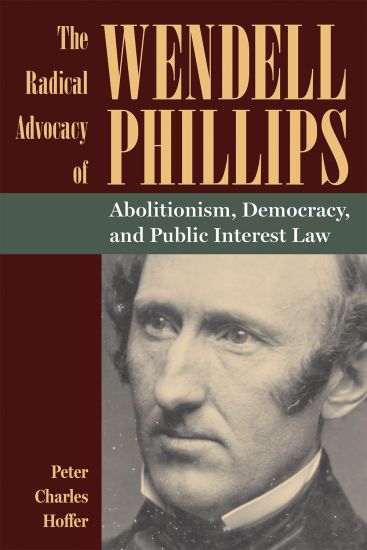
The Radical Advocacy of Wendell Phillips

The Radical Advocacy of Wendell Phillips

Peter Charles Hoffer

KENT STATE UNIVERSITY PRESS
2024
nidottu
Examining the life of an early advocate of the legal rights of Black Americans In this brisk, engaging exploration of 19th-century radical reformer and abolitionist Wendell Phillips, Peter Charles Hoffer makes the case that Phillips deserves credit as the nation's first public interest lawyer, someone who led the antebellum crusade against slavery and championed First Amendment rights and equality for all Americans, including Black people and women. As a young lawyer, bored and working at a languishing practice, Phillips nonetheless believed that the law would serve as the basis for meaningful social change, including the abolishment of slavery. While many believed the US Constitution was a virtually faultless, foundational document for governance, Phillips viewed it as deeply racist, proslavery, and, therefore, in contradiction to the Declaration of Independence. Unsurprisingly, many of Phillips's ideas were viewed as controversial and unpopular at the time, even with other abolitionists. He frequently disagreed with more conservative politicians, including Abraham Lincoln. But beyond merely criticizing the Constitution, Phillips subscribed to a "democratic positivist" belief, which contends that law is the central component of a strong democracy and that law can and should be changed by the will of the people. Thus, he believed it was critical to change public opinion on issues like slavery, which in turn would help change laws that legalized the institution. Throughout his life, he used his impressive skills as an orator to raise awareness to the horrors of enslavement, appealed to Americans' consciences, and directed them to act through voting and lawmaking. Democratic positivist approaches like his have continued to be used by lawyers to influence social reforms ranging from the civil rights movement of the 1960s to advocacy for unhoused people to abolishing America's carceral state, and Hoffer persuasively argues that Phillips's influence has been long ranging and is still recognizable in contemporary America's political landscape.
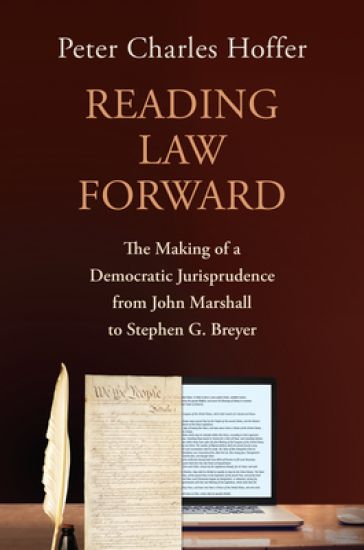
Reading Law Forward

Reading Law Forward

Peter Charles Hoffer

UNIVERSITY PRESS OF KANSAS
2023
sidottu
In the current legal climate where “everyone is an originalist,” conventional wisdom suggests that judges merely find law, rather than make it. Orthodox common-law jurisprudence makes fidelity to the past the central goal and criterion. By contrast, the alternative approach, “reading the law forward”—what some call judicial pragmatism or consequentialism—is viewed as heretical. Rather than mount a theoretical defense of a forward-thinking jurisprudence, legal historian Peter Charles Hoffer offers an empirical study of how this approach to constitutional interpretation actually leads to better law. Reading Law Forward looks at seven judges who exemplify this alternative jurisprudence: John Marshall, Joseph Story, Lemuel Shaw, Louis D. Brandeis, Benjamin Cardozo, William O. Douglas, and Stephen G. Breyer.“In the hands of America’s leading judges, a jurisprudence of reading law forward enabled courts to respond to the challenges of changing conditions. It kept law fresh. It promoted and still promotes the growth of a democratic society,” Hoffer convincingly argues.
The Brave New World

The Brave New World

Peter Charles Hoffer

Johns Hopkins University Press
2023
pokkari
A lively synthesis of early American history, now in its third edition.The Brave New World covers the entire span of early American history, from 30,000 years before Europeans landed on North American shores to the Revolutionary War. With its exploration of the places and peoples of early America, this comprehensive new edition of a classic textbook brings together the most recent scholarship on the colonial and revolutionary eras, Native Americans, slavery and the slave trade, politics, war, and the daily lives of ordinary people.In this edition, Peter Charles Hoffer incorporates the wealth of innovative work on early American history, including fresh material on• environmental history• the Dutch and French Caribbean• Indigenous societies• consumer goods• mapping• captivity tales• settler imperialism• power—who has it, who wants it, how it is expressed, and how it is opposedEmphasizing how diverse and entangled the early American imperial world was, this edition also greatly expands the geographical scope of the book. An updated bibliographic essay offering short descriptions of relevant books, articles, collections, and anthologies rounds out the volume. Wide-ranging and inclusive, The Brave New World continues to provide students, instructors, and historians with an engaging and accessible history of early North America.
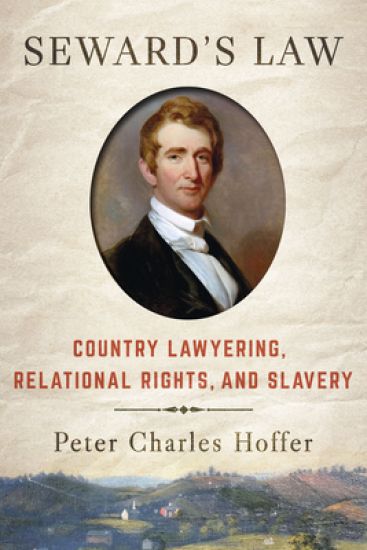
Seward's Law

Seward's Law

Peter Charles Hoffer

CORNELL UNIVERSITY PRESS
2023
sidottu
In Seward's Law, Peter Charles Hoffer argues that William H. Seward's legal practice in Auburn, New York, informed his theory of relational rights—a theory that demonstrated how the country could end slavery and establish a practical form of justice. This theory, Hoffer demonstrates, had ties to Seward's career as a country lawyer. Despite his rise to prominence, and indeed preeminence, as a US secretary of state, Seward's country-lawyer mentality endured throughout his life, as evinced in his personal attitudes and professional conduct. Relational rights, identified and termed here for the first time by Hoffer, are communal and reciprocal, what everyone owed to every other member of their community. Such rights are at the center of a jurisprudential outlook that arises directly from living in a village. Though Seward was limited by the Victorian mores and the racialist presumptions of his day, the concept of relational rights that animated him was the natural antithesis to the theories and practices of slavery. In the legal regime underpinning the institution, masters owed nothing to their bondmen and women, while those enslaved unconditionally owed life and labor to their masters. The irrepressible conflict was, for Seward, jurisprudential as well as moral and political. Hoffer's leading assumption in Seward's Law is that a lifetime spent as a lawyer influences how a person responds to everyday challenges. Seward remained a country lawyer at heart, and that fact defined the course of his political career.
Revolution and Regeneration

Revolution and Regeneration

Peter Charles Hoffer; Gerald Moran

UNIVERSITY OF GEORGIA PRESS
2021
sidottu
Revolution and Regeneration is a book about the aging of the “young men of 1776,” the men who came to adulthood with the American Revolution, found their identity merged with the new republic they had created, and grew old as the nation matured. As they identified themselves with their nation’s past, so they used that past to judge their own lives and what they had accomplished, or failed to accomplish.Revolution and Regeneration is a marriage of psychohistory and intellectual history, applying the principles of the psychology of maturation to a generation whose experiences were crucial to our history—the generation of Adams, Jefferson, Hamilton, and Madison. Their need for identity drove them to demand independence for themselves and their communities. Revolution and Regeneration tells their stories, from youth to old age.The Georgia Open History Library has been made possible in part by a major grant from the National Endowment for the Humanities: Democracy demands wisdom. Any views, findings, conclusions, or recommendations expressed in this collection, do not necessarily represent those of the National Endowment for the Humanities.
Revolution and Regeneration

Revolution and Regeneration

Peter Charles Hoffer; Gerald Moran

UNIVERSITY OF GEORGIA PRESS
2021
pokkari
Revolution and Regeneration is a book about the aging of the “young men of 1776,” the men who came to adulthood with the American Revolution, found their identity merged with the new republic they had created, and grew old as the nation matured. As they identified themselves with their nation’s past, so they used that past to judge their own lives and what they had accomplished, or failed to accomplish.Revolution and Regeneration is a marriage of psychohistory and intellectual history, applying the principles of the psychology of maturation to a generation whose experiences were crucial to our history—the generation of Adams, Jefferson, Hamilton, and Madison. Their need for identity drove them to demand independence for themselves and their communities. Revolution and Regeneration tells their stories, from youth to old age.The Georgia Open History Library has been made possible in part by a major grant from the National Endowment for the Humanities: Democracy demands wisdom. Any views, findings, conclusions, or recommendations expressed in this collection, do not necessarily represent those of the National Endowment for the Humanities.
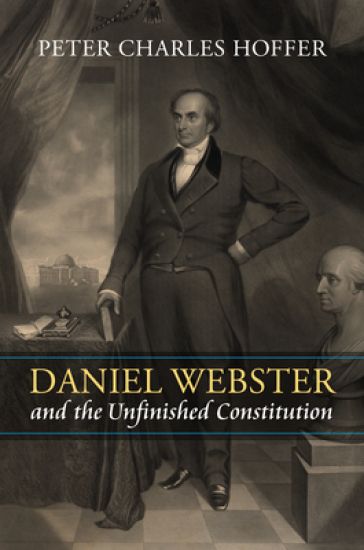
Daniel Webster and the Unfinished Constitution

Daniel Webster and the Unfinished Constitution

Peter Charles Hoffer

University Press of Kansas
2021
sidottu
Daniel Webster and the Unfinished Constitution reveals Webster as the foremost constitutional lawyer of his day. Peter Charles Hoffer builds a persuasive case that Webster was more than a skilled practitioner who rose rapidly from his hardscrabble New Hampshire origins. Hoffer thoroughly documents the ways in which Webster was an innovative jurist. While Chief Justice John Marshall gets credit for much of our early constitutional jurisprudence, in fact in a series of key cases Marshall simply borrowed Webster's oral and written arguments.For Webster, Marshall, and many lawyers and jurists of their day, professions of adherence to the Constitution were universal. Yet they knew that the Constitution could not be fixed in time; its text needed to be read in light of the rapidly transforming early republic and antebellum eras or it would become irrelevant. As Chief Justice Marshall explained in Bank of the United States v. Deveaux (1809): 'A constitution, from its nature, deals in generals, not in detail. Its framers cannot perceive minute distinctions which arise in the progress of the nation, and therefore confine it to the establishment of broad and general principles.' But were these 'broad and general principles' themselves fixed? For Webster there were landmarks: the Contract Clause and the Commerce Clause. While others were exploring and surveying the Northwest Territory and the Louisiana Purchase, Webster set out to map the spaces in the constitutional and legal landscape that were unmarked.Peter Charles Hoffer provides an insightful and timely study of how Webster's analysis of three key constitutional issues is relevant to today's constitutional conflicts: the relationship between law and politics, between public policy and private rights, and between the federal government and the states, all of which remain contentious in our constitutional jurisprudence and crucial to our constitutional order.
Roe v. Wade

Roe v. Wade

N. E. H. Hull; Peter Charles Hoffer

University Press of Kansas
2021
sidottu
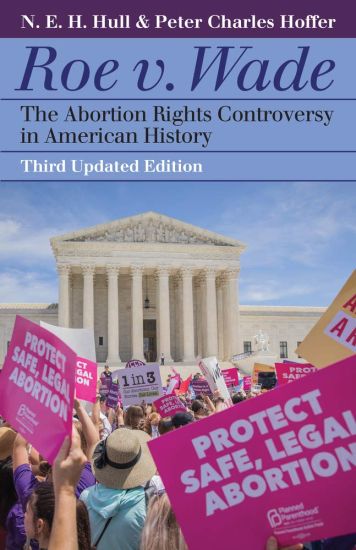
Few Supreme Court decisions have stirred up as much controversy, vitriolic debate, and even violence as Roe v. Wade in 1973. Four decades later, it remains a touchstone for the culture wars in the United States and a pivot upon which much of our politics turns. With that in mind, N. E. H. Hull and Peter Charles Hoffer have taken stock of the abortion debates, controversies, and cases that have emerged during the past decade in order to update their best-selling book on this landmark case.As with the first two editions, this book details the case's historical background; highlights Roe v. Wade's core issues, essential personalities, and key precedents; tracks the case's path through the courts; clarifies the jurisprudence behind the Court's ruling in Roe; assesses the impact of the presidential elections of George W. Bush and Barack Obama along with the confirmations of Chief Justice John Roberts, Justice Samuel Alito, Justice Sonia Sotomayor; and gauges the case's impact on American society and subsequent challenges to it in Webster v. Reproductive Health Services (1989), Planned Parenthood v. Casey (1992), and Gonzales v. Carhart (2007). This third updated edition also adds two completely new chapters covering abortion politics and legal battles in Obama's second term and Donald J. Trump's first term.The new material covers two important cases in detail: Whole Woman's Health v. Hellerstedt (2016) and June Medical Services, LLC v. Russo (2020). The cases dealt with state laws-Texas and Louisiana, respectively-designed to limit access to abortion by requiring doctors performing abortions to have admission privileges at a state-authorized hospital within thirty miles of the abortion clinic. In both cases the Court ruled the laws unconstitutional, thus handing abortion rights' activists key victories in the face of an increasingly conservative Court. The new chapters also cover the confirmations of Justices Elena Kagan, Neil Gorsuch, and Brett Kavanaugh as well as the heated political environment surrounding the Court in the age of Trump.
Roe v. Wade

Roe v. Wade

N. E. H. Hull; Peter Charles Hoffer

University Press of Kansas
2021
nidottu
Few Supreme Court decisions have stirred up as much controversy, vitriolic debate, and even violence as Roe v. Wade in 1973. Four decades later, it remains a touchstone for the culture wars in the United States and a pivot upon which much of our politics turns. With that in mind, N. E. H. Hull and Peter Charles Hoffer have taken stock of the abortion debates, controversies, and cases that have emerged during the past decade in order to update their best-selling book on this landmark case.As with the first two editions, this book details the case's historical background; highlights Roe v. Wade's core issues, essential personalities, and key precedents; tracks the case's path through the courts; clarifies the jurisprudence behind the Court's ruling in Roe; assesses the impact of the presidential elections of George W. Bush and Barack Obama along with the confirmations of Chief Justice John Roberts, Justice Samuel Alito, Justice Sonia Sotomayor; and gauges the case's impact on American society and subsequent challenges to it in Webster v. Reproductive Health Services (1989), Planned Parenthood v. Casey (1992), and Gonzales v. Carhart (2007). This third updated edition also adds two completely new chapters covering abortion politics and legal battles in Obama's second term and Donald J. Trump's first term.The new material covers two important cases in detail: Whole Woman's Health v. Hellerstedt (2016) and June Medical Services, LLC v. Russo (2020). The cases dealt with state laws-Texas and Louisiana, respectively-designed to limit access to abortion by requiring doctors performing abortions to have admission privileges at a state-authorized hospital within thirty miles of the abortion clinic. In both cases the Court ruled the laws unconstitutional, thus handing abortion rights' activists key victories in the face of an increasingly conservative Court. The new chapters also cover the confirmations of Justices Elena Kagan, Neil Gorsuch, and Brett Kavanaugh as well as the heated political environment surrounding the Court in the age of Trump.
Zombie History

Zombie History

Peter Charles Hoffer

The University of Michigan Press
2020
sidottu
Fake history is not a harmless mistake of fact or interpretation. It is a mistake that conceals prejudice; a mistake that discriminates against certain kinds of people; a mistake held despite a preponderance of evidence; a mistake that harms us. Fake history is like the Zombies we see in mass media, for the fake fact, like the fictional Zombie, lives by turning real events and people into monstrous perversions of fact and interpretation. Its pervasiveness reveals that prejudice remains its chief appeal to those who believe it. Its effect is insidious, because we cannot or will not destroy those mischievous lies. Zombie history is almost impossible to kill. Some Zombie history was and is political, a genre of what Hannah Arendt called “organizational lying” about the past. Its makers designed the Zombie to create a basis in the false past for particular discriminatory policies. Other history Zombies are cultural. They encapsulate and empower prejudice and stereotyping. Still other popular history Zombies do not look disfigured, but like Zombies walk among us without our realizing how devastating their impact can be. Zombie History argues that, whatever their purpose, whatever the venue in which they appear, history Zombies undermine the very foundations of disinterested study of the past.
Zombie History

Zombie History

Peter Charles Hoffer

The University of Michigan Press
2020
nidottu
Fake history is not a harmless mistake of fact or interpretation. It is a mistake that conceals prejudice; a mistake that discriminates against certain kinds of people; a mistake held despite a preponderance of evidence; a mistake that harms us. Fake history is like the Zombies we see in mass media, for the fake fact, like the fictional Zombie, lives by turning real events and people into monstrous perversions of fact and interpretation. Its pervasiveness reveals that prejudice remains its chief appeal to those who believe it. Its effect is insidious, because we cannot or will not destroy those mischievous lies. Zombie history is almost impossible to kill. Some Zombie history was and is political, a genre of what Hannah Arendt called “organizational lying” about the past. Its makers designed the Zombie to create a basis in the false past for particular discriminatory policies. Other history Zombies are cultural. They encapsulate and empower prejudice and stereotyping. Still other popular history Zombies do not look disfigured, but like Zombies walk among us without our realizing how devastating their impact can be. Zombie History argues that, whatever their purpose, whatever the venue in which they appear, history Zombies undermine the very foundations of disinterested study of the past.
Law and People in Colonial America

Law and People in Colonial America

Peter Charles Hoffer

Johns Hopkins University Press
2019
pokkari
An essential, rigorous, and lively introduction to the beginnings of American law.How did American colonists transform British law into their own? What were the colonies' first legal institutions, and who served in them? And why did the early Americans develop a passion for litigation that continues to this day? In Law and People in Colonial America, Peter Charles Hoffer tells the story of early American law from its beginnings on the British mainland to its maturation during the crisis of the American Revolution. For the men and women of colonial America, Hoffer explains, law was a pervasive influence in everyday life. Because it was their law, the colonists continually adapted it to fit changing circumstances. They also developed a sense of legalism that influenced virtually all social, economic, and political relationships. This sense of intimacy with the law, Hoffer argues, assumed a transforming power in times of crisis. In the midst of a war for independence, American revolutionaries used their intimacy with the law to explain how their rebellion could be lawful, while legislators wrote republican constitutions that would endure for centuries.Today the role of law in American life is more pervasive than ever. And because our system of law involves a continuing dialogue between past and present, interpreting the meaning of precedent and of past legislation, the study of legal history is a vital part of every citizen's basic education. Taking advantage of rich new scholarship that goes beyond traditional approaches to view slavery as a fundamental cultural and social institution as well as an economic one, this second edition includes an extensive, entirely new chapter on colonial and revolutionary-era slave law. Law and People in Colonial America is a lively introduction to early American law. It makes for essential reading.
Litigation Nation

Litigation Nation

Peter Charles Hoffer

Rowman Littlefield
2019
sidottu
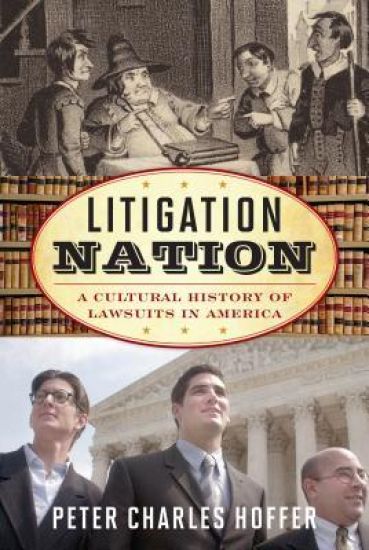
Americans have long been identified as a people of law and lawyers with an addiction to lawsuits. This national characteristic became so prevalent in late twentieth-century America that some legal authorities dubbed the pattern a “litigation crisis.” In Litigation Nation: A History of Litigation in America, Peter C. Hoffer charts the history of civil litigation from the seventeenth century to the present, using key cases that illustrate the central theme in civil litigation during different periods of U.S. history and enable readers to explore and understand key questions in American life and culture. Hoffer’s concise and accessible treatment to this history will appeal to general audiences as it examines both historical and contemporary questions, debates, and litigation concerning gender, discrimination, harassment, and workplace culture.
The Search for Justice

The Search for Justice

Peter Charles Hoffer

University of Chicago Press
2019
pokkari
The civil rights era was a time of pervasive change in American political and social life. Among the decisive forces driving change were lawyers, who wielded the power of law to resolve competing concepts of order and equality and, in the end, to hold out the promise of a new and better nation. The Search for Justice is a look the role of the lawyers throughout the period, focusing on one of the central issues of the time: school segregation. The most notable participants to address this issue were the public interest lawyers of the NAACP's Legal Defense Fund, whose counselors brought lawsuits and carried out appeals in state and federal courts over the course of twenty years. But also playing a part in the story were members of the bar who defended Jim Crow laws explicitly or implicitly and, in some cases, also served in state or federal government; lawyers who sat on state and federal benches and heard civil rights cases; and, finally, law professors who analyzed the reasoning of the courts in classrooms and public forums removed from the fray. With rich, copiously researched detail, Hoffer takes readers through the interactions of these groups, setting their activities not only in the context of the civil rights movement but also of their full political and legal legacies, including the growth of corporate private legal practice after World War II and the expansion of the role of law professors in public discourse, particularly with the New Deal. Seeing the civil rights era through the lens of law enables us to understand for the first time the many ways in which lawyers affected the course and outcome of the movement.
The Search for Justice

The Search for Justice

Peter Charles Hoffer

University of Chicago Press
2019
sidottu
The civil rights era was a time of pervasive change in American political and social life. Among the decisive forces driving change were lawyers, who wielded the power of law to resolve competing concepts of order and equality and, in the end, to hold out the promise of a new and better nation.The Search for Justice is a look the role of the lawyers throughout the period, focusing on one of the central issues of the time: school segregation. The most notable participants to address this issue were the public interest lawyers of the NAACP's Legal Defense Fund, whose counselors brought lawsuits and carried out appeals in state and federal courts over the course of twenty years. But also playing a part in the story were members of the bar who defended Jim Crow laws explicitly or implicitly and, in some cases, also served in state or federal government; lawyers who sat on state and federal benches and heard civil rights cases; and, finally, law professors who analyzed the reasoning of the courts in classrooms and public forums removed from the fray. With rich, copiously researched detail, Hoffer takes readers through the interactions of these groups, setting their activities not only in the context of the civil rights movement but also of their full political and legal legacies, including the growth of corporate private legal practice after World War II and the expansion of the role of law professors in public discourse, particularly with the New Deal. Seeing the civil rights era through the lens of law enables us to understand for the first time the many ways in which lawyers affected the course and outcome of the movement.
The Clamor of Lawyers

The Clamor of Lawyers

Peter Charles Hoffer; William James Hull Hoffer

Cornell University Press
2018
sidottu
The Clamor of Lawyers explores a series of extended public pronouncements that British North American colonial lawyers crafted between 1761 and 1776. Most, though not all, were composed outside of the courtroom and detached from on-going litigation. While they have been studied as political theory, these writings and speeches are rarely viewed as the work of active lawyers, despite the fact that key protagonists in the story of American independence were members of the bar with extensive practices. The American Revolution was, in fact, a lawyers' revolution. Peter Charles Hoffer and Williamjames Hull Hoffer broaden our understanding of the role that lawyers played in framing and resolving the British imperial crisis. The revolutionary lawyers, including John Adams's idol James Otis, Jr., Pennsylvania's John Dickinson, and Virginians Thomas Jefferson and Patrick Henry, along with Adams and others, deployed the skills of their profession to further the public welfare in challenging times. They were the framers of the American Revolution and the governments that followed. Loyalist lawyers and lawyers for the crown also participated in this public discourse, but because they lost out in the end, their arguments are often slighted or ignored in popular accounts. This division within the colonial legal profession is central to understanding the American Republic that resulted from the Revolution.