Kirjojen hintavertailu. Mukana 12 390 323 kirjaa ja 12 kauppaa.

Kirjailija

Richard A. Posner

Kirjat ja teokset yhdessä paikassa: 50 kirjaa, julkaisuja vuosilta 1983-2019, suosituimpien joukossa The Quotable Judge Posner. Vertaile teosten hintoja ja tarkista saatavuus suomalaisista kirjakaupoista.

Mukana myös kirjoitusasut: Richard A Posner

50 kirjaa

Kirjojen julkaisuhaarukka 1983-2019.

Antitrust Law, Second Edition

Antitrust Law, Second Edition

Richard A Posner

University of Chicago Press
2019
pokkari
When it was first published a quarter of a century ago, Richard Posner's exposition and defense of an economic approach to antitrust law was a jeremiad against the intellectual disarray that then characterized the field. As other perspectives on antitrust law have fallen away, Posner's book has played a major role in transforming the field of antitrust law into a body of economically rational principles largely in accord with the ideas set forth in the first edition. Today's antitrust professionals may disagree on specific practices and rules, but most litigators, prosecutors, judges, and scholars agree that the primary goal of antitrust laws should be to promote economic welfare, and that economic theory should be used to determine how well business practices conform to that goal. In this thoroughly revised edition, Posner explains the economic approach to new generations of lawyers and students. He updates and amplifies his approach as it applies to the developments, both legal and economic, in the antitrust field since 1976. The "new economy," for example, has presented a host of difficult antitrust questions, and in an entirely new chapter, Posner explains how the economic approach can be applied to new industries such as software manufacturers, Internet service providers, and those that provide communications equipment and services. "The antitrust laws are here to stay," Posner writes, "and the practical question is how to administer them better-more rationally, more accurately, more expeditiously, more efficiently." This fully revised classic will continue to be the standard work in the field.
Helping the Helpless: Justice for Pro Se's: A Company Handbook

Helping the Helpless: Justice for Pro Se's: A Company Handbook

Richard a. Posner

Createspace Independent Publishing Platform
2018
nidottu
Pro se's are in a difficult position, not only because most of them can't afford lawyers and the rest don't have lawyers, but also and perhaps more importantly because of widespread judicial hostility to them; they are thought by many judges unworthy of the attention of the judiciary. As explained in detail in my two books mentioned at the outset of this book, I retired from my court last September because of my distress at the summary fashion in which the court disposed of pro se appeals-rejecting them even when they had merit. We as a team can and I hope will accomplish more for the pro se community than has ever been done before. We have a virtually infinite number of choices of how to make a difference. The most important threshold issues are how best to spend our finite time and how to organize an effective institution. First and foremost is our commitment to help pro se individuals, in whatever respects their legitimate needs dictate, to the extent we're able. The members of the Posner Center of Justice for Pro Se's have each made that choice, and the pro se world is the fortunate beneficiary of the choice.
Justice for Pro Se's

Justice for Pro Se's

Richard a. Posner

Createspace Independent Publishing Platform
2018
nidottu
Pro se's are in a difficult position, not only because most of them can't afford lawyers and the rest don't have lawyers, but also and perhaps more importantly because of widespread judicial hostility to them; they are thought by many judges unworthy of the attention of the judiciary. As explained in detail in my two books mentioned at the outset of this book, I retired from my court last September because of my distress at the summary fashion in which the court disposed of pro se appeals-rejecting them even when they had merit. We as a team can and I hope will accomplish more for the pro se community than has ever been done before. We have a virtually infinite number of choices of how to make a difference. The most important threshold issues are how best to spend our finite time and how to organize an effective institution. First and foremost is our commitment to help pro se individuals, in whatever respects their legitimate needs dictate, to the extent we're able. The members of the Posner Center of Justice for Pro Se's have each made that choice, and the pro se world is the fortunate beneficiary of the choice.
Justice for Pro Se's

Justice for Pro Se's

Richard a. Posner

Createspace Independent Publishing Platform
2018
nidottu
Pro se's are in a difficult position, not only because most of them can't afford lawyers and the rest don't have lawyers, but also and perhaps more importantly because of widespread judicial hostility to them; they are thought by many judges unworthy of the attention of the judiciary. As explained in detail in my two books mentioned at the outset of this book, I retired from my court last September because of my distress at the summary fashion in which the court disposed of pro se appeals-rejecting them even when they had merit. We as a team can and I hope will accomplish more for the pro se community than has ever been done before. We have a virtually infinite number of choices of how to make a difference. The most important threshold issues are how best to spend our finite time and how to organize an effective institution. First and foremost is our commitment to help pro se individuals, in whatever respects their legitimate needs dictate, to the extent we're able. The members of the Posner Center of Justice for Pro Se's have each made that choice, and the pro se world is the fortunate beneficiary of the choise.
Improving the Federal Judiciary: Staff Attorney Programs, the Plight of the Pro Se's, and the Televising of Oral Arguments
In this second edition of a book first published in September 2017, Judge Posner explains the measures his company has taken to improve the representation of pro se litigants throughout the nation. He focuses on the problems of the pro ses, the people, often prisoners, who bring lawsuits without a lawyer and the staff attorneys who review these lawsuits and make recommendations to the judges on how to decide the cases. He has done extensive research into the procedures of all thirteen circuits and compares their performance. This is the most extensive comparative review of the staff attorney programs in the circuit courts that has ever been done. Judge Posner has many suggestions for improving the way these cases are handled. In addition, he discusses the need for televising the circuit court hearings. He is a believer in government transparency, and feels the public should have easy access to the workings of the courts. Finally, Judge Posner reviews the duties of the circuit chief judge and recommends clarification of the position.
The Federal Judiciary

The Federal Judiciary

Richard A. Posner

Harvard University Press
2017
sidottu
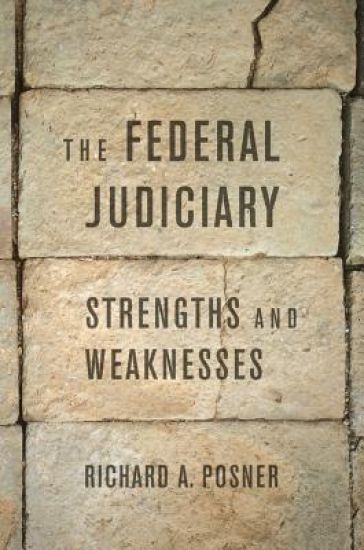
No sitting federal judge has ever written so trenchant a critique of the federal judiciary as Richard A. Posner does in this, his most confrontational book. Skewering the politicization of the Supreme Court, the mismanagement of judicial staff, the overly complex system of appeals, the threat of originalism, outdated procedures, and the backward-looking traditions of law schools and the American judicial system, Posner has written a cri de coeur and a battle cry. With the prospect that the Supreme Court will soon be remade in substantial, potentially revanchist, ways, The Federal Judiciary exposes the American legal system’s most troubling failures in order to instigate much-needed reforms.Posner presents excerpts from legal texts and arguments to expose their flaws, incorporating his own explanation and judgment to educate readers in the mechanics of judicial thinking. This rigorous intellectual work separates sound logic from artful rhetoric designed to subvert precedent and open the door to oblique interpretations of American constitutional law. In a rebuke of Justice Antonin Scalia’s legacy, Posner shows how originalists have used these rhetorical strategies to advance a self-serving political agenda. Judicial culture adheres to an antiquated traditionalism, Posner argues, that inhibits progressive responses to threats from new technologies and other unforeseen challenges to society.With practical prescriptions for overhauling judicial practices and precedents, The Federal Judiciary offers an unequaled resource for understanding the institution designed by the founders to check congressional and presidential power and resist its abuse.
Child Exploitation and Trafficking

Child Exploitation and Trafficking

Virginia M. Kendall; T. Markus Funk; Richard A. Posner

Rowman Littlefield
2016
sidottu
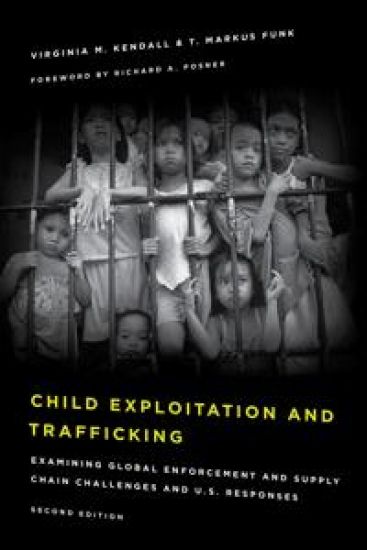
Each year, more than two million children around the world fall victim to commercial sexual and labor exploitation. Put simply, the growing epidemic of child exploitation demands a coordinated response. In addition to compliance concerns raised by the Foreign Corrupt Practices Act (FCPA), UK Bribery Act, and other more familiar transnational anti-corruption laws, today’s companies must also respond to more novel legal requirements, such as those contained in the California Transparency in Supply Chains Act, Federal Acquisition Regulations on Trafficking in Persons in Federal Contracts, U.K. Modern Slavery Act of 2015, European Union’s Directive on Transparency and its amendments, and the proposed federal Business Transparency in Trafficking and Slavery Act and other laws. This Second Edition of Child Exploitation and Trafficking: Examining Global Enforcement and Supply Chain Challenges and U.S. Responses brings fresh, practical thinking to this oft-misunderstood area of the law, helping erase some of its counterproductive mythology. The book not only provides the first comprehensive, practical introduction to the history and present-day reality of child exploitation and supply chain issues, but it also traces the interconnected web of domestic and transnational federal laws and law enforcement efforts launched in response thereto. The Second Edition not only is updated to reflect the latest trends and other development presented by two of the premier experts concerning this constantly-evolving field, but it also contains new chapters examining areas such as special issues in the fight against human trafficking and the raft of landmark anti-trafficking laws that herald a new compliance reality for the globe’s business community. Written from the distinctive perspective of those who have spent their careers in the trenches investigating, prosecuting, and adjudicating these intricate, emotional cases, as well as those who are tasked with ensuring that products are free from the taint of child exploitation and force labor, the book is uniquely proscriptive, as well as descriptive, in the sense that it relies on real-world examples to serve up practical advice and reform proposals for those involved at all levels of this challenging area.
Child Exploitation and Trafficking

Child Exploitation and Trafficking

Virginia M. Kendall; T. Markus Funk; Richard A. Posner

Rowman Littlefield
2016
nidottu
Each year, more than two million children around the world fall victim to commercial sexual and labor exploitation. Put simply, the growing epidemic of child exploitation demands a coordinated response. In addition to compliance concerns raised by the Foreign Corrupt Practices Act (FCPA), UK Bribery Act, and other more familiar transnational anti-corruption laws, today’s companies must also respond to more novel legal requirements, such as those contained in the California Transparency in Supply Chains Act, Federal Acquisition Regulations on Trafficking in Persons in Federal Contracts, U.K. Modern Slavery Act of 2015, European Union’s Directive on Transparency and its amendments, and the proposed federal Business Transparency in Trafficking and Slavery Act and other laws. This Second Edition of Child Exploitation and Trafficking: Examining Global Enforcement and Supply Chain Challenges and U.S. Responses brings fresh, practical thinking to this oft-misunderstood area of the law, helping erase some of its counterproductive mythology. The book not only provides the first comprehensive, practical introduction to the history and present-day reality of child exploitation and supply chain issues, but it also traces the interconnected web of domestic and transnational federal laws and law enforcement efforts launched in response thereto. The Second Edition not only is updated to reflect the latest trends and other development presented by two of the premier experts concerning this constantly-evolving field, but it also contains new chapters examining areas such as special issues in the fight against human trafficking and the raft of landmark anti-trafficking laws that herald a new compliance reality for the globe’s business community. Written from the distinctive perspective of those who have spent their careers in the trenches investigating, prosecuting, and adjudicating these intricate, emotional cases, as well as those who are tasked with ensuring that products are free from the taint of child exploitation and force labor, the book is uniquely proscriptive, as well as descriptive, in the sense that it relies on real-world examples to serve up practical advice and reform proposals for those involved at all levels of this challenging area.
Divergent Paths

Divergent Paths

Richard A. Posner

Harvard University Press
2016
sidottu
Judges and legal scholars talk past one another, if they have any conversation at all. Academics couch their criticisms of judicial decisions in theoretical terms, which leads many judges—at the risk of intellectual stagnation—to dismiss most academic discourse as opaque and divorced from reality. In Divergent Paths, Richard Posner turns his attention to this widening gap within the legal profession, reflecting on its causes and consequences and asking what can be done to close or at least narrow it.The shortcomings of academic legal analysis are real, but they cannot disguise the fact that the modern judiciary has several serious deficiencies that academic research and teaching could help to solve or alleviate. In U.S. federal courts, which is the focus of Posner’s analysis of the judicial path, judges confront ever more difficult cases, many involving complex and arcane scientific and technological distinctions, yet continue to be wedded to legal traditions sometimes centuries old. Posner asks how legal education can be made less theory-driven and more compatible with the present and future demands of judging and lawyering.Law schools, he points out, have great potential to promote much-needed improvements in the judiciary, but doing so will require significant changes in curriculum, hiring policy, and methods of educating future judges. If law schools start to focus more on practical problems facing the American legal system rather than on debating its theoretical failures, the gulf separating the academy and the judiciary will narrow.
Reflections on Judging

Reflections on Judging

Richard A. Posner

Harvard University Press
2013
sidottu
In Reflections on Judging, Richard Posner distills the experience of his thirty-one years as a judge of the United States Court of Appeals for the Seventh Circuit. Surveying how the judiciary has changed since his 1981 appointment, he engages the issues at stake today, suggesting how lawyers should argue cases and judges decide them, how trials can be improved, and, most urgently, how to cope with the dizzying pace of technological advance that makes litigation ever more challenging to judges and lawyers.For Posner, legal formalism presents one of the main obstacles to tackling these problems. Formalist judges--most notably Justice Antonin Scalia--needlessly complicate the legal process by advocating "canons of constructions" (principles for interpreting statutes and the Constitution) that are confusing and self-contradictory. Posner calls instead for a renewed commitment to legal realism, whereby a good judge gathers facts, carefully considers context, and comes to a sensible conclusion that avoids inflicting collateral damage on other areas of the law. This, Posner believes, was the approach of the jurists he most admires and seeks to emulate: Oliver Wendell Holmes, Louis Brandeis, Benjamin Cardozo, Learned Hand, Robert Jackson, and Henry Friendly, and it is an approach that can best resolve our twenty-first-century legal disputes.
The Behavior of Federal Judges

The Behavior of Federal Judges

Lee Epstein; William M. Landes; Richard A. Posner

Harvard University Press
2013
sidottu
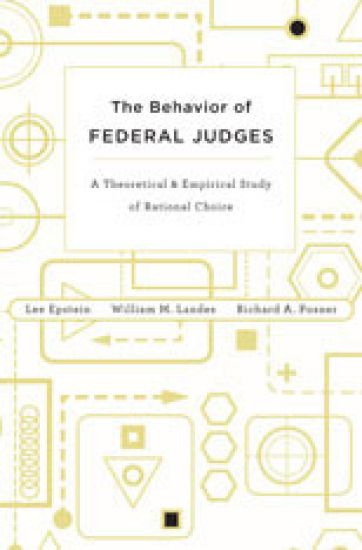
Judges play a central role in the American legal system, but their behavior as decision-makers is not well understood, even among themselves. The system permits judges to be quite secretive (and most of them are), so indirect methods are required to make sense of their behavior. Here, a political scientist, an economist, and a judge work together to construct a unified theory of judicial decision-making. Using statistical methods to test hypotheses, they dispel the mystery of how judicial decisions in district courts, circuit courts, and the Supreme Court are made.The authors derive their hypotheses from a labor-market model, which allows them to consider judges as they would any other economic actors: as self-interested individuals motivated by both the pecuniary and non-pecuniary aspects of their work. In the authors' view, this model describes judicial behavior better than either the traditional “legalist” theory, which sees judges as automatons who mechanically apply the law to the facts, or the current dominant theory in political science, which exaggerates the ideological component in judicial behavior. Ideology does figure into decision-making at all levels of the federal judiciary, the authors find, but its influence is not uniform. It diminishes as one moves down the judicial hierarchy from the Supreme Court to the courts of appeals to the district courts. As The Behavior of Federal Judges demonstrates, the good news is that ideology does not extinguish the influence of other components in judicial decision-making. Federal judges are not just robots or politicians in robes.
Catastrophe: Risk and Response

Catastrophe: Risk and Response

Richard A. Posner

Oxford University Press, USA
2012
nidottu
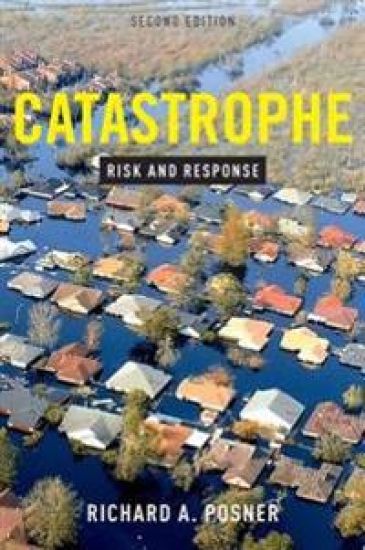
The risk of global catastrophes is real, and growing. An asteroid collision that could kill a quarter of humanity in twenty-four hours and the rest soon after; irreversible global warming that could flip, precipitating "snowball earth;" a particle accelerator disaster that could reduce the earth to a hyperdense sphere only 100 meters across--all these extinction events, and others, are possible, and they warrant serious thought about assessment and prevention. In Catastrophe, Richard A. Posner addresses the threat of global disaster from a fresh, interdisciplinary perspective. Incorporating insights from economists, physical scientists, environmental scientists, psychologists, and other experts, Posner explains how we can minimize risks and differentiate low probability risks from more threatening high probability ones. He raises difficult questions about the role of politicians and policymakers in addressing catastrophic risk. Must we yield a degree of national sovereignty in order to deal effectively with global warming? Is limiting our civil liberties a necessary and proper response to the threat of bioterrorist attacks? Is investing in detection and interception systems for asteroids money well spent? How far can we press cost-benefit analysis in the design of responses to world-threatening events? These are but a few of the issues explored in this fascinating, disturbing, and necessary book. In this revised and updated edition, Posner incorporates many new scholarly insights about catastrophe and risk that have emerged in the wake of the 2004 Indonesian Tsunami, Hurricane Katrina, and the 2008 financial crisis, recent catastrophes which he discusses in detail. "We would be well advised to...take the message of this book seriously." --Peter Singer, The New York Times Book Review "Catastrophe is worth the price of the book simply for Posner's lively and readable summary of the apocalyptic dystopias that serious scientists judge to be possible." --Graham Allison, The Washington Post Book World "Posner's perspective, very different from those held by most scientists, is a welcome addition to considerations of catastrophic risks." --Science
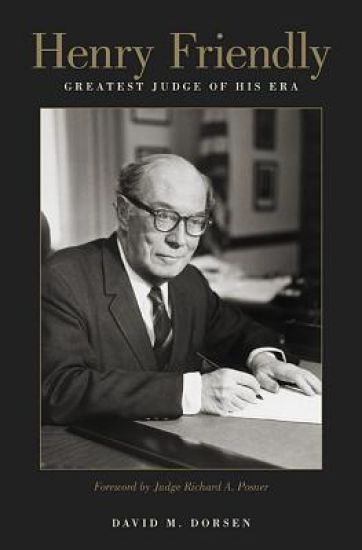
Henry Friendly, Greatest Judge of His Era

Henry Friendly, Greatest Judge of His Era

David M. Dorsen; Richard A. Posner

The Belknap Press
2012
sidottu
Henry Friendly is frequently grouped with Oliver Wendell Holmes, Louis Brandeis, Benjamin Cardozo, and Learned Hand as the best American jurists of the twentieth century. In this first, comprehensive biography of Friendly, David M. Dorsen opens a unique window onto how a judge of this caliber thinks and decides cases, and how Friendly lived his life.During his time on the Court of Appeals for the Second Circuit (1959–1986), Judge Friendly was revered as a conservative who exemplified the tradition of judicial restraint. But he demonstrated remarkable creativity in circumventing precedent and formulating new rules in multiple areas of the law. Henry Friendly, Greatest Judge of His Era describes the inner workings of Friendly’s chambers and his craftsmanship in writing opinions. His articles on habeas corpus, the Fourth Amendment, self-incrimination, and the reach of the state are still cited by the Supreme Court. Dorsen draws on extensive research, employing private memoranda between the judges and interviews with all fifty-one of Friendly’s law clerks—a veritable Who’s Who that includes Chief Justice John R. Roberts, Jr., six other federal judges, and seventeen professors at Harvard, Yale, Stanford, and elsewhere. In his Foreword, Judge Richard Posner writes: “David Dorsen has produced the most illuminating, the most useful, judicial biography that I have ever read . . . We learn more about the American judiciary at its best than we can learn from any other . . . Some of what I’ve learned has already induced me to make certain changes in my judicial practice.”
The Crisis of Capitalist Democracy

The Crisis of Capitalist Democracy

Richard A. Posner

Harvard University Press
2011
nidottu
Following his timely and well-received A Failure of Capitalism, Richard Posner steps back to take a longer view of the continuing crisis of democratic capitalism as the American and world economies crawl gradually back from the depths to which they had fallen in the autumn of 2008 and the winter of 2009.By means of a lucid narrative of the crisis and a series of analytical chapters pinpointing critical issues of economic collapse and gradual recovery, Posner helps non-technical readers understand business-cycle and financial economics, and financial and governmental institutions, practices, and transactions, while maintaining a neutrality impossible for persons professionally committed to one theory or another. He calls for fresh thinking about the business cycle that would build on the original ideas of Keynes. Central to these ideas is that of uncertainty as opposed to risk. Risk can be quantified and measured. Uncertainty cannot, and in this lies the inherent instability of a capitalist economy.As we emerge from the financial earthquake, a deficit aftershock rumbles. It is in reference to that potential aftershock, as well as to the government’s stumbling efforts at financial regulatory reform, that Posner raises the question of the adequacy of our democratic institutions to the economic challenges heightened by the greatest economic crisis since the Great Depression. The crisis and the government’s energetic response to it have enormously increased the national debt at the same time that structural defects in the American political system may make it impossible to pay down the debt by any means other than inflation or devaluation.
Remaking Domestic Intelligence

Remaking Domestic Intelligence

Richard A. Posner

Hoover Institution Press,U.S.
2011
sidottu
The author reveals the dangerous weaknesses undermining domestic intelligence in the United States and tells why a new national security service should not be part of the FBI. He explains the need for a new domestic intelligence agency, modeled on the Canadian Security Intelligence Service and lodged in the Department of Homeland Security.
A Failure of Capitalism

A Failure of Capitalism

Richard A. Posner

Harvard University Press
2011
nidottu
The financial and economic crisis that began in 2008 is the most alarming of our lifetime because of the warp-speed at which it is occurring. How could it have happened, especially after all that we’ve learned from the Great Depression? Why wasn’t it anticipated so that remedial steps could be taken to avoid or mitigate it? What can be done to reverse a slide into a full-blown depression? Why have the responses to date of the government and the economics profession been so lackluster? Richard Posner presents a concise and non-technical examination of this mother of all financial disasters and of the, as yet, stumbling efforts to cope with it. No previous acquaintance on the part of the reader with macroeconomics or the theory of finance is presupposed. This is a book for intelligent generalists that will interest specialists as well.Among the facts and causes Posner identifies are: excess savings flowing in from Asia and the reckless lowering of interest rates by the Federal Reserve Board; the relation between executive compensation, short-term profit goals, and risky lending; the housing bubble fuelled by low interest rates, aggressive mortgage marketing, and loose regulations; the low savings rate of American people; and the highly leveraged balance sheets of large financial institutions.Posner analyzes the two basic remedial approaches to the crisis, which correspond to the two theories of the cause of the Great Depression: the monetarist—that the Federal Reserve Board allowed the money supply to shrink, thus failing to prevent a disastrous deflation—and the Keynesian—that the depression was the product of a credit binge in the 1920s, a stock-market crash, and the ensuing downward spiral in economic activity. Posner concludes that the pendulum swung too far and that our financial markets need to be more heavily regulated.
Uncommon Sense

Uncommon Sense

Gary S. Becker; Richard A. Posner

University of Chicago Press
2010
nidottu
On December 5, 2004, the still-developing blogosphere took one of its biggest steps toward mainstream credibility, as Nobel Prize - winning economist Gary S. Becker and renowned jurist and legal scholar Richard A. Posner announced the formation of the Becker-Posner Blog. In no time, the blog had established a wide readership and reputation as a reliable source of lively, thought-provoking commentary on current events, its pithy and profound weekly essays highlighting the value of economic reasoning when applied to unexpected topics. "Uncommon Sense" gathers the most important and innovative entries from the blog, arranged by topic, along with updates and even reconsiderations when subsequent events have shed new light on a question. Whether it's Posner making the economic case for the legalization of gay marriage, Becker arguing in favor of the sale of human organs for transplant, or even the pair of scholars vigorously disagreeing about the utility of collective punishment, the writing is always clear, the interplay energetic, and the resulting discussion deeply informed and intellectually substantial. To have a single thinker of the stature of a Becker or Posner addressing questions of this nature would make for fascinating reading; to have both, writing and responding to each other, is an exceptionally rare treat. With "Uncommon Sense", they invite the adventurous reader to join them on a whirlwind intellectual journey. All they ask is that you leave your preconceptions behind.
How Judges Think

How Judges Think

Richard A. Posner

Harvard University Press
2010
nidottu
A distinguished and experienced appellate court judge, Richard A. Posner offers in this new book a unique and, to orthodox legal thinkers, a startling perspective on how judges and justices decide cases. When conventional legal materials enable judges to ascertain the true facts of a case and apply clear pre-existing legal rules to them, Posner argues, they do so straightforwardly; that is the domain of legalist reasoning. However, in non-routine cases, the conventional materials run out and judges are on their own, navigating uncharted seas with equipment consisting of experience, emotions, and often unconscious beliefs. In doing so, they take on a legislative role, though one that is confined by internal and external constraints, such as professional ethics, opinions of respected colleagues, and limitations imposed by other branches of government on freewheeling judicial discretion. Occasional legislators, judges are motivated by political considerations in a broad and sometimes a narrow sense of that term. In that open area, most American judges are legal pragmatists. Legal pragmatism is forward-looking and policy-based. It focuses on the consequences of a decision in both the short and the long term, rather than on its antecedent logic. Legal pragmatism so understood is really just a form of ordinary practical reasoning, rather than some special kind of legal reasoning. Supreme Court justices are uniquely free from the constraints on ordinary judges and uniquely tempted to engage in legislative forms of adjudication. More than any other court, the Supreme Court is best understood as a political court.
The Quotable Judge Posner

The Quotable Judge Posner

Richard A. Posner

State University of New York Press
2010
pokkari
Collection of quotations and judicial opinions of federal appellate judge Richard A. Posner A collection of pithy and penetrating observations and rulings by one of the most famous appellate judges in America, The Quotable Judge Posner showcases the wit and wisdom of Richard A. Posner. During his more than twenty-five years as a federal appellate judge, Judge Posner reached over 2,000 opinions, many of which are cited frequently in the opinions of Supreme Court Justices. This anthology presents the judge's entertaining and insightful observations on fifty wide ranging topics, from Abortion to Telecommunications to Zoning and Planning. Law students who have encountered Judge Posner's judicial opinions will benefit from this collection, as will general readers who will enjoy Posner's trenchant comments on American society, constitutional norms, and legal culture.