Kirjojen hintavertailu. Mukana 12 390 323 kirjaa ja 12 kauppaa.

Kirjailija

Roland Barthes

Kirjat ja teokset yhdessä paikassa: 100 kirjaa, julkaisuja vuosilta 1966-2026, suosituimpien joukossa Roland Barthes Reader. Vertaile teosten hintoja ja tarkista saatavuus suomalaisista kirjakaupoista.

100 kirjaa

Kirjojen julkaisuhaarukka 1966-2026.

Lover's Discourse

Lover's Discourse

Roland Barthes

Vintage
2002
pokkari
Here, Barthes addresses the language of love, a language of solitude, of mythology, of what he calls an "image repertoire". It is aimed at two groups of readers: those who have been in love, and those who have not. A wide range of examples are included, from Nietzsche to Zen.
Sollers

Sollers

Roland Barthes

Continuum International Publishing Group Ltd.
2000
sidottu
In his discussion of the controversial French writer Sollers, Barthes raises critical issues of central importance - such as the nature of narrative, the theory of language, the problems of traditional realism and the relationship between literature and politics. The Introduction and notes provide an important presentation of Sollers for the English-speaking reader. Roland Barthes (19-15-1980) is one of the most important figures in the development of modern critical theory and a leading exponent of la nouvelle critique. His many works include Criticism and Truth (Athlone 1987), Writing Degree Zero, Mythologies, S/Z and Elements of Semiology.
Camera Lucida

Camera Lucida

Roland Barthes

Ccv
1993
pokkari
Examining the themes of presence and absence, the relationship between photography and theatre, history and death, these 'reflections on photography' begin as an investigation into the nature of photographs. Then, as Barthes contemplates a photograph of his mother as a child, the book becomes an exposition of his own mind.
S/Z

S/Z

Roland Barthes

JOHN WILEY AND SONS LTD
1990
nidottu
S/Z is the linguistic distillation of Barthes's system of semiology, a science of signs and symbols, in which Balzac's novella, Sarrasine, is dissected semantically to uncover layers of hidden meaning.
The Fashion System

The Fashion System

Roland Barthes; Richard Howard; Matthew (TRN) Ward

University of California Press
1990
pokkari
In his consideration of the language of the fashion magazine--the structural analysis of descriptions of women's clothing by writers about fashion--Barthes gives us a brief history of semiology. At the same time, he identifies economics as the underlying reason for the luxuriant prose of the fashion magazine: "Calculating, industrial society is obliged to form consumers who don't calculate; if clothing's producers and consumers had the same consciousness, clothing would be bought (and produced) only at the very slow rate of its dilapidation."
The Rustle of Language

The Rustle of Language

Roland Barthes; Richard Howard

University of California Press
1989
pokkari
The Rustle of Language is a collection of forty-five essays, written between 1967 and 1980, on language, literature, and teaching--the pleasure of the text--in an authoritative translation by Richard Howard.
Empire Signs

Empire Signs

Roland Barthes

Anchor Books
1983
nidottu
With this book, Barthes offers a broad-ranging meditation on the culture, society, art, literature, language, and iconography--in short, both the sign-oriented realities and fantasies--of Japan itself.
A Barthes Reader

A Barthes Reader

Roland Barthes

Hill Wang
1983
nidottu
"A Barthes Reader" gives one the image of Barthes as one of the great public teachers of our time, someone who thought out, argued for, and made available several steps in a penetrating reflection on language sign systems, texts- and what they have to tell us about the concept of being human. Susan Sontag's prefatory essay is one of her finest acts of criticism, informed by intellectual sympathy and a sure sense of the contours of the mind she is describing.
Image-Music-Text

Image-Music-Text

Roland Barthes

Hill Wang
1978
nidottu
These essays, as selected and translated by Stephen Heath, are among the finest writings Barthes ever published on film and photography, and on the phenomena of sound and image. The classic pieces "Introduction to the Structural Analysis of Narrative" and "The Death of the Author" are also included.
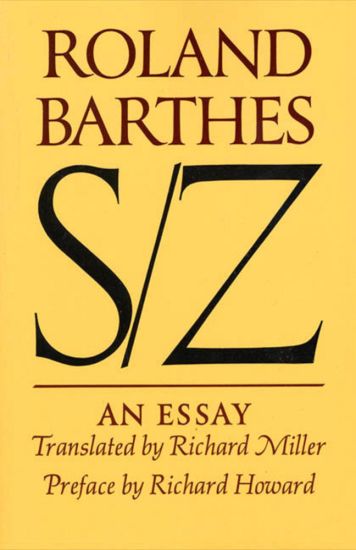
S/Z

S/Z

Roland Barthes

Farrar, Straus Giroux Inc
1975
nidottu
Preface by Richard Howard. Translated by Richard Miller. This is Barthes's scrupulous literary analysis of Balzac's short story "Sarrasine."
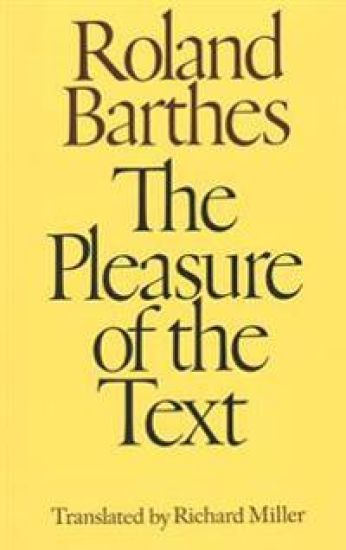
The Pleasure of the Text

The Pleasure of the Text

Roland Barthes

Hill Wang
1975
nidottu
What is it that we do when we enjoy a text? What is the pleasure of reading? The French critic and theorist Roland Barthes's answers to these questions constitute "perhaps for the first time in the history of criticism . . . not only a poetics of reading . . . but a much more difficult achievement, an erotics of reading . . . . Like filings which gather to form a figure in a magnetic field, the parts and pieces here do come together, determined to affirm the pleasure we must take in our reading as against the indifference of (mere) knowledge." --Richard Howard
Critical Essays

Critical Essays

Roland Barthes

Northwestern University Press
1972
nidottu
The essays in this volume were written during the years that its author's first four books were published in France. They chart the course of Barthe's criticism from the vocabularies of existentialism and Marxism (reflections on the social situation of literature and writer's responsibility before History) to a psychoanalysis of substances (after Bachelard) and a psychoanalytical anthropology (which evidently brought Barthes to his present terms of understanding with Levi-Strauss and Lacan).
Kritiska essäer

Kritiska essäer

Roland Barthes

Arkiv förlag/A-Z förlag
1967
pokkari
Innehåll: Värld och sakvärld; Objektiv -- objektbestämd -- litteratur; Baudelaires dramatik; Den blinda Mor Courage; Brecht-revolutionen; Teaterdräktens patologiska tillstånd; Bokstavlig litteratur; Att spela antik teater; Avant-garde -- i spetsen för vad slags teater; Brecht-kritikens uppgifter; Att vilja är förtärande eld ; Den siste av de lyckliga författarna; Det finns ingen Robbe-Grillet-skola; Litteratur och metaspråk; Tacitus och dödens barock; Häxan; Zazie och liutteraturen; Arbetare och reformerta präster; Kaflas svar; A propos Brechts Mutter; Författare och skribenter; Litteraturen just nu; Å ömse håll; Litteratur, kontinuitet och diskontinuitet; Tidningsnotisens struktur; Robbe-Grillet -- en sista positionsbestämning?; Tecknets gestaltning; Strukturalistisk aktivitet; La Bruyère; Ögats metafor; Två slag av kritik; Vad är litteraturkritik?; Litteratur och signifikation
Litteraturens nollpunkt

Litteraturens nollpunkt

Roland Barthes

Arkiv förlag/A-Z förlag
1966
pokkari
I sin inledning till den här boken sktiver Roland Barthes: Hébert började aldrig ett nummer av Pére Duchêne utan att stoppa in ett antal fan och helvete. Dessa kraftuttryck hade ingen egentlig innebörd, de gav bara en antydan. Om vad? Om en hel revolutionär situation. Där har vi alltså ett exempel på ett skrivsätt som inte bara vill meddela eller uttrycka något utan även poängtera något som ligger utanför själva språket men som samtidigt innefattar historien och den ståndpunkt man själv intar visavi den. Det finns inget skriftspråk utan adress, och det som gäller för Pére Duchêne gäller också för litteraturen. Även den bör antyda något annat än sitt innehåll och sin individuella form, något som är dess eget fält och som gör den till just litteratur. Därav följer en mängd givna tecken utan samband med vare sig idén eller språket eller stilen, vilka är ägnade att i vimlet av alla tänkbara uttryckssätt fastslå det rituella språkets isolering. Lenna skrivtecknens sakrala ordning gör litteraturen till en institution och tenderar uppenbarligen at skilja den från historien, ty ingen begränsning kommer till stånd utan en idé om beständighet. Men nu förhåller det sig så att där historien är utestängd, där verkar den också som allra tydligast; det är alltså möjligt att spåra en det litterära språkets historia som varken är historien om språket i sig eller om de olika stilarterna utan bara historien om litteraturens tecken, och man kan vara övertygad om att denna formella historia på sitt sätt och med all önskvärd tydlighet manifesterar sitt samband med den historia som går på djupet.