Kirjojen hintavertailu. Mukana 12 390 323 kirjaa ja 12 kauppaa.

Kirjailija

Roland Barthes

Kirjat ja teokset yhdessä paikassa: 100 kirjaa, julkaisuja vuosilta 1966-2026, suosituimpien joukossa Roland Barthes Reader. Vertaile teosten hintoja ja tarkista saatavuus suomalaisista kirjakaupoista.

100 kirjaa

Kirjojen julkaisuhaarukka 1966-2026.

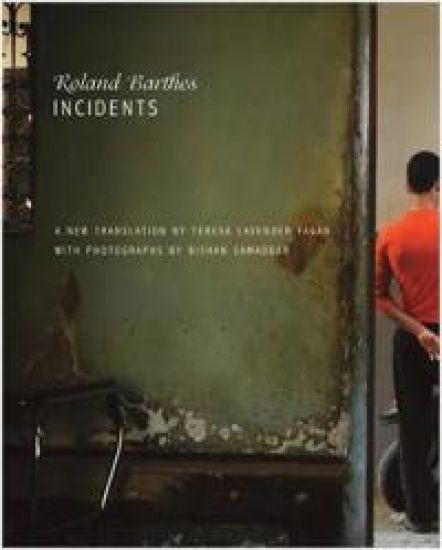
Incidents

Incidents

Roland Barthes

Seagull Books London Ltd
2010
nidottu
French philosopher and literary theorist Roland Barthes was one of the leading influences on the post-structuralist movement in twentieth-century literary thought, and some of his best-known works, like "S/Z", speak directly to the essential and individual relationship between a reader and a literary text. Here, in "Incidents", readers have the privilege of going inside the life and thought of Barthes, through a work that is a testament to Barthes' belief that a literary work should invite the full, active participation of the reader. The essays collected in "Incidents", originally published in French shortly after Barthes' death, provide unique insight into the author's life, his personal struggles, and his delights. Though Barthes questioned the act of keeping a journal with the aim of having it published, he decided to undertake a diary-like experiment in four parts. The first, which gives the collection its title, is a revealing personal account of his time living in Morocco. The second, "The Light of the Southwest", is an ode to Barthes' favorite region in France, while in "At Le Palace Tonight", Barthes describes a vibrant Paris entertainment spot. Finally, the journal entries of "Evenings in Paris" reveal Barthes as an older gay man, struggling with his desire for young lovers. Rendered here in a fresh and lyrical translation, "Incidents" will delight fans of Barthes' other works, as well as anyone curious for a look inside the mind of one of the twentieth century's foremost intellectuals.
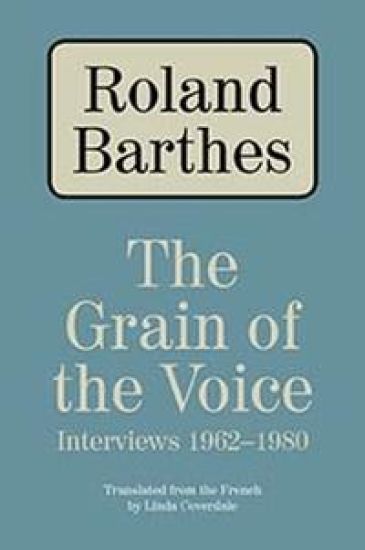
The Grain of the Voice

The Grain of the Voice

Roland Barthes

Northwestern University Press
2009
nidottu
This book brings together the great majority of Barthes’s interviews that originally appeared in French in Le Figaro Littéraire, Cahiers du Cinéma, France-Observateur, L'Express, and elsewhere. Barthes replied to questions-on the cinema, on his own works, on fashion, writing, and criticism-in his unique voice; here we have Barthes in conversation, speaking directly, with all his individuality. These interviews provide an insight into the rich, probing intelligence of one of the great and influential minds of our time.
Den gamle retorikken

Den gamle retorikken

Roland Barthes

Spartacus
2009
sidottu
Denne lille håndboken henvender seg til alle som vil vite noe om retorikkens vesen og historie. Boken gir en enestående innføring i talekunstens systematikk, og er samtidig gjennomsyret av en kritisk refleksjon over språkets makt. Punkt for punkt går Barthes gjennom retorikkens dynamiske og detaljerte klassifiseringer - og konkluderer med at om vi i dag ikke lenger kan støtte oss til et fast retorisk system, så er det nødvendig å kjenne dets historie, for verden er fremdeles "utrolig full av gammel retorikk". Roland Barthes (1915-1980) er en av det tyvende århundres betydeligste europeiske tenkere og essayister.
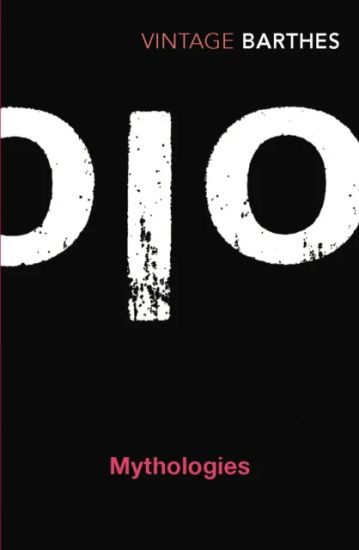
Mythologies

Mythologies

Roland Barthes

Vintage
2009
pokkari
'Barthes' purpose is to tear away masks and demystify the signs, signals and symbols of the language of mass culture' The TimesIn this magnificent and often surprising collection of essays Barthes explores the myths of mass culture.
Die Vorbereitung des Romans

Die Vorbereitung des Romans

Roland Barthes

SUHRKAMP VERLAG
2008
pokkari
Im April 1978 beschließt Roland Barthes, einen Roman zu schreiben, kommt aber über Stichworte nicht hinaus. Die Erfahrung dieses Scheiterns macht er in den folgenden Jahren zum Thema der theoretischen Arbeit: Er widmet dem Übergang "vom Schreiben-Wollen zum Schreiben-Können" zwei Vorlesungen am Coll?ge de France. Darin geht er der Frage nach, wie aus verstreuten Ideen ein Textkontinuum entsteht, das einen "Realitätseffekt" erzeugt. Er behandelt aber auch, am Beispiel von Proust, Flaubert und Tolstoi, den Prozeß des Schreibens sowie die "diätetischen Regeln", denen sich die Autoren unterwerfen - die Einsamkeit, die Nacht, die Stimulanzien .
What Is Sport?

What Is Sport?

Roland Barthes

Yale University Press
2007
pokkari
A poetic meditation on professional sport by one of the major figures of twentieth-century French Literature and thought, published in an elegant paperback gift edition A little-known gem, the text of Barthes’s What Is Sport? was never reprinted in the Seuil editions of his Complete Works—neither the three-volume version nor the later five-volume edition. It is published here in a graceful and faithful English translation by Pulitzer Prize winner Richard Howard. Originally commissioned by the Canadian Broadcasting Corporation as the text for a documentary film directed by Hubert Aquin, What Is Sport? was written three years after the publication of Barthes’s Mythologies (1957) and bears considerable resemblance to that work. Some of Barthes’s best writing seems to have been inspired by popular culture.Once again blurring the distinction between high and low, the great French literary theorist muses philosophically on the question: What is sport? In investigating the phenomenon of sport, Barthes considers five national sports: bullfighting (Spain), car racing (America), cycling (France), hockey (Canada), and soccer (England). For Barthes, sport is spectacle and serves the primary social function that theater once did in antiquity, collecting a city or nation within a shared experience. The real pleasure of this book, however, lies less in its generalities than in its fleeting, strangely haunting moments of insight. It makes an appropriate gift for any sport enthusiast as well as those interested in the writing of Roland Barthes.
Mytologier

Mytologier

Roland Barthes

Arkiv förlag/A-Z förlag
2007
nidottu
I sitt klassiska arbete Mytologier (1957) analyserar och förklarar sociologen och semiologen Roland Barthes (1915-1980) de "myter" som utgör den moderna människans vardagsvärld. I korta kapitel presenterar han en serie fenomen från det dagliga livet i Västeuropa - bland annat romare på film, författare på semester, tvättmedel, Charlie Chaplin, Greta Garbo, biff och pommes frites, vin och mjölk, bilmodeller, den objektiva litteraturkritiken, Einsteins hjärna och Tour de France. I det sammanfattande och framåtblickande kapitlet "Myten idag" redogör Barthes för sin metod. Hans mål är att avslöja den ideologi vars främsta kännetecken är att historiskt bestämda företeelser framställs och tolkas som eviga och "naturliga". Barthes var en intellektuell som tidigt tog masskulturen på ett kritiskt allvar. Poängen är inte att avfärda den utan att belysa dess mytiska karaktär och ideologiska funktion.
The Neutral

The Neutral

Roland Barthes

Columbia University Press
2007
pokkari
"I define the Neutral as that which outplays the paradigm, or rather I call Neutral everything that baffles paradigm." With these words, Roland Barthes describes a concept that profoundly shaped his work and was the subject of a landmark series of lectures delivered in 1978 at the College de France, just two years before his death. Not published in France until 2002, and appearing in English for the first time, these creative and engaging lectures deepen our understanding of Roland Barthes's intellectual itinerary and reveal his distinctive style as thinker and teacher. The Neutral (le neutre), as Barthes describes it, escapes or undoes the paradigmatic binary oppositions that structure and produce meaning in Western thought and discourse. These binaries are found in all aspects of human society ranging from language to sexuality to politics. For Barthes, the attempt to deconstruct or escape from these binaries has profound ethical, philosophical, and linguistic implications. The Neutral is comprised of the prewritten texts from which Barthes lectured and centers around 23 "figures," also referred to as "traits" or "twinklings," that are possible embodiments of the Neutral (sleep, silence, tact, etc.) or of the anti-Neutral (anger, arrogance, conflict, etc.). His lectures draw on a diverse set of authors and intellectual traditions, including Lao-tzu, Tolstoy, German mysticism, classical philosophy, Rousseau, Baudelaire, Walter Benjamin, and John Cage. Barthes's idiosyncratic approach to his subjects gives the lectures a playful, personal, and even joyous quality that enhances his rich insights. In addition to his reflections on a variety of literary and scholarly works, Barthes's personal convictions and the events of his life shaped the course and content of the lectures. Most prominently, as Barthes admits, the recent death of his mother and the idea of mourning shape several of his lectures.
Criticism and Truth

Criticism and Truth

Roland Barthes

Continuum International Publishing Group Ltd.
2007
nidottu
Roland Barthes (1915-1980) was a major French writer, literary theorist and critic of French culture and society. His classic works include "Mythologies" and "Camera Lucida". "Criticism and Truth" is a brilliant discussion of the language of literary criticism and a key work in the Barthes canon. It is a cultural, linguistic and intellectual challenge to those who believe in the clarity, flexibility and neutrality of language, couched in Barthes' own inimitable and provocative style.
Det lyse rommet

Det lyse rommet

Roland Barthes

Pax
2007
nidottu
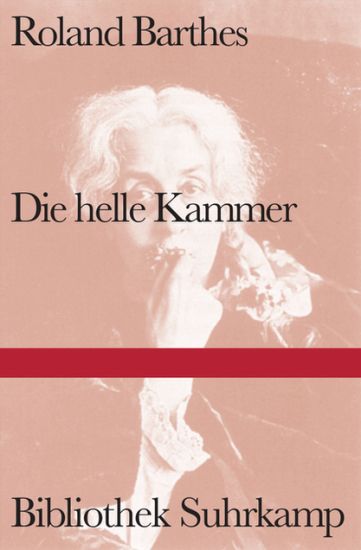
Boken er et essay om det fotografiske bildet. Kommer virkeligheten til syne i fotografiet? Kan fotografi være kunst? Her drøftes virkningen av dokumenterbilder, pressefotos, kunstfotografier og familieportretter, både høytidelige og mer trivielle. Fotografiets egenart forstår Barthes først etter å ha studert et portrett av sin mor, og slik reflektert hans egen sorgarbeid.
Am Nullpunkt der Literatur / Literatur oder Geschichte / Kritik und.Wahrheit
Dieser Band versammelt die lange vergriffenen Einzelwerke Am Nullpunkt der Literatur, Literatur oder Geschichte und Kritik und Wahrheit aus der frühen Periode des Barthesschen Werkes und macht sie wieder zugänglich. Hier wird der zentrale Begriff der "?criture", der "Schreibweise", entfaltet, wird die klassisch gewordene Unterscheidung zwischen "?crivain" und "?crivant", zwischen "Schriftsteller" und "Schreiber" getroffen; hier wird ein Umgang mit Literatur erprobt, der Begriffe und Möglichkeiten einer Kritik literarischer Texte aus dem Geist des Strukturalismus entfaltet. In ihrer stilistischen Brillanz, gedanklichen Tiefe und wissenschaftlichen Fundierung setzen Barthes' Texte Maßstäbe, die auch heutiger Literaturkritik unvermindert wichtige Impulse geben können.
The Neutral

The Neutral

Roland Barthes

Columbia University Press
2005
sidottu
"I define the Neutral as that which outplays the paradigm, or rather I call Neutral everything that baffles paradigm." With these words, Roland Barthes describes a concept that profoundly shaped his work and was the subject of a landmark series of lectures delivered in 1978 at the College de France, just two years before his death. Not published in France until 2002, and appearing in English for the first time, these creative and engaging lectures deepen our understanding of Roland Barthes's intellectual itinerary and reveal his distinctive style as thinker and teacher. The Neutral (le neutre), as Barthes describes it, escapes or undoes the paradigmatic binary oppositions that structure and produce meaning in Western thought and discourse. These binaries are found in all aspects of human society ranging from language to sexuality to politics. For Barthes, the attempt to deconstruct or escape from these binaries has profound ethical, philosophical, and linguistic implications. The Neutral is comprised of the prewritten texts from which Barthes lectured and centers around 23 "figures," also referred to as "traits" or "twinklings," that are possible embodiments of the Neutral (sleep, silence, tact, etc.) or of the anti-Neutral (anger, arrogance, conflict, etc.). His lectures draw on a diverse set of authors and intellectual traditions, including Lao-tzu, Tolstoy, German mysticism, classical philosophy, Rousseau, Baudelaire, Walter Benjamin, and John Cage. Barthes's idiosyncratic approach to his subjects gives the lectures a playful, personal, and even joyous quality that enhances his rich insights. In addition to his reflections on a variety of literary and scholarly works, Barthes's personal convictions and the events of his life shaped the course and content of the lectures. Most prominently, as Barthes admits, the recent death of his mother and the idea of mourning shape several of his lectures.
Criticism and Truth

Criticism and Truth

Roland Barthes

Continuum International Publishing Group Ltd.
2004
nidottu
Roland Barthes (1915-1980) was a major French writer, literary theorist and critic of French culture and society. His classic works include Mythologies and Camera Lucida. Criticism and Truth is a brilliant discussion of the language of literary criticism and a key work in the Barthes canon. It is a cultural, linguistic and intellectual challenge to those who believe in the clarity, flexibility and neutrality of language, couched in Barthes' own inimitable and provocative style. Translated and Edited by Katrine Pilcher Keuneman Introduced by Philip Thody.