Kirjojen hintavertailu. Mukana 12 147 378 kirjaa ja 12 kauppaa.

Kirjailija

Jacques Derrida

Kirjat ja teokset yhdessä paikassa: 171 kirjaa, julkaisuja vuosilta 1982-2027, suosituimpien joukossa Given Time II. Vertaile teosten hintoja ja tarkista saatavuus suomalaisista kirjakaupoista.

171 kirjaa

Kirjojen julkaisuhaarukka 1982-2027.

Given Time II

Given Time II

Jacques Derrida

THE UNIVERSITY OF CHICAGO PRESS
2026
sidottu
The long-awaited conclusion to Derrida’s seminar on the gift and time. In 1991, Jacques Derrida published the first half of a seminar delivered from 1978 to 1979 on gifts and time, but the second installment (though expected) was not completed in his lifetime. Given Time II completes the seminar with eight sessions that showcase Derrida’s most advanced work on the problematic of the gift in Heidegger, with deep dives into some of the most difficult texts in the Heideggerian corpus, including “The Origin of the Work of Art,” “The Thing,” and “On Time and Being.” Beyond Heidegger, Derrida engages Claude Lévi-Strauss, Marcel Mauss, Maurice Blanchot, Jacques Lacan, and others on the act of giving and receiving, the sacrificial gift, and more. Throughout, Derrida identifies a paradox of gift giving: for the gift to be received as a gift, it must not appear as such, since gifts often involve a cycle of debt and repayment. Given Time II is a uniquely Derridean treatment of an important subject in the work of Heidegger and beyond.
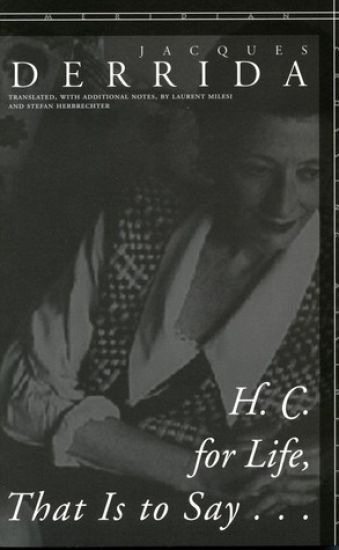
H. C. for Life, That Is to Say...

H. C. for Life, That Is to Say...

Jacques Derrida

Stanford University Press
2006
sidottu
H. C. for Life, That Is to Say . . . is Derrida's literary critical recollection of his lifelong friendship with Hélène Cixous. The main figure that informs Derrida's reading here is that of "taking sides." While Hélène Cixous in her life and work takes the side of life, "for life," Derrida admits always feeling drawn to the side of death. Rather than being an obvious choice, taking the side of life is an act of faith, by wagering one's life on life. H. C. for Life sets up and explores this interminable "argument" between Derrida and Cixous as to what death has in store deep within life itself, before the end. In addition to being a memoir, it is also a theoretical confrontation—for example about the meaning of "might" and "omnipotence," and a philosophical and philological analysis of the crypts within the vast oeuvre of Hélène Cixous. Finally, the book is Derrida's tribute to the thought of the woman whom he regards as one of the great French poets, writers, and thinkers of our time.
Jacques Derrida

Jacques Derrida

Geoffrey Bennington; Jacques Derrida

University of Chicago Press
1999
nidottu
Geoffrey Bennington sets out here to write a systematic account of the thought of Jacques Derrida. Responding to Bennington's text at every turn is Derrida's own, excerpts from his life and thought that resist circumscription. Together these texts, as a dialogue and a contest, constitute a critical introduction to one of the leading philosophers of the 20th century. Bennington's account of Derrida leads the reader through the philosopher's work on language and writing, and through more mysterious themes of signature, sexual difference, law, and affirmation. Seeking to escape this systematic rendering - in fact, to prove it impossible - Derrida interweaves Bennington's text with surprising and disruptive "periphrases": reflections on his mother's death agony, commentaries on St. Augustine's "Confessions", memories of childhood, remarks on Judaism, and references to his collaborator's efforts.
Of Grammatology

Of Grammatology

Jacques Derrida

Johns Hopkins University Press
2027
pokkari
The book that transformed critical thought, revisited for a new generation. Since its publication in English, Of Grammatology has remained one of the most influential works of twentieth-century thought. Jacques Derrida's sustained critique of Western metaphysics reshaped debates across philosophy, literary studies, linguistics, anthropology, psychoanalysis, and the human sciences, introducing deconstruction as both a method and a challenge to inherited assumptions about meaning, language, and presence. This fiftieth-anniversary edition revisits Derrida's landmark text with renewed attention to its intellectual afterlives. Gayatri Chakravorty Spivak's translation—long recognized for its precision and ambition—has been carefully revised to reflect decades of engagement with Derrida's work and its reception. Spivak's new preface to the introduction helps recontextualize this inventive work of scholarship and its ongoing relevance. Of Grammatology remains a demanding and generative work that invites readers to rethink foundational concepts of writing, structure, and difference. This anniversary edition makes one of modern criticism's indispensable texts newly accessible while preserving the rigor that has defined its legacy.
Hospitality, Volume I

Hospitality, Volume I

Jacques Derrida

THE UNIVERSITY OF CHICAGO PRESS
2026
nidottu
Jacques Derrida explores the ramifications of what we owe to others. Hospitality reproduces a two-year seminar series delivered by Jacques Derrida at the École des hautes études en sciences sociales in Paris between 1995 and 1997. In these lectures, Derrida asks a series of related questions about responsibility and “the foreigner”: How do we welcome or turn away the foreigner? What does the idea of the foreigner reveal about kinship and the state, particularly in relation to friendship, citizenship, migration, asylum, assimilation, and xenophobia? Derrida approaches these questions through readings of several classical texts as well as modern texts by Heidegger, Arendt, Camus, and others. Central to his project is a rigorous distinction between conventional, finite hospitality, with its many conditions, and the aspirational idea of hospitality as something offered unconditionally to the stranger. This volume collects the first year of the seminar.
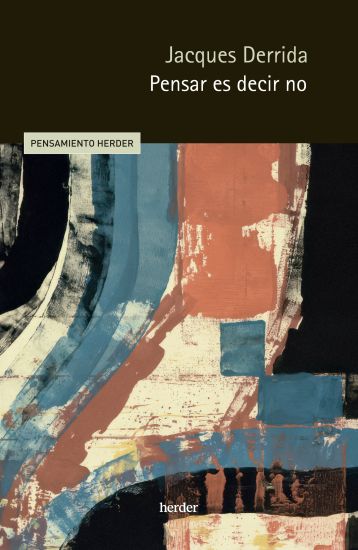
To Think Is to Say No

To Think Is to Say No

Jacques Derrida

FORDHAM UNIVERSITY PRESS
2026
pokkari
To Think Is to Say No presents, for the first time in English, a remarkable early lecture course delivered by Jacques Derrida at the Sorbonne during the 1960–1961 academic year. Composed of four sessions and drawn from Derrida’s handwritten manuscripts, this volume offers a rare glimpse into the development of one of the most influential philosophers of the twentieth century. Taking its title from a phrase by the French philosopher Alain—"to think is to say no"—the course explores the relationship between thinking, negation, and belief. Beginning with Alain’s provocative claim that genuine thought arises through questioning and refusal, Derrida develops what might be called a brief history of negation in Western philosophy, engaging figures from Plato, Kant, and Hegel to Husserl, Bergson, Sartre, and Heidegger. At stake is not only the logic of affirmation and negation but also the origin of thought itself: does thinking begin with a "yes" or a "no"? Derrida’s response challenges Alain’s formulation while developing a central thread of his later philosophy: the idea of an originary affirmation of the other, a "yes" that precedes every affirmation and negation. In tracing this tension, the course reveals the early emergence of themes that would come to define Derrida’s work—language, responsibility, pedagogy, and the ethical relation to others—while showcasing his distinctive teaching style and intellectual rigor. Edited by Brieuc Gérard and translated by Pascale-Anne Brault and Michael Naas, To Think Is to Say No brings into print a foundational document of Derrida’s thought. Both an essential contribution to Derrida scholarship and a compelling introduction to his philosophical concerns, this volume illuminates the origins of deconstruction and the enduring question of what it means to think.
To Think Is to Say No

To Think Is to Say No

Jacques Derrida

FORDHAM UNIVERSITY PRESS
2026
sidottu
To Think Is to Say No presents, for the first time in English, a remarkable early lecture course delivered by Jacques Derrida at the Sorbonne during the 1960–1961 academic year. Composed of four sessions and drawn from Derrida’s handwritten manuscripts, this volume offers a rare glimpse into the development of one of the most influential philosophers of the twentieth century. Taking its title from a phrase by the French philosopher Alain – "to think is to say no" – the course explores the relationship between thinking, negation, and belief. Beginning with Alain’s provocative claim that genuine thought arises through questioning and refusal, Derrida develops what might be called a brief history of negation in Western philosophy, engaging figures from Plato, Kant, and Hegel to Husserl, Bergson, Sartre, and Heidegger. At stake is not only the logic of affirmation and negation but also the origin of thought itself: does thinking begin with a "yes" or a "no"? Derrida’s response challenges Alain’s formulation while developing a central thread of his later philosophy: the idea of an originary affirmation of the other, a "yes" that precedes every affirmation and negation. In tracing this tension, the course reveals the early emergence of themes that would come to define Derrida’s work—language, responsibility, pedagogy, and the ethical relation to others—while showcasing his distinctive teaching style and intellectual rigor. Edited by Brieuc Gérard and translated by Pascale-Anne Brault and Michael Naas, To Think Is to Say No brings into print a foundational document of Derrida’s thought. Both an essential contribution to Derrida scholarship and a compelling introduction to his philosophical concerns, this volume illuminates the origins of deconstruction and the enduring question of what it means to think.
Specters of Marx

Specters of Marx

Jacques Derrida

TAYLOR FRANCIS LTD
2026
sidottu
Published shortly after the fall of Communism in Eastern Europe and the dissolution of the Soviet regime, Specters of Marx is one of Derrida's most interesting and prophetic books. Whilst many in the West heralded the triumph of liberal democracy and “the end of history”, Derrida takes several steps back to argue that whilst Communism may have disappeared in much of the world, the questions posed by Marx continue to haunt us. In his customary provocative style, he asks some uncomfortable questions: after the fall of Communism, can we preserve Marx's legacy of radicalism? How do we continue his philosophy of responsibility? Uncannily anticipating many of the challenges facing us today, Derrida argues that the capitalist system is plagued by a multitude of ills, including aggression, trade wars, debt, the exploitation of migrant labour and ethnic conflict. This Routledge Classics edition is a translation of the revised French edition and includes a debate between Derrida and Étienne Balibar on Marx and Marxism, published here in English for the first time. It also includes new corrections and additions to the text and footnotes made by Derrida after the book's initial publication in French. Translated by Peggy Kamuf and with a new Foreword by Peter Salmon, this Routledge Classics edition retains the original Editors’ Introduction by Bernd Magnus and Stephen Cullenberg.
Specters of Marx

Specters of Marx

Jacques Derrida

TAYLOR FRANCIS LTD
2026
nidottu
Published shortly after the fall of Communism in Eastern Europe and the dissolution of the Soviet regime, Specters of Marx is one of Derrida's most interesting and prophetic books. Whilst many in the West heralded the triumph of liberal democracy and “the end of history”, Derrida takes several steps back to argue that whilst Communism may have disappeared in much of the world, the questions posed by Marx continue to haunt us. In his customary provocative style, he asks some uncomfortable questions: after the fall of Communism, can we preserve Marx's legacy of radicalism? How do we continue his philosophy of responsibility? Uncannily anticipating many of the challenges facing us today, Derrida argues that the capitalist system is plagued by a multitude of ills, including aggression, trade wars, debt, the exploitation of migrant labour and ethnic conflict. This Routledge Classics edition is a translation of the revised French edition and includes a debate between Derrida and Étienne Balibar on Marx and Marxism, published here in English for the first time. It also includes new corrections and additions to the text and footnotes made by Derrida after the book's initial publication in French. Translated by Peggy Kamuf and with a new Foreword by Peter Salmon, this Routledge Classics edition retains the original Editors’ Introduction by Bernd Magnus and Stephen Cullenberg.
Tro & viden

Tro & viden

Jacques Derrida

Forlaget Klim
2024
nidottu
I begyndelsen af 1990’erne blev det i alverdens medier bebudet, at religionen nu, til alles overraskelse, var vendt tilbage på verdensscenen som politisk faktor, også selvom kirkerne stod stadig mere tomme. I Tro & viden fra 1995 forsøger den franske filosof Jacques Derrida at redegøre for, hvorfor religionen således bliver ved med at vende tilbage i en angiveligt sekulær, oplyst tidsalder. Dette leder på sporet af en afgrundsdyb tro, som ligger til grund for religion såvel som videnskab:“Jeg sagde til mig selv, at man gør sig blind for det fænomen, der kaldes religionens genkomst i dag, hvis man fortsætter med så naivt at modstille fornuft og religion. Det ville være nødvendigt, men ikke enkelt, at vise, at religionen og fornuften har samme kilde.”Dette er dog ingen irrationalisme, for tværtimod påpeger Derrida, at den måske mest udbredte obskurantisme i dag har form af blind tro på en videnskab, der ikke vil vide af forskellen på tro og viden. Enhver overvejelse af religionens plads i et sekulariseret samfund kræver oplysning af dette forhold, hvis ikke debatten uophørligt skal pendulere mellem rationalisme og dennes spejlbillede.Jacques Derrida (1930-2004) er en af det 20. århundredes største filosoffer, hvis navn forbliver tæt knyttet til “dekonstruktionen”. Tro & viden er oversat og forsynet med et introducerende forord og forklarende noter af Kristian Olesen Toft og Bjarke Mørkøre Stigel Hansen.
Hospitality, Volume II

Hospitality, Volume II

Jacques Derrida

THE UNIVERSITY OF CHICAGO PRESS
2024
sidottu
Jacques Derrida explores the ramifications of what we owe to others.Hospitality reproduces a two-year seminar series delivered by Jacques Derrida at the École des hautes études en sciences sociales in Paris between 1995 and 1997. In these lectures, Derrida asks a series of related questions about responsibility and “the foreigner”: How do we welcome or turn away the foreigner? What does the idea of the foreigner reveal about kinship and the state, particularly in relation to friendship, citizenship, migration, asylum, assimilation, and xenophobia? Central to his project is a rigorous distinction between conventional, finite hospitality, with its many conditions, and the aspirational idea of hospitality as something offered unconditionally to the stranger. This volume collects the second year of the seminar, which considers an Islamic problematic of hospitality, the relevance of forgiveness, and the work of Emmanuel Levinas.
Thinking What Comes, Volume 2

Thinking What Comes, Volume 2

Jacques Derrida

EDINBURGH UNIVERSITY PRESS
2024
sidottu
In two volumes, Geoffrey Bennington and Kas Saghafi present the majority of Jacques Derrida's untranslated, and previously uncollected, essays and interviews. Dating mostly from 1992 to 2004, these writings offer a fuller picture of Derrida's biography, theoretical engagements and the stakes of his social and political investments. Institutions, Inventions, and Inscriptions by Jacques Derrida: Thinking What Comes, Volume 2 collects Derrida's writings on friends including Emmanuel Levinas, Alain David, Louis Marin, Marie-Louise Mallet, Safaa Fathy, Mathieu Benezet and Jos Joliet. It also features interviews that illuminate his experience at school, his writing habits, the relation he saw between philosophical discourse to the 'poetic', and his views on the singularity of literature and fiction. Whether writing about racism and anti-Semitism, filiation and fidelity, or hospitality and responsibility, Derrida is razor-sharp and impassioned. These volumes allow significant insight into his mature thought.
Thinking What Comes, Volume 1

Thinking What Comes, Volume 1

Jacques Derrida

EDINBURGH UNIVERSITY PRESS
2024
sidottu
In two volumes, Geoffrey Bennington and Kas Saghafi present the majority of Jacques Derrida's untranslated, and previously uncollected, essays and interviews. Dating mostly from 1992 to 2004, these writings offer a fuller picture of Derrida's biography, theoretical engagements and the stakes of his social and political investments. In the interviews in Essays, Interviews, and Interventions by Jacques Derrida: Thinking What Comes, Volume 1, Derrida proposes the foundation of a new European political culture, discusses the strengths of Nelson Mandela, and reflects on the archive. He also considers his experience of political life, his relationship to institutions (particularly the College international de philosophie), and his views on 'intellectualism'. Whether writing about public health, Palestine, or the notion of the promise, Derrida is razor-sharp and impassioned. These volumes allow significant insight into his mature thought.